
Wet carpets shut down rooms. In a home, that means kids and pets are cordoned off from entire sections of the house for hours. In a business, it means lost productivity, rerouted foot traffic, and frustrated employees. Carpet cleaning quick dry methods explained properly can change that equation completely. The difference between a carpet that dries in one hour versus one that sits damp overnight is not luck. It comes down to the right equipment, the right technique, and a clear understanding of what actually pulls moisture out of carpet fibers. This guide covers all of it.
Table of Contents
- Key takeaways
- Carpet cleaning quick dry methods explained: tools and conditions
- Step-by-step methods for faster carpet drying
- Low-moisture and dry cleaning methods compared
- Common mistakes that slow carpet drying
- What to expect: realistic drying times and verification
- My take on balancing deep cleaning with fast drying
- Get professional quick-dry carpet cleaning from Carpetandtileplus
- FAQ
Key takeaways
| Point | Details |
|---|---|
| Extraction is the priority | Removing moisture during cleaning is responsible for 90% of drying success, not what you do afterward. |
| Room conditions control drying speed | Keeping temperature at 65-68°F and using dehumidifiers cuts dry time significantly in any climate. |
| Fan placement matters more than quantity | Air movers must sweep across carpet surfaces, not blow straight down, to pull moisture out effectively. |
| Dry methods suit maintenance, not deep cleaning | Encapsulation and compound cleaning dry in under an hour but cannot replace periodic hot water extraction. |
| Padding moisture is the hidden problem | Carpet fibers may feel dry while the pad underneath still holds moisture, creating mold risk below the surface. |
Carpet cleaning quick dry methods explained: tools and conditions
Before any technique works, the room has to be set up correctly. Getting this wrong means even the best equipment produces mediocre results.
The three tools that matter most are air movers, dehumidifiers, and your HVAC system. Air movers are not box fans from a hardware store. They generate high-velocity airflow across the carpet surface, which accelerates evaporation. Dehumidifiers pull that evaporated moisture out of the air so it does not resettle into the carpet or walls. Your HVAC system, running on a normal cycle, keeps the process moving even after the active equipment is turned off.
Room temperature plays a bigger role than most people realize. Temperature around 65-68°F combined with active dehumidification creates the conditions where moisture leaves carpet fibers quickly. Too cold and evaporation slows to a crawl. Too warm without humidity control and you just heat up a damp room.
Here is what to have in place before cleaning starts:
- At least one air mover per room (two for rooms over 200 square feet)
- A dehumidifier rated for the room’s square footage
- Open windows if outdoor humidity is below 50%, closed if it is above
- HVAC running on a normal cycle, not fan-only mode
- Clear floor space so air can circulate without obstacles
Pro Tip: Cross-ventilation works best when you position your air movers to push air toward an open window or door on the opposite side of the room. This creates a through-flow that carries moisture out of the space entirely rather than just moving it around.
One common mistake worth flagging early: pointing a fan straight down at the carpet. Air movers work by sweeping across the carpet surface, creating a vortex effect that lifts moisture up and away from fibers. Pointing them downward actually traps moisture in the pile. Angle them at roughly 45 degrees toward the carpet, not perpendicular to it.
Step-by-step methods for faster carpet drying
This is where fast carpet drying techniques either succeed or fall apart. Follow these steps in order, and you will consistently cut dry times to a fraction of what most people experience.
- Pre-vacuum before any wet cleaning. Dry soil that gets wet turns into a slurry that clogs fibers and extends dry time. Vacuuming first removes the bulk of loose debris so the cleaning solution can reach the fibers that actually need it.
- Apply cleaning solution conservatively. More is not better with wet extraction. Use only what is needed to treat the soil, and always follow the manufacturer’s dilution ratio. Over-saturation is the most common cause of extended drying.
- Extract with slow, overlapping passes. Slow, overlapping vacuum passes are what separate a 2-hour dry time from an 8-hour one. Each pass removes more moisture from the fibers and the pad underneath. Rushing this step adds hours to your drying window.
- Run a second extraction pass immediately. Do not wait. A second pass right after the first pulls out moisture that the initial pass loosened but did not fully remove.
- Position air movers at 45 degrees to the carpet. Aim them to sweep across the surface, not into it. Move them every 30 minutes to cover the full room evenly.
- Run the dehumidifier continuously. Humidity is the silent factor that undermines every other step. Rooms at 70% relative humidity or higher will dramatically slow drying regardless of how good your air movers are.
- Check the padding separately. Press a dry white cloth firmly into the carpet. If it comes away damp after 10 seconds, the padding still has moisture that needs more extraction or drying time.
Pro Tip: In winter or during humid Chicago-area summers, run your dehumidifier in the cleaned room for at least two hours before you declare the job done. The carpet surface can feel dry while the air in the room still holds enough moisture to re-dampen it overnight.
Here is how dry times typically shake out by method and environment:
| Method | Typical dry time | Best environment |
|---|---|---|
| Hot water extraction (professional grade) | 1 to 6 hours | Any climate with air movers and dehumidifier |
| Hot water extraction (rental machine) | 6 to 24 hours | Dry climates only |
| Encapsulation cleaning | 30 to 60 minutes | Commercial spaces, maintenance cleaning |
| Dry compound cleaning | 15 to 30 minutes | Delicate fibers, wool, antiques |
| Low-moisture bonnet cleaning | 1 to 2 hours | Light-soil commercial maintenance |
Low-moisture and dry cleaning methods compared
When the goal is the fastest possible return to normal use, low-moisture and dry cleaning methods offer real advantages. Understanding what you gain and what you give up is what makes the choice useful.
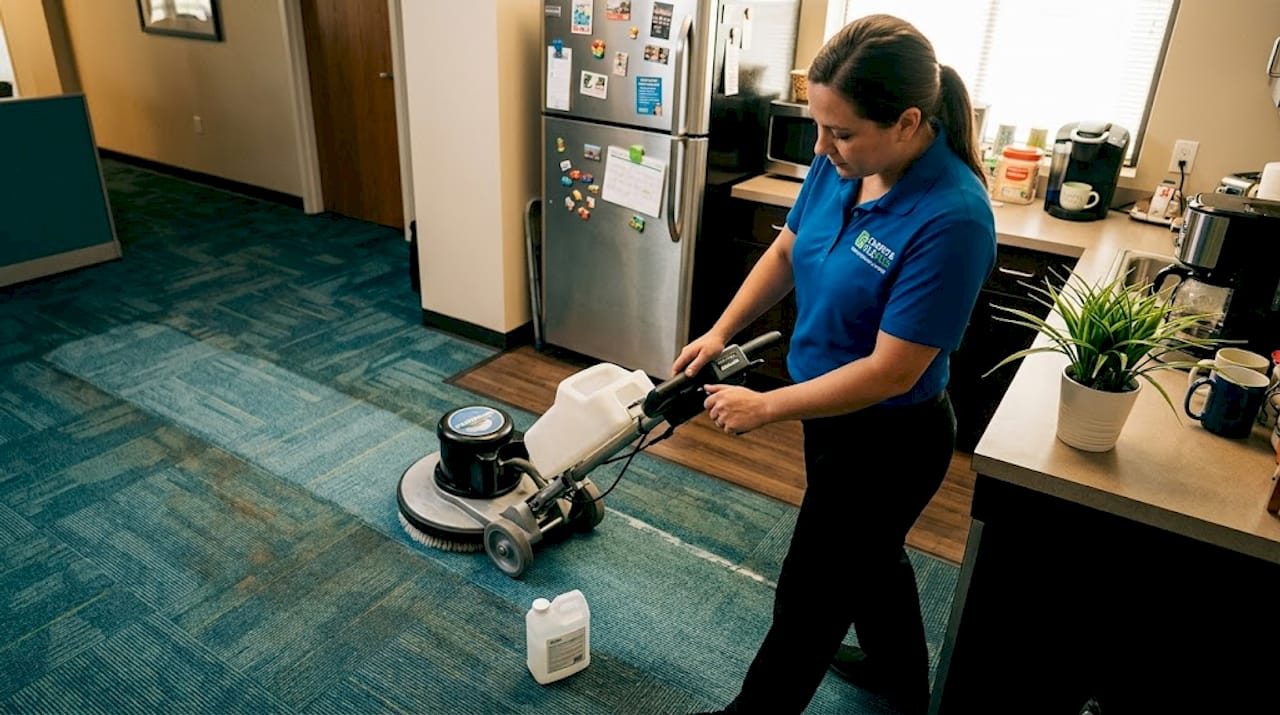
Encapsulation cleaning works by applying a polymer solution that surrounds soil particles and crystallizes them as it dries. Once dry, the crystals are vacuumed away. Encapsulation dries in 30 to 60 minutes and leaves almost no moisture behind. For commercial spaces with high foot traffic that cannot afford a full-day closure, it is a practical maintenance solution. The limitation is real though: encapsulation is a maintenance method only. It cannot replace hot water extraction for deep fiber cleaning in heavily soiled carpets.
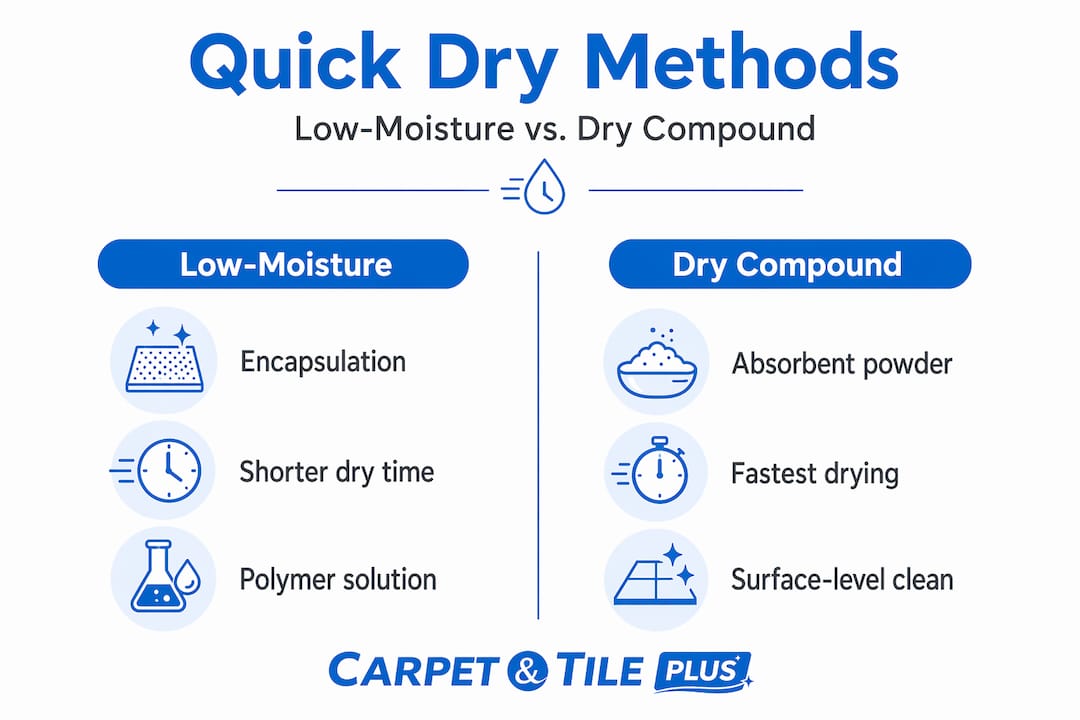
Dry compound cleaning takes the low-moisture idea further. An absorbent powder compound is worked into the carpet with a counter-rotating brush machine. The compound absorbs soil from the fibers and is then vacuumed out. Dry compound is ideal for wool, sisal, and antique rugs where water can damage or shrink fibers. Drying is almost immediate because there is no water involved.
Here is a side-by-side of how these methods stack up:
| Feature | Hot water extraction | Encapsulation | Dry compound |
|---|---|---|---|
| Dry time | 1 to 6 hours | 30 to 60 minutes | 15 to 30 minutes |
| Deep cleaning ability | High | Low to medium | Low |
| Best for | All carpet types | Commercial maintenance | Delicate fibers |
| Soil removal | Deep fiber level | Surface level | Surface level |
| Frequency needed | Every 12 to 18 months | Every 3 to 6 months | As needed |
A few things to know before choosing:
- Encapsulation works best as a bridge between deep cleans, not as a replacement for them
- Dry compound does not sanitize or remove allergens from deep in the fiber stack
- Professional deep cleaning with high-powered extraction still delivers the most thorough clean, even when you factor in dry time
- For commercial spaces, rotating encapsulation and periodic hot water extraction gives you speed without sacrificing fiber health
Common mistakes that slow carpet drying
Most drying problems come from the same handful of errors. Knowing what they are means you can sidestep them entirely.
- Over-wetting during cleaning. This is the single most common cause of 24-plus-hour dry times. Too much solution saturates the pad and subfloor, which no amount of airflow can fix quickly.
- Skipping the second extraction pass. One pass removes most of the moisture. The second pass removes what is left behind. Skipping it can add three to four hours to your dry time.
- Wrong fan placement. Pointing fans straight down pushes moisture back into the carpet. Angle them across the surface to create that drying vortex effect.
- Ignoring the padding. Carpet fibers dry faster than padding. The surface can feel completely dry while the pad underneath is still holding moisture, which creates a mold-friendly environment within 24 to 48 hours.
- No humidity control. Running fans without a dehumidifier in a humid room just moves wet air around. The moisture has nowhere to go.
When carpet stays damp past 48 hours, mold growth risk increases exponentially. At that point, you are no longer dealing with a drying problem. You are dealing with a remediation problem. If you are not confident the carpet has dried fully, call a professional before that 48-hour window closes.
What to expect: realistic drying times and verification
Setting the right expectations saves a lot of frustration. Typical carpets dry within 2 to 6 hours when professional-grade extraction is paired with air movers and a dehumidifier. Wool takes longer due to its high absorbency. Synthetic fibers like nylon and polyester dry noticeably faster.
Environmental factors shift these numbers considerably. A home in Barrington on a dry fall day will see carpets dry faster than a Streamwood office cleaned during a humid July week. The air quality benefits of a thorough clean are also only realized when the carpet dries completely, since damp fibers can harbor bacteria and allergens just as readily as dirty ones.
To verify drying is complete:
- Press a dry white cloth into the carpet for 10 seconds. No moisture transfer means the surface is dry.
- Check the padding by lifting a corner of carpet at a wall seam and pressing a dry cloth against the pad.
- Run your hand across the surface. Dry carpet has a slight springiness. Damp carpet feels slightly heavy and matted.
- Do not replace furniture until all three checks pass.
My take on balancing deep cleaning with fast drying
I’ve been doing this long enough to know that the conversation about drying time almost always leads to shortcuts that cost people more in the long run.
What I’ve seen repeatedly is homeowners or office managers pushing for the fastest possible method without understanding the tradeoff. Dry compound in 20 minutes sounds great until you realize the carpet still has years of embedded soil that no powder compound is going to lift. That buildup degrades fiber faster than traffic does.
In my experience, the best outcome is not the fastest dry time. It’s the fastest dry time that does not compromise the cleaning result. Professional dual-vacuum extraction achieves exactly that: deep cleaning with minimal residual moisture, giving you a genuinely clean fiber and a short wait time. That is not a marketing claim. It is the result of using equipment that generates real extraction power, not the kind you rent from a grocery store.
What I’ve learned about humidity is something most people never think about until it bites them. You can do everything right and still end up with a damp carpet the next morning if the room’s ambient humidity is not controlled. Dehumidifiers are not optional in the Midwest, especially in summer.
My practical advice: stop thinking about drying speed as something separate from cleaning quality. They are the same job. Do the extraction right, control the environment, and a healthy carpet with a short dry time is what you get every time.
— Jim
Get professional quick-dry carpet cleaning from Carpetandtileplus
If you are tired of carpet cleaning that leaves you waiting around all day, Carpetandtileplus is the answer for homeowners and businesses across the Northwest Suburbs of Chicago.

Carpetandtileplus is IICRC-certified and uses professional-grade equipment that delivers a one-hour dry time on most residential jobs, using organic cleaning solutions that are safe for kids and pets. For commercial clients in Elgin, Arlington Heights, Palatine, and beyond, the commercial carpet cleaning services are designed around minimal disruption. That means your business is back to normal the same day. With hundreds of five-star reviews and over 20 years of experience, Carpetandtileplus does not guess at drying. They engineer it. Call today to schedule your next clean.
FAQ
How long does carpet take to dry after professional cleaning?
Carpets typically dry within 2 to 6 hours when professional-grade extraction and air movers are used. Carpetandtileplus consistently achieves a one-hour dry time on most residential jobs.
What is the fastest carpet cleaning method for drying?
Dry compound cleaning dries in 15 to 30 minutes, making it the fastest option. However, it is a surface-level method and is best suited for delicate fibers or maintenance between deep cleans, not as a replacement for hot water extraction.
Can I speed up carpet drying myself after a professional clean?
Yes. Open windows if outdoor humidity is below 50%, run ceiling fans, and keep the HVAC running. Placing a dehumidifier in the room is the single most effective thing you can do to cut drying time on your own.
Why does my carpet still smell damp after it looks dry?
The carpet surface dries faster than the padding underneath. A damp odor usually means the padding is still holding moisture. If the smell persists past 24 hours, the carpet needs additional extraction or professional attention before mold risk becomes a real problem.
Is encapsulation cleaning good enough for commercial carpet maintenance?
Encapsulation is effective for maintenance cleaning in commercial spaces because it dries in 30 to 60 minutes and allows immediate foot traffic. For heavily soiled carpets, it should be paired with periodic hot water extraction for thorough fiber-level cleaning.