
Commercial carpet cleaning best practices are not one-size-fits-all. Your office lobby takes a different beating than a hospital corridor, and what works for a boutique hotel is not the same as what keeps a distribution warehouse looking presentable. The stakes are real: dirty carpets project a poor image, trap allergens, and accelerate fiber breakdown. This article gives property managers and business owners a practical, method-by-method framework for choosing the right cleaning approaches, maintaining carpets between professional visits, and getting the most out of every dollar spent on upkeep.
Table of Contents
- Key takeaways
- 1. Commercial carpet cleaning best practices: the core criteria
- 2. Hot water extraction: the deep clean standard
- 3. Encapsulation cleaning: the maintenance method that actually works
- 4. Method comparison: choosing the right fit for your facility
- 5. Vacuum selection and technique for commercial spaces
- 6. Spot cleaning and stain response protocols
- 7. Managing humidity and indoor environment factors
- 8. Protective measures that extend carpet life
- What two decades of carpet care actually taught me
- Professional carpet cleaning for your commercial space
- FAQ
Key takeaways
| Point | Details |
|---|---|
| Match method to traffic level | High-traffic zones need more frequent cleaning cycles; choose encapsulation for routine upkeep and hot water extraction for deep restoration. |
| Sealed HEPA vacuums matter | A HEPA filter without a sealed system allows particles to bypass filtration and return to the air. |
| Hybrid strategies win long-term | Combining routine encapsulation with periodic hot water extraction extends carpet life and reduces total cleaning costs. |
| Humidity control is underrated | Keeping indoor humidity between 40% and 50% prevents microbial growth and preserves carpet fiber integrity. |
| Spot clean within minutes | Treating spills immediately prevents permanent staining and reduces the need for restorative deep cleans. |
1. Commercial carpet cleaning best practices: the core criteria
Before picking a cleaning method, you need a framework for evaluating whether your current approach is actually working. Most property managers skip this step and wonder why carpets look worn within a year or two of installation.
Cleaning frequency and traffic volume are your starting point. A lobby that processes 500 people a day needs a completely different schedule than a back-office suite used by ten people. Map traffic zones across your building and set cleaning intervals accordingly. High-traffic area carpet maintenance tips almost always center on this one point: zone-based scheduling.
Drying time and business disruption matter more in commercial settings than anywhere else. A cleaning method that takes 12 hours to dry may be excellent in a residential home but unacceptable in a busy retail space. Factor downtime into every cleaning decision you make.
Carpet fiber type and age affect which chemicals and methods are safe to use. Cut-pile carpets trap soil differently than loop-pile, and older carpets with weakened fibers may not tolerate aggressive hot water extraction without accelerating wear. Luxury carpet care best practices almost always include a fiber-type assessment before any treatment begins.
- Routine vacuuming frequency tailored to foot traffic
- Immediate spot and stain response protocols
- Compatible cleaning chemistry for carpet fiber type
- Acceptable drying window for your business operations
- Indoor humidity management to prevent microbial buildup
Pro Tip: Before scheduling any professional cleaning, walk your facility with a checklist. Note high-traffic corridors, areas near entrances, and zones with recurring stains. That 15-minute walk will shape a smarter cleaning contract.
2. Hot water extraction: the deep clean standard
Hot water extraction (commonly called steam cleaning, though no actual steam is involved) is the gold standard for deep cleaning commercial carpets. It injects hot water mixed with a cleaning solution deep into carpet fibers and immediately extracts it along with dislodged soil, bacteria, and allergens.
Hot water extraction delivers the most thorough deep cleaning for heavily soiled commercial carpets. It penetrates the base of the fiber, not just the surface, which is why it remains the method of choice for restorative cleaning jobs and post-renovation cleanups.
The tradeoff is drying time. Depending on airflow, humidity, and carpet pile depth, drying can take anywhere from 4 to 12 hours. That window makes scheduling critical. Most commercial building carpet care best practices recommend scheduling hot water extraction on Friday evenings or during planned closures to avoid operational disruption.
- Best for: heavily soiled carpets, post-event restoration, annual deep cleans
- Drying time: 4 to 12 hours
- Operational impact: high (closed or restricted access required)
- Fiber compatibility: most commercial carpet types when performed correctly
Pro Tip: After hot water extraction, run fans or portable air movers across the cleaned area. Cutting drying time from 10 hours to 5 hours is often just a matter of improving airflow.
3. Encapsulation cleaning: the maintenance method that actually works
Encapsulation is the method most facilities underutilize, yet it is arguably the most practical solution for ongoing commercial carpet maintenance. A polymer-based cleaning agent is agitated into carpet fibers, where it surrounds soil particles and crystallizes them. Once dry, the crystals are vacuumed away cleanly.
Encapsulation offers drying times of just 30 to 60 minutes, making it almost invisible to daily operations. A cleaning crew can treat a corridor during a slow period, and foot traffic can resume within the hour. For office carpet cleaning techniques, this is a game-changing advantage.
It is not a replacement for hot water extraction. Encapsulation does not penetrate deep soil loads or address embedded grit as thoroughly. But as a maintenance cleaning tool between restorative sessions, it keeps carpets looking fresh and slows soil buildup significantly.
Dry compound cleaning is a third option worth knowing. A dry, absorptive powder is worked into the carpet and vacuumed out. It requires virtually no drying time and works well for spot maintenance in sensitive areas like server rooms or medical facilities. However, residue buildup over time makes it unsuitable as a primary method.
Pro Tip: Schedule encapsulation cleaning every 1 to 3 months for high-traffic zones. This spacing keeps visual appearance consistent and reduces how often you need the more disruptive hot water extraction cycle.
4. Method comparison: choosing the right fit for your facility
The right method depends on your carpet type, traffic volume, and tolerance for downtime. Use this comparison to guide your scheduling decisions.
| Factor | Hot water extraction | Encapsulation | Dry compound |
|---|---|---|---|
| Cleaning depth | Deep (fiber base) | Surface to mid-fiber | Surface only |
| Drying time | 4 to 12 hours | 30 to 60 minutes | Near zero |
| Operational impact | High | Low | Very low |
| Best use case | Restorative/annual | Routine maintenance | Spot/sensitive areas |
| Cost per visit | Higher | Moderate | Low to moderate |
| Long-term carpet impact | Extends life when done correctly | Preserves appearance | Risk of residue buildup |
Combining encapsulation with hot water extraction yields the best long-term results. A hybrid cleaning strategy balances operational impact and cost efficiency without compromising carpet longevity. For industrial carpet cleaning best practices, this hybrid model is considered the standard framework.
Pro Tip: Use your comparison table as a negotiating tool when reviewing cleaning contracts. Ask vendors to specify which method they use for each visit type and at what frequency. Vague contracts lead to under-serviced carpets.
5. Vacuum selection and technique for commercial spaces
Most businesses own a commercial vacuum. Very few own the right one. Vacuum quality and technique together determine how much soil actually leaves the building versus how much simply gets redistributed.
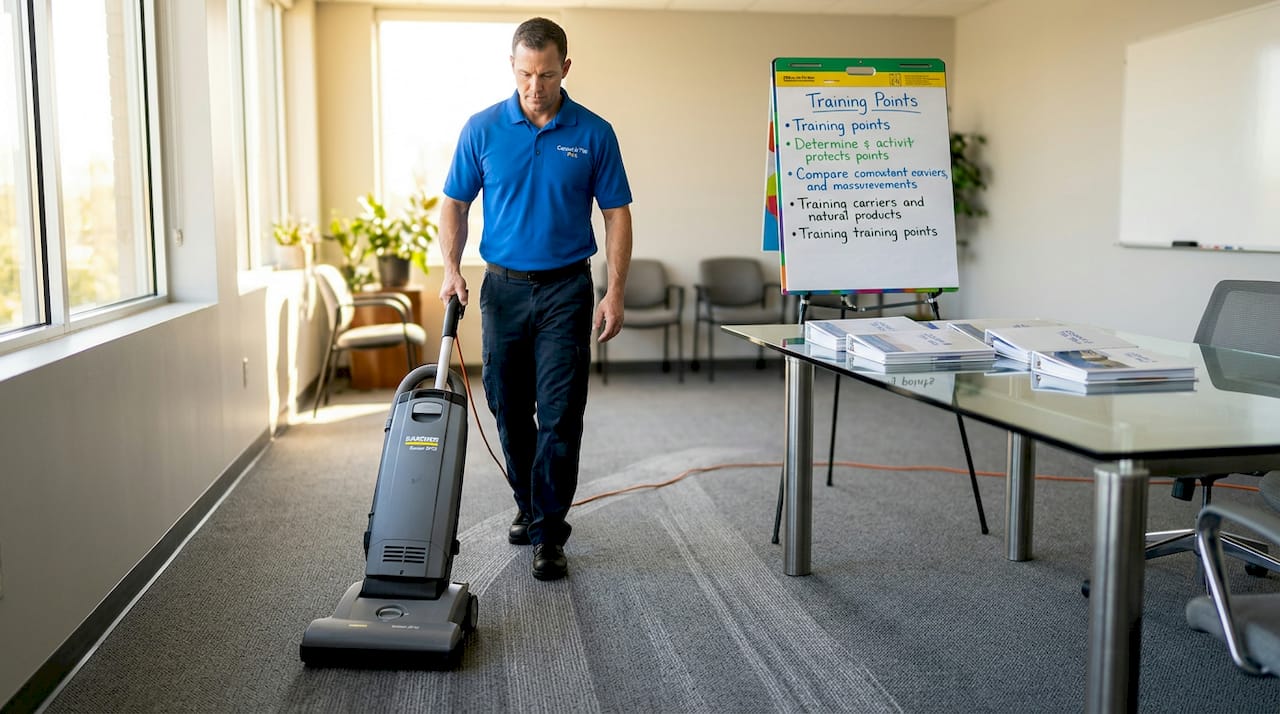
True HEPA filtration captures at least 99.97% of particles at 0.3 microns. But here is the detail most buyers miss: HEPA filtration in an unsealed vacuum can increase airborne particles by up to 130%, because particles simply bypass the filter through gaps in the housing. The HEPA label alone means nothing without third-party certification of a fully sealed system.
For carpet maintenance best practices between cleanings, your vacuum is doing most of the heavy lifting. Make it count.
- Vacuum high-traffic entries and corridors daily
- Vacuum standard office areas at least three times per week
- Vacuum low-traffic conference rooms weekly
- Replace vacuum bags or empty canisters before they reach 50% capacity
Technique matters as much as equipment. Vacuuming in multiple directions with overlapping strokes by 50% maximizes debris capture and lifts matted fibers. Slow passes remove significantly more soil than fast, rushed strokes. Set the vacuum head height so it creates light resistance against the carpet. Too high and you miss debris. Too low and you risk fiber damage.
Pro Tip: If your building has high-allergen concerns, such as clinics, schools, or childcare centers, invest in certified asthma and allergy-friendly vacuums. The upfront cost is real, but the air quality benefit is measurable.
6. Spot cleaning and stain response protocols
Every commercial carpet maintenance program lives or dies by its spill response speed. The difference between a stain that lifts completely and one that becomes permanent is often measured in minutes, not days.
When a spill occurs, blot it immediately with a clean white cloth. Never rub. Rubbing spreads the stain laterally and pushes it deeper into the fiber. Work from the outer edge inward to contain the spill. Apply a pH-neutral spot cleaner, blot again, and rinse with cold water.
Keep a spill response kit in every break room, near entry points, and in any high-risk zone. Contents should include clean white microfiber cloths, a pH-neutral spot cleaner, and a spray bottle of cold water. The kit costs almost nothing and prevents carpet repairs that cost hundreds.
- Use cold water, not hot, for most protein-based stains (coffee, food, blood)
- Test any cleaning product on an inconspicuous area before full application
- Document repeat stain locations as they often indicate a systemic issue (leaky plumbing, drainage problems)
- Avoid store-bought consumer sprays on commercial-grade carpets; many leave surfactant residue that attracts more soil
7. Managing humidity and indoor environment factors
High humidity promotes microbial growth and reduces filter efficiency in vacuums. For commercial spaces with carpeting, keeping relative humidity below 65% and ideally between 40% and 50% is a maintenance best practice that most facilities teams overlook entirely.
Humidity above 60% creates conditions that allow mold and bacteria to colonize carpet backing and padding within 24 to 48 hours after a wet cleaning or spill. In buildings with older HVAC systems or poor ventilation, this is a real and recurring problem.
Monitor humidity levels with a simple digital hygrometer placed at floor level in problem areas. If readings consistently exceed 55%, address the HVAC ventilation, not just the carpet.
Indoor air quality experts stress that proper humidity control is often overlooked but critical to effective carpet cleaning and occupant health. It is also one of the cheapest interventions available. A $20 hygrometer and a conversation with your building engineer can prevent a $5,000 mold remediation.
8. Protective measures that extend carpet life
The best commercial carpet cleaning strategy includes measures that reduce how much soil reaches the carpet in the first place. Entry management is where this starts.
High-quality walk-off mats at every exterior entrance capture roughly 80% of the soil and moisture that would otherwise travel across your carpet. Mats should be at least 6 feet long to allow for multiple footsteps, and they need regular cleaning themselves. A saturated mat does not stop anything.
Consider a shoe-cover station in environments where cleanliness is a priority, such as healthcare facilities, labs, or tech environments. It sounds extreme until you calculate how much you spend on carpet replacement.
Scheduling professional deep cleaning every 6 to 12 months based on usage and carpet type is the baseline for commercial building carpet care best practices. High-traffic facilities or those with food service may require more frequent cycles. Knowing how often carpets should be cleaned for your specific environment prevents both under-cleaning and unnecessary expense.
What two decades of carpet care actually taught me
After years of seeing how commercial properties handle their carpets, the most consistent pattern I notice is the gap between what facilities teams intend to do and what actually happens on the ground.
The businesses that keep carpets looking sharp for years are not spending the most money. They are the ones with a written schedule, a vacuum protocol people actually follow, and a relationship with a professional cleaner who visits before the carpet looks like it needs it.
What I have come to believe is that encapsulation is the most underused tool in commercial carpet care. Most managers only know about steam cleaning, so that is what they request. But for high-traffic environments, regular encapsulation between annual extractions is the single change that makes the biggest difference in appearance and lifespan. The hybrid cleaning approach is not complicated. It just requires intentional scheduling.
I also push every commercial client to stop buying whatever vacuum is on sale. A certified sealed HEPA system costs more up front. But when you understand that an unsealed vacuum can pump fine particulates back into the air your employees breathe, the math changes quickly.
If there is one mindset shift worth making, it is this: carpet maintenance is building maintenance. Treat it that way, and your costs stay predictable. Neglect it, and you pay for premature replacement on a timeline that is entirely preventable.
— Jim
Professional carpet cleaning for your commercial space
If you manage a commercial facility in the Northwest Suburbs of Chicago and your carpet maintenance program has more gaps than structure, Carpetandtileplus can help you close them. As an IICRC-certified, family-owned business with over 20 years of commercial experience, Carpetandtileplus uses organic cleaning products and a proven hybrid approach that delivers results without shutting down your operations.
With a one-hour dry time on most jobs and hundreds of five-star reviews from businesses across Elgin, Bartlett, Arlington Heights, and Palatine, Carpetandtileplus offers commercial carpet cleaning services tailored to your traffic levels, carpet type, and scheduling needs. Whether you need restorative hot water extraction, routine encapsulation maintenance, or odor remediation through carpet odor removal, the team is equipped to handle it. Contact Carpetandtileplus to schedule a facility assessment and build a cleaning program that actually works.
FAQ
How often should commercial carpets be professionally cleaned?
Commercial carpets typically need deep cleaning every 6 to 12 months, though high-traffic facilities may require quarterly cycles. Routine encapsulation maintenance between deep cleans extends that interval while keeping appearance consistent.
What is the best method for commercial carpet cleaning?
A hybrid approach combining periodic hot water extraction with regular encapsulation maintenance delivers the best balance of cleanliness and operational continuity. Hot water extraction handles deep soil removal, while encapsulation keeps carpets looking fresh between sessions.
Does vacuuming technique really matter for commercial carpets?
Yes. Multi-directional overlapping strokes remove significantly more soil than single-direction passes, and using a certified sealed HEPA vacuum prevents fine particles from re-entering the air. Technique and equipment together determine how effective daily vacuuming actually is.
How do I prevent mold in commercial carpets?
Keep indoor humidity between 40% and 50%, respond to spills within minutes, and allow adequate drying time after wet cleaning methods. High humidity above 65% creates conditions that allow microbial growth in carpet backing within 24 to 48 hours.
Are encapsulation and steam cleaning the same thing?
No. Encapsulation uses a crystallizing polymer solution that dries in 30 to 60 minutes and is then vacuumed away. Steam cleaning (hot water extraction) injects hot water deep into fibers and extracts it, requiring 4 to 12 hours of drying time. Each method serves a different purpose in a commercial maintenance program.