
Most homeowners give zero thought to the drain tile system buried around their foundation. It was installed when the house was built, it’s underground, and it presumably keeps doing its job. That assumption is exactly why drain tile needs professional cleaning more often than people realize. Left unchecked, these systems fill with silt, roots, and even iron-eating bacteria until they fail completely. And when they fail, you’re not looking at a minor inconvenience. You’re looking at flooded basements, cracked foundations, and repair bills that can gut your savings.
Table of Contents
- Key takeaways
- Why drain tile needs professional cleaning
- Warning signs your drain tile is failing
- Why professional cleaning outperforms DIY every time
- How often to clean drain tile and what to expect
- The real cost of neglecting your drain tile
- My take on why homeowners keep making this mistake
- Keep your home protected with Carpetandtileplus
- FAQ
Key takeaways
| Point | Details |
|---|---|
| Neglect causes failure | Drain tile systems accumulate sediment and roots over time, making professional maintenance unavoidable. |
| DIY cleaning falls short | Consumer-grade tools cannot replicate the power of professional hydro-jetting equipment. |
| Camera inspection is non-negotiable | Professionals diagnose root causes before cleaning, preventing repeat failures. |
| Cost of inaction is steep | Basement flood damage can exceed $40,000, while professional maintenance costs roughly $250. |
| Annual cleaning pays off | Regular maintenance reduces plumbing repairs by up to 30% every year. |
Why drain tile needs professional cleaning
Before getting into why professional service matters, it helps to understand what drain tile actually does. Drain tile, sometimes called weeping tile, is a perforated pipe system buried along the perimeter of your foundation. Its entire job is to collect groundwater before it builds up against your basement walls and redirect that water away from the structure.
When the ground around your home gets saturated after heavy rain or snowmelt, hydrostatic pressure builds up fast. That pressure pushes water against your foundation walls from every direction. Drain tile relieves that pressure by giving groundwater a clear path to exit. Without a functioning system, that pressure has nowhere to go except into cracks, through mortar joints, and eventually into your living space.
Most installations use corrugated plastic pipe surrounded by gravel and wrapped in filter fabric. Over years, however, the reality of what’s underground catches up with even the best installation:
- Fine silt and sand particles work through filter fabric and settle inside the pipe
- Tree and shrub roots follow the moisture gradient directly into perforations
- Natural ground shifts move pipe sections out of alignment
- Iron ochre, a rust-colored gelatinous slime produced by iron-eating bacteria, coats pipe walls and blocks flow
- Sediment compacts into hard plugs that restrict drainage to a trickle
Experts consistently identify neglect as the primary cause of drain tile failure. The system is buried and invisible, so most homeowners adopt a “set it and forget it” approach. That approach works until it doesn’t, and the failure point rarely announces itself gently.
Warning signs your drain tile is failing
Knowing what to watch for gives you a serious advantage. Drain tile systems don’t fail overnight. They degrade gradually, and the early symptoms are often misread or ignored entirely.
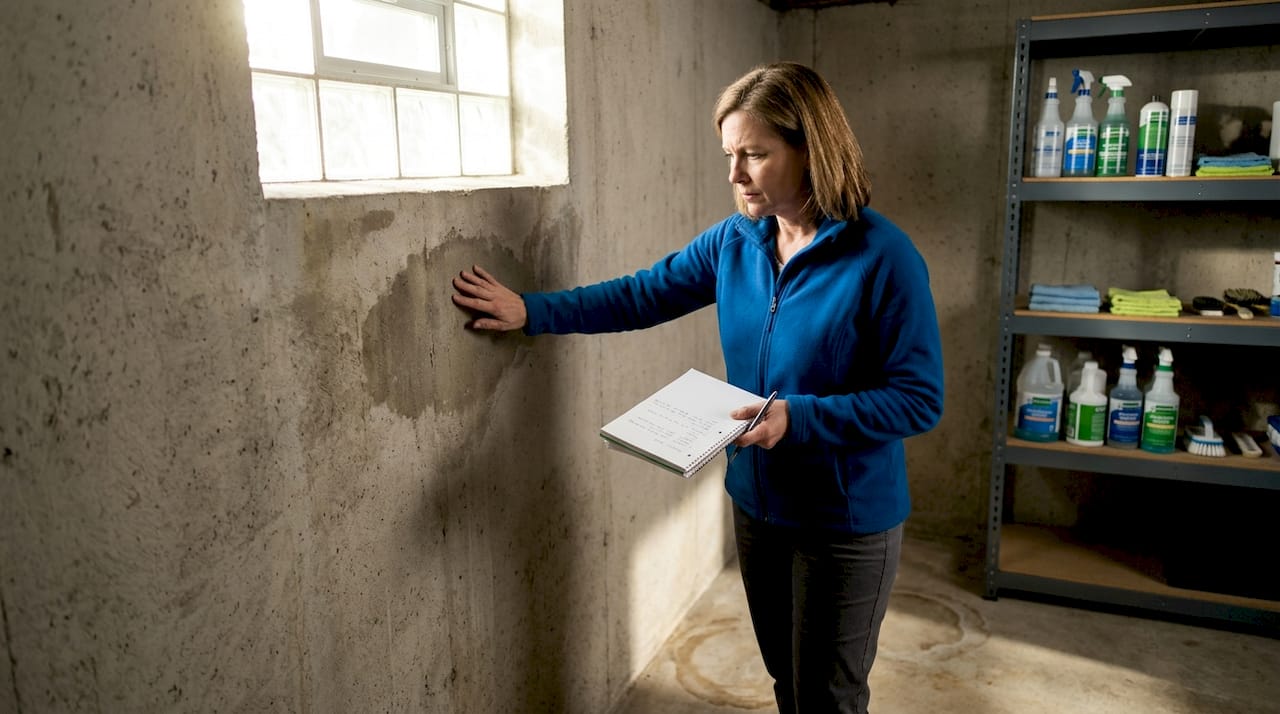
The most obvious sign is recurring moisture in your basement. If you’re seeing damp patches on lower sections of your walls, white chalky mineral deposits on concrete, or a musty smell that never fully goes away, your drain tile is likely not draining at full capacity. Slow drainage throughout your home can also point to system-wide blockages, since interior floor drains often connect to the same network.
Foul odors coming from floor drains are another red flag. When flow is blocked, stagnant water sits in the pipe and breeds bacteria. That smell isn’t just unpleasant. It’s a sign the system isn’t moving water the way it should.
A few other signs worth watching:
- Water pooling around your foundation after rain instead of draining away
- Visible rust-colored staining near floor drains, which indicates iron ochre buildup from bacteria colonization inside the pipe
- Repeated basement flooding during storms that weren’t a problem in previous years
- Foundation wall cracks that are widening, pointing to unrelieved hydrostatic pressure
- Soft or sunken soil near the foundation, suggesting erosion caused by water that isn’t draining properly
Pro Tip: If you notice any two of these signs at the same time, don’t wait. Two symptoms together almost always mean the system is significantly compromised, not just mildly slow.
DIY fixes for drain tile problems rarely hold. You can snake a drain and clear a surface clog, but you won’t remove compacted sediment from the pipe walls, you won’t extract embedded root systems, and you certainly won’t address iron ochre, which requires specialized treatment. Ignoring persistent drain issues leads directly to more expensive repairs. The temporary fix becomes a recurring cost.
Why professional cleaning outperforms DIY every time
Here’s where understanding the importance of cleaning drain tile turns into a real argument for hiring trained professionals. It’s not about skepticism toward handy homeowners. It’s about what the job physically requires.
Professional drain tile cleaning services follow a defined process that makes temporary fixes impossible:
- Camera inspection first. Before any cleaning begins, a camera inspection diagnoses the exact cause. Is it a root intrusion? Sediment buildup? A collapsed section? Grease? The camera tells the technician what they’re dealing with before any equipment touches the pipe. This step alone separates professional service from guesswork.
- Hydro-jetting for real cleaning. Professional equipment uses pressurized water at up to 4,000 PSI to scour pipe walls completely. Mechanical snakes push through the center of a clog but leave debris coating the walls. Hydro-jetting strips the pipe clean from wall to wall, removing compacted material that a snake can’t reach.
- Post-cleaning camera verification. Once cleaning is complete, the camera goes back in. Post-cleaning verification confirms the pipe walls are clear and, critically, identifies any hidden damage like cracks or joint separations that become visible only after cleaning. Without this step, you might assume a job is done when an underlying problem still exists.
- Proper diagnosis of iron ochre. Standard equipment does nothing for iron ochre. A professional recognizes it, treats it with the right process, and can advise on ongoing management to prevent rapid recurrence.
- Avoiding chemical damage. Over-the-counter drain chemicals that homeowners pour into floor drains can degrade older pipe materials and damage sump pump components. Professionals don’t use those products.
“Drain tile maintenance acts as insurance for structural integrity by managing groundwater and preventing the foundation damage that hydrostatic pressure causes when it goes unchecked.” — House Weeping Tile: Ultimate 2026 Guide
The cost comparison settles the debate quickly. Basement flood damage routinely exceeds $40,000 when foundation repair, waterproofing remediation, mold removal, and content replacement are factored in. Professional drain tile cleaning typically costs around $250. Framing professional drain tile maintenance as optional gets expensive fast.
How often to clean drain tile and what to expect
Scheduling is where a lot of homeowners get stuck. There’s no universal rule, because frequency depends on your property’s specific conditions.
Factors that push cleaning frequency higher include older homes with clay or concrete tile pipe instead of modern corrugated plastic, properties surrounded by mature trees with aggressive root systems, homes in areas with high iron content in the soil, and basements that have had moisture problems in the past.
As a baseline, most professionals recommend having drain tile inspected every two to three years, with cleaning performed as needed based on inspection findings. If your property has any of the risk factors above, annual inspection makes more sense.
Here’s what a professional service visit typically includes:
- A walkthrough with the homeowner to understand symptoms and history
- Camera inspection of accessible cleanouts and drain tile runs
- Hydro-jetting or appropriate mechanical cleaning based on inspection findings
- Post-cleaning camera pass to verify results and document condition
- A written report or verbal summary of findings, including any repair recommendations
Pro Tip: Ask any service provider whether they perform a post-cleaning camera inspection as standard practice. If they say no, find someone who does. Without verification, you have no way to know the job was completed correctly.
Selecting the right provider matters. Look for companies with documented experience in drain tile systems specifically, not just general plumbing. Ask about their camera equipment, whether they use hydro-jetting, and how they handle iron ochre. Reading drain cleaning methods before you call a service provider helps you ask the right questions and spot contractors who are cutting corners.
The real cost of neglecting your drain tile
Skipping professional drain tile maintenance doesn’t save money. It defers a larger bill.
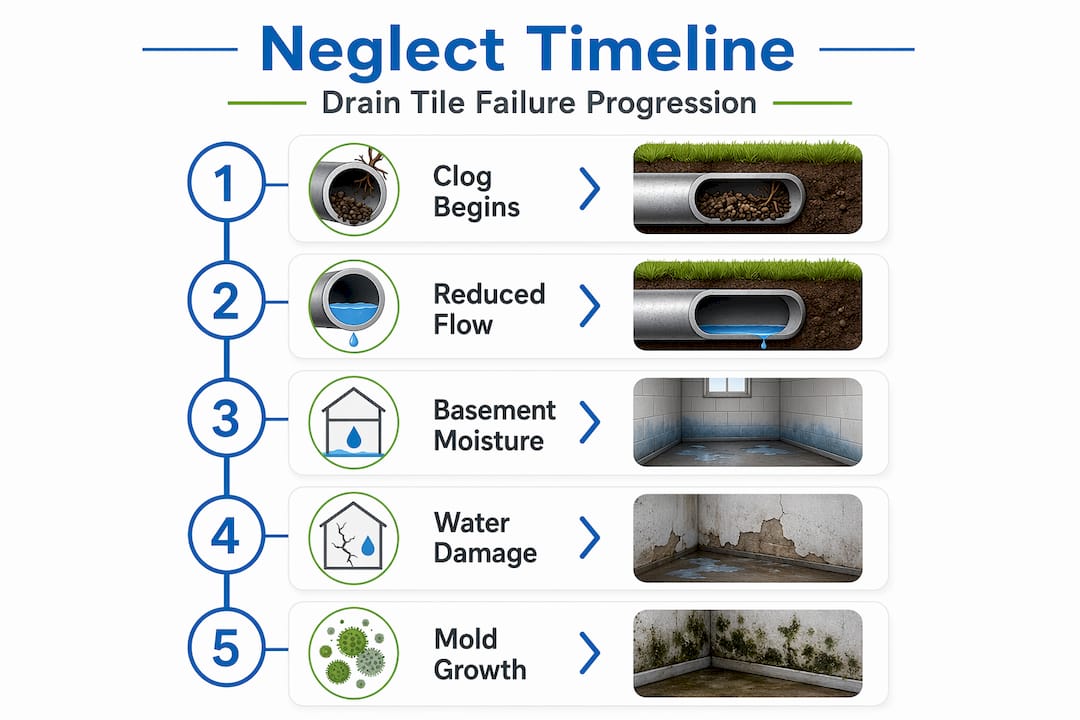
The progression is predictable. A partially clogged system reduces drainage efficiency until water starts accumulating against foundation walls. That sustained hydrostatic pressure works into hairline cracks, widening them over time. Once moisture penetrates regularly, the freeze-thaw cycle of Chicago area winters accelerates the damage. By the time a homeowner calls for help, the problem has usually moved beyond drain tile cleaning into foundation repair territory.
| Scenario | Estimated Cost |
|---|---|
| Professional drain tile cleaning | ~$250 |
| Basement water damage remediation | $3,000–$10,000+ |
| Foundation crack repair | $500–$15,000 |
| Full foundation waterproofing | $10,000–$30,000+ |
| Mold remediation after flooding | $1,500–$9,000 |
| Basement flood repair (severe) | $40,000+ |
Beyond money, neglected drain tile creates health risks. Persistent basement moisture is a mold incubator. Mold spreads through HVAC systems and affects indoor air quality throughout the entire home. For families with asthma or allergies, that’s a serious quality-of-life issue, not just an aesthetic one.
The good news is that early intervention genuinely works. A homeowner who catches a developing clog at the annual inspection stage pays for cleaning and walks away with a healthy system. The homeowner who waits for a flooded basement pays ten times that amount and deals with weeks of disruption.
My take on why homeowners keep making this mistake
I’ve seen this pattern play out more times than I can count. A homeowner calls about drainage problems that have been getting worse for a couple of years. They describe early warning signs they noticed but dismissed because nothing catastrophic had happened yet. Then something catastrophic happens.
The misconception I hear most often is that a properly installed drain tile system is permanent. People genuinely believe that if the original contractor did good work, there’s nothing to maintain. That belief costs homeowners a lot of money. No underground system stays clean indefinitely. Gravity, biology, and ground movement work on it every single day.
What I’ve also learned is that most homeowners respond well once they see the camera footage from inside their own pipes. There’s something about watching silted pipe walls or live root intrusion on a screen that makes the abstract danger suddenly concrete. Professional diagnosis isn’t just about fixing problems. It’s about making the invisible visible so homeowners can make informed decisions.
My honest advice: treat drain tile maintenance the same way you treat your furnace service. You don’t wait for your furnace to stop working before you have it inspected. Your foundation deserves the same logic.
— Jim
Keep your home protected with Carpetandtileplus
When you’re focused on protecting your home from water and drainage problems, professional maintenance across every system matters. Carpetandtileplus has served homeowners across Elgin, Bartlett, Streamwood, Arlington Heights, Palatine, Barrington, and Hanover Park for over 20 years, and we understand how much a clean, well-maintained home means to your family.

Our IICRC-certified team uses organic cleaning products and proven methods to protect your home’s surfaces and air quality. From residential tile and grout cleaning that restores your floors and walls to like-new condition, to carpet cleaning and air duct services that improve indoor air quality, we cover the full picture of home maintenance. Hundreds of five-star reviews from Northwest Suburbs homeowners reflect the care we put into every job. Schedule your service today and see why local families trust Carpetandtileplus to keep their homes clean, healthy, and protected.
FAQ
What is drain tile and why does it need cleaning?
Drain tile is a perforated pipe system buried around your foundation that redirects groundwater away from basement walls. It needs regular cleaning because silt, roots, and bacterial growth accumulate inside the pipe over time, reducing drainage and creating conditions for foundation damage.
How often should drain tile be professionally cleaned?
Most homes benefit from a professional inspection every two to three years, with cleaning performed based on findings. Homes with mature trees, older clay pipe, or a history of basement moisture should schedule annual inspections.
Can I clean drain tile myself?
Consumer tools like drain snakes can punch through surface clogs but cannot remove compacted sediment from pipe walls or address root intrusions and iron ochre. Professional hydro-jetting at up to 4,000 PSI is required for thorough, lasting results.
What are the signs that drain tile needs professional attention?
Key signs include recurring basement moisture, musty odors from floor drains, rust-colored staining near drains, water pooling around the foundation after rain, and foundation wall cracks that are slowly widening.
How much does professional drain tile cleaning cost compared to repairs?
Professional cleaning typically costs around $250. By contrast, basement flood damage from a failed drain tile system can exceed $40,000 when foundation repair, mold remediation, and water damage restoration are included.