
Non-toxic grout cleaning is a professional, on-site service where IICRC-certified technicians use organic or low-toxicity chemistries, including hypochlorous water and peroxide-based solutions, to lift stains and sanitize grout lines without harsh acids or fumes. Homeowners with deep-set stains, shower mold, or highly porous grout should hire a certified pro rather than experiment with retail products. Expect an inspection, a test patch, targeted non-toxic cleaning, extraction, and often a one-hour dry time before the room is back in use.
TL;DR:
- Non-toxic grout cleaning relies on specialized chemistry choices based on grout material and porosity, with test patches ensuring safety for surfaces.
- The most effective cleaning methods use electrolyzed water, hydrogen peroxide with orange oil, or neutral pH cleaners that do not require rinsing or leave harmful residues.
- Avoid DIY methods that use acid or aggressive scrubbing, as these can damage grout, cause uneven coloring, or create long-term staining issues.
- Sealing grout after cleaning with penetrative or topical sealers is essential to maintain cleanliness and prevent rapid soil absorption.
- Professional technicians can accurately assess, treat, and advise on sealing or regrouting, especially for deep stains, mold, historic grout, or highly porous surfaces.
Table of Contents
- What Happens During a Non Toxic Grout Cleaning Visit
- How Do Organic Grout Cleaning Chemistries Actually Work?
- When Should You Skip DIY and Call a Professional?
- How Long Does Non-Toxic Grout Cleaning Last, and How Do You Maintain It?
- A Technician’s Take on Non-Toxic Grout Jobs
- Book Non-Toxic Tile and Grout Cleaning With Carpet and Tile Plus
- Sources
What Happens During a Non Toxic Grout Cleaning Visit
A professional visit doesn’t start with a bottle and a brush. It starts with a walkthrough. Technicians look at grout color, sanding texture, tile material, and how porous the grout has become over the years, because that determines which chemistry and how much agitation the surface can safely take. Cement grout in a 1990s kitchen behaves nothing like epoxy grout in a newly renovated bathroom, and treating them the same way is how damage happens.
A small test patch usually comes next, tucked in a low-visibility corner. This confirms the cleaning approach will lift soil without stripping color or opening up the grout’s surface. Professional teams rely on this step specifically to avoid committing an entire floor to a method that might backfire on one section.
From there, the actual cleaning follows a fairly consistent sequence:
- Pre-treatment: a non-toxic solution, often hypochlorous or peroxide-based, is applied to break down grease, soap scum, and biological soil.
- Agitation: rotary scrubbing or hand tools work the solution into the grout lines without grinding away the surface.
- Extraction: low-residue extraction pulls out the dissolved soil and most of the moisture, rather than letting it sit and re-soil the grout.
- Spot treatment: stubborn stains get a second, more targeted pass.
- Sealing (optional): a penetrative sealer locks in the clean look if the homeowner chooses it.
The realistic outcome for most jobs is dramatic improvement, not necessarily a return to factory-white grout. Decades-old staining sometimes needs sealing or a color coat to finish the job. What most homeowners notice first, though, is timing. Low-residue extraction paired with targeted drying methods can get floors back to a one-hour dry time, which matters enormously if you’re running a household or a business on a schedule.
How Do Organic Grout Cleaning Chemistries Actually Work?
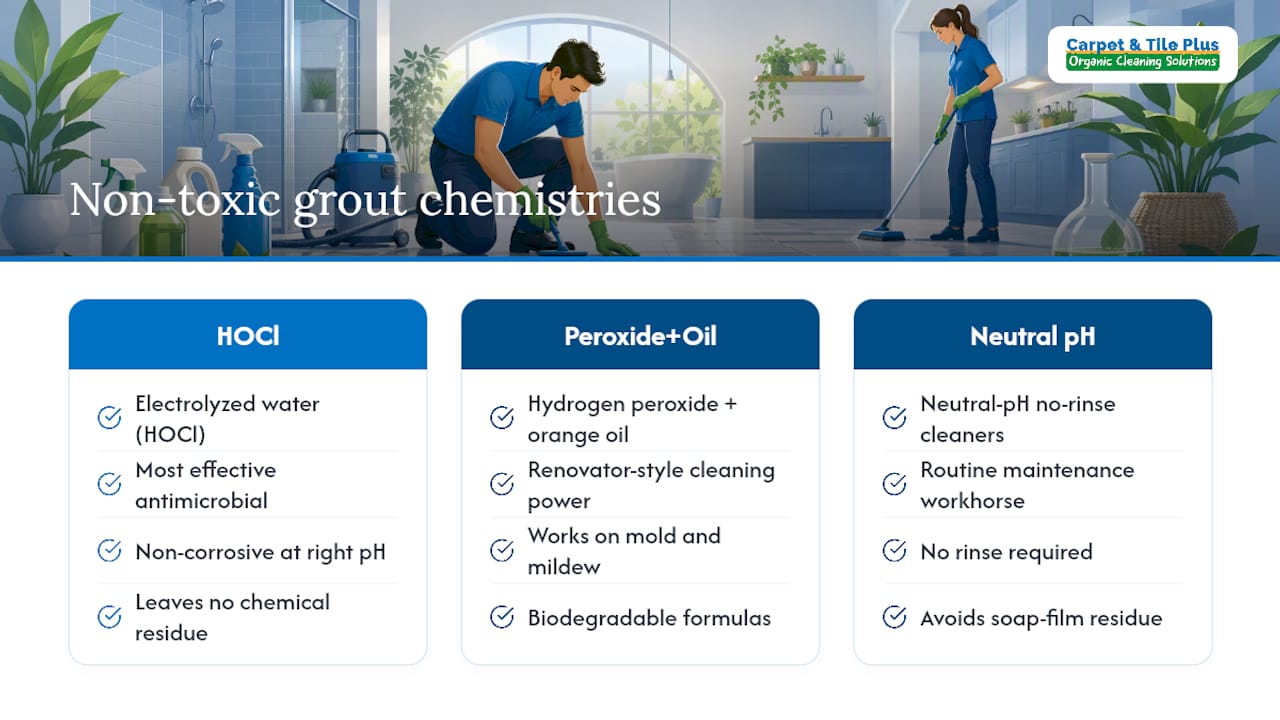
Non-toxic doesn’t mean weak. It means the chemistry does its job without leaving behind fumes, acid residue, or a soil-attracting film. Three approaches dominate professional non-toxic grout cleaning right now.
Electrolyzed water (HOCl). This is water run through an electrical process that converts it into hypochlorous acid, a compound your own white blood cells produce to fight infection. At the right pH, HOCl is the most effective antimicrobial form of chlorine and is non-corrosive at that range, which is why it’s gained traction in professional cleaning over the last several years.
A 2023 peer-reviewed comparison found that electrolyzed HOCl solutions cleaned and sanitized floors comparably to eco-labelled detergents, while leaving no chemical residue and cutting lifecycle emissions in the machine application tested.
That’s a meaningful finding for grout specifically, because grout’s porosity means anything left behind tends to stay behind.
Hydrogen peroxide and orange oil systems. These renovator-style products bring serious cleaning power to heavily soiled grout without relying on acids. HydrOxi Pro Grout Smart is one example, carrying Green Seal and NSF backing, and EnvirOx’s peroxide-orange formula documents similar renovation strength against mold and mildew while staying biodegradable. Look for these certifications, not just the word “natural” on a label.
Neutral pH, no-rinse cleaners. These are the workhorses for routine maintenance. Because they don’t require rinsing, they don’t leave the soap-film residue that ironically attracts new dirt.
Where non-toxic methods hit a ceiling: severe, decades-old staining that has actually changed the grout’s mineral structure usually can’t be reversed with any chemistry, toxic or not. At that point, regrouting or color sealing is the honest answer.
When Should You Skip DIY and Call a Professional?
Grout is basically porous concrete. Treat it wrong, and you don’t just fail to clean it. You can permanently change it.
Here’s what tends to go wrong with DIY attempts:
- Wrong pH cleaners eat away at the grout binder, opening up porosity and making future staining worse instead of better.
- Acidic “miracle” cleaners strip color sealers, leaving blotchy, uneven grout that looks worse than before you started.
- Aggressive scrubbing wears down the grout profile, creating low spots where water and soil collect.
- Leftover residue from rinse-required products attracts dirt faster than the original stain did.
Certain situations tip the scale toward hiring a pro almost automatically: widespread mold in a shower, large stains that have set for months or years, colored or historic grout where a mistake can’t be undone, or grout so porous it drinks up whatever touches it.
Pro Tip: If a stain has been there longer than a season, don’t reach for a stronger cleaner. Reach for the phone. A technician can run a test patch in minutes and tell you honestly whether it’s a cleaning problem or a regrouting problem.
What a certified technician brings that a bottle from the hardware store can’t: correct pH selection based on your specific grout, controlled agitation calibrated to avoid damage, full extraction instead of a damp mop, and an honest referral to sealing or regrouting when cleaning alone won’t cut it.
How Long Does Non-Toxic Grout Cleaning Last, and How Do You Maintain It?
Clean doesn’t mean protected. That’s the gap most homeowners miss, and it’s exactly why sealing after cleaning matters: unsealed grout absorbs moisture and soil almost immediately after a professional cleaning, undoing the work within weeks in high-traffic areas.
Two sealer types cover most situations:
- Penetrative sealers soak into the grout and repel moisture without changing its color, ideal for grout that still looks good.
- Topical or color sealers sit on the surface and can restore uniform color to grout that’s faded or blotchy, useful when the grout itself has discolored unevenly.
Between professional visits, a no-rinse neutral pH cleaner applied with a microfiber flat mop keeps soil from building back up without interfering with the sealer underneath.
| Maintenance step | Frequency | Why it matters |
|---|---|---|
| Neutral pH no-rinse cleaning | Weekly | Avoids residue buildup that attracts new soil |
| Spill wipe-up | Immediately | Prevents staining before it sets into porous grout |
| Sealer inspection | Every year | Confirms moisture protection is still active |
| Professional deep cleaning | Every year (more often in high-traffic areas) | Removes what daily mopping can’t reach |
Rapid spill cleanup does more heavy lifting than most people realize. A dropped glass of wine wiped up in seconds rarely stains; left overnight, it can etch itself into the grout’s texture. If you’re managing tile in a busy kitchen or a commercial space, our guide on caring for grout in high-traffic areas breaks down cadence in more detail, and our sealing guide walks through picking the right sealer type for your tile.
A Technician’s Take on Non-Toxic Grout Jobs
I’ve spent over 20 years in this industry, and the biggest misconception I run into is that “non-toxic” means “less effective.” It’s the opposite of my experience. The jobs that go sideways aren’t the ones using organic chemistries. They’re the ones where someone reached for a bleach-based cleaner or a harsh acid gel because they assumed stronger automatically means better.
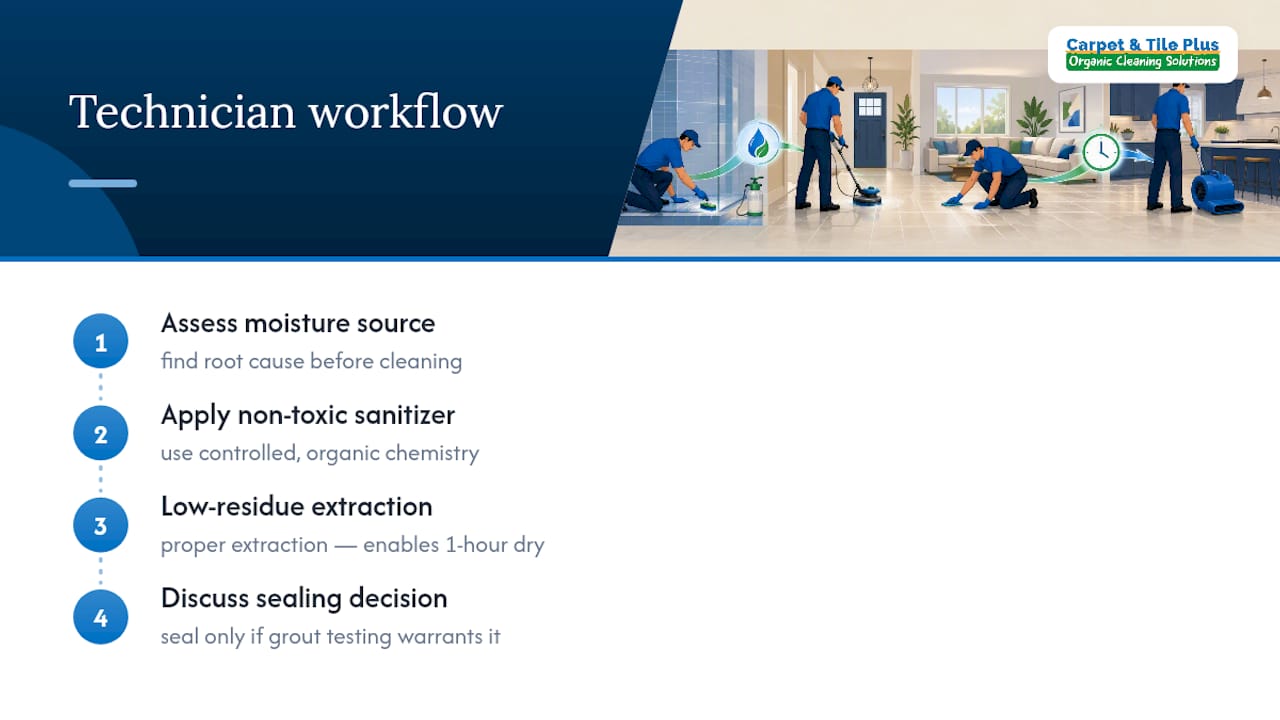
Shower mold is the case that comes up constantly. Homeowners often try bleach first, which can lighten mold visually while doing nothing about the moisture problem underneath it, and it degrades grout over repeated use. Our technicians handle that differently: assess the moisture source, apply a controlled non-toxic sanitizer, extract it properly, and then talk through whether sealing makes sense given how the grout tested during the visit. That last conversation matters. Not every job needs sealing immediately, and I’d rather tell a customer that honestly than upsell a service they don’t need yet.
The one-hour dry time we’ve built our process around isn’t a gimmick. It’s the direct result of low-residue extraction done correctly, and it’s the difference between a family avoiding their kitchen for an afternoon and being back in it before dinner.
— Jim
Book Non-Toxic Tile and Grout Cleaning With Carpet and Tile Plus
If you’ve read this far, you already know the difference between a cleaner that just moves dirt around and one that actually restores your grout without leaving behind chemical residue. Professional carpet and tile cleaning companies bring IICRC-certified technicians and organic cleaning products directly to homes and businesses, offering a fast dry time that minimizes disruption.

When you call to schedule, have a few details ready: which rooms or areas need attention, your tile and grout type if you know it, and any visible issues like shower mold or set-in staining. That helps our technicians arrive prepared with the right chemistry rather than guessing on-site. Commercial property managers juggling kitchens or high-traffic common areas can lean on the same process at scale.
Ready to see what your grout actually looks like under the buildup? Get a quote through our residential tile and grout cleaning services page, or check out our commercial tile and grout cleaning options if you’re managing a business property.
Sources
This guide draws on the IICRC’s consumer care guidance for professional pH standards and sealing recommendations, a 2023 peer-reviewed comparison of electrolyzed HOCl cleaning against eco-labelled detergents, and product certification pages for HydrOxi Pro and EnvirOx confirming Green Seal, EcoLogo, and NSF backing for the chemistries discussed. Cleaning protocols referenced also draw on high-touch surface sanitizing standards used across the professional cleaning industry.
- IICRC Consumer Floor and Furnishings Care Information
- Electrolyzed water (HOCl) cleaning and sanitization comparative study
- EnvirOx Green Certified H2O2 Orange Tile & Grout Renovator