Chlorine bleach is the stronger of the two: it whitens and disinfects, but it can strip color and damage fibers. Oxygen bleach is the gentler one: it lifts stains and keeps whites bright without fading colors, but it does not disinfect. For laundry, you pick by fabric and by what you need the bleach to do. For the carpet and grout in your home or business, the better route is a cleaning that uses neither from a bottle. Our IICRC-certified technicians clean carpet, tile and grout across the Northwest Suburbs with organic products and a one-hour dry time.
TL;DR
- Chlorine bleach (sodium hypochlorite) whitens, disinfects and removes stains, but it can fade colors and weaken fibers. Never use it on wool or silk.
- Oxygen bleach (hydrogen peroxide or sodium percarbonate) is safe on most washable fabrics and colors, but it maintains whiteness rather than restoring it, and it does not disinfect.
- Never mix chlorine bleach with ammonia, vinegar or any acid-based cleaner. The gases that result are dangerous.
- Carpet, tile and grout are better handled by a professional cleaning than by pouring either bleach on them.
- For odors, baking soda is a mild surface deodorizer and activated charcoal adsorbs odor molecules from the air. Neither removes the source.
Table of Contents
- What each bleach actually is
- Side by side
- Does chlorine work better than oxygen?
- Can you swap one for the other?
- Safety: the part you cannot skip
- Where oxygen bleach is used around the house
- Why carpet and grout call for a professional cleaning
- Baking soda vs activated charcoal for odors
- Our view
- Have us handle the carpet, tile and grout
- FAQ
- Sources
What each bleach actually is
Both types work by oxidation, a chemical reaction that breaks apart the molecules that give a stain its color. The difference is the active ingredient.
Chlorine bleach is a dilute solution of sodium hypochlorite. Nebraska Extension describes it as a strong oxidizer used to remove stains, whiten, disinfect or deodorize, and notes it can damage some textiles and hard surfaces. The standard liquid household product is a 5.25% sodium hypochlorite solution that must be diluted before it touches fabric.
Oxygen bleach is sold as a powder or liquid and is usually built on hydrogen peroxide, sodium percarbonate or sodium perborate. The Royal Society of Chemistry explains that sodium percarbonate breaks down in water into sodium carbonate and hydrogen peroxide, and that the by-products are oxygen, water and sodium carbonate. It also notes that chlorine bleach is left out of stain removers because it is more powerfully oxidizing and can bleach dyes and damage fabric, while percarbonate does not weaken cotton.
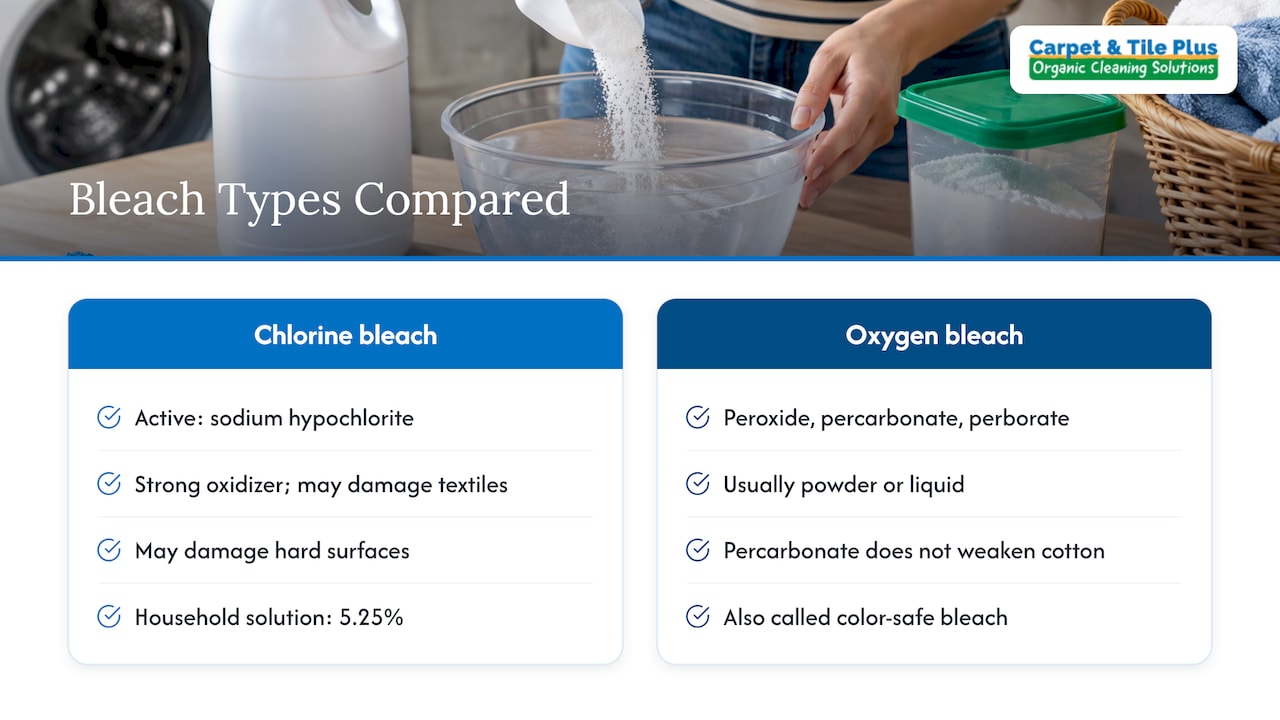
You will also see oxygen bleach called color-safe bleach or non-chlorine bleach. These are the same family.
Side by side
| Chlorine bleach | Oxygen bleach | |
|---|---|---|
| Main ingredient | Sodium hypochlorite | Hydrogen peroxide, sodium percarbonate or sodium perborate |
| Strength | More powerful, fast acting | Gentler, works more slowly |
| Whitening | Restores discolored whites | Maintains whiteness rather than restoring it |
| Disinfecting | Yes, when used as the label directs | No |
| Colored fabrics | Can cause color loss | Safe on most colorfast and colored washables |
| Wool and silk | Never | Avoid as well |
| Water temperature | Works across temperatures | Best in warm to hot water |
| Odor | Strong | Little to none |
The American Cleaning Institute (ACI), the trade association for cleaning product makers, backs up the core of this table: chlorine bleaches are more powerful and disinfect, clean and whiten, while oxygen bleaches are gentler, work on all washable fabrics and maintain rather than restore whiteness.
Does chlorine work better than oxygen?
It depends on the job, and “stronger” is not the same as “better.”
For a white cotton towel that has gone gray, or for a task that needs disinfecting, chlorine bleach is the more powerful tool. For a red wine ring on a colored shirt, a grass stain on kids’ play clothes or a dingy pillowcase, oxygen bleach does the job without the risk of fading. Better Homes & Gardens points out that oxygen bleach has no strong odor and can be used in laundry and on many hard and soft surfaces, but that it does not disinfect.
Two practical details from ACI change the result:
- Timing with chlorine. Add it about five minutes after the wash cycle begins, so it can agitate without destroying the enzymes and whiteners in your detergent.
- Placement with oxygen. Add it to the wash water before the clothes go in, and never pour the powder directly onto wet clothes. It works best in warm to hot water.
The stain-removal reference from Cedar Falls Library adds that a stain should lift within about 15 minutes of fresh chlorine bleach, or it won’t come out, and that bleach older than six months may have lost its strength. Repeated use, even diluted, weakens cellulose fibers such as cotton.
Can you swap one for the other?
Only in one direction. If a garment’s care label says not to use liquid household bleach, ACI recommends an oxygen bleach to help remove stains and odors. Going the other way is where damage happens: chlorine on a fabric labeled for non-chlorine bleach can strip dye or weaken the fiber.
Keep these rules in mind:
- Read the garment label first. Fiber content, finishes and trims all affect what is safe.
- Skip both on silk, wool and leather. Chlorine is off the table for wool and silk. The Spruce warns that oxygen bleach can also ruin silk, wool and anything with leather trim or wooden buttons.
- Test a hidden spot. Homes and Gardens advises trying oxygen bleach on a small, out-of-sight area before using it widely.
- Rinse oxygen bleach well. Otherwise it can leave a powdery white residue.
Safety: the part you cannot skip
The single most important rule is never to combine products. ACI states that chlorine bleach must never be mixed with ammonia, ammonia-based products or acidic products, and that the combination can be dangerous or deadly. Oxygen bleach should also never be mixed with chlorine bleach, ammonia or other cleaners, according to Better Homes & Gardens.
The EPA-registered label for a leading household chlorine bleach gives more specifics:
- Do not use it or mix it with toilet bowl cleaners, rust removers, or acid- or ammonia-containing products, because hazardous gases are released.
- Prolonged contact with metal may cause pitting or discoloration.
- It causes substantial but temporary eye injury and is harmful if absorbed through the skin or swallowed.
- For eye contact, rinse with water for 15 to 20 minutes and call a poison control center.
Also store bleach out of reach of children and pets, and never use it on food. If someone swallows bleach or breathes in fumes from a mixture, call Poison Control at 1-800-222-1222 or 911 in an emergency.
One point on disinfecting: ACI says it takes pre-cleaning the surface, a solution diluted as the label directs, about five minutes of contact at room temperature, then a rinse with warm water. Products with built-in color-safe bleach do not disinfect.
Where oxygen bleach is used around the house
Beyond laundry, oxygen bleach shows up in many cleaning routines. Better Homes & Gardens lists upholstery, rugs, mattresses, soap scum in tubs and sinks, and outdoor concrete, brick and pavers. It also lists grout, with a sit time of 30 minutes or more. It is not meant for painted or stained wood.
Exterior surfaces have their own precautions, such as testing a spot first and keeping product off materials it can harm. If you are tackling siding, this guide on how to clean vinyl siding walks through the precautions.
Inside the home, carpet and grout are different. Both are porous, and both hold dirt deep below what you see.
Why carpet and grout call for a professional cleaning
The question behind most searches for oxygen versus chlorine is “what will get this stain out?” On carpet, the stakes are higher than on a T-shirt. A bleached spot cannot be washed or replaced, and the damage shows in the middle of a room. Nebraska Extension’s warning that chlorine bleach can damage some textiles and hard surfaces applies to both carpet fibers and tile surroundings.
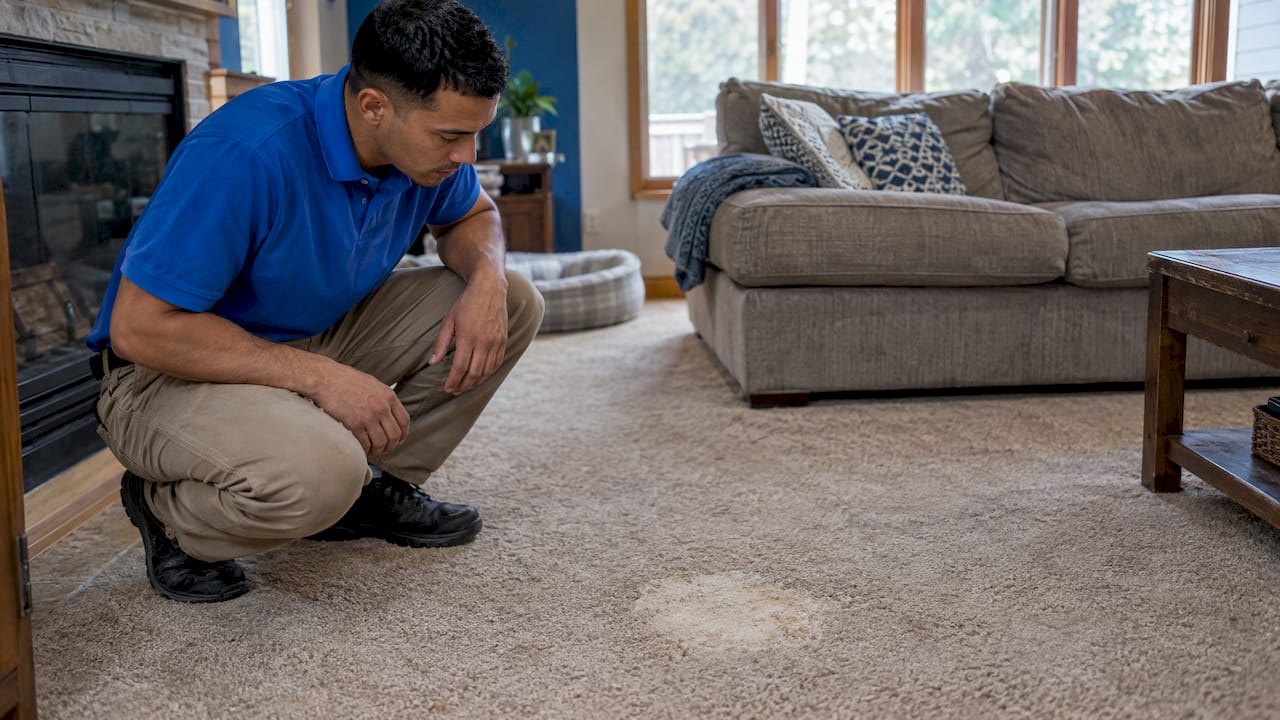
Carpet fibers also respond to chemistry beyond bleach. The pH of a cleaning solution affects how it removes soil and how long fibers last, which we explain in how pH levels affect carpet cleaning and fiber life. Using the wrong product, or too much of the right one, can leave residue that attracts dirt back.
Grout is the other trouble spot. It is a textured, absorbent line between tiles, so it soaks up whatever you put on it, and grime sits deep in it. Our approach there is described in how chlorine-free tile cleaning works: organic products rather than bleach.
That is why we built our service around three things:
- Organic cleaning products that keep the process safe and eco-friendly, which matters in homes with children and pets. See what organic carpet cleaning products are.
- IICRC-certified cleaners. The IICRC is the cleaning and restoration industry’s certifying body, and our technicians hold its certification.
- A one-hour dry time, so rooms are back in use quickly. For a business, that means less disruption to the working day.
Baking soda vs activated charcoal for odors
Many people reach for these two when a room smells, so here is the short version.
Baking soda is a mildly alkaline, non-abrasive cleaner. Nebraska Extension notes it can be dissolved in water, used as a scouring powder, or used as an adsorbent cleaner or deodorizer. Adsorbent means odor molecules stick to its surface.
Activated charcoal has a huge amount of surface area packed into a small volume, which is why it is effective at adsorbing odor molecules from the air.
In practice, baking soda suits a small, dry area you can reach, such as a refrigerator shelf or a shoe. Charcoal suits enclosed air, such as a closet or a car. Neither one removes the thing causing the smell. If the odor comes from pet accidents that have soaked through carpet fibers and the pad underneath, a surface powder will not reach it. That is the situation our carpet pet stain and odor removal service is for, and we explain how we trace the source in our guide to pet-friendly carpet cleaning.
Our view
We hear the bleach question from customers all the time, and it usually starts with a stain they want gone. Our answer comes from how we clean.
Bottled bleach, either kind, is a laundry tool. Carpet and grout are not laundry. They hold soil deep, and the wrong chemistry shows up as faded patches or residue that brings the dirt back.
That is why we use organic cleaning products and low-moisture methods that give a one-hour dry time. Our cleaners are IICRC-certified, and we have more than 20 years in the business. Every job comes with our 100% satisfaction guarantee.
If you have a stain you are tempted to bleach, call us first. We can look at the fiber, the stain and the surface, and choose the cleaning that fits.
Joe
Have us handle the carpet, tile and grout
We clean homes and businesses in Arlington Heights, Bartlett, Barrington, Elgin, Elk Grove Village, Hoffman Estates, Lake Zurich, Mount Prospect, Palatine, Rolling Meadows, Streamwood and the surrounding Northwest Suburbs.
Residential carpet cleaning is published at $120 to $300 per one-off job, and commercial carpet cleaning at $200 to $500. See the details on our carpet cleaning pricing page. For stained or dingy grout, see our residential tile and grout cleaning service, or commercial tile and grout cleaning for your business. You can book through carpetandtileplus.com.
FAQ
Is OxiClean just oxygen bleach?
OxiClean is a brand of oxygen bleach. Oxygen bleaches use hydrogen peroxide, sodium percarbonate or sodium perborate as the active ingredient, according to the manufacturer’s own comparison. Check each product’s label for its ingredients and directions.
What should you not use oxygen bleach on?
Silk, wool and leather, including leather trim, plus items with wooden buttons and painted or stained wood. Test a hidden area before using it on anything else. If a stain is on carpet or grout, we can clean it for you.
Can I mix chlorine bleach with vinegar or ammonia for extra strength?
No. Chlorine bleach must never be mixed with ammonia or acidic products, which include vinegar. The mixture can be dangerous or deadly, according to the American Cleaning Institute. Use one product at a time and rinse between them.
Does oxygen bleach disinfect?
No. Chlorine bleach disinfects when used per its label, while oxygen bleach cleans and lifts stains but is not a disinfectant. Products with built-in color-safe bleach do not disinfect either.
Sources
- How to Use Bleach, American Cleaning Institute
- EC88-422 Household Cleaning and Laundry Products, University of Nebraska Extension
- Quick ‘n Easy Stain Removal
- Chemistry in your cupboard, Royal Society of Chemistry
- Here’s What You Can (and Should Never) Clean with Bleach, Better Homes & Gardens
- What Is Oxygen Bleach?, Better Homes & Gardens
- What Is Oxygen Bleach? How to Use It in Laundry, The Spruce
- 10 genius ways to use oxygen bleach, Homes and Gardens
- US EPA pesticide product label, household bleach
- Oxygen Bleach vs Chlorine Bleach, OxiClean