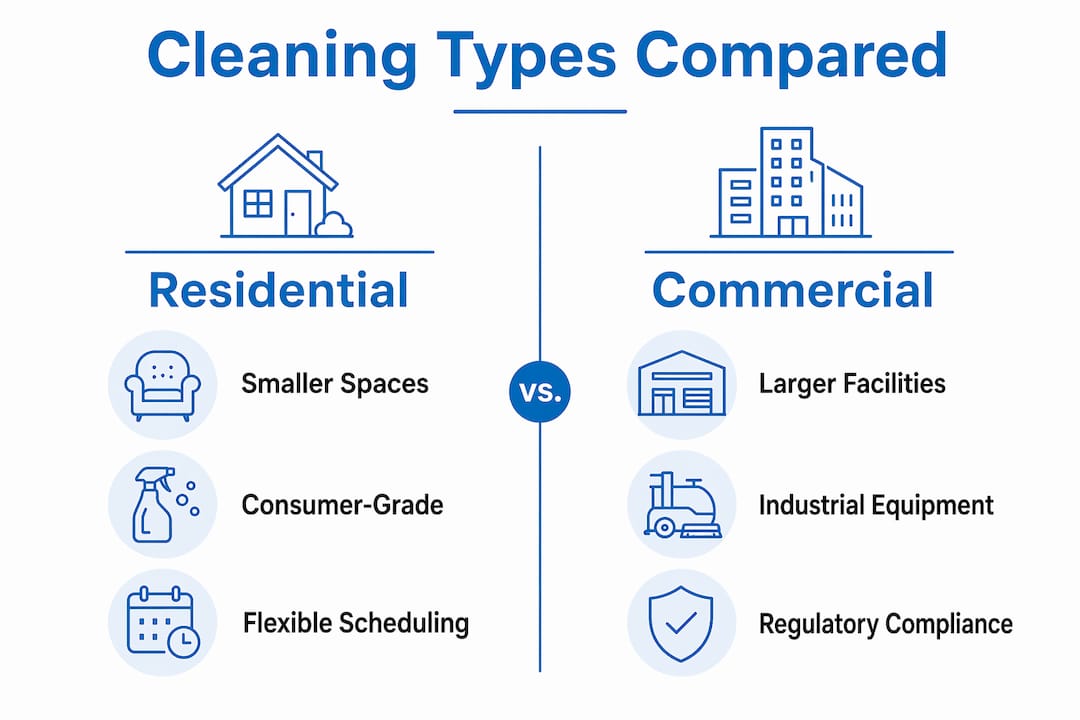
Residential cleaning is defined as the professional cleaning of private homes, apartments, and condos, while commercial cleaning covers business facilities, offices, schools, and public spaces under formal regulatory standards. Understanding what is residential vs commercial cleaning difference matters because choosing the wrong service type leads to inadequate hygiene, compliance risks for businesses, or poor results for homeowners. The two service categories differ fundamentally in scale, equipment, staffing, and legal structure. Organizations like OSHA, the CDC, and the International Sanitary Supply Association (ISSA) set the compliance benchmarks that separate commercial cleaning from its residential counterpart.
What is the residential vs commercial cleaning difference?
The core difference comes down to scope and accountability. Residential cleaning services focus on personal comfort in private spaces. Commercial cleaning protects public health and business infrastructure under enforceable standards.
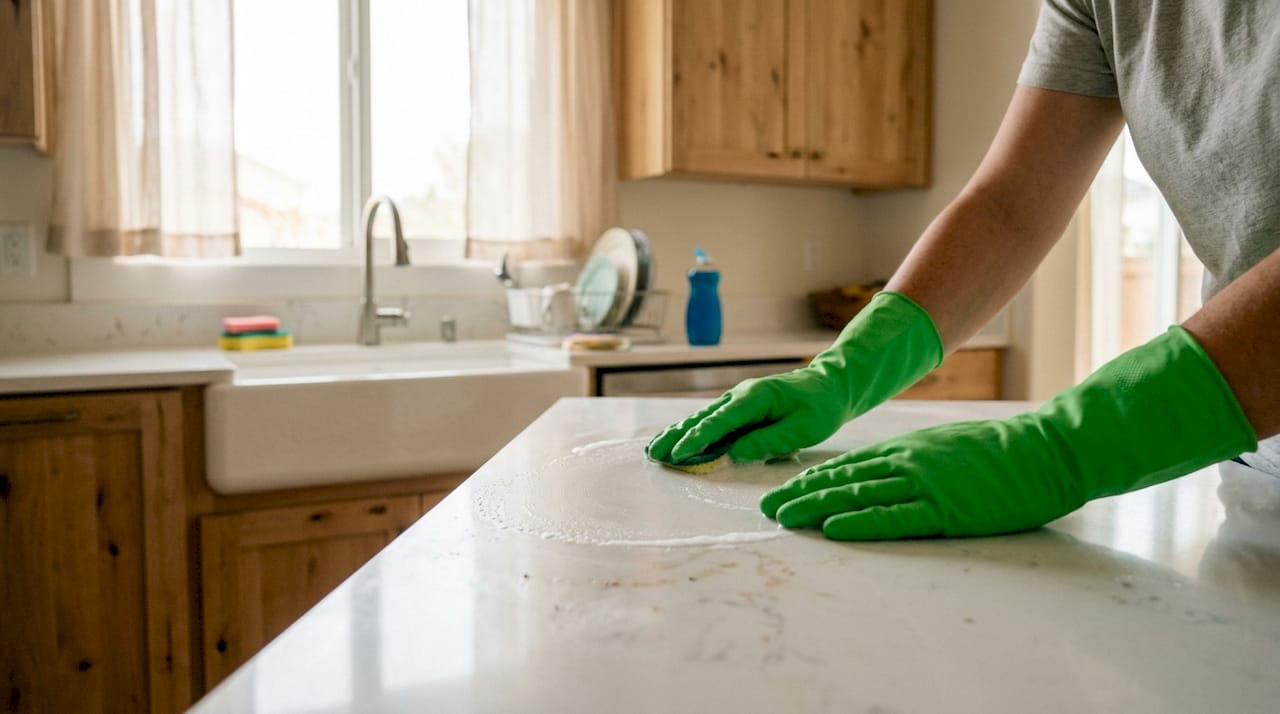
Residential cleaning covers smaller, self-contained spaces: bedrooms, kitchens, bathrooms, and living areas. The goal is comfort and tidiness for the people who live there. Scheduling is flexible, and the client’s personal satisfaction drives quality expectations.
Commercial cleaning, by contrast, protects building infrastructure and public health in ways that go far beyond surface tidiness. A hospital corridor, a school cafeteria, and a corporate lobby each carry health and safety obligations that no residential cleaning routine can meet. The ISSA describes commercial cleaning as a restorative process, not just a cosmetic one.
The regulatory gap between the two is significant. Commercial cleaning requires OSHA and CDC compliance, while residential cleaning operates without formal regulatory oversight. That distinction shapes every other difference between the two service types.
How do scale and environment differ between residential and commercial cleaning?
Scale is the most visible difference between home and office cleaning. A residential job typically involves one or two rooms cleaned by one or two people in a few hours. A commercial job can span tens of thousands of square feet and require multi-person crews working in coordinated shifts.
Residential cleaning is handled by small teams, often just one or two cleaners per visit. Commercial cleaning involves larger crews, specialized shift schedules, and sometimes 24-hour operations to avoid disrupting business hours. That scale directly affects manpower, equipment load, and time on site.
The environments themselves are also fundamentally different:
- Residential spaces include bedrooms, kitchens, bathrooms, and living rooms with predictable layouts and low daily foot traffic.
- Commercial spaces include open-plan offices, medical waiting rooms, retail floors, school hallways, and industrial kitchens with high daily foot traffic and complex layouts.
- Specialized commercial environments such as hospitals or food-service facilities require site-specific cleaning protocols that residential providers are not equipped to deliver.
| Factor | Residential cleaning | Commercial cleaning |
|---|---|---|
| Space size | Small to medium (homes, apartments) | Large to very large (offices, schools, hospitals) |
| Daily foot traffic | Low | High to very high |
| Crew size | 1–2 cleaners | Multi-person crews |
| Scheduling | Flexible, client-directed | Structured shifts, often after hours |
| Specialized services | General tidying and surface cleaning | Floor stripping, post-construction, high-level disinfection |
Specialized commercial services like floor stripping, post-construction cleanup, and high-level disinfection simply do not exist in the residential cleaning catalog. That gap reflects the operational complexity of commercial environments.
What equipment and materials does each cleaning type use?
Equipment is where the differences in cleaning types become most concrete. Residential cleaning relies on consumer-grade vacuums, standard mops, and retail cleaning sprays. These tools work well for low-traffic private spaces but fall short in high-use commercial environments.
Commercial cleaning demands industrial-grade machines and EPA-registered disinfectants that meet OSHA chemical safety standards. Truck-mounted extraction units, commercial-grade floor buffers, and HEPA-filter vacuums are standard in professional commercial operations. These tools remove contaminants at a level that consumer products cannot match.
| Equipment or material | Residential cleaning | Commercial cleaning |
|---|---|---|
| Vacuum | Consumer-grade upright or canister | Industrial HEPA-filter or truck-mounted unit |
| Mop system | Standard string or flat mop | Microfiber commercial mop with wringer cart |
| Disinfectants | Retail spray cleaners | EPA-registered, OSHA-compliant disinfectants |
| Floor care | Basic sweep and mop | Buffing, stripping, and sealing machines |
| Carpet cleaning | Portable steam cleaner | Truck-mounted hot water extraction |
Pro Tip: When evaluating a cleaning provider for a business space, ask specifically whether their disinfectants are EPA-registered. A “yes” answer signals they meet the minimum commercial compliance standard. A vague answer is a red flag.
Industrial-grade equipment and specialized chemicals protect building assets and surfaces while meeting compliance requirements. Using residential-grade products in a commercial setting risks both surface damage and regulatory violations. Carpetandtileplus uses IICRC-certified methods and organic cleaning products that meet professional standards for both residential and commercial carpet and tile work.
How do staffing, training, and compliance differ?
Staffing structure separates residential and commercial cleaning more than most clients realize. Residential cleaning services often operate with small, informal teams. Scheduling is flexible, and training is largely on-the-job with a focus on client preferences.
Commercial cleaning requires a different operational model entirely. Trained staff with documented site-specific protocols are the standard because commercial environments carry higher liability, stricter security requirements, and complex hazardous waste handling. A cleaner working in a medical facility, for example, must understand bloodborne pathogen protocols. That knowledge does not come from residential cleaning experience.
Key compliance differences include:
- OSHA standards govern chemical handling, personal protective equipment, and workplace safety in commercial cleaning.
- CDC guidelines apply to disinfection protocols in healthcare and public facilities.
- ISSA certifications signal that a commercial cleaning provider meets recognized industry training benchmarks.
- Site-specific onboarding is required for commercial cleaners before they begin work at a new facility.
Pro Tip: Before signing with any commercial cleaning provider, ask for proof of OSHA training records and site-specific onboarding documentation. Providers who cannot produce these records create liability exposure for your business.
Residential cleaning focuses on consumer satisfaction without formal regulatory oversight. That flexibility is a feature for homeowners. For businesses, it is a liability. The cleaning standards that apply to residential settings differ substantially from those required in commercial or public-use environments.
What are the contract and scheduling differences?
Contract structure is one of the most practical differences between residential and commercial cleaning services. Residential cleaning is typically booked on a per-visit or recurring basis with easy cancellation and flexible rescheduling. There is rarely a formal contract, and pricing is usually straightforward.
Commercial cleaning operates under legally binding service contracts that define service levels, frequency, response times, and quality benchmarks. These contracts protect both the client and the provider. They also create the accountability structure that businesses need to maintain consistent operations.
The key contract and scheduling differences break down as follows:
- Service level agreements (SLAs) in commercial contracts specify measurable outcomes, not just general cleaning tasks. Performance is tracked and inspected regularly.
- Pricing models for commercial cleaning are typically based on square footage, frequency, and service complexity rather than a flat per-visit rate.
- Scheduling for commercial cleaning is often set around business hours, with cleaning crews arriving early morning, late evening, or overnight to avoid disruption.
- Cancellation terms in commercial contracts require advance notice and may carry financial penalties, unlike the informal arrangements common in residential cleaning.
- Business continuity depends on uninterrupted cleaning service in commercial environments. Legal contracts guarantee predictable service that flexible residential arrangements cannot provide.
Commercial service performance is quantified with SLAs and regular inspections. That accountability structure is absent in residential cleaning, where quality is judged by the homeowner’s personal impression after each visit.
How do you choose the right cleaning service for your needs?
Choosing the wrong cleaning service creates real problems: inadequate hygiene, compliance violations for businesses, or wasted money for homeowners. The right choice depends on your space, your usage, and your obligations.
Use these criteria to guide your decision:
- Space size and usage. A private home with two adults needs residential cleaning. An office with 50 employees, a retail store, or a medical clinic needs commercial cleaning.
- Regulatory obligations. Any business open to the public or operating in a regulated industry must use a cleaning provider that meets OSHA and CDC standards.
- Frequency and consistency. Homeowners can tolerate flexible scheduling. Businesses cannot afford gaps in cleaning service that create health or safety risks.
- Specialized needs. Post-construction cleanup, floor restoration, or high-level disinfection require commercial carpet cleaning expertise that residential providers do not offer.
Pro Tip: If you manage a small business and are tempted to hire a residential cleaning service to save money, calculate the compliance risk first. A single OSHA violation can cost far more than the price difference between service types.
Cleaning companies rarely excel in both service types simultaneously because the operational structures are too different. Look for providers who specialize clearly in one category, or who demonstrate documented capability in both through certifications and client references. Carpetandtileplus holds IICRC certification and serves both residential and commercial clients across the Northwest Suburbs of Chicago with over 20 years of experience.
Key Takeaways
Residential and commercial cleaning are distinct service categories separated by scale, equipment, regulatory compliance, and contract structure, and choosing the wrong type creates measurable risks for both homeowners and businesses.
| Point | Details |
|---|---|
| Regulatory divide | Commercial cleaning must comply with OSHA and CDC standards; residential cleaning has no formal regulatory requirement. |
| Equipment gap | Commercial jobs require industrial-grade machines and EPA-registered disinfectants that consumer-grade tools cannot replace. |
| Staffing and training | Commercial cleaners need documented, site-specific training; residential teams operate with informal, flexible arrangements. |
| Contract structure | Commercial cleaning uses legally binding SLAs with measurable outcomes; residential cleaning relies on flexible, informal scheduling. |
| Service selection | Match your cleaning service to your space size, regulatory obligations, and consistency requirements to avoid compliance and hygiene risks. |
What I’ve learned after 20 years of cleaning both homes and businesses
The most common mistake I see is a business owner hiring a residential cleaning service because the price is lower. It seems reasonable on the surface. The crew shows up, the office looks tidy, and the invoice is half what a commercial provider would charge. Then an OSHA inspector visits, or a client notices the restrooms are not properly disinfected, and the cost of that decision becomes very clear.
Residential and commercial cleaning are not interchangeable. The equipment is different, the chemicals are different, the training is different, and the accountability structure is completely different. A residential cleaner who does excellent work in a home is not automatically qualified to clean a medical waiting room or a commercial kitchen. The protocols simply do not transfer.
What I have also observed is that businesses underestimate the value of a formal contract. Homeowners often prefer flexibility, and that makes sense for their needs. But a business that relies on informal scheduling arrangements will eventually face a gap in service at the worst possible time. A structured contract with defined service levels protects operations in a way that a handshake agreement never can.
The other misconception worth addressing is that commercial cleaning is just residential cleaning at a larger scale. It is not. The commercial carpet cleaning best practices that apply to a high-traffic office lobby are fundamentally different from what works in a residential living room, even if both involve carpet. Fiber types, soil loads, drying time requirements, and chemical compatibility all shift when you move from a home to a business environment.
My advice is simple: be honest about what your space actually is and what it demands. Then find a provider with documented experience in that specific category.
— Jim
Carpetandtileplus serves both residential and commercial cleaning needs
Whether you need a thorough clean for your home or a compliant, scheduled service for your business, Carpetandtileplus delivers results backed by IICRC certification and over 20 years of experience across the Northwest Suburbs of Chicago.
For homeowners, residential carpet cleaning from Carpetandtileplus uses organic, eco-friendly products with a one-hour dry time so your routine stays on track. For businesses, commercial carpet cleaning and tile and grout services are built around your schedule and compliance requirements. Hundreds of five-star reviews across Elgin, Bartlett, Streamwood, Arlington Heights, and Palatine reflect the consistent quality that both homeowners and business clients rely on. Contact Carpetandtileplus to schedule a service that fits your space.
FAQ
What is the main difference between residential and commercial cleaning?
Residential cleaning focuses on private homes using flexible schedules and consumer-grade products. Commercial cleaning serves business and public facilities under OSHA and CDC regulatory standards with industrial-grade equipment and formal service contracts.
Can a residential cleaning company handle commercial jobs?
Cleaning companies rarely excel in both service types because the operational structures, equipment, training, and compliance requirements are fundamentally different. Businesses risk compliance violations and inadequate hygiene when using residential-only providers.
What regulations apply to commercial cleaning services?
Commercial cleaning must comply with OSHA chemical safety standards and CDC disinfection guidelines, particularly in healthcare, food service, and public facilities. Residential cleaning has no equivalent formal regulatory requirement.
How do commercial cleaning contracts differ from residential arrangements?
Commercial cleaning uses legally binding service level agreements with measurable outcomes, defined schedules, and formal cancellation terms. Residential cleaning typically operates on a flexible, per-visit basis with minimal contractual obligation.
What types of cleaning does commercial cleaning include that residential does not?
Commercial cleaning includes specialized services such as floor stripping, post-construction cleanup, and high-level disinfection using EPA-registered disinfectants. These services are not standard offerings from residential cleaning providers.