
Walk into a retail store with dingy, discolored grout lines running across the floor and your first impression takes a hit before you even look at the merchandise. For retail business owners in the Northwest Suburbs of Chicago, commercial tile grout cleaning in retail spaces is not a cosmetic luxury but a direct factor in how customers perceive your store. This guide walks you through exactly what preparation looks like, how professional cleaners execute the process, what mistakes to avoid, and how to build a maintenance plan that keeps your floors looking sharp year-round.
Table of Contents
- What you need to prepare for professional tile grout cleaning
- Step-by-step process of commercial tile grout cleaning in retail spaces
- Common challenges and mistakes in commercial tile grout cleaning
- How to verify and maintain tile grout cleanliness over time
- Why professional tile grout cleaning is a smart investment for retail spaces
- Get expert commercial tile grout cleaning in the Northwest Suburbs
- Frequently asked questions
Key Takeaways
| Point | Details |
|---|---|
| Professional cleaning essentials | Using specialized tools and safe methods is key to effective commercial grout cleaning. |
| Step-by-step cleaning | Professional services follow a detailed process from inspection to sealing for best results. |
| Avoid common mistakes | Avoid harsh chemicals and DIY attempts that can damage grout and tiles. |
| Regular maintenance | Scheduled cleaning and sealing preserve grout appearance and longevity over time. |
| Value of professionals | Investing in professional cleaning protects your retail image and reduces costly repairs. |
What you need to prepare for professional tile grout cleaning
Having introduced why clean grout matters, let’s explore what you need to prepare before scheduling a professional service. Preparation is where most retail owners drop the ball, and a little planning on your end makes the job faster and the results last longer.
Know your tile and grout type first
Not all tile is treated the same way. Ceramic and porcelain tiles handle aggressive scrubbing well, but natural stone like travertine or slate requires gentler, pH-neutral solutions to avoid etching the surface. The grout itself matters too. Sanded grout is common in wider joints and tolerates more abrasive methods, while unsanded or epoxy grout needs careful chemical selection. Before any service call, let your provider know what you’re working with.
Professional tile grout cleaning tools are matched to the surface, which is exactly why this first step matters. Generic store-bought equipment cannot adapt the way commercial machinery does.
Tools and equipment professionals bring
Here’s what a properly equipped professional cleaning crew shows up with:
- High-speed rotary scrubbers for mechanical agitation that loosens embedded dirt
- Truck-mounted or portable steam cleaners for heat-based extraction
- Commercial-grade alkaline cleaners formulated to cut through grease without corroding grout
- Grout-specific sealers applied post-cleaning to lock in results
- Wet-dry vacuums and water extraction units to speed up drying time
Pro Tip: Ask your cleaning provider whether they use truck-mounted or portable units. Truck-mounted systems typically produce higher water pressure and heat, which translates to deeper extraction and faster dry times. For a busy retail space, that one-hour dry time difference is significant.
Preparing your space before the crew arrives
| Task | Why it matters |
|---|---|
| Move portable displays and racks | Gives cleaners full floor access |
| Post wet floor signs at entry points | Keeps customers and staff safe |
| Notify staff of schedule | Prevents confusion and foot traffic during cleaning |
| Identify high-traffic zones to prioritize | Helps the crew focus effort where buildup is worst |
| Note any cracked or loose grout | Prevents water intrusion into subfloor during cleaning |
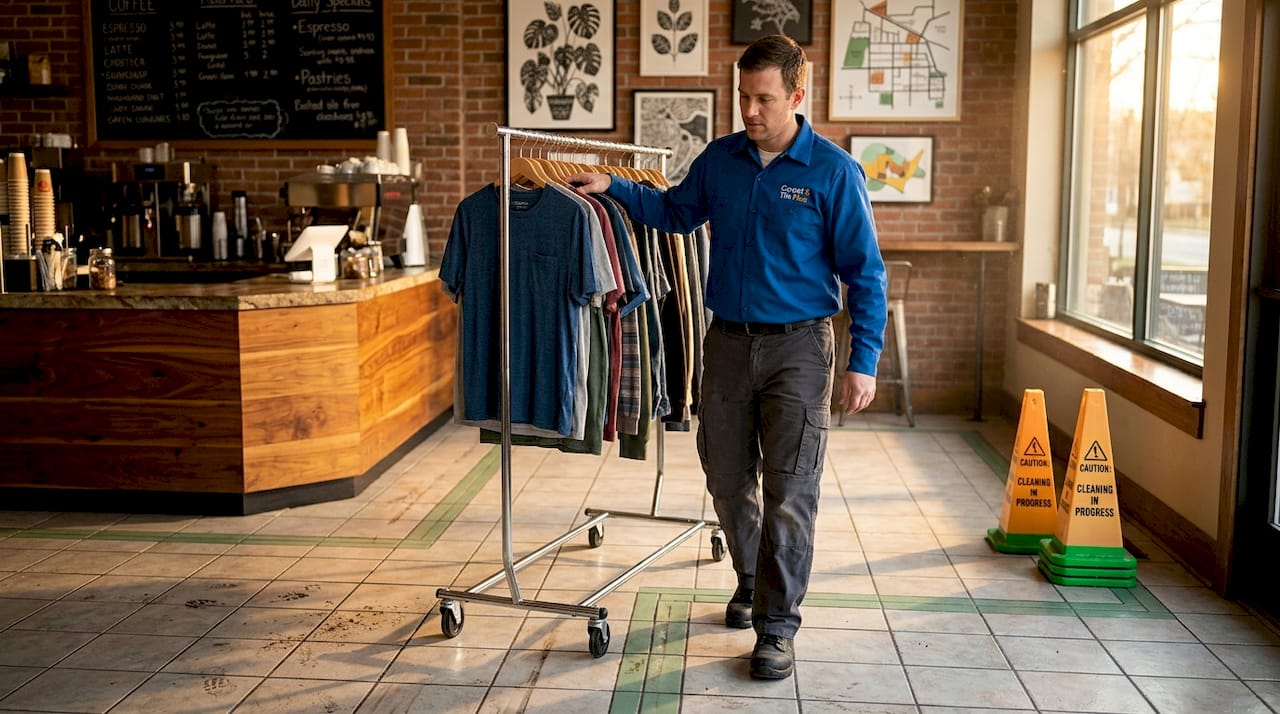
Scheduling the work during off-hours, whether early morning or after close, protects your customers from disruption and gives the floor time to dry before foot traffic resumes. For stores in Bartlett, Streamwood, or Palatine with consistent daily traffic, this timing consideration is non-negotiable.
Step-by-step process of commercial tile grout cleaning in retail spaces
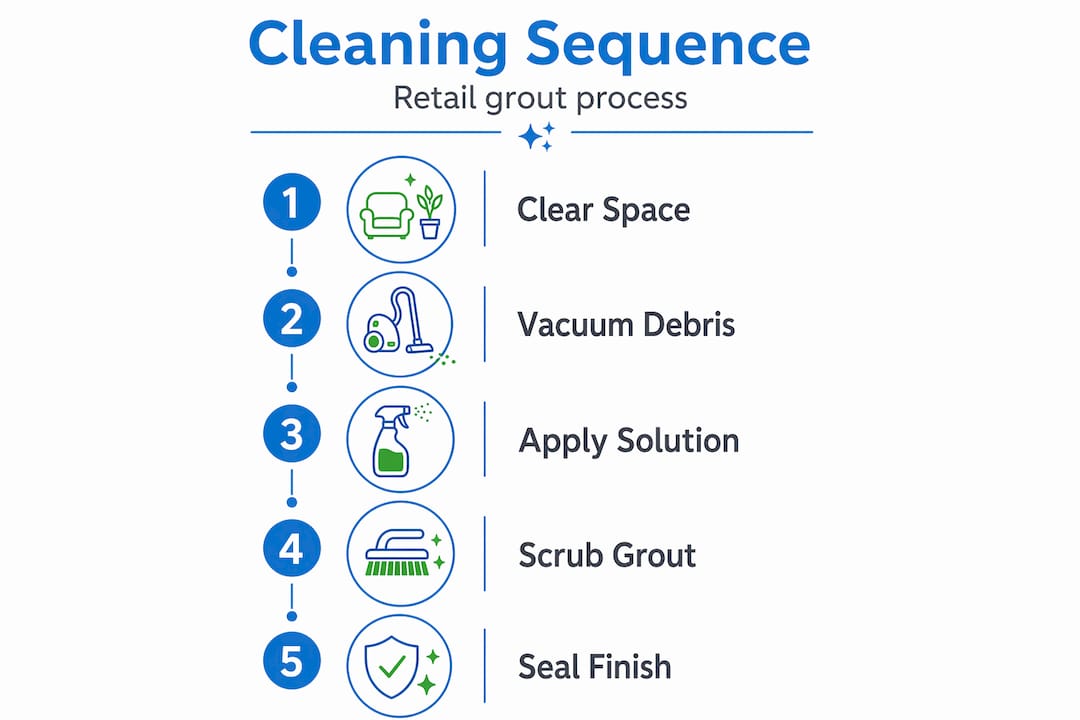
Now that you know how to prepare, let’s walk through the actual cleaning steps professionals use in retail spaces. This is not a single-pass job. The commercial tile & grout cleaning process follows a methodical sequence that each step depends on the one before it.
The professional cleaning sequence
- Initial inspection. The technician walks the floor to identify staining type, grout condition, cracked lines, and tile material. This shapes every decision that follows.
- Pre-treatment application. A professional-grade alkaline or enzymatic cleaner is applied to the grout lines and tile surface. The solution dwells for several minutes to break down grease, bacteria, and mineral deposits.
- Mechanical scrubbing. Rotary brushes agitate the softened soil out of the porous grout. This is the step that regular mopping simply cannot replicate, because the mechanical action reaches into the grout’s surface texture.
- Steam extraction or hot water rinse. High-temperature steam or pressurized water flushes out the loosened debris along with the cleaning solution. This also sanitizes the surface, which matters in retail environments where hundreds of shoes track in outside contaminants daily.
- Inspection under bright lighting. The technician checks grout lines with a flashlight or inspection light. Stubborn stains get a second treatment before the floor is declared clean.
- Grout sealing. Once dry, a penetrating sealer is applied to protect the grout from future staining. Think of it as a shield that buys you time between professional cleanings.
Pro Tip: Request that your provider seal immediately after cleaning, not at a return visit. Freshly cleaned grout is maximally porous and absorbs sealer most effectively in that window.
What makes retail grout different from residential grout
Retail floors take a beating that home floors never face. A boutique in Arlington Heights or a grocery store in Hanover Park may see several hundred foot-traffic passes per day. Each pass deposits oils, moisture, and fine grit that work into the grout over time. Foot traffic also compacts dirt deeper than in a residential setting, which is why the pre-treatment dwell time is often longer for commercial jobs.
- Grout in retail spaces tends to stain faster near entrance mats and checkout lanes
- Kitchen or café areas within retail stores carry grease-based contamination similar to commercial tile cleaning on restaurant floors
- High-moisture zones like restrooms need anti-mold formulations in the cleaning solution
Common challenges and mistakes in commercial tile grout cleaning
Understanding the cleaning steps helps, but you also need to be aware of common pitfalls to avoid costly errors. Most grout damage in retail spaces is self-inflicted, which means it is completely preventable.
What goes wrong and why
- Using acidic cleaners on unsealed grout. Vinegar-based or citrus cleaners sound natural and safe, but they erode the calcium in grout over time. The lines become crumbly and discolored faster than they would with no cleaning at all.
- Relying on DIY scrubbing with inadequate equipment. A standard hand brush and household cleaner cannot match the pressure, heat, or chemical penetration of commercial tools. Effective tile grout cleaning methods require the right equipment for the right surface.
- Skipping the sealing step. Cleaning without sealing is like washing your car and leaving it in the rain. The grout is now freshly cleaned but totally vulnerable.
- Irregular cleaning intervals. Waiting too long between professional sessions allows staining to cross the threshold from “cleanable” to “permanently discolored.” At that point, the only fix is re-grouting, which costs significantly more.
- Cleaning during business hours. Wet tile is a slip hazard and foot traffic during cleaning contaminates the work in progress. Scheduling matters as much as technique.
Choosing the wrong cleaning method can permanently damage tile and grout. Once grout is etched or structurally compromised, no amount of cleaning restores it. Prevention and correct technique are always less expensive than repair.
Poor scheduling is consistently underestimated as a mistake. A full cleaning that is interrupted by customer foot traffic halfway through leaves the floor uneven in appearance and the grout partially treated. Set the schedule, stick to it, and keep the area closed until the floor is fully dry.
How to verify and maintain tile grout cleanliness over time
After cleaning, it’s crucial to confirm results and plan ongoing maintenance to keep your retail space inviting. A one-time deep clean does not stay clean on its own.
How to assess the quality of a completed cleaning
- Grout color should be uniform. If lines look patchy or some sections are clearly lighter than others, the cleaning was inconsistent.
- No tacky residue on the tile surface. Leftover cleaning solution means the extraction was incomplete, and that residue will actually attract dirt faster.
- Grout lines should feel smooth, not gritty. Run your finger across a joint. Grit means the scrubbing was insufficient.
- Check corners and edges. These are the zones most often missed by rotary machines. Inspect them closely.
Recommended cleaning intervals by traffic level
Grout cleaning frequency and maintenance should be calibrated to your specific store’s foot traffic, not a one-size-fits-all calendar.
| Traffic level | Example retail setting | Recommended interval |
|---|---|---|
| Low | Small boutique, specialty shop | Once per year |
| Moderate | Mid-size clothing or home goods store | Every 6 to 9 months |
| High | Grocery, pharmacy, or high-volume retail | Every 3 to 6 months |
| Very high | Food court adjacent, entrance lobbies | Every 2 to 3 months |
Between professional visits, spot cleaning matters more than most owners realize. A mop with a neutral pH cleaner handles surface grime without degrading the sealer. Keep a spray bottle of diluted neutral cleaner near the mop closet and train staff to treat spills immediately rather than mopping over them hours later.
Why professional tile grout cleaning is a smart investment for retail spaces
Here is the perspective that most discussions skip: retail owners tend to think of tile cleaning as a maintenance cost, similar to replacing light bulbs. It is actually closer to a reputation investment.
Customers in the Northwest Suburbs of Chicago have options. When someone walks into your store in Elgin or Barrington and the floors look grimy, that impression does not erase itself once they reach the clothing racks or checkout counter. Cleanliness is a proxy for care. A customer’s brain connects a dirty floor with a business that cuts corners. That association is unfair, but it is real, and it affects buying decisions.
The financial argument is equally clear. Grout that is cleaned and sealed on a regular schedule lasts far longer than neglected grout. Re-grouting a 2,000-square-foot retail floor can cost thousands of dollars. Scheduled commercial tile grout cleaning benefits extend the life of your existing floor by years, often at a fraction of the replacement cost.
There is also an employee angle that rarely gets discussed. Your staff works in that space every day. A clean, well-maintained floor tells your team that you take the work environment seriously. It contributes to morale in a quiet but real way. Conversely, a floor that has been neglected sends a different message entirely, one that affects attitude and retention over time.
The businesses we work with in Streamwood and Palatine that commit to a quarterly or semi-annual cleaning schedule consistently report fewer complaints about floor appearance and spend less on reactive repairs. Prevention beats response, every time.
Get expert commercial tile grout cleaning in the Northwest Suburbs
If your retail floor is overdue for a professional cleaning, you do not have to figure out the scheduling, the products, or the technique on your own.

Carpet & Tile Plus has served retail and commercial clients across the Northwest Suburbs of Chicago for over 20 years. Our IICRC-certified technicians bring commercial-grade equipment, organic cleaning products, and the experience to handle every tile type without risk of damage. We offer commercial tile grout cleaning services with flexible scheduling designed around your store hours, not ours, and our one-hour dry time means your floor is ready for customers faster than you might expect. We also provide commercial carpet cleaning services for retail spaces with mixed flooring. Local store owners can also explore our tile grout cleaning in Hoffman Estates resource to learn more about what service looks like in your area.
Frequently asked questions
How often should I have my retail store’s tile grout professionally cleaned?
For high-traffic retail spaces, professional grout cleaning every 6 to 12 months maintains appearance and prevents stubborn buildup, though very high-traffic stores may need service every 2 to 3 months.
Can regular mopping replace professional tile grout cleaning in stores?
Regular mopping cleans the tile surface but cannot reach the embedded dirt and staining inside grout lines. Specialized tools and commercial-grade extraction are required for thorough results.
Will professional tile grout cleaning disrupt my retail business operations?
Professional services are typically scheduled during off-hours and deliver dry times as short as one hour, so your store can open on time without slip hazards or wet floor delays.
How can I choose the right professional tile grout cleaner for my retail space?
Look for locally operating providers with commercial experience, IICRC certification, and verifiable customer reviews. Guidance for retail managers on selecting the right commercial service provider can help you ask the right questions before you book.