Professional cleaning of installed wool broadloom typically runs $120 to $300 per job for most homes, with pricing shaped by room size and condition, according to Carpet & Tile Plus’s own cost guidance. Because wool reacts badly to the wrong chemistry, the price should reflect wool-safe methods and trained technicians, not just square footage. Before hiring, check for WoolSafe certification and IICRC-trained staff.
TL;DR:
- Ask every cleaner for the solution’s pH range; wool safe products sit around 5.5 to 7.5, while stronger alkaline cleaners can cause permanent discoloration.
- Commercial jobs typically cost $200 to $500 because larger areas, heavier traffic, and scheduling outside business hours add labor and complexity compared with residential work.
- Verify WoolSafe status: approval requires five years’ experience, a certified Fibre Care Specialist on staff, and exclusive use of independently tested wool safe products.
- Require an inspection, a spot test, and a written estimate listing the method, chemicals, drying time, insurance, and warranty terms.
- Schedule professional cleaning about once a year, or every 18 months for lighter use; homes with pets or heavy traffic may need more frequent service.
Table of Contents
- What makes one wool cleaning quote higher than another
- Realistic U.S. price models and ballpark ranges to use for budgeting
- What professionals check before they give a quote
- Checklist: how to vet a wool-capable cleaner
- What happens during a wool broadloom cleaning and typical outcomes
- How often to schedule professional cleaning and routine maintenance tips
- Comparing residential and commercial wool carpet cleaning costs
- Why cutting corners on wool cleaning costs more later
- How Carpet & Tile Plus helps you get a wool-safe clean
- FAQ
- Sources
What makes one wool cleaning quote higher than another
Two quotes for the same square footage can land far apart once you factor in condition and method. A light refresh on a well-maintained carpet costs far less than a restorative clean on carpet with years of trapped soil or old stains.
Several variables drive the final number:
- Condition and soil level: heavy traffic lanes, embedded grit, and old stains require more passes and specialized pretreatment.
- Fiber composition: pure wool and wool blends respond differently to moisture and chemistry, and a provider has to adjust method accordingly.
- Cleaning method: low-moisture dry compound or encapsulation suits sensitive wool fibers, while restorative wet cleaning is reserved for heavier jobs.
- Chemistry: wool needs pH-neutral, wool-safe solutions because high-alkaline products in the 9 to 12 range can cause yellowing, browning, or tannin migration.
- Labor and access: stairs, furniture moving, and tight access add time and typically a line-item fee.
- Special services: pet-stain and odor treatment, wicking correction, or a repair referral after over-wetting all add to the invoice.
Wool is a protein fiber, which is why the chemistry point matters more here than with synthetic carpet. A solution that works fine on nylon can permanently discolor wool.
Pro Tip: Ask every bidder what pH range their cleaning solution falls in. A wool-safe answer sits close to neutral, roughly 5.5 to 7.5.
Realistic U.S. price models and ballpark ranges to use for budgeting
Providers typically quote one of a few ways: a flat per-room rate, a per-square-foot rate, an hourly rate for larger commercial spaces, or a minimum service charge that applies regardless of size. Knowing which model you are being quoted makes it much easier to compare bids.
As a general illustration, homeowners can expect pricing to scale with service level:
- Light refresh (recently cleaned, low traffic): toward the lower end of a provider’s range.
- Deep clean (typical annual maintenance): a mid-range price reflecting standard soil levels.
- Restorative clean (heavy staining, years since last service, or pet accidents): the higher end, often with add-on fees.
For residential work, Carpet & Tile Plus’s published pricing runs $120 to $300, while commercial jobs run $200 to $500 given the larger footprints and heavier commercial traffic involved. Spot treatment, pet-odor remediation, or multiple-visit plans for severely soiled carpet add to either range. Local labor rates and the specific condition found during an on-site inspection are what ultimately set your final number, so treat any phone-only estimate as a starting point rather than a guarantee.
What professionals check before they give a quote
A provider who knows wool will ask several questions before naming a price, not after. That front-loaded process protects both your carpet and your wallet.
- Carpet composition: is it pure wool or a wool blend, and what’s the manufacturer brand?
- Stain and soil history: are there visible stains, pet accidents, or a long gap since the last professional cleaning?
- Room details: square footage, number of rooms, stairs, and furniture that needs moving.
- Backing and structural condition: any existing rippling, delamination, or prior water damage.
During the walkthrough, a trained technician performs spot testing and checks backing condition, watching for the kind of over-wetting risk the IICRC S100 Standard addresses through pre-inspection and method selection. Disclosing blend content matters because wool blends can call for a different method than pure wool, and failing to mention it can lead to the wrong chemistry being applied. A technician holding WoolSafe or IICRC CCT credentials represents additional training, which is often reflected in the quote.
Pro Tip: Have your carpet’s manufacturer and style name ready before the estimate call. It speeds up accurate pricing.
Checklist: how to vet a wool-capable cleaner
Not every carpet cleaning company is set up to handle wool safely, so a short vetting process before booking saves you from costly mistakes.
- Confirm WoolSafe Approved Service Provider or WoolSafe Fibre Care Specialist status and ask to see proof, since WoolSafe certification requires at least five years of experience, a certified Fibre Care Specialist on staff, and the exclusive use of independently tested wool-safe products.
- Ask directly what pH range their cleaning agents fall in and whether those products are WoolSafe-approved or follow IICRC-recommended methods.
- Request a written estimate listing method, expected drying time, chemicals used, proof of insurance, and whether the work supports your carpet’s manufacturer warranty.
- Walk away from any contractor who refuses a pre-inspection or defaults to high-alkaline chemistry, since that combination is a leading cause of irreversible wool damage.
Pro Tip: A written estimate that skips drying time or chemical type is incomplete. Ask for both before you sign off.
What happens during a wool broadloom cleaning and typical outcomes
A wool-safe cleaning appointment follows a fairly predictable sequence, and knowing it ahead of time helps you judge whether a provider is cutting corners.
- Pre-inspection: the technician checks fiber type, soil level, and existing damage.
- Spot testing: a small, hidden area is tested with the chosen solution to confirm no adverse reaction.
- Method selection: low-moisture or wet extraction is chosen based on fiber sensitivity and soil level.
- Cleaning and grooming: the carpet is cleaned, then groomed to reset pile direction.
- Drying: low-moisture methods often allow near-immediate use, while restorative wet cleaning requires longer drying windows and active moisture management, consistent with IICRC guidance on textile floor covering care.
If a stain reappears after drying, it’s usually wicking, meaning residue trapped in the backing has migrated back to the surface. A qualified technician will address it rather than simply re-treating the visible spot, and if moisture has caused rippling, a referral to restretching may follow.
How often to schedule professional cleaning and routine maintenance tips
Wool broadloom generally benefits from professional cleaning about once a year, and in some cases every 18 months, with frequency adjusted upward for high-traffic households or homes with pets, and Shaw recommends professional cleaning at least once every 18 months.
- Vacuum regularly with a quality HEPA-rated vacuum using a beater bar for standard cut-pile wool, adjusting technique for looped or specialty weaves.
- Routine professional cleaning can meaningfully extend carpet life compared to vacuuming alone and helps preserve manufacturer warranty coverage, which often requires documented maintenance.
- Entry mats at every exterior door cut down on the grit that causes most fiber abrasion.
- Rotating furniture occasionally and limiting direct UV exposure through window coverings both reduce uneven wear and fading over time.
For a fuller breakdown of how to set your own schedule, see this guide to choosing carpet cleaning frequency.
Comparing residential and commercial wool carpet cleaning costs
Commercial wool carpet cleaning typically costs more per job than residential work, largely because of scale and complexity rather than a different cleaning philosophy. Based on published pricing for the Northwest Chicago suburbs, residential wool cleaning runs $120 to $300, while commercial jobs run $200 to $500.
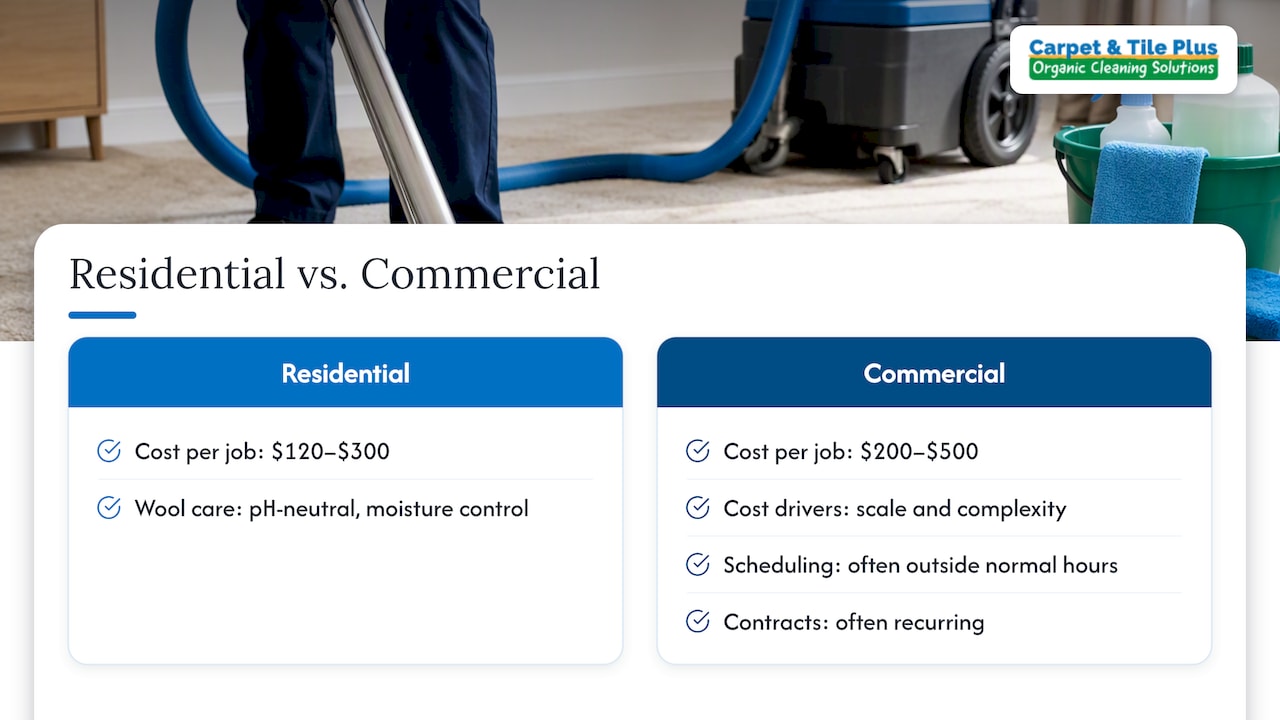
Several factors explain the gap. Commercial spaces usually cover more square footage, which adds labor time even at a similar per-square-foot rate. Business settings often require scheduling outside normal hours to avoid disrupting operations, and foot traffic in commercial wool carpet, such as in lobbies or conference rooms, tends to be heavier and more consistent than in a home. The CRI 204 Commercial Carpet Standard also emphasizes a consistent maintenance program with cost-effective cleaning schedules and trained technicians, which commercial clients often set up as recurring contracts rather than one-off visits.
That said, the underlying wool-safe principles don’t change between the two settings. A conference room with wool broadloom still needs pH-neutral chemistry and careful moisture control, just as a living room does. Property managers budgeting for commercial wool carpet should expect to pay for both the added square footage and the scheduling flexibility that commercial sites typically require.
Why cutting corners on wool cleaning costs more later
Wool fiber doesn’t forgive careless cleaning. A harsh chemical pass might look fine at first, then show yellowing or browning, damage that no amount of re-cleaning reverses. That’s the real cost comparison homeowners should be making, not just dollars per room.
The lowest bid on your counter often means the shortest list of wool-safe steps. A provider skipping pre-inspection or spot testing to save time is also skipping the safeguards that protect your warranty and your investment.
— Joe
How Carpet & Tile Plus helps you get a wool-safe clean
We clean carpets with IICRC-certified technicians, organic cleaning products, and low-moisture methods that can dry quickly, minimizing over-wetting risk. Serving homeowners and property managers across the Northwest Suburbs of Chicago, including Elgin, Bartlett, Streamwood, Arlington Heights, Palatine, Barrington, and Hanover Park, we build each quote around an on-site inspection rather than a guess over the phone.
When you request your estimate, ask us to spell out:
- The cleaning method we recommend for your specific carpet
- The pH range of the products we’ll use
- Expected drying time for your rooms
- Proof of insurance and how our process supports your manufacturer’s warranty
Ready to see what your wool carpet actually needs? Schedule a residential carpet cleaning inspection and get a written quote built around your home.
FAQ
How much does professional wool carpet cleaning cost?
Residential wool carpet cleaning typically runs $120 to $300 per job, while commercial wool carpet cleaning runs $200 to $500 given larger spaces and heavier traffic. Your final price depends on carpet condition, size, and the cleaning method required.
Is wool carpet more expensive to clean than synthetic carpet?
Wool cleaning can cost more because it requires pH-neutral, wool-safe products and often a low-moisture method to avoid yellowing or shrinkage, a concern detailed in carpet pH guidance. The added care and certified labor, not the fiber itself, usually account for the difference.
How often should wool carpet be professionally cleaned?
Most wool broadloom benefits from professional cleaning about once a year, with homes under heavy traffic or with pets sometimes needing service more frequently. Regular vacuuming between visits helps stretch that interval.
What certifications should I look for in a wool carpet cleaner?
Look for a WoolSafe Approved Service Provider or WoolSafe Fibre Care Specialist, which confirms specific training and approved product use, along with IICRC CCT certification. Both indicate a technician trained to handle wool’s sensitivity to moisture and chemistry.
Does cleaning method affect whether my carpet stays under warranty?
Yes, manufacturer warranties such as Shaw’s wool broadloom warranty guidance recommend following specific maintenance and cleaning guidelines, and failing to do so can void coverage. Always confirm your provider’s method aligns with your carpet manufacturer’s documented requirements.
Sources
- Our Certification Marks – The WoolSafe Organisation
- ANSI/IICRC S100 Standard for Professional Cleaning of Textile Floor Coverings
- Mytee