
Tile grout cleaning in a commercial kitchen is a systematic, multi-step process that removes embedded grease, kills bacteria, and keeps your floors compliant with health department standards. The industry term for this process is “deep cleaning,” and it goes far beyond what routine mopping achieves. Grout is cement-based and porous, which means it absorbs grease, moisture, and bacteria every single service. Restaurant owners and kitchen managers who skip a structured cleaning protocol risk failed health inspections, slip hazards, and grout damage that costs far more to repair than to prevent. This guide walks you through every step.
What tools and chemicals do you need for tile grout cleaning commercial kitchen step by step?
The right equipment separates a surface-level clean from a true deep clean. Professional grout cleaning tools fall into three categories: extraction equipment, mechanical agitation tools, and chemical agents.
Essential equipment
- HEPA vacuum: Removes dry soil, food debris, and loose grit before any liquid is applied. Skipping this step turns dry soil into muddy slurry that clogs grout pores.
- Rotary floor scrubber with stiff nylon brushes: Counter-rotating stiff brushes penetrate grout pores far more effectively than standard medium-bristled pads or manual scrubbing.
- Hot water extractor: Delivers high-pressure hot water at approximately 220°F and 1,200 PSI to flush out loosened grease and sanitize simultaneously.
- Stiff nylon hand brushes: For corners, edges, and areas the rotary scrubber cannot reach.
- Wet-extraction vacuum: Removes the slurry created during agitation before it dries and re-adheres to the grout.
Cleaning chemicals
| Chemical Type | Purpose | Application Notes |
|---|---|---|
| Alkaline degreaser | Breaks down grease and cooking oils | Apply undiluted to heavily soiled areas |
| pH-neutral cleaner | Routine maintenance and final rinse | Safe for sealed grout and tile finishes |
| Enzyme-based cleaner | Targets organic residue and odors | Useful in drains and high-grease zones |
Safety and area preparation
Clear the floor of all movable equipment and floor mats before you start. Wet floors in commercial kitchens create slip hazards, so post wet-floor signs and restrict access during cleaning. Wear rubber-soled boots, chemical-resistant gloves, and eye protection when handling alkaline degreasers.
Pro Tip: Apply alkaline degreaser to a 2-square-foot test area first. This confirms the product is safe for your specific tile and grout type before you commit to the full floor.
How do you clean grout in a commercial kitchen step by step?
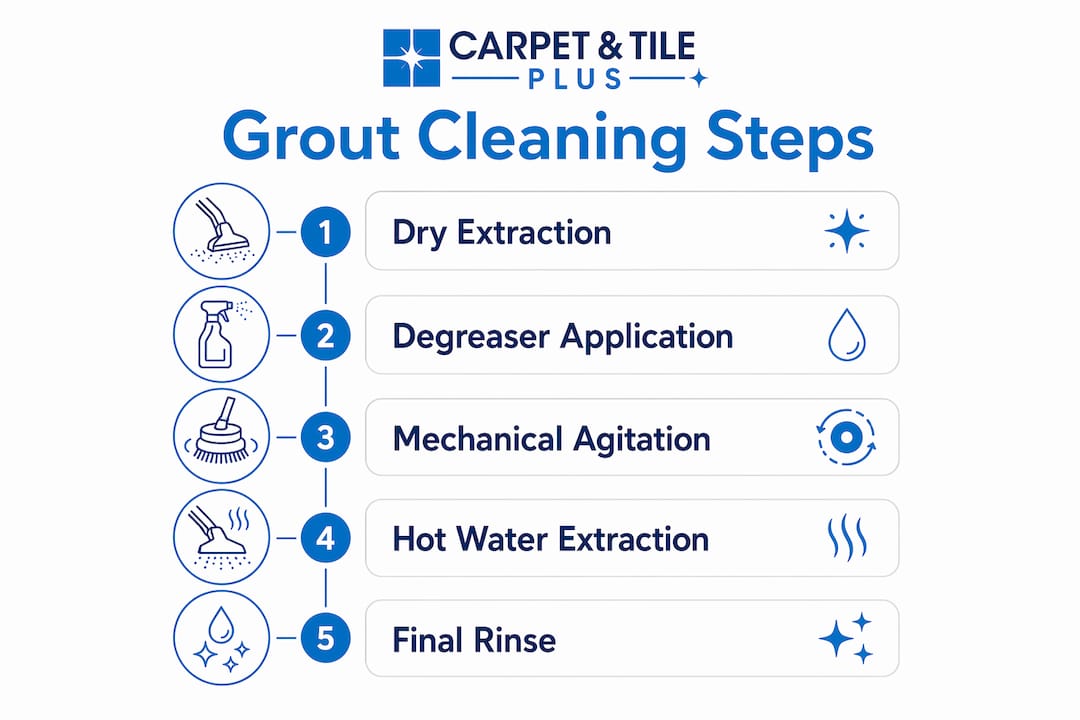
Grout cleaning in a commercial kitchen follows a four-step sequence: dry extraction, chemical application, mechanical agitation, and hot water extraction. Each step builds on the previous one. Skipping any step reduces the result significantly.
Step 1: Dry soil extraction
Run a HEPA vacuum across the entire floor surface. Pay close attention to grout lines, corners, and the areas around cooking equipment where food debris accumulates. This step prevents loose soil from mixing with your cleaning solution and forming a greasy paste that is harder to remove.
Step 2: Apply alkaline degreaser
Apply your alkaline degreaser evenly across the floor, working in manageable sections. Dwell time matters: grout cleaning is primarily a chemical breakdown of grease followed by physical removal, and insufficient dwell time drastically reduces effectiveness. Allow the degreaser to sit for 10–15 minutes. For heavily soiled grout lines, extend the dwell time to 20 minutes.
Step 3: Mechanical agitation
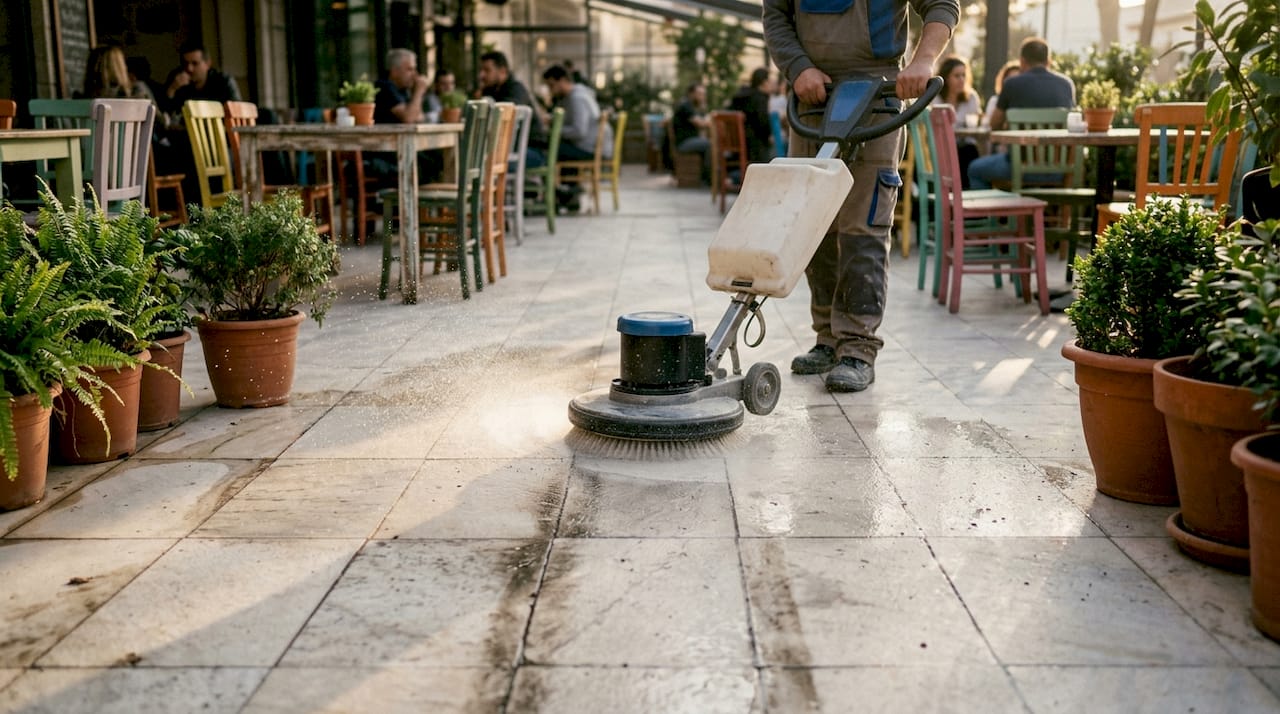
This is the step most kitchen managers underestimate. Routine mopping spreads grease across the surface rather than pulling it out of grout pores. A rotary floor scrubber with counter-rotating stiff brushes reaches deep into those pores and dislodges grease that has been compressing for weeks or months. Work the scrubber in overlapping passes across the floor. Follow immediately with stiff hand brushes along walls, under equipment bases, and in tight corners.
Pro Tip: Do not let the loosened slurry sit. Commercial kitchens generate thick, greasy slurry during agitation. Extract it immediately with a wet-extraction vacuum. If it dries, the grease re-adheres to the grout and your effort is wasted.
Step 4: Hot water extraction
Run the hot water extractor across the floor at approximately 220°F and 1,200 PSI. High-pressure hot water at this temperature kills 99.9% of bacteria and viruses without requiring harsh bleach. This step simultaneously flushes residual grease from grout pores and sanitizes the surface to food-safe standards.
Step 5: Final rinse and inspection
Rinse the entire floor with clean water and extract thoroughly. Residual cleaning solution left on the floor attracts dirt and grease rapidly, undoing your cleaning effort within days. Inspect grout lines under bright light. Any lines that still appear dark or discolored need a second pass with the hand brush and extractor.
Recommended cleaning frequency
| Kitchen Zone | Deep Clean Frequency | Spot Clean Frequency |
|---|---|---|
| Cooking line and fryer area | Weekly | Daily |
| Prep and dishwashing areas | Every 2 weeks | Daily |
| Dining room tile floors | Monthly | Weekly |
| Storage and dry goods areas | Monthly | As needed |
How do you avoid common mistakes in commercial kitchen grout cleaning?
The most damaging mistakes in grout cleaning are also the most common. Understanding them protects your floor investment and keeps your cleaning results lasting longer.
Using acidic cleaners or wire brushes: Over-scrubbing with wire brushes or acidic solutions weakens cement-based grout structure, causing crumbling and permanent damage. Stick to stiff nylon brushes and alkaline or pH-neutral cleaners. Acid-based products are appropriate only for specific tile types like unglazed quarry tile, and only when the manufacturer confirms compatibility.
Skipping the test patch: Always test any new cleaning product on an inconspicuous area before applying it to the full floor. A test patch takes two minutes and can prevent irreversible grout damage across an entire kitchen.
Insufficient dwell time: Spraying degreaser and scrubbing immediately is one of the most common errors. The chemistry needs time to work. Rushing this step means you are scrubbing grease that has not yet been broken down, which is both ineffective and physically harder.
Leaving cleaning residue behind: Dried residues attract dirt and grease faster than bare grout does. Always extract thoroughly and do a final clean-water rinse.
Ignoring high-traffic lines: The grout lines directly in front of the fryer, grill, and prep stations accumulate grease at a much faster rate than the rest of the floor. These lines need more frequent attention and longer dwell times during each cleaning cycle.
Pro Tip: Mark your highest-grease zones with tape during your first deep clean. Use those marks to prioritize agitation time and degreaser concentration in every subsequent session.
What post-cleaning care keeps commercial kitchen grout clean longer?
Cleaning grout thoroughly is only half the job. Grout sealing after cleaning creates a hydrophobic barrier that prevents grease and moisture from penetrating the surface in the first place.
Why sealing matters in a commercial kitchen
Sealing grout is a sanitary necessity, not a cosmetic upgrade. Professional-grade sealers last longer and better protect porous grout from bacteria and stains than consumer products. A properly sealed floor requires less frequent deep cleaning, which reduces labor costs and floor downtime. Sealing also supports compliance with health codes by preventing bacterial growth in grout pores.
How to apply sealant correctly
Grout needs up to a full day to dry after cleaning before sealant application. Applying sealer to damp grout traps moisture inside and reduces the sealer’s effectiveness. Once the grout is fully dry, apply the sealer in thin, even coats using a foam applicator or brush. Wipe excess sealer off tile surfaces immediately to avoid hazy residue.
Daily and weekly maintenance
Consistent daily habits dramatically reduce the frequency of full deep cleans. The tile grout cleaning for high-traffic areas approach combines daily spot cleaning with scheduled mechanical scrubbing.
- Daily: Sweep or vacuum dry debris after each service. Spot clean visible grease spills with a pH-neutral cleaner immediately.
- Weekly: Run a rotary scrubber with a pH-neutral cleaner across the full cooking line and prep areas.
- Monthly: Perform a full deep clean using the four-step process described above.
- Annually: Reapply professional-grade grout sealer after a thorough deep clean.
Key Takeaways
Effective tile grout cleaning in a commercial kitchen requires four sequential steps: dry extraction, alkaline degreaser application with adequate dwell time, mechanical agitation, and hot water extraction at 220°F and 1,200 PSI.
| Point | Details |
|---|---|
| Four-step process is non-negotiable | Dry extraction, degreaser, agitation, and hot water extraction each serve a distinct purpose. |
| Dwell time drives chemical effectiveness | Allow 10–20 minutes for alkaline degreaser to break down grease before scrubbing. |
| Mechanical agitation is required | Rotary scrubbers with stiff nylon brushes reach grease that mops and standard pads cannot. |
| Seal grout after every deep clean | Professional-grade sealers create a hydrophobic barrier that reduces future grease penetration. |
| Residue removal is critical | Extract slurry and rinse thoroughly; dried residue attracts new grease faster than bare grout. |
What I have learned after years of cleaning commercial kitchen grout
Restaurant owners consistently tell me the same thing after their first professional deep clean: they had no idea how much grease was actually in those grout lines. That reaction makes sense. Routine mopping looks like cleaning. The floor looks wet, it smells like cleaner, and the surface appears clear. But grout lines are essentially tiny tunnels running across your floor, and surface-level mopping never reaches inside them.
The single biggest shift I have seen in kitchen hygiene outcomes comes from switching to mechanical agitation with a rotary scrubber. Manual scrubbing with a hand brush is better than nothing, but it is not in the same category as a counter-rotating machine brush working at the right pressure. The difference shows up immediately in the color of the extraction water.
Scheduling is the other factor that separates well-maintained kitchens from struggling ones. Kitchens that build grout cleaning into their weekly and monthly schedules spend far less time on each session because grease never gets the chance to compound. Kitchens that clean reactively, only when the floor looks visibly dirty, face much longer cleaning sessions and more frequent grout repair costs.
My honest recommendation: treat your first deep clean as a reset, then protect that reset with daily spot cleaning, weekly mechanical scrubbing, and a proper seal. That sequence is what makes the difference between a floor that stays clean and one that is always catching up.
— Jim
Carpetandtileplus commercial tile and grout cleaning services
Restaurant and kitchen managers in the Northwest Suburbs of Chicago trust Carpetandtileplus for commercial tile and grout cleaning that goes beyond surface results. Our IICRC-certified technicians use professional-grade rotary scrubbers, hot water extraction equipment, and organic cleaning products to remove embedded grease and restore grout to a hygienic standard.

With over 20 years of experience and hundreds of five-star reviews, Carpetandtileplus serves kitchens in Elgin, Bartlett, Streamwood, Arlington Heights, Palatine, Barrington, and Hanover Park. We deliver a one-hour dry time so your kitchen gets back to service fast. Contact Carpetandtileplus to schedule a professional deep clean and protect your floor investment for the long term.
FAQ
What is the best cleaner for commercial kitchen grout?
An alkaline degreaser is the most effective cleaner for grease-saturated commercial kitchen grout. Follow it with a pH-neutral cleaner for the final rinse to protect grout integrity.
How often should commercial kitchen grout be deep cleaned?
High-grease zones like the cooking line and fryer area need a full deep clean weekly. Prep and dishwashing areas require deep cleaning every two weeks.
Can you clean commercial kitchen grout without a rotary scrubber?
Manual scrubbing with stiff nylon hand brushes is possible but significantly less effective. Rotary scrubbers with stiff brushes penetrate grout pores at a depth and speed that manual tools cannot match.
Does grout need to be sealed after cleaning?
Yes. Sealing grout after cleaning creates a hydrophobic barrier that prevents grease and bacteria from re-entering porous grout. Allow grout to dry fully for up to 24 hours before applying sealant.
What happens if you leave cleaning solution on kitchen grout?
Dried cleaning residue attracts dirt and grease rapidly, reversing your cleaning results within days. Always extract thoroughly and perform a final clean-water rinse after every deep clean session.