
Most professionally cleaned carpets dry within 6–12 hours with hot water extraction under good conditions, or as fast as 20–90 minutes with low-moisture methods. The single highest-leverage action you can take the moment the technician leaves: get air moving. Active airflow, not passive waiting, is what separates a 4-hour dry from a 12-hour one.
Here’s what to do immediately to minimize disruption and reduce carpet drying time:
- Confirm extraction quality before the tech leaves. Ask if they ran adequate dry passes and request a moisture meter reading.
- Switch your HVAC to continuous fan to circulate air through the building.
- Position air movers or box fans low, angled across the carpet surface at roughly 45 degrees.
- Run a dehumidifier if indoor relative humidity is above 60%.
- Keep the space clear of furniture and foot traffic until the backing, not just the surface fibers, tests dry.
Two important benchmarks to keep in mind: the U.S. EPA recommends drying porous materials like carpet and backing within 24–48 hours to limit microbial growth, and the IICRC’s S500 standard reinforces that timeline as the threshold before remediation becomes necessary. Surface fibers dry well before the backing and pad do. That gap is where most furniture-return mistakes happen.
Professional air movers can reduce drying time by roughly 40–60% compared with still air — the single biggest variable you control after the cleaner leaves.
Table of Contents
- How long does carpet take to dry by cleaning method?
- What factors speed up or slow down carpet drying?
- How to dry carpet fast: a step-by-step plan
- Commercial and high-traffic sites: how to cut downtime
- When is it safe to walk on carpet and return furniture?
- Mold risk: the 24–48 hour threshold you need to know
- How Carpetandtileplus minimizes drying time and disruption
- Key Takeaways
- Why drying is the part of carpet cleaning most people underestimate
- Fast-dry carpet cleaning in the Northwest Suburbs of Chicago
- Useful sources
How long does carpet take to dry by cleaning method?
The method your cleaner uses determines your baseline drying window before any equipment or environmental factors come into play.
| Method | Typical Dry Time | Range | Best Use Case |
|---|---|---|---|
| Hot water extraction (steam) typically requires 6–12 hours to dry, depending on conditions. | Residential deep clean, heavy soiling | ||
| Low-moisture / encapsulation methods often dry quickly, typically within 20–90 minutes, depending on conditions. | Same-day commercial, light maintenance | ||
| Bonnet / spin-pad cleaning usually dries within one to a few hours, varying by situation. | Commercial interim cleaning | ||
| Dry compound methods tend to require very short drying periods, generally less than an hour. | Delicate fibers, zero-downtime situations |
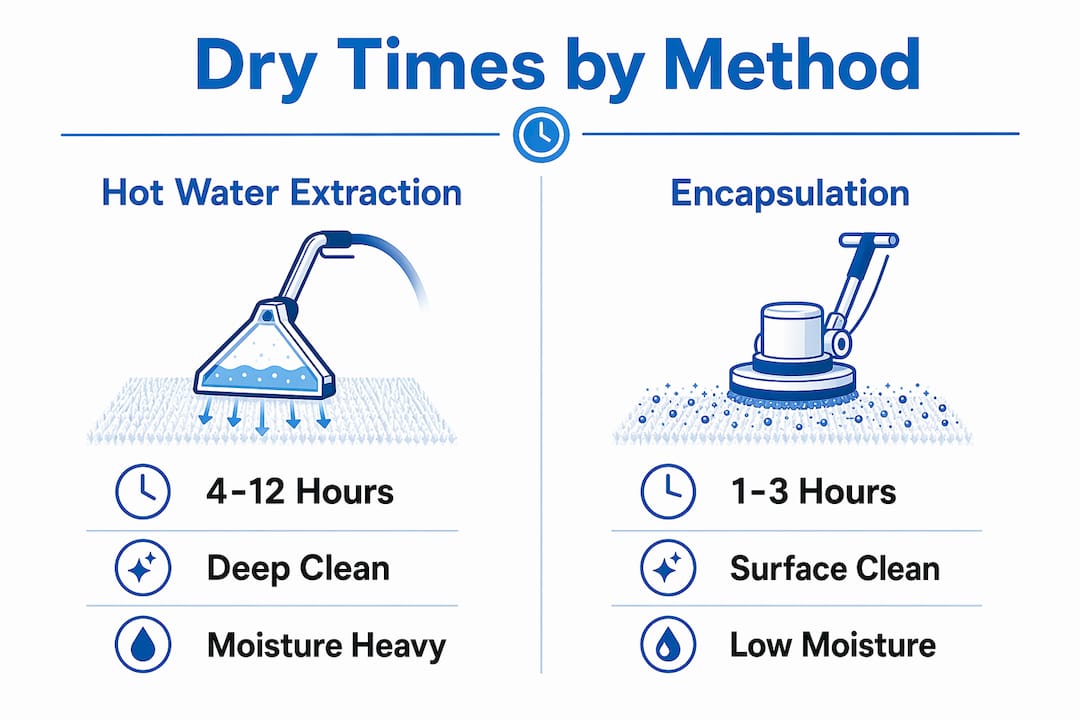
Hot water extraction introduces the most moisture but delivers the deepest clean. Encapsulation methods crystallize soil into dry particles that vacuum out later, which is why they’re the go-to for commercial spaces that can’t close for half a day. Dry compound uses an absorbent powder worked into the pile, then vacuumed out — almost no drying needed, though it doesn’t reach deeply embedded soil.
Equipment quality matters as much as method. A truck-mounted hot water extraction unit pulls significantly more moisture out of the pile than a portable machine, which means a truck-mount job often dries in 6–12 hours while the same room cleaned with a portable unit might need closer to 12. If you’re booking a cleaner and downtime is a concern, ask specifically whether they use truck-mounted equipment.
Speed vs. cleaning depth tradeoffs:
- Hot water extraction: deepest clean, longest dry time
- Encapsulation: fast dry, effective for maintenance cleaning, not ideal for heavily soiled carpet
- Bonnet: quick surface refresh, limited penetration
- Dry compound: near-zero downtime, surface-level clean only
What factors speed up or slow down carpet drying?
Environmental and material conditions can easily double or cut your drying window in half. Knowing which variables you control makes the difference between a 4-hour dry and a 20-hour one.
Environmental variables:
- Relative humidity (RH): Keep indoor RH below 60%. Humidity above 70% or temperatures below 65°F can double drying time. Above 60% RH, surface fibers may feel dry while the backing stays damp.
- Temperature: Warmer air holds more moisture and accelerates evaporation. A room at 72°F dries noticeably faster than one at 62°F.
- Air movement: Still air is the enemy. Even a single air mover pointed across the carpet surface makes a measurable difference.
Carpet and pad characteristics:
- Wool fibers absorb and release moisture more slowly than synthetic nylon or polyester.
- High-pile and dense loop constructions (like Berber) trap moisture deeper and take longer to release it.
- A thick, saturated pad is often the last thing to dry — and the first place mold takes hold if drying stalls.
Building factors:
- Basements and interior rooms without HVAC returns can add 4–8 hours to drying time compared with well-ventilated spaces. For these rooms, direct dehumidification and overnight air movers are standard practice.
- Closed doors and blocked vents prevent moisture-laden air from escaping.
Extraction quality:
Poor extraction is the most underestimated factor. A technician who skips dry passes or uses a weak vacuum leaves significantly more water in the pile. One extra dry pass during cleaning can shave hours off the drying window.
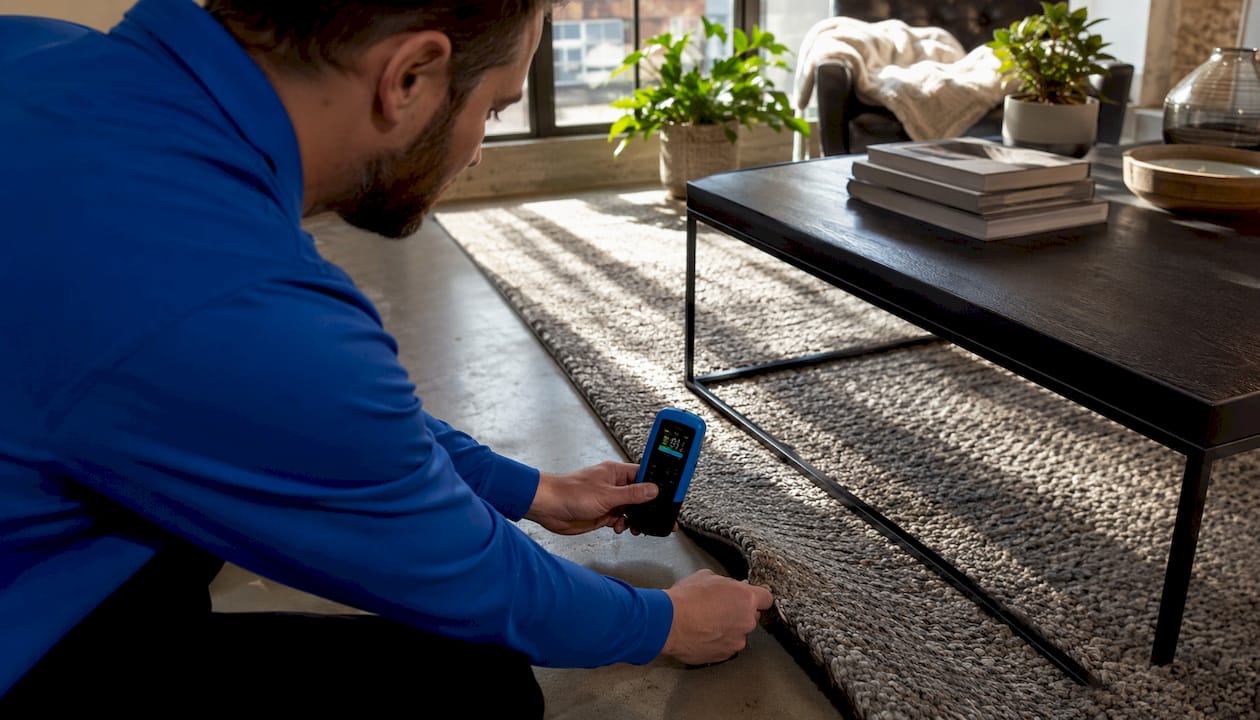
Pro Tip: Buy or borrow an inexpensive humidity meter (hygrometer) before your cleaning appointment. Check the reading when the tech finishes, then again at 2-hour intervals. When RH drops below 50% and the backing passes the towel test (see Section 6), the carpet is genuinely dry — not just surface-dry.
How to dry carpet fast: a step-by-step plan
Start active drying the moment the technician finishes. Passive drying, meaning you close the door and wait, is the single most common reason carpets take 18–24 hours instead of 6.
Step 1: Verify extraction before the tech leaves.
Ask for a moisture meter reading on the carpet backing. A good reading is below 15% moisture content. If the tech doesn’t carry a meter, note it and monitor closely.
Step 2: Switch HVAC to continuous fan.
This keeps air circulating even when the heating or cooling cycle isn’t running. If your air ducts are clean and clear, this step alone can cut dry time by an hour or two.
Step 3: Position air movers.
Place them low, angled at 45 degrees across the carpet surface. Professional axial air movers rated at 1,500–3,000 CFM outperform standard box fans significantly. For a typical residential room, one to two air movers is usually enough. Rent them from a local equipment supplier if your cleaner doesn’t leave them.
Step 4: Run a dehumidifier if RH exceeds 60%.
Low-grain refrigerant (LGR) dehumidifiers pull moisture from the air more efficiently than standard units, especially in cooler rooms. In a basement or during a humid Chicago summer, a standard dehumidifier often can’t keep up — rent an LGR unit if conditions are tough.
Step 5: Check the backing before returning furniture.
Press a clean white towel firmly against the carpet backing for 10 seconds. If it comes away damp, the carpet isn’t ready. Furniture placed on damp carpet wicks moisture up through the pile, causing browning stains and potential finish damage to wood or metal legs.
Step 6: Use floor runners for temporary traffic.
If you need to walk through the area, lay clean cotton or plastic floor runners to protect the pile and prevent re-soiling.
Equipment checklist:
- Air movers: 1,500–3,000 CFM axial units (preferred over box fans)
- Dehumidifier: LGR type for basements or high-humidity conditions; standard refrigerant for typical rooms
- Hygrometer: any basic model works
- Clean white towels: for the backing moisture test
Contingency situations:
- Basement rooms: Add a second dehumidifier and plan for overnight drying. Don’t rely on windows alone.
- Outdoor humidity is high: Keep windows closed. Opening windows only helps when outdoor air is drier than indoor air — check with your hygrometer first.
- Wool or delicate carpet: Use gentler, more diffused airflow rather than pointing a high-velocity mover directly at the pile. High-velocity air can distort wool fibers.
Pro Tip: Ask your cleaner to write the estimated dry time and moisture reading on the work order before they leave. That single step eliminates most post-cleaning disputes and gives you a clear benchmark to check against.
Commercial and high-traffic sites: how to cut downtime
Property managers face a different problem than homeowners. The carpet needs to be clean, but the space also needs to be open. Those two goals require deliberate scheduling and the right method choice.
Scheduling tactics:
- Book cleaning during off-hours: evenings, overnight, or weekends. For a standard office, a commercial carpet cleaning job that starts at 7 PM can be fully dry and ready by 7 AM.
- Always quote the upper end of the drying range to staff and tenants. If the range is 4–8 hours, tell people 8. You’ll look good when it finishes early; you won’t have complaints if it runs long.
- Plan around your traffic patterns. A lobby needs to reopen before a back office does — sequence the cleaning accordingly.
Equipment scale for commercial footprints:
| Area | Air Movers | Dehumidifiers | Expected Dry Time (HWE) |
|---|---|---|---|
| Up to 500 sq ft | 2 | 1 | 4–6 hours |
| 500 sq ft | 3–4 | 1–2 | 5–8 hours |
| — | 5–6 | 2–3 | 6–10 hours |
For daytime commercial work where closure isn’t possible, encapsulation is the practical answer. Dry times of 30–90 minutes mean a section of carpet can be cleaned and reopened within a single break period.
Traffic management during drying:
- Post clear signage at every entry point to the drying area.
- Use temporary matting or plastic runners to create one-way traffic paths around wet zones.
- Send a brief staff notification before cleaning begins. A one-paragraph email stating the cleaning window, affected areas, and expected reopen time prevents most complaints.
Risk mitigation:
In humid climates or during summer months in the Midwest, insist on supplemental dehumidification even for overnight jobs. A humid night with no active drying equipment can undo two hours of good extraction work.
When is it safe to walk on carpet and return furniture?
The surface feeling dry is not the same as the carpet being dry. That distinction matters for both furniture safety and carpet longevity.
| Time After Cleaning | What’s Dry | Safe Activity |
|---|---|---|
| Under 2 hours | Surface fibers only | No foot traffic |
| 2–6 hours | Upper pile (most methods) | Light sock-only traffic if surface feels firm |
| 6–12 hours | Pile and most backing (extraction, good conditions) | Furniture with felt or plastic protective pads |
| 12–24 hours | Full system including pad (most conditions) | Normal use, heavy furniture |
How to check properly:
Press a clean white towel against the carpet backing for 10 seconds. A dry towel means the system is ready. Any dampness means wait. For commercial spaces or high-value residential carpet, a moisture meter reading below 15% is a more reliable standard than the towel test alone.
Warnings:
- Never place furniture with felt pads, wood bases, or metal legs on damp carpet. Moisture wicks upward, leaving rust rings, tannin stains, and finish damage that are difficult or impossible to remove.
- If you notice apparent new spots appearing during drying, wait 48 hours before treating them. Backing swelling during drying can push old stains to the surface; most resolve as the system fully dries. Applying heat to treat a spot during this window can set it permanently.
When to delay further:
High humidity, basement locations, and wool carpets all need extra time. Don’t rush furniture return in any of these situations, even if the surface feels dry.
Mold risk: the 24–48 hour threshold you need to know
Carpet that stays damp beyond 48 hours is a health risk, not just an inconvenience. The U.S. EPA’s mold remediation guidance for schools and commercial buildings lists carpet and backing as materials that must be dried within 24–48 hours to prevent microbial growth. The IICRC S500 standard reinforces this timeline as the threshold where a drying situation becomes a remediation situation.
The U.S. EPA and IICRC both identify 24–48 hours as the critical window for drying carpet and backing to prevent mold amplification.
Humidity above 60–70% accelerates microbial growth even when the carpet feels surface-dry. Mold doesn’t need standing water — it needs moisture content in the material and warm, still air. A basement room with no active drying equipment can hit that threshold faster than most people expect.
Red flags that require professional remediation:
- Musty odor that persists 48 hours after cleaning
- Visible discoloration or staining on the backing or subfloor
- Moisture meter readings that remain elevated after 24 hours of active drying
- Any situation where the carpet was wet before cleaning (flooding, pipe leak) rather than just wet from cleaning
If any of these apply, stop the fans and call a remediation contractor. Spreading air through a moldy space without containment can distribute spores through the building.
Immediate containment steps if you suspect mold:
Close off the affected room, turn off the HVAC to that zone, and contact a certified remediation professional. For odor issues that stem from prolonged dampness rather than active mold, carpet odor removal services can address the problem after the area is confirmed dry.
How Carpetandtileplus minimizes drying time and disruption
Carpetandtileplus approaches drying as an active part of the service, not something that happens after the truck leaves. Every job includes moisture-meter verification at the end of the clean, so you get a documented reading rather than a guess.
What sets the service apart:
- IICRC-certified technicians trained in moisture management and drying protocols
- Organic, residue-free cleaning products that dry faster and reduce re-soiling compared with detergent-heavy formulations
- Air movers and dehumidifiers deployed on-site when conditions require them
- Quick-dry encapsulation options available for commercial clients who need same-day reuse
- Overnight and off-hours scheduling for businesses in the Northwest Suburbs of Chicago
The service area covers Elgin, Bartlett, Streamwood, Arlington Heights, Palatine, Barrington, and Hanover Park. For commercial property managers, Carpetandtileplus provides written dry-time estimates on the work order and can coordinate overnight cleaning windows to eliminate business-hours disruption entirely.
Key Takeaways
Active moisture management — combining air movers, continuous HVAC fan, and a dehumidifier when RH exceeds 60% — is the fastest and most reliable way to reduce carpet drying time and minimize disruption after professional cleaning.
| Point | Details |
|---|---|
| Verify extraction first | Ask for a moisture meter reading before the tech leaves; below 15% moisture content is the target. |
| Start active drying immediately | Run air movers, switch HVAC to continuous fan, and add a dehumidifier if indoor RH exceeds 60%. |
| Don’t rush furniture return | Use the white-towel backing test; damp backing means wait, even if surface fibers feel dry. |
| Schedule off-hours for commercial work | Evening or overnight cleaning with supplemental equipment eliminates business-hours downtime entirely. |
| Carpetandtileplus | Offers IICRC-certified fast-dry cleaning with moisture verification and off-hours scheduling across the Northwest Suburbs of Chicago. |
Why drying is the part of carpet cleaning most people underestimate
Most of the conversation about carpet cleaning focuses on the clean itself: which method, which products, how often. Drying gets treated as the passive aftermath. That’s exactly backwards.
A carpet that’s cleaned well but dried poorly ends up smelling musty, re-soiling faster, and potentially harboring microbial growth in the backing where you can’t see it. The clean is undone by the drying failure. What I find most interesting about the 24–48 hour EPA threshold is that it applies to routine professional cleaning, not just flood scenarios. Every hot water extraction job introduces enough moisture to hit that window if conditions are bad and no active drying equipment is running.
The other thing most guides miss: the backing and pad dry last, not first. Homeowners press their hand to the carpet surface, feel dry fibers, and put the couch back. Three days later there’s a rust ring from the leg and a faint musty smell from the pad. The white-towel test on the backing is a 10-second check that prevents an expensive mistake.
For commercial managers, the calculus is slightly different. The question isn’t just “is it dry?” but “can I prove it was dried correctly?” A written moisture reading on the work order is your documentation if a tenant later claims the cleaning caused a mold problem. That piece of paper is worth more than any verbal assurance.
Fast-dry carpet cleaning in the Northwest Suburbs of Chicago
If you’re done reading about drying times and ready to book a clean that actually minimizes disruption, Carpetandtileplus is the practical choice for homeowners and property managers across the Northwest Suburbs.

The service is built around fast-dry results: IICRC-certified technicians, organic residue-free products that cut re-soiling, and a typical 20–90 minute dry time for quick-dry methods. For commercial accounts, off-hours and overnight scheduling means your space is clean and dry before the workday starts. Air movers and dehumidifiers are part of the job when conditions call for them, not an add-on you have to request.
Book residential carpet cleaning or commercial carpet cleaning directly through the site. Request your preferred scheduling window, mention any humidity or basement concerns, and Carpetandtileplus will confirm a written dry-time estimate with your booking.
Useful sources
| Source | What It Supports |
|---|---|
| U.S. EPA — Mold Remediation in Schools and Commercial Buildings, Chapter 4 | 24–48 hour drying threshold for carpet and backing; dehumidifier and fan guidance |
| U.S. EPA — A Brief Guide to Mold, Moisture, and Your Home | Mold prevention timeline; moisture management for porous materials |
| IICRC Tip Sheet — Carpet Topics | IICRC S500 moisture thresholds; wicking and spot reappearance guidance |
| Carpet Cleaning Authority — Drying Time Guide | Air mover effectiveness; 40–60% drying time reduction with professional equipment |
| National Carpet Cleaning Authority — Drying Times | Method-by-method drying ranges (HWE 6–12 hours; low-moisture 20–90 minutes) |
| Carpet Cleaning Digital — Pro Operator Guide | Humidity and temperature multipliers; HVAC room configurations; LGR dehumidifier guidance |
| JAN-PRO — How to Dry a Carpet Fast | Window ventilation guidance; when outdoor humidity makes opening windows counterproductive |