Air duct cleaning is not inherently a scam, but the industry attracts more deceptive operators than almost any other home service category. The EPA’s guidance is blunt: routine cleaning is not recommended, and companies claiming EPA certification are misrepresenting themselves, because no such certification exists. The moment you see that claim, stop the conversation.
Here is the short version of what you need to know:
- Legitimate cleaning exists when specific conditions are met: visible mold inside hard ducts, a vermin infestation, or ducts clogged with substantial debris.
- Most scams start with a price that sounds too good to be true, typically a whole-house special under $100, which is a bait-and-switch setup.
- NADCA membership is the closest thing to a meaningful credential in this industry. Ask for it before you book.
- Realistic pricing for a properly scoped job runs $450–$1,000 depending on system size and contamination level.
- Your one immediate action: if a company contacts you by door-to-door visit or a social media ad offering a suspiciously low price, do not let them in until you have verified their NADCA membership, confirmed they carry liability insurance, and received a written scope of work.
Carpetandtileplus, which serves homeowners across the Northwest Suburbs of Chicago, follows NADCA source-removal standards and carries IICRC certification. That combination is the baseline you should expect from any contractor you hire.
Key Takeaways
Duct cleaning is only worth doing when EPA-defined conditions are met, and the single most effective protection against fraud is demanding a written scope and NADCA-verified credentials before any work begins.
| Point | Details |
|---|---|
| Cleaning is conditional | Only consider it for visible mold, vermin, heavy debris, or post-damage situations per EPA guidance. |
| Realistic price range | A properly scoped whole-system job typically costs $450–$1,000; anything under $100 is a bait-and-switch setup. |
| NADCA membership matters | Verify the contractor’s NADCA membership directly on nadca.com before booking. |
| Written scope is non-negotiable | Demand a written scope, itemized invoice, and before-and-after documentation before you pay. |
| Prevention beats reactive cleaning | Regular MERV-rated filter changes and duct sealing reduce contamination and lower your need for cleaning. |
Table of Contents
- When does your HVAC system actually need cleaning?
- How air duct cleaning scams work and the red flags to watch for
- What a legitimate HVAC cleaning should actually include
- How much should a legitimate duct cleaning cost?
- How to vet and hire a trustworthy duct cleaner
- What can go wrong and how to protect yourself
- What you can do instead of or before hiring a cleaner
- How Carpetandtileplus approaches duct cleaning in the Chicago suburbs
- The part most duct cleaning advice gets wrong
- Sources
When does your HVAC system actually need cleaning?
Most homes do not need duct cleaning on any fixed schedule. The EPA recommends considering it only when one of these specific conditions applies:
- Visible substantial mold growing inside hard-surface ducts or on other HVAC components. Flexible or fiberglass-lined ducts with mold typically need replacement, not cleaning.
- Vermin infestation confirmed inside the ductwork, not just in the attic or crawl space.
- Ducts clogged with large amounts of dust and debris that are visibly restricting airflow.
- Post-fire or water damage where smoke residue or moisture has contaminated the system.
- Recent major renovation that generated heavy construction dust before the system was sealed off.
NADCA adds that the correct focus is the entire HVAC system, not just the visible registers. If a contractor only wants to clean the vents you can see, that is not a proper job.
For mold claims specifically, ask for photographic or video evidence from inside the duct, or request a lab test from an independent industrial hygienist before authorizing any work. A contractor who resists showing you the evidence is manufacturing urgency, not solving a real problem.
Pro Tip: Before calling anyone, remove one of your supply registers and shine a flashlight inside. If you see a light coating of dust, that is normal. If you see thick debris, dark staining, or anything that looks like mold growth, photograph it and use that as the baseline when talking to contractors.
How air duct cleaning scams work and the red flags to watch for
The scam playbook is remarkably consistent. Knowing how it unfolds is the best protection you have.
The most common fraud types:
- Blow-and-go: The crew shows up, runs a shop vac over a few registers, and leaves in under an hour. Nothing inside the system gets touched.
- Bait-and-switch pricing: A $49 or $79 whole-house special gets you in the door. Once the technician is inside, the price balloons to $500 or more through invented problems and add-ons.
- Fake mold scares: The technician points a flashlight at normal dust and tells you it is mold. You need a $300 chemical treatment today, or your family is at risk.
- Chemical fogging upsells: Sanitizers and sealants are presented as standard procedure. They are not. NADCA is explicit that biocides and sealants are only appropriate after mechanical source removal and only on nonporous surfaces.
- Door-to-door and social media pressure: BBB data and local reporting show that Nextdoor and Facebook ads are now the primary vector for low-price scam offers, with homeowners frequently reporting price inflation once the technician is inside.
Red flags to memorize:
- No written scope of work before the job starts
- Demand for cash or full payment upfront
- Claim of “EPA certification” (no such certification exists)
- NADCA logo on the truck but no verifiable membership number
- Pressure to decide immediately or “lose the deal”
- Refusal to show you photographic evidence of any contamination they claim to have found
“We found mold in your ducts — it’s a health emergency. We can treat it today for $800, but we need your decision right now.” That sentence, in any variation, is a script. A real contractor documents the finding, gives you a written estimate, and lets you verify the claim independently before you spend a dollar.
What a legitimate HVAC cleaning should actually include
A proper job is labor-intensive and takes several hours. If a crew is done in 45 minutes, they did not clean your system.
NADCA’s source-removal standard defines what a complete cleaning covers:
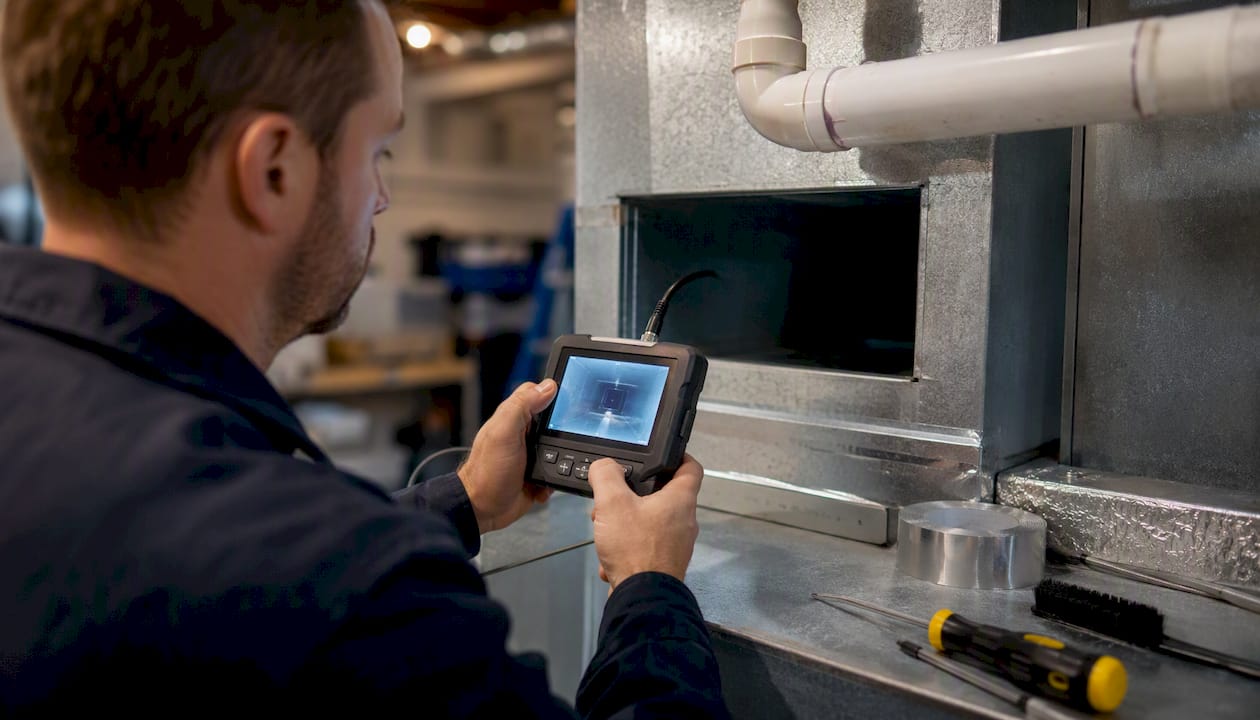
- Pre-inspection with a camera or high-definition video run through inaccessible duct sections, not just a flashlight check at the register.
- Access point creation to reach all duct sections, including supply and return plenums.
- Agitation using brushes, air whips, or skipper balls to dislodge debris from duct walls.
- Continuous negative-pressure vacuuming with a truck-mount or commercial HEPA vacuum to capture dislodged material rather than push it deeper into the system.
- Air handler components: coils, drain pans, blower assembly, and registers are all part of the job.
- Cleanup and containment so debris does not end up in your living space.
- Post-cleaning inspection with before-and-after photos or video of the same duct sections.
An EPA pilot study found that mechanical cleaning methods did remove particulate and fibrous contamination from duct surfaces, though effects on airborne air quality were inconclusive in that study’s short monitoring window. That is an honest summary of what cleaning can and cannot promise: cleaner surfaces, with realistic rather than guaranteed airborne improvements.
What chemical treatments should look like:
- Biocides and sanitizers are not routine add-ons.
- They are only appropriate after mechanical cleaning is complete.
- They should only be applied to nonporous duct surfaces, never to flexible or fiberglass-lined ducts.
- Any product used must be EPA-registered and applied per label directions.
If a contractor leads with a chemical treatment before doing any mechanical work, that is a red flag, not a service upgrade.
Pro Tip: Ask the contractor to show you a before-and-after video of the same duct section. Any company using proper camera equipment can produce this in under five minutes. If they cannot, the inspection was not thorough.
How much should a legitimate duct cleaning cost?
Expect to pay $450–$1,000 for a properly scoped whole-system cleaning on an average home. That range reflects real labor, commercial-grade equipment, and the time required to do the job correctly.
What drives the price up or down:
- System size: more square footage and more zones mean more access points and more time.
- Contamination level: heavy debris, mold remediation, or post-renovation cleanup adds scope.
- Access difficulty: finished basements, crawl spaces, and complex duct layouts take longer.
- Add-ons: dryer vent cleaning is a legitimate and commonly bundled service; chemical treatments are not.
Pricing patterns that should concern you:
- A whole-house special under $100. Industry analysis is consistent: companies advertising sub-$100 jobs rely on upsells and bait-and-switch to make money. The advertised price covers almost nothing.
- Per-register pricing with no cap. At $25–$35 per register, a 20-register home hits $500–$700 before any other components are included. Get a total price in writing.
- Verbal quotes only. If the contractor will not put the scope and price in writing before starting, walk away.
Statistic to keep in mind: BBB-reported complaints about duct cleaning scams consistently cite price inflation after the technician enters the home as the most common complaint pattern. The advertised price and the final invoice rarely match when a scam is involved.
How to vet and hire a trustworthy duct cleaner
Follow this sequence before you book anyone.
- Get at least three written estimates. EPA and NADCA both support comparing multiple scopes. An estimate that is dramatically lower than the others is not a deal; it is a warning.
- Verify NADCA membership. Go to NADCA’s website directly and search the contractor by name or zip code. Do not accept a logo on a truck as proof.
- Confirm liability insurance. Ask for a certificate of insurance naming your address. A contractor who hesitates to provide this is not properly insured.
- Check the local business license where your state or municipality requires one for HVAC contractors.
- Look up their BBB profile and Google reviews. A pattern of complaints about price inflation or incomplete work is more informative than a handful of five-star reviews.
- Ask these specific questions before booking:
- What equipment do you use? (Correct answer: truck-mount or commercial HEPA vacuum with agitation tools.)
- Does the price include the air handler, coils, and blower assembly? (It should.)
- Will you provide before-and-after video or photos? (Yes is the only acceptable answer.)
- Are chemical treatments included, and are they EPA-registered? (They should not be automatic; ask what triggers their recommendation.)
Documentation to demand before you pay:
- Written scope of work signed before the job starts
- Itemized invoice listing every component cleaned
- Before-and-after photos or video of inaccessible duct sections
- Proof of NADCA membership and insurance
Pro Tip: Use NADCA’s online contractor locator at nadca.com to find verified members in your area. Cross-reference any contractor you find there against the BBB and your state’s contractor license lookup tool. That three-step check takes about ten minutes and eliminates most bad actors.
The EPA also recommends asking providers to show you the contamination they claim exists before authorizing any work. That single step stops most scams cold. You can also use the air duct cleaning checklist from Carpetandtileplus to document what was promised and what was delivered.
What can go wrong and how to protect yourself
A bad cleaning job is not just a waste of money. It can actively make things worse.
Real risks from poor or fraudulent cleaning:
- Disturbed contaminants: aggressive blowing without proper negative pressure can push debris into living spaces instead of capturing it.
- System damage: improper tools or techniques can puncture flexible ductwork or damage coils.
- Inappropriate chemical exposure: unlabeled or misapplied biocides in the duct system can circulate through your home’s air.
- Voided equipment warranty: some HVAC manufacturers specify that unauthorized cleaning methods void the warranty on components.
- Financial loss: bait-and-switch upsells can turn a $79 advertised job into a $1,200 invoice.
Before the job:
- Confirm the written scope matches what was discussed on the phone.
- Stay home for the entire job. A contractor who prefers you to leave is a red flag.
- Photograph your registers, visible duct sections, and HVAC components before work begins.
During the job:
- Watch for proper equipment setup: the vacuum should be running before any agitation starts.
- Note whether the crew is actually accessing the air handler and coils, not just the registers.
- Ask to see the camera footage before they leave.
After the job:
- Withhold final payment until you have reviewed the before-and-after documentation.
- Confirm the invoice matches the written scope exactly.
If something goes wrong:
- Document everything: photos, the original written scope, the final invoice, and any verbal claims made during the job.
- File a complaint with your state’s contractor licensing board.
- Report to the BBB at bbb.org.
- Contact your state attorney general’s consumer protection office if the amount is significant.
- Dispute the charge with your credit card company if you paid by card and the service was materially different from what was promised.
What you can do instead of or before hiring a cleaner
Many of the conditions that make duct cleaning feel necessary are preventable with basic maintenance.
Preventive steps that actually reduce contamination:
- Change your HVAC filter on schedule. A MERV 8 filter catches most household dust and allergens; MERV 11–13 handles finer particles without restricting airflow on most residential systems. A clogged filter pushes debris into the duct system.
- Clean supply and return registers with a damp cloth every few months.
- Seal visible duct leaks with mastic sealant or metal tape. Leaky ducts pull in attic and crawl-space air, which is often far dirtier than indoor air.
- Run a HEPA air purifier in high-traffic rooms. Consumer Reports notes that standalone air filtration is one of the more reliable ways to reduce airborne particulates when duct cleaning is not warranted.
- Control indoor humidity to stay below 50%. Moisture is the primary driver of mold growth in ductwork.
When remediation, not cleaning, is the right call:
- Wet or water-damaged fiberglass duct liner cannot be effectively cleaned. It needs to be replaced.
- Duct leaks that are pulling in contaminated air need sealing before any cleaning makes sense.
- Persistent mold that returns after cleaning usually signals a humidity or moisture problem that cleaning alone will not fix.
When a test makes sense before you hire anyone:
If you suspect mold but cannot see it, an independent industrial hygienist can take an air or surface sample for a few hundred dollars. That result tells you whether a problem actually exists before you spend $600–$1,000 on cleaning, and it removes the contractor’s ability to manufacture urgency.
Pro Tip: Upgrading to a MERV 11 filter and sealing accessible duct joints with mastic costs under $50 and can meaningfully reduce the rate at which debris accumulates in your system. That is a better first step than scheduling a cleaning you may not need.
How Carpetandtileplus approaches duct cleaning in the Chicago suburbs
Carpetandtileplus serves homeowners across Elgin, Bartlett, Streamwood, Arlington Heights, Palatine, Barrington, and Hanover Park. The process follows NADCA source-removal standards from the first call to the final invoice.
What the process looks like in practice:
- Pre-inspection with camera documentation of inaccessible duct sections before any work begins.
- Full system source removal: supply and return ducts, air handler, coils, drain pans, blower assembly, and registers.
- Continuous negative-pressure vacuuming using commercial-grade equipment, with agitation tools to dislodge debris from duct walls.
- Before-and-after time-stamped video of the same duct sections so you can see exactly what changed.
- Written scope and itemized invoice provided before payment.
Credentials and proof signals:
- IICRC-certified technicians, the same certification standard that governs professional carpet and water damage restoration.
- Organic cleaning products where treatments are appropriate, with no unlabeled chemical add-ons.
- Hundreds of verified five-star reviews from homeowners across the Northwest Suburbs.
- Local, family-owned business with over 20 years of operating history in the same service area. Local accountability is not a marketing phrase; it means the owner’s reputation is tied to every job.
The EPA’s newer IAQ guidance now explicitly recognizes the benefits of documented source removal, which is the approach Carpetandtileplus has followed throughout its operating history. That shift in guidance helps separate contractors who do the work correctly from those who use the “is it even worth it?” debate as cover for a low-effort job.
Pro Tip: Ask any contractor you interview to show you a sample of their before-and-after documentation from a recent job. A reputable company has this on file. If they cannot produce an example, they are not doing camera inspections, which means you have no way to verify the work was done.
For a full breakdown of the process, see Carpetandtileplus’s HVAC duct cleaning guide or book a service through the air duct cleaning page.
The part most duct cleaning advice gets wrong
Most consumer guides on this topic treat the question as binary: either cleaning is a scam or it is not. That framing misses the actual problem.
The real issue is that a legitimate service exists, it is occasionally worth doing, and the industry has almost no barrier to entry. Anyone can buy a shop vac, print a flyer, and call themselves a duct cleaner. That gap between what the service should be and what most low-price operators actually deliver is where homeowners get hurt.
The conventional advice to “just check reviews” is not enough. Scam operators accumulate five-star reviews the same way legitimate ones do, especially when the homeowner has no way to verify whether the work inside the ducts was actually done. Before-and-after video documentation is the only check that closes that gap, and most guides do not mention it.
What I think homeowners underestimate is the value of the EPA’s specific trigger list. It is not a formality. If none of those conditions apply to your home, you almost certainly do not need cleaning right now, and the best thing you can do is hang up on the next low-price offer you receive. The peer-reviewed evidence for routine cleaning improving air quality is limited and mixed. That does not mean cleaning is useless; it means the bar for justifying it should be higher than a $49 social media ad.
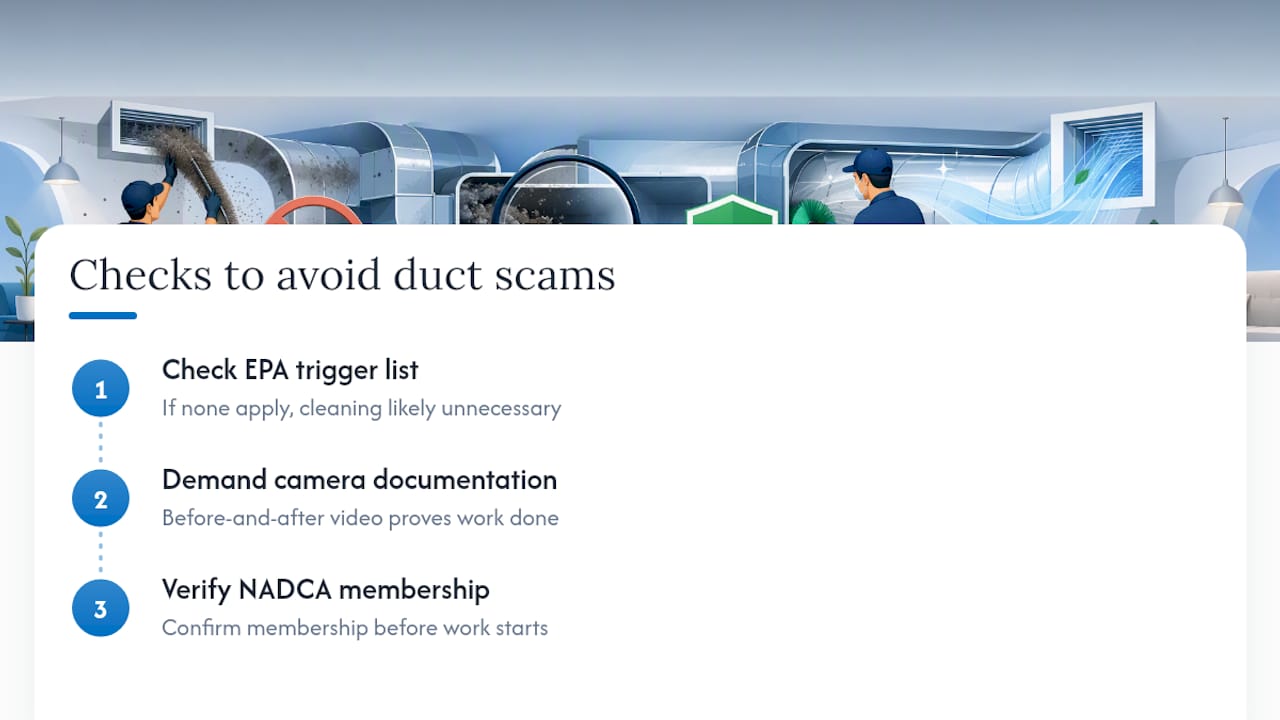
The homeowners who get scammed are not naive. They are people who wanted to do something good for their family’s health and ran into a contractor who knew exactly how to exploit that. The protection is not skepticism about cleaning in general. It is knowing the EPA’s specific criteria, demanding camera documentation, and verifying NADCA membership before anyone touches your system. Those three steps, done in that order, stop most fraud before it starts.
This article is general information, not a substitute for advice from a qualified financial advisor. Consult a qualified financial professional about your own circumstances before acting on anything here.
Sources
These are the primary sources worth reading before you hire anyone or make a decision about your system.
- Should You Have the Air Ducts in Your Home Cleaned? | US EPA
- Proper Cleaning Methods | National Air Duct Cleaners Association (NADCA)
- EPA pilot field study on air duct cleaning effectiveness (NEPIS)
- How to spot air duct cleaning scams before you get ripped off by ‘dirty’ companies
- PubMed: study of air duct cleaning effectiveness
On the research: Peer-reviewed literature on duct cleaning consistently shows that surface contamination is reduced by proper mechanical cleaning, but airborne IAQ improvements are not guaranteed. That is the honest answer, and any contractor who promises dramatic health benefits from cleaning alone is overstating what the evidence supports.