
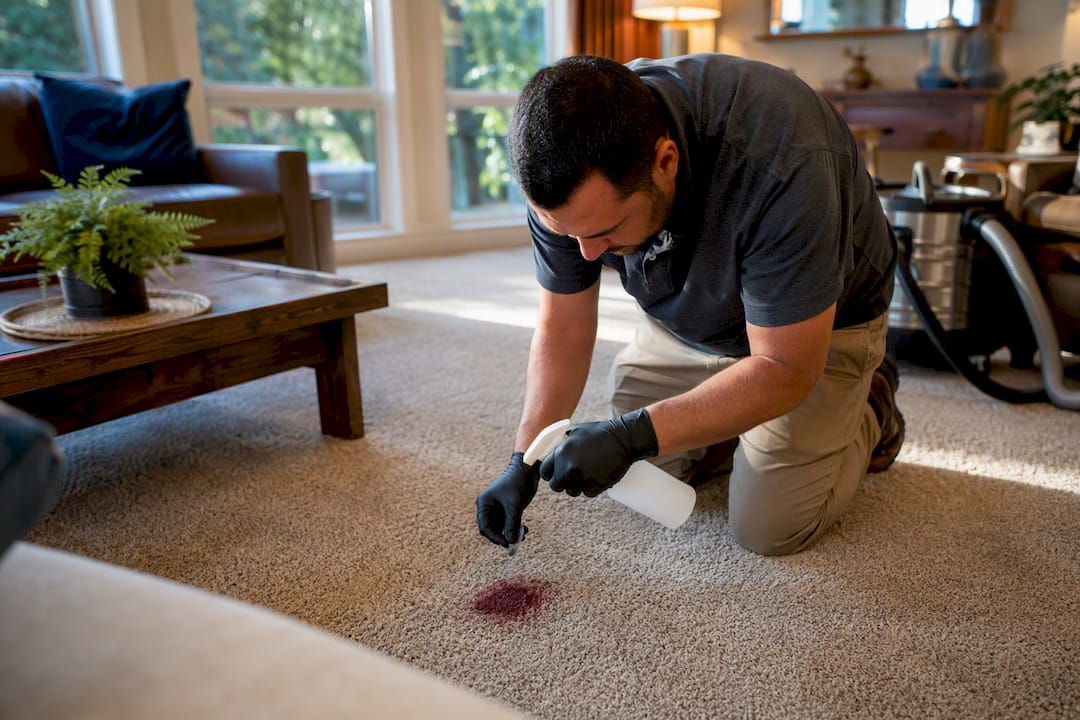
Blot immediately, dilute with cold club soda or plain cold water, then spot-treat. Don’t rub, and never touch the spot with hot water. Tannins, the pigment compounds that give red wine its color, set permanently when heat or friction pushes them deeper into carpet fibers instead of lifting them out.
Here’s the order that actually matters:
- Blot from the outside in with a clean white cloth or paper towels, pressing straight down rather than wiping.
- Pour on cold club soda or cold water, enough to saturate the spot, then blot again.
- Apply one spot treatment (covered below) only after the first two steps, and only if color remains.
If the wine has soaked through to the pad or backing, or the spill covers more than a dinner-plate-sized area, stop the home treatment and call a professional before it wicks back up later.
Key Takeaways
Acting within the first hour and blotting instead of scrubbing determine whether a red wine stain lifts completely or leaves a lasting mark.
| Point | Details |
|---|---|
| Speed decides the outcome | Spills treated within the first hour are far easier to remove than stains left overnight. |
| Blot, never rub | Pressing and lifting keeps pigment from driving deeper into carpet fibers. |
| Match the method to the fiber | Club soda and vinegar are safe on most carpets; patch-test hydrogen peroxide first, especially on wool or silk. |
| Watch for wicking | A stain that fades and later reappears usually means wine soaked into the pad. |
| Call a pro for deep or old stains | Carpetandtileplus uses IICRC-certified technicians and organic products with a one-hour dry time for spills that outlast home remedies. |
Table of Contents
- How to Get Red Wine Out of Carpet in the First 15 Minutes
- What Household Products Actually Remove Red Wine Stains?
- Is It Safe to Treat Wine Stains on Wool or Silk Carpet?
- When Should You Call a Professional Carpet Cleaner?
- Why Do Wine Stains Reappear After Cleaning?
- The Truth About DIY Wine Stain Removal
- Get Help When a Wine Stain Outlasts Your Patience
- Sources
How to Get Red Wine Out of Carpet in the First 15 Minutes
What you do in the first quarter hour decides whether this stain becomes a five-minute fix or a permanent shadow on your carpet. Speed matters more than any specific product you use.
Grab these before you touch the spill: white microfiber cloths or plain paper towels (colored cloths can transfer dye), cold water, a bottle of club soda, and a wet/dry vacuum if you own one. Skip anything tinted or textured. A patterned dish towel can bleed its own color into the stain and confuse what you’re actually treating.
Blot using a press-and-lift motion, never a side-to-side scrub. Start at the outer edge of the stain and work inward, so you’re squeezing wine toward the center instead of spreading it outward into clean fiber. Rotate to a fresh section of cloth every few presses. A stain-soaked cloth just redeposits pigment the moment you press it back down.
- Use a wet/dry shop vacuum on the wet stain if the spill is large enough to warrant it. It pulls liquid out of the pile and pad before it has a chance to spread.
- Never apply heat. No hair dryer, no hot water rinse, no steam. Heat cooks the tannins into the fibers, and that’s how a treatable stain becomes a permanent one.
- If you can’t finish the job right away, mist the spot lightly with cold water and lay a dry towel over it. That slows drying and keeps the stain workable until you get back to it.
Pro Tip: Keep a small stack of white microfiber cloths and a can of club soda in a kitchen drawer. Reacting in the first two minutes matters more than any product you use after that.
What Household Products Actually Remove Red Wine Stains?
Blotting rather than scrubbing is the single most important mechanical step in any home remedy. Scrubbing frays carpet fibers and drives pigment deeper, which is exactly the opposite of what you want. Once you’ve blotted and diluted, these five kitchen staples handle most of what’s left.
- Club soda. Pour a modest amount directly onto the stain and blot immediately. The carbonation helps lift and dilute the wine pigment rather than pushing it deeper. Repeat two or three times before moving to a stronger method.
- Salt or baking soda. These only work on a spill that’s still wet. Pour a generous layer over the stain, let it absorb liquid for 10 to 15 minutes, then vacuum it up once dry.
- Vinegar and dish soap. Mix 1 tablespoon of white vinegar and 1 tablespoon of dish soap into 2 cups of cool water. Spray it onto the stain, blot, then rinse with a damp cloth.
- Hydrogen peroxide and dish soap. Mix 2 parts 3% hydrogen peroxide with 1 part dish soap. Apply, let it sit for 15 to 25 minutes, then blot and rinse. This combination oxidizes leftover tannins, but it carries real bleaching risk on colored or natural-fiber carpet, so patch-test first every time.
Fresh spills treated promptly are more likely to lift completely than stains left overnight, which often need an oxidizer dwell period or professional extraction to fully clear. If you’ve cycled through two home methods and the stain hasn’t faded at all, stop. Repeated scrubbing at that point does more damage than the wine ever would.
Is It Safe to Treat Wine Stains on Wool or Silk Carpet?
Wool and silk carpets play by different rules, and the standard household fixes above can backfire badly on them. Natural fibers absorb dye more readily than synthetic ones, and oxidizers like hydrogen peroxide can strip color from wool just as easily as they lift wine pigment.
- Pick a hidden spot, like under a piece of furniture, and apply one drop of your chosen solution.
- Wait 10 minutes, then blot and check closely for any color change or texture shift before treating the visible stain.
- If you notice fading, bleeding, or a change in fiber texture during the test, do not proceed with that product anywhere else on the carpet.
- On wool, antique, or hand-knotted carpet, treat any uncertainty as a stop sign. Specialized wool cleaning uses gentler chemistry built for exactly this fiber sensitivity, and it’s worth the call before you risk a $2,000 rug over a $20 bottle of wine.
When Should You Call a Professional Carpet Cleaner?
Some stains are simply past the point where a kitchen remedy will finish the job. If the pad underneath feels damp when you press on it, if the spill covers a wide area, if more than 24 hours have passed, or if a faint pink “ghost” remains after your best DIY effort, it’s time to hand it off.
Wine that reaches the carpet backing or pad can wick back up to the surface days later even after the visible stain seems gone, which is why professionals treat deep spills differently than surface ones. A typical professional sequence looks like this:
- Assess how far the wine penetrated and whether the pad is affected.
- Apply an alkaline pre-spray to loosen the tannin bond in the fibers.
- Use a controlled oxidizer dwell time when residual color remains.
- Run hot-water extraction with truck-mounted equipment to pull the stain and cleaning solution out completely.
- Apply an acid rinse to neutralize pH and stop the stain from reappearing later.
- Dry the area quickly and thoroughly to prevent wicking, a step Carpetandtileplus backs with an average one-hour dry time.
Pro Tip: If you’re not sure whether a spill has reached the pad, press firmly on the stain with a dry white towel and check for dampness. Any moisture transfer means it’s gone deeper than a surface treatment can fix.
Carpetandtileplus technicians are IICRC-certified and use organic cleaning products, which matters if you’ve got kids or pets crawling across the same spot an hour later.
Why Do Wine Stains Reappear After Cleaning?
A stain that fades, then reappears a day or two later, is usually wicking. Wine trapped in the pad slowly migrates back up through the fibers as the carpet dries, leaving a faint pink shadow where the stain used to be.
- Press a dry towel over the spot and check for moisture underneath, or peer at the carpet backing if you can lift a corner.
- Try a slow, gentle re-extraction with a wet/dry vacuum before reaching for more chemicals.
- A light oxidizer application can work on pale, synthetic carpet, but stop the moment you see any color loss in the surrounding fibers.
- Repeated ghosting after two or three attempts usually means the dye has set permanently, and only spot dyeing or professional-grade extraction will fully resolve it.
The Truth About DIY Wine Stain Removal
Most advice on this topic treats every red wine spill the same, and that’s the biggest mistake homeowners make. A splash on synthetic berber carpet caught in the first two minutes is a completely different problem than the same splash soaked into a wool area rug overnight. Conventional wisdom skips straight to “here are five products,” when the real skill is knowing which of those five to skip.
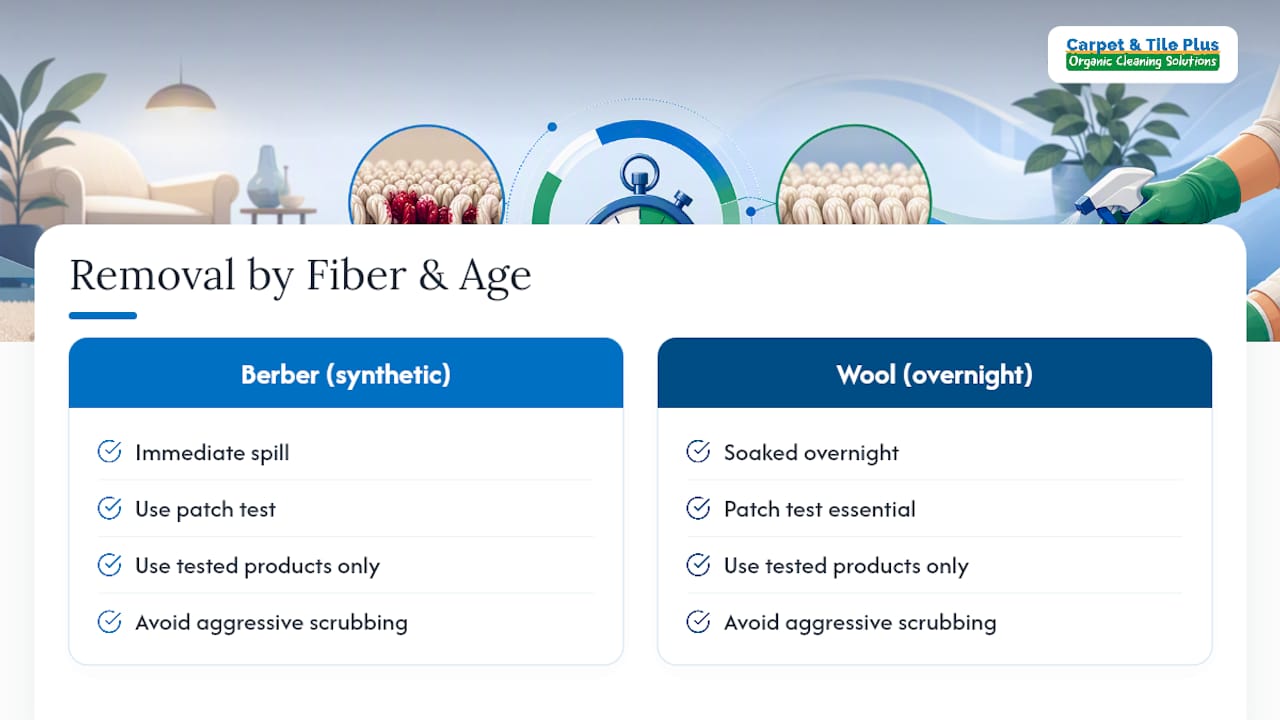
I’d argue the patch test is the single most underused step in this entire process. People treat it as optional friction before the “real” cleaning, when it’s actually the step that prevents an $80 mistake from becoming a $2,000 one on delicate fiber.
The other overlooked piece is timing your surrender. Homeowners often cycle through three or four home remedies on a stain that stopped responding after the first one, and each extra round of scrubbing does more damage than the wine itself. Two honest attempts, then a professional call, beats stubbornness every time.
— Jim
Get Help When a Wine Stain Outlasts Your Patience
Club soda and a clean cloth handle most fresh spills, but not every stain plays fair. Once wine reaches the pad, sets past 24 hours, or shows up on a wool rug you’re afraid to touch with peroxide, you need equipment and chemistry that a kitchen cabinet can’t provide.

Carpetandtileplus brings truck-mounted hot-water extraction, IICRC-certified technicians, and organic cleaning products to homes across Chicago’s Northwest Suburbs, including Elgin, Bartlett, Streamwood, Arlington Heights, Palatine, Barrington, and Hanover Park. That combination matters most on the exact stains this guide warns you about: deep-set tannins, wicking from the pad, and delicate fibers that punish trial and error. Our one-hour dry time also means you’re not living around wet carpet for a full day while you wait for a set-in stain to lift.
If your wine spill has moved past what blotting and club soda can fix, book a residential carpet cleaning and let a certified technician finish the job right the first time.
Sources
- Carpet and Rug Institute — Carpet stains 4-1-1: Best practices for removing stains
- IICRC — Tip Sheet: Carpet Topics (Wine stain guidance)
- The Spruce — Remove red wine stains on carpet
- CarpetCleaningDigital — Red wine stain removal (professional guide)