
A dusty return vent is normal, and you can clean the grille in about ten minutes: turn the system off, unscrew the cover, wash it, vacuum the opening and put it back. What matters is what the dust tells you. Gray fluff on the grille is routine. Black dust that keeps coming back, dust blowing out of your supply vents, or a musty smell means the problem is deeper than the cover, and that is when a professional duct inspection and cleaning is worth booking. We clean air ducts for homes and businesses across the Northwest Suburbs, from Arlington Heights to Elgin, and this guide covers both halves: the grille you can do yourself and the ductwork behind it.
What are the key takeaways about air return vent cleaning?
- Return vents collect dust because they pull room air through the grate. The US EPA says this is normal and does not by itself mean the ducts hold heavy deposits.
- To clean a return cover: switch the HVAC off, remove the cover, wipe or wash it, vacuum the opening, let it dry, reattach it.
- Black dust around a vent is often ordinary dust, but it can also be mold, rust or insulation. Where it appears and whether it returns tell you which.
- Dust coming out of supply vents, visible mold, pests, or ducts clogged with debris are the signs to have the ductwork inspected and cleaned.
Table of Contents
- What a return vent does, and why it gets dusty
- How to clean an air return vent cover
- How often to clean the cover
- Black dust around or coming from your vents
- Dust coming out of the supply vents
- When the ducts themselves need cleaning
- What a professional air duct cleaning covers
- Air duct cleaning with Carpet and Tile Plus
- Our perspective
- FAQ
- Sources
What a return vent does, and why it gets dusty
Your heating and cooling system works as a loop. Return vents pull room air back toward the furnace or air handler. The system filters and heats or cools that air, then pushes it back into rooms through supply registers. The return is the intake, so every particle in the air passing through your home brushes across its grate first.
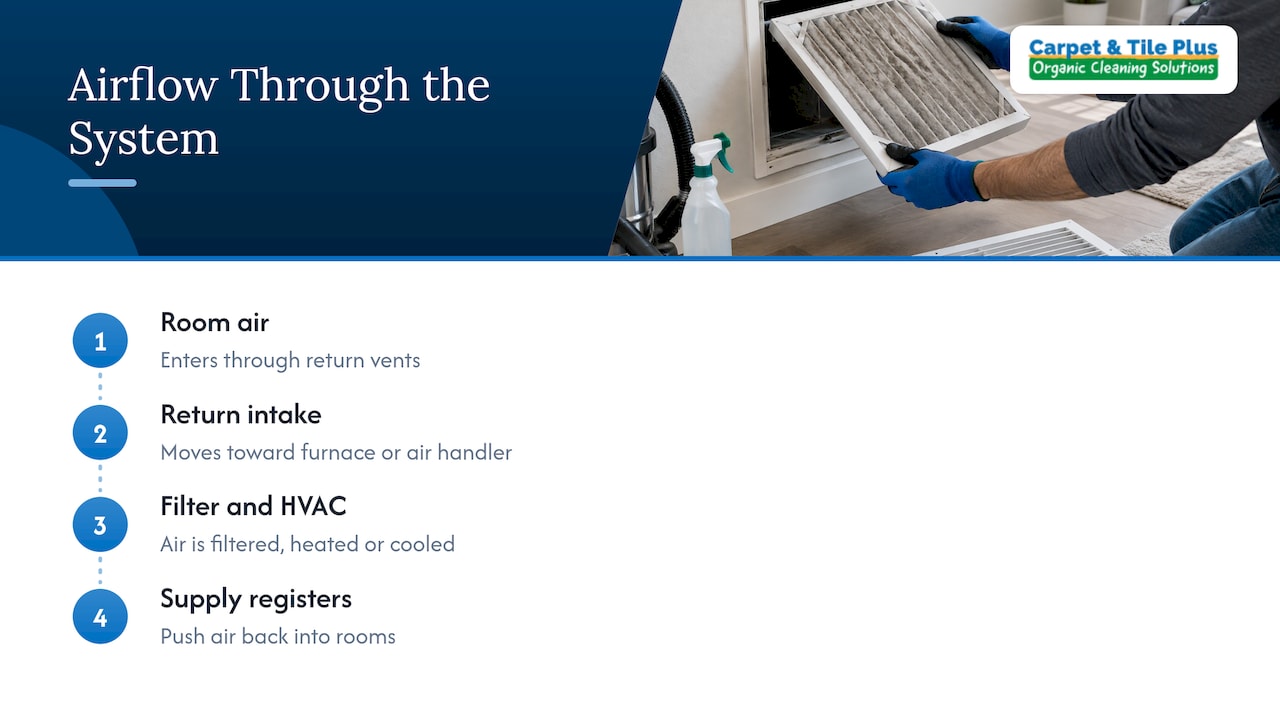
That is why the return cover is usually the dustiest vent in the house. The EPA states that return registers normally get dusty as dust-laden air passes through the grate, and that registers can simply be vacuumed or removed and cleaned. A dusty cover is the system doing its job, not a sign of failure.
In the older homes common in Arlington Heights, Palatine and Mount Prospect, you will often find large return grilles in hallways or low on walls. Newer subdivisions in Bartlett, Streamwood or Lake Zurich may have several smaller returns upstairs and one big one below. The cleaning method is the same for all of them.
How to clean an air return vent cover
The steps below follow the routine in Martha Stewart’s vent-cleaning guide, with a few practical additions.
What you need
- A screwdriver (or a drill with the right bit)
- A vacuum with a crevice tool and a brush attachment
- A damp microfiber cloth
- A soft-bristled brush, warm water and a little dish soap
- A towel for drying
The steps
- Turn off the HVAC system. Cleaning while the system runs can pull stirred-up dust and debris into the equipment. Set the thermostat to off, not just to a different temperature.
- Remove the cover. Most are held by two to four screws. Keep the screws in a cup so they do not disappear into the carpet. Some covers simply lift off or sit on a spring clip.
- Wipe the surface. Use a damp microfiber cloth to pick up loose dust. Do not spray cleaner into the opening.
- Scrub the grille. For stuck-on grime, use a soft-bristled brush and warm soapy water, then rinse.
- Air dry completely. A damp cover put back on a return can leave moisture where dust will stick to it.
- Vacuum the opening. Use the crevice tool to reach inside the first few inches of the duct, then the brush attachment on the frame and the wall or ceiling around it.
- Reattach the cover and restart the system. Only once everything is dry.
On a cleaning day, do the supply registers too. They are cleaned the same way, and they are where you will first notice dust or staining that points to a bigger issue.
Common mistakes
- Reaching deep into the duct with a household vacuum. The crevice tool is for the opening. Anything further back, such as the trunk line that runs to the furnace, calls for equipment designed for it.
- Skipping the filter. The filter sits in the return path, often right behind a large return grille or at the furnace. A clogged or low-grade filter is the first thing to check when a house is dusty. Check it monthly during heavy heating and cooling months, and replace it on the manufacturer’s schedule.
- Cleaning while dust is still being made. If you are sanding, remodeling or cutting tile, the EPA advises sealing supply and return registers and keeping the system off until the dust is cleaned up. Wiping the grille afterward will not undo dust that was drawn into the ducts during the work.
For general dust control between cleanings, the EPA recommends regular vacuuming with a HEPA vacuum, or the highest-efficiency bags your vacuum accepts. Our guide on cutting duct dust with better filters, the circulate fan and sealed leaks goes through the filter side in more detail.
How often to clean the cover
There is no official schedule for the grille itself. A practical rule is to vacuum return covers every time you do the floors and take them off for a wash a couple of times a year, for example at the start of the heating season and the cooling season. Homes with pets, shedding carpets or heavy foot traffic from a business entrance will need it more often. If you notice a gray mat building across the slats within weeks, the filter and the sources of dust in the room deserve a look before the ducts do.
Black dust around or coming from your vents
Black dust is the version of this problem that sends most people searching. The first thing to know is that black marks near a vent are not automatically mold, and are not automatically coming from your ducts.
UL Solutions, a safety science company that has published guidance on this, says black particles associated with an HVAC system are typically mold, rust or insulation. It also points out that in many cases the HVAC system is not the source at all: staining around a diffuser often reflects a dust source in the room itself.
A simple way to read the pattern
UL’s guidance suggests a few checks you can do yourself:
- Look at where the particles land. Particles only near air outlets point toward the system. Particles on shelves, sills and other surfaces away from any vent point toward a source in the room.
- Trap them. Place a white polyester filter material over the outlet. If nothing collects on it, the HVAC system is probably not the source.
- Know what only a lab can tell you. Only laboratory analysis can confirm mold. Insulation backing and metallic rust can be told apart with pressure and magnetic tests.
The EPA adds that a microbiology laboratory can confirm whether a substance is mold from a sticky-tape sample, which is a modest-cost way to stop guessing.
Common household explanations
Some of the usual suspects are candles, fireplaces, gas appliances, cooking soot and heavy traffic dust. Dark halos around a ceiling supply vent are frequently the result of dust carried by airflow settling in a ring where the vent meets the cooler ceiling surface. Northern Illinois winters, with the furnace running for months, give that process plenty of time to build up a visible line.
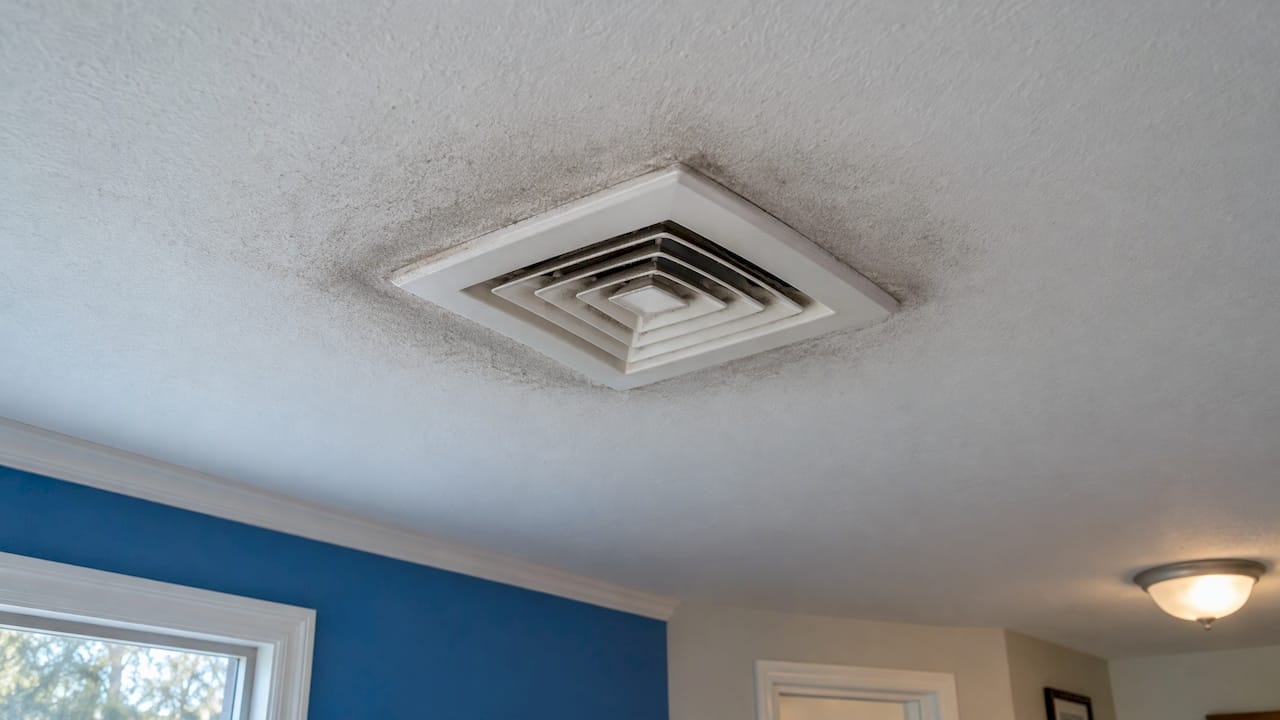
When black marks deserve more attention
Treat the marks as a reason to call someone when any of these apply:
- They return within days or weeks of being wiped away.
- You smell something musty when the system starts.
- There are speckles on the ceiling or wall around a vent that appear mainly in air-conditioning season.
- You can see dark growth on the inside of the grille or on duct surfaces.
If you wipe suspected mold, wear disposable gloves and avoid stirring it up. For more than a light film, the EPA’s guidance calls for goggles without ventilation holes and an N-95 respirator. Anyone in the home with asthma, allergies or unexplained symptoms should not be the one doing the cleaning. Because mold needs moisture, wiping it off treats the symptom. The moisture source, such as a leaking duct, a clogged condensate line or high humidity, has to be found and fixed or it comes back.
Dust coming out of the supply vents
Dust on a return grille is expected. Dust blowing out of the supply registers is different. The air at that point has already been through the system and should be cleaner than room air, so visible dust there says something upstream is not working as it should.
Work through these in order:
- The filter. It is the most common culprit. A clogged filter cannot trap new particles, and a thin fiberglass filter lets fine dust pass through. Check it first and make sure it fits snugly with no gaps at the edges.
- Leaky return ducts. Leaks in the return side can pull unfiltered air from attics, crawl spaces or wall cavities straight into the system.
- Debris in the ductwork. Construction dust, years of buildup, or material that has collected in a long return trunk can be carried out into the rooms.
- A dirty blower or coil. These components sit in the airflow and can shed what they have collected.
- Poorly sealed or damaged covers. A cover that does not seat properly lets dust pass around it.
The first one or two are things you can fix in an afternoon. If a fresh filter and a clean grille do not change what comes out of the supply registers, the cause is behind the wall, and it is time for someone to look inside.
When the ducts themselves need cleaning
Cleaning the cover handles the surface. Cleaning the ductwork handles what is behind it. The question is when to move from one to the other, and official guidance is specific.
The EPA says to consider duct cleaning when there is:
- Substantial visible mold growth inside hard-surface ducts or on heating and cooling components
- A rodent or insect infestation in the ducts
- Ducts clogged with excessive dust and debris, or particles being released into the home from supply registers
The NIH’s occupational health fact sheet on duct cleaning lists similar circumstances where the EPA and industrial hygienists agree cleaning is appropriate: lasting water damage in ducts, slime or microbial growth, debris that restricts airflow, dust discharging from supply diffusers, and offensive odors from ductwork or HVAC components.
In practice, here is what that looks like in a Northwest Suburbs home:
- You finished a remodel, a basement build-out or a flooring project and dust got into open registers.
- You can see dust or debris inside the return opening with a flashlight, well beyond the first few inches.
- Supply registers leave a visible film or you see dust puffing out when the system starts.
- There was a water event, such as a flooded basement or a leaking coil pan, and the ducts were affected.
- You hear or smell signs of pests in the system.
- You bought a house and do not know the history of the ductwork.
Whatever the cause was, it should be corrected first. The EPA is clear that if the source of contamination, such as moisture or a leak, is not fixed, the problem will likely recur. If insulated duct material has become wet or moldy, the EPA says it should be replaced rather than cleaned. Our team can tell you during an inspection which of these applies to your system.
For a closer look at the three triggers, read our page on choosing air duct cleaners based on EPA triggers. To see what happens during a visit, our HVAC duct cleaning process guide walks through it step by step.
What a professional air duct cleaning covers
A professional cleaning goes where a household vacuum cannot: the return trunk, the branch runs, the supply registers and the connection to the equipment. It is also done with a vacuum collection system, which matters because the EPA notes that an inadequate collection setup can release more dust than it removes. Doing the job with proper containment is part of the work.
Before you book anyone, take along your own notes from the checks above: where the dust appears, whether it returns, any odor, any recent renovation or water event. A good technician will want that history. Our air duct cleaning checklist for homeowners lists what to gather and what to expect on the day.
Air duct cleaning with Carpet and Tile Plus
We are a local, family-owned company serving homeowners and businesses across the Northwest Suburbs, including Arlington Heights, Bartlett, Barrington, Elgin, Elk Grove Village, Hoffman Estates, Lake Zurich, Mount Prospect, Palatine, Rolling Meadows and Streamwood. Our cleaners are IICRC-certified, we use organic cleaning products, and our work comes with a 100% satisfaction guarantee. We have more than 20 years in the industry.
If your return vents are dusty, your supply vents are blowing dust, or you have black marks that keep coming back, our air duct cleaning service is the next step. Property managers with multiple units can also read how NADCA triggers help time multi-unit duct cleaning.

If you are also dealing with dusty carpet near the vents, the same visit can be planned alongside our residential carpet cleaning, which we aim to leave dry in about an hour.
Our perspective
Most people who call us about a dusty return vent do not actually have a duct problem. They have a dirty grille, and we tell them so: take the cover off, wash it, vacuum the opening, and check the filter.
The calls that do need us are the ones where the cover is only the beginning. The dust shows up at the supply registers, the black marks return after a wipe, a renovation sent drywall dust into open vents, or the house just has a smell nobody can place. Those are the situations the EPA lists for considering duct cleaning, and they are the ones where cleaning the whole system, not just the faceplate, makes the difference.
We are a family-owned business, our technicians are IICRC-certified, and we use organic cleaning products because the air in your home is the air your family breathes. We stand behind the work with a 100% satisfaction guarantee. If you are unsure which side of the line you are on, that is a perfectly good reason to call us.
Joe
FAQ
Is it normal for my air return vent to be dusty?
Yes. The EPA says return registers normally get dusty because dust-laden air passes through the grate, and it does not by itself indicate heavy deposits in the ducts. You can vacuum the grille or remove and wash it.
Is black dust around my vents mold?
Not necessarily. UL Solutions says black particles from an HVAC system are typically mold, rust or insulation, and often the source is dust in the room rather than the system. Only a lab can confirm mold. If the marks return quickly or come with a musty smell, have the system inspected.
Why is dust coming out of my vents?
Start with the filter: a clogged or thin filter lets dust through. Then consider leaky return ducts, debris in the ductwork, or a dirty blower or coil. If a clean filter and clean registers do not stop it, particles being released from supply registers is one of the EPA’s reasons to consider duct cleaning.
Should I clean my vents with the system running?
No. Turn the HVAC off first. Running the system while you clean can pull stirred-up dust and debris into the equipment. Restart it only after the covers are dry and back in place.
How do I know if my ducts need professional cleaning?
Look for visible mold, pests, ducts clogged with dust and debris, dust coming from supply registers, water damage or odors from the system. If you see any of these, call us for an inspection, and fix any moisture or leak source so the problem does not return.
Sources
- Should You Have the Air Ducts in Your Home Cleaned? (US EPA)
- How to Clean Your Air Vents (Martha Stewart)
- Black Particles and the HVAC System (UL Solutions)
- DOHS Fact Sheet on HVAC Duct Cleaning (NIH Office of Research Services)