
The most effective allergy-friendly carpet cleaning routine combines frequent HEPA vacuuming with professional hot water extraction or dry steam cleaning at regular intervals, with more frequent cleaning if allergies are severe or pets are in the home. This pairing outperforms either method alone. Call in an IICRC-certified technician promptly if you spot mold, have had recent flooding, or symptoms persist despite regular home maintenance.
TL;DR:
- Combining frequent HEPA vacuuming with professional hot water extraction or dry steam cleaning achieves the highest allergen reduction in carpets.
- Vacuuming with a true HEPA or sealed system regularly is essential, especially in high-traffic areas and for homes with pets, to prevent allergen buildup.
- HEPA vacuuming plus dry steam cleaning reduces dust mite allergens by approximately 85.5%, outperforming vacuuming alone, which reduces around 80.8%.
- Use low-VOC, fragrance-free cleaning products, and avoid antimicrobial additives to prevent chemical irritants and residue that can attract more dust.
- Maintaining indoor humidity below 50%, prompt professional cleaning when needed, and replacing contaminated carpets are key to controlling allergens over time.
Table of Contents
- What Kind of Vacuuming Actually Cuts Down Allergens
- Hot Water Extraction Vs. Dry Steam: What the Research Shows
- Choosing Cleaning Products That Don’t Add to the Problem
- Preventing Allergens From Building Back Up
- When DIY Isn’t Enough and What to Ask a Professional
- Why This Protocol Reflects Both the Research and Real-World Practice
- Where Most Homeowners Get Allergy-Friendly Carpet Care Wrong
- Book an Allergy-Friendly Carpet Cleaning With Carpetandtileplus
- Sources
What Kind of Vacuuming Actually Cuts Down Allergens
Not every vacuum helps. Some make the problem worse by blowing fine dust and dander right back into the air through a leaky exhaust. Look for a machine with true HEPA filtration or a fully sealed system, since a HEPA filter that leaks around its housing does almost nothing for allergy sufferers.
For households managing allergies, vacuum frequently, increasing to daily in high-traffic zones or rooms where pets spend most of their time. Carpet acts as a reservoir, holding onto dust and allergens at levels far higher than hard flooring, and every footstep can resuspend those particles into the air you breathe. That’s the whole reason vacuuming frequency matters more on carpet than on tile.
Technique matters almost as much as equipment. Slow, overlapping passes pull embedded particles out of the pile far better than quick back-and-forth strokes. On high-pile carpet, vacuum in at least two directions, and don’t skip the perimeter where dust and dander collect along baseboards.
A few maintenance habits keep the vacuum itself from becoming a problem:
- Empty bagless canisters outdoors or in a garage, never over a sink or in a closed room, since dumping the bin indoors releases a cloud of what you just picked up.
- Replace HEPA filters on the manufacturer’s schedule, typically every 6 to 12 months depending on use.
- Change bags before they’re completely full. A vacuum losing suction is also losing filtration efficiency.
- Check the exhaust seal periodically. If you can smell dust after running the vacuum, air is escaping somewhere it shouldn’t.
For a room-by-room breakdown of quick wins, see this guide on reducing dust mites in carpet.
Hot Water Extraction Vs. Dry Steam: What the Research Shows
Vacuuming alone can only do so much, because dust mite allergens and pollen fragments get worked deep into carpet fibers over time. Deep cleaning is where the real allergen reduction happens, and the research on which method works best is fairly specific.
A controlled evaluation found that HEPA vacuuming combined with dry steam cleaning reduced house dust mite allergen loadings by about 85.5%, compared to roughly 80.8% for HEPA vacuuming by itself. That’s not a massive gap on paper, but it’s the difference between a carpet that’s mostly clean and one that’s been reset closer to allergen neutral.
HEPA + dry steam or HWE: 85.5% allergen reduction. HEPA alone: 80.8%.
The mechanisms behind each method differ. Extraction physically pulls soil, dander, and mite debris out of the fibers along with the cleaning solution. Steam works differently: heat can denature allergen proteins and reduce dust mite populations, essentially neutralizing what vacuuming alone leaves behind. A follow-up analysis of the same intervention found that a second HEPA pass after steam or extraction pulled out even more fine particulate, particularly in carpets that hadn’t been deep cleaned in a while, per research published by RSC Publishing.
Neither method is without trade-offs:
- Hot water extraction removes more embedded soil but leaves carpet wetter, so drying time and equipment quality matter more.
- Dry steam uses less moisture, which lowers mold risk, but may need a slower pass to reach the same allergen reduction on thick pile.
- Over-wetting either way, especially with underpowered home units, can invite mold within 24 to 48 hours if the carpet doesn’t dry fast enough.
The practical sequence that gets the best results: HEPA vacuum first, pretreat any stains or heavily soiled spots, run the extraction or steam pass, then follow with one more HEPA vacuum once the carpet is fully dry.
Choosing Cleaning Products That Don’t Add to the Problem
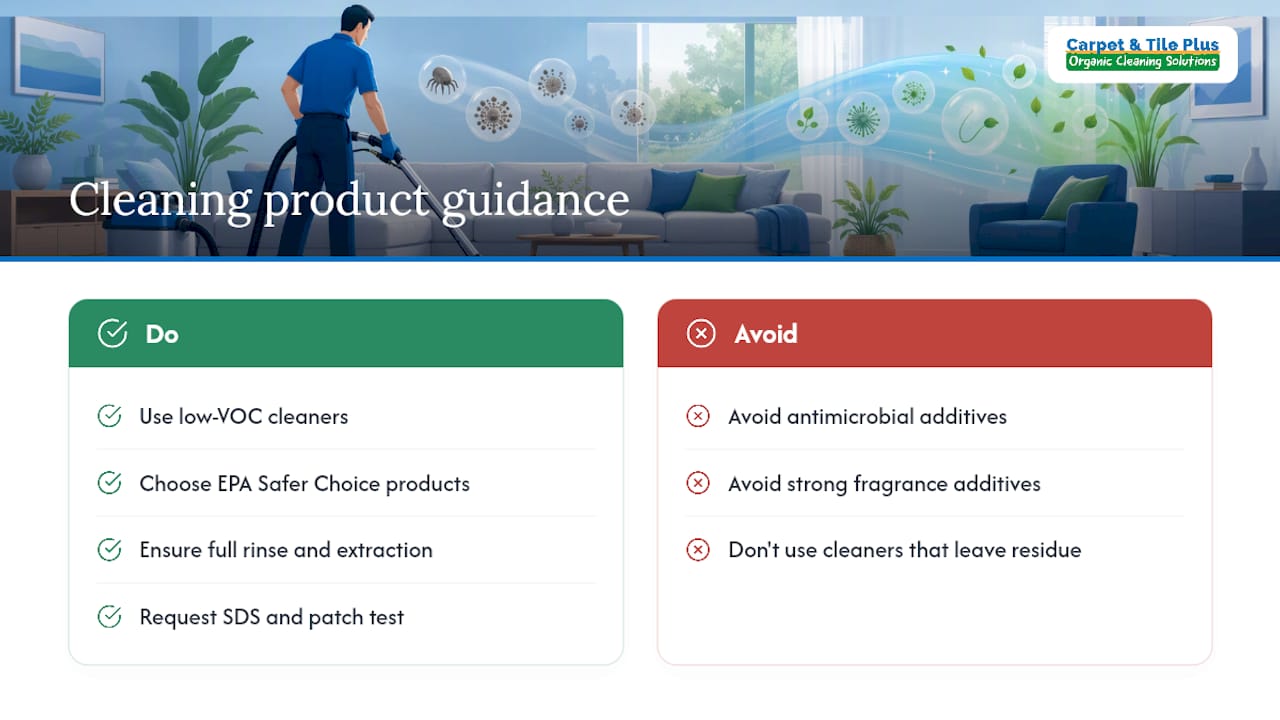
Deep cleaning defeats its own purpose if the product left behind irritates the exact people you’re trying to protect. Low-VOC formulas and EPA Safer Choice-labeled cleaners avoid the harsh solvents and heavy fragrances that can trigger airway irritation in sensitive occupants, even after the carpet looks and smells clean.
Skip antimicrobial additives unless there’s an actual mold or bacterial issue to address. Most allergy triggers in carpet, dust mite waste, pet dander, pollen fragments, aren’t bacterial, so an antimicrobial boost adds chemical exposure without adding benefit. The same goes for strong fragrance additives marketed as “fresh scent.” They mask odor instead of removing allergens, and for anyone with asthma, fragrance itself can be the trigger.
Full rinse and extraction matter more than the product label. A cleaner that doesn’t fully rinse out leaves a sticky residue that actually attracts more dust over the following weeks.
Pro Tip: If anyone in your home has severe chemical sensitivity, ask your cleaning company for the product name or Safety Data Sheet before the appointment, and request a patch test on a hidden section of carpet first.
Preventing Allergens From Building Back Up
Cleaning solves today’s problem. Preventing re-accumulation is what keeps allergy symptoms from creeping back within weeks of a professional clean.
- Keep indoor humidity under 50%. Mold and dust mites both thrive above that threshold, and the EPA specifically recommends humidity control as a core defense against biological contaminants indoors.
- Put washable area rugs in bedrooms and entryways. They catch a large share of what would otherwise settle into wall-to-wall carpet, and you can machine wash them monthly instead of waiting for a professional visit.
- Enforce a no-shoes policy at the door. Shoes track in pollen, pesticide residue, and outdoor allergens that end up ground into carpet fibers within days.
- Manage pet dander on a schedule. Bathe and brush pets regularly, wash pet beds weekly, and keep pet sleeping areas out of bedrooms if allergies are severe.
- Know when carpet replacement is the real answer. If dander or mold has penetrated the backing and pad, or odors persist after multiple professional cleanings, replacement may outperform further cleaning attempts.
When DIY Isn’t Enough and What to Ask a Professional
Some situations call for a professional no matter how diligent your home routine is. Persistent symptoms despite regular vacuuming, visible embedded soil that won’t lift, lingering pet odor, or any carpet that’s been through a water intrusion are all signs it’s time to call in a pro rather than buy another rental machine.
Before booking, ask a few direct questions:
- Are the technicians IICRC certified, and in which specific method (carpet cleaning, water damage restoration)?
- Do they use truck-mounted hot water extraction, dry steam, or both, and can they explain why for your carpet type?
- Do they offer low-VOC or organic product options for sensitive households?
- What’s the expected dry time, and what happens if humidity is already high in your home?
- Can they provide proof of insurance?
A quality allergy-focused service starts with a HEPA pre-vacuum, applies targeted pretreatment on problem areas, runs full extraction, and finishes with guidance on drying and follow-up care. For more on what a standard appointment includes, see this carpet cleaning FAQ.
Why This Protocol Reflects Both the Research and Real-World Practice
Carpetandtileplus has built its process around more than 20 years of hands-on experience, and it lines up closely with what the peer-reviewed studies actually show. IICRC-certified technicians run a sealed-system HEPA pre-vacuum, targeted pretreatment, and truck-mounted extraction, with a one-hour dry time achievable on most jobs, which directly addresses the mold risk tied to slow-drying carpet.
The gap between lab results and living rooms is usually the weak link. Studies show HEPA plus steam or extraction beats HEPA alone. That only holds up if the equipment is powerful enough and the technician actually follows the sequence.
Using organic, low-VOC products throughout keeps the chemical side of the equation aligned with the allergen-reduction side, so one doesn’t undercut the other.
Where Most Homeowners Get Allergy-Friendly Carpet Care Wrong
The biggest mistake I see isn’t skipping vacuuming. It’s treating a single annual deep clean as sufficient protection, then wondering why symptoms flare up again by month four.
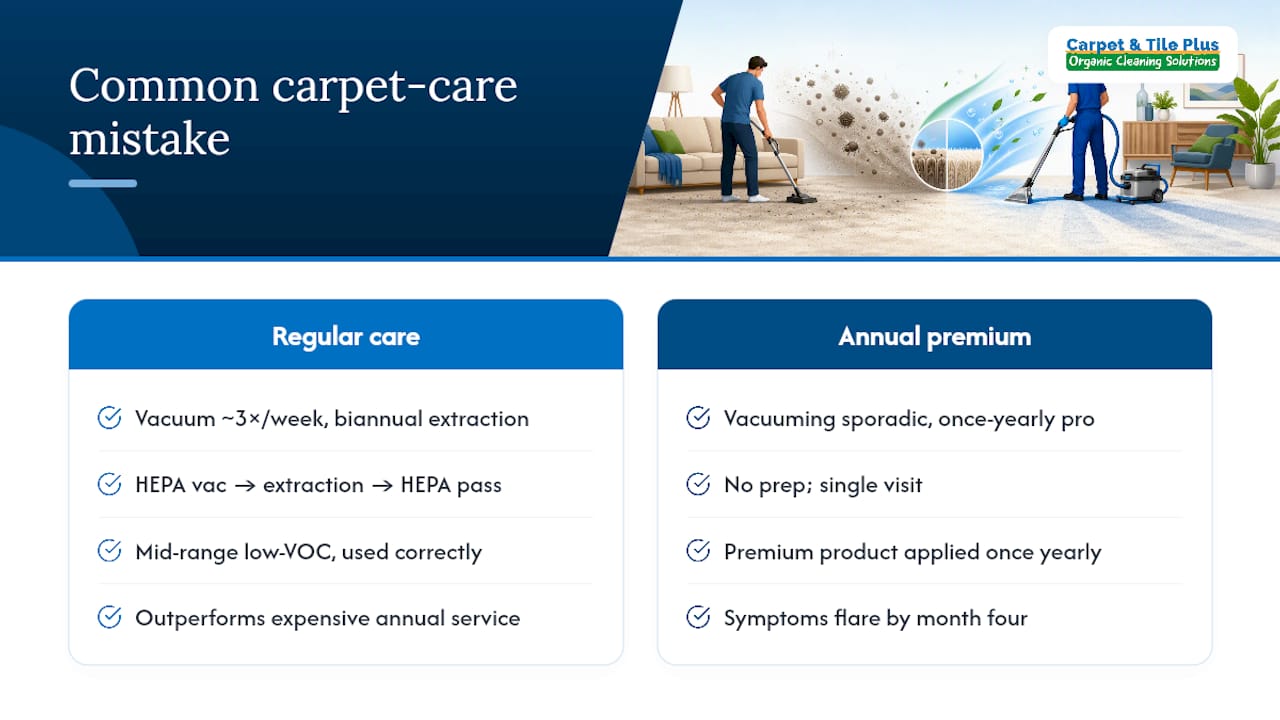
Conventional advice tends to fixate on picking the “right” cleaner and ignores sequence and frequency, which matter more. A mediocre low-VOC product used correctly, HEPA vacuum first, extraction second, HEPA pass third, beats a premium product applied once a year with no prep.
If you’re prioritizing one thing, prioritize consistency over intensity. A household vacuuming three times a week with a mid-range HEPA machine and a biannual professional extraction will outperform a household that vacuums sporadically but hires the most expensive cleaning service in town once a year. Allergen control is a maintenance problem first, a product problem second.
— Jim
Book an Allergy-Friendly Carpet Cleaning With Carpetandtileplus
The protocol involves sealed-system HEPA pre-vacuum, truck-mounted hot water extraction or dry steam, and organic, low-VOC products, with a one-hour dry time on most jobs to minimize downtime.
That fast dry time matters more than it sounds. Slow-drying carpet is exactly what invites the mold growth the EPA warns about, so a quicker turnaround is a genuine allergen-control advantage, not just a convenience. Our IICRC-certified technicians handle everything from routine residential carpet cleaning to persistent pet odor and dander problems through our odor removal service. If you’re unsure how often your household needs a professional visit, our guide on cleaning frequency breaks it down by pet ownership, allergy severity, and traffic level. Homeowners in the area can request a quote and schedule cleaning services tailored to maintain cleanliness between visits.
Sources
- Evaluation of HEPA vacuum cleaning and dry steam cleaning in reducing levels of polycyclic aromatic hydrocarbons and house dust mite allergens in carpets (Europe PMC)
- Evaluation of HEPA vacuum cleaning and dry steam cleaning in reducing levels of polycyclic aromatic hydrocarbons and house dust mite allergens in carpets (RSC Publishing)
- Biological contaminants and indoor air quality | US EPA
- IICRC consumer floor and furnishings care tips (PDF)