The most reliable pet-friendly carpet cleaning approach combines two steps: enzyme-based spot treatment the moment an accident happens, plus scheduled professional hot-water extraction using low-residue, low-VOC products for deep odor removal. If a stain is old or odor keeps resurfacing, it’s a job for a professional who can map contamination with UV light and moisture meters, treat down to the pad, and show you the product’s Safety Data Sheet before they start.
TL;DR:
- Enzyme-based spot treatments should be used immediately after accidents, followed by professional hot-water extraction with low-residue, low-VOC products for best odor removal.
- Always verify cleaning products’ safety certifications, such as third-party seals or SDS, and ensure technicians are IICRC-certified before hiring.
- Fresh pet stains are easiest to treat within one hour by blotting, applying enzyme cleaners, and avoiding heat to prevent setting stains or odors.
- Professional treatments are necessary for urine that has penetrated past the carpet backing, with UV mapping guiding targeted deep cleaning or pad replacement if needed.
- Regular maintenance, including vacuuming twice weekly, spot treatment, and quick addressing of new accidents, extends carpet life and prevents persistent odors.
Table of Contents
- What Is Pet-Friendly Carpet Cleaning, and Which Method Fits Your Situation?
- How Do You Choose Safe, Effective Products and Verify Them?
- How Do You Treat a Fresh Pet Stain Step by Step?
- When Do You Need a Professional for Pet Odor Removal?
- What’s the Right Maintenance Routine for a Home with Pets?
- How Do You Handle Vomit, Feces, and Mud Stains?
- How Do You Keep Carpet Healthy Between Professional Cleanings?
- Which Carpet Materials Actually Hold Up Best with Pets?
- Why an Organic, IICRC-Certified Approach Actually Makes the Difference
- Get Professional Pet Odor Removal from Carpet & Tile Plus
- Sources
What Is Pet-Friendly Carpet Cleaning, and Which Method Fits Your Situation?
Not every pet accident calls for the same fix, and knowing the difference saves you money and protects your dog or cat from unnecessary chemical exposure. Here’s how the main options actually work.
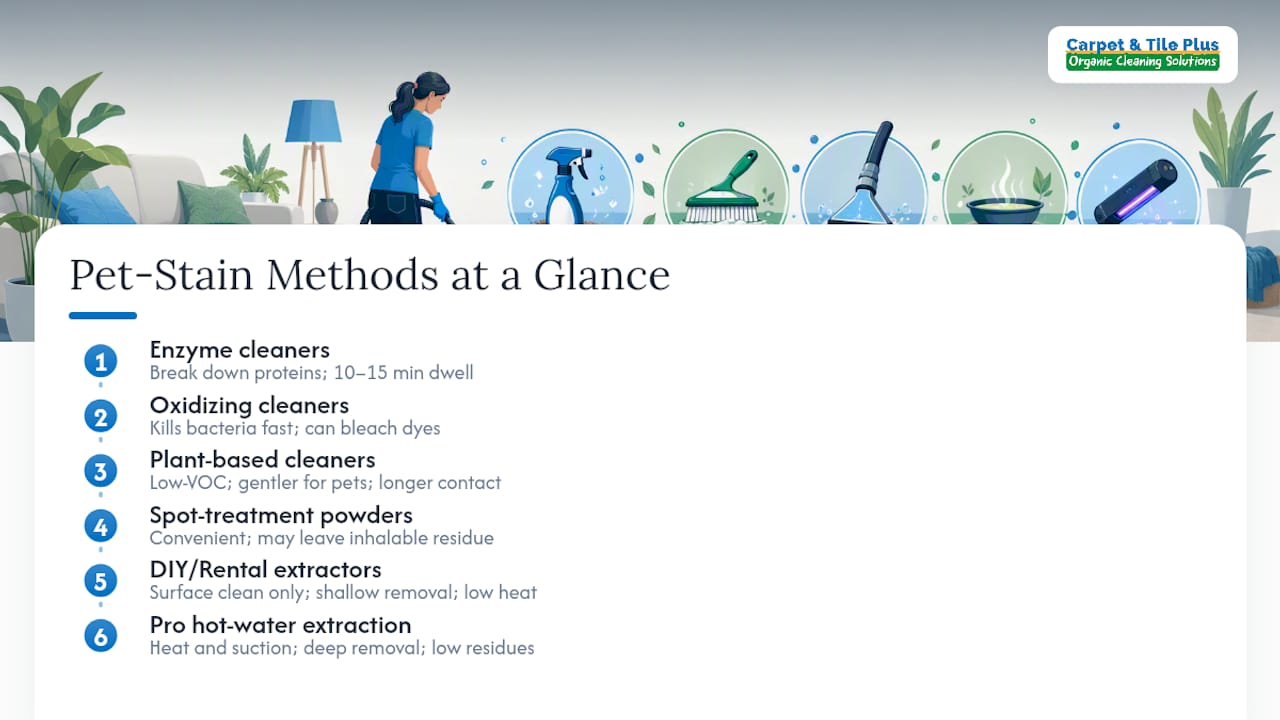
Enzyme cleaners break down the proteins and bacteria in urine, vomit, and organic mess at a molecular level instead of just masking the smell. They need dwell time (usually 10 to 15 minutes) to work, and they’re the closest thing to a universal recommendation for pet stains because they attack the actual source of odor rather than covering it up.
Oxidizing cleaners (often hydrogen peroxide based) lift color from urine stains and kill odor-causing bacteria fast, but they can bleach certain dyes if left too long, so they demand a spot test first.
Plant-based, low-VOC cleaners skip the harsh solvents and fragrances that can bother sensitive pets, though they sometimes need a longer contact time to match the cleaning power of stronger chemistry.
Spot-treatment powders are convenient, but Gallery Carpet Care warns they can leave a fine residue that pets inhale or lick off their paws, so enzyme liquids and extraction are the safer default.
Rental or DIY extractors handle surface cleaning fine but rarely generate the heat, vacuum pressure, or dwell time needed to pull contamination out of the carpet pad.
Professional hot-water extraction (HWE) relies on heat, water volume, and suction rather than heavy chemical concentration, which is exactly why low-moisture, truck-mounted HWE methods tend to leave fewer residues in homes with pets than high-chemical alternatives. The takeaway: extraction power often does more of the safety work than the cleaning solution itself.
How Do You Choose Safe, Effective Products and Verify Them?
Labels that say “pet safe” or “natural” mean almost nothing on their own. There’s no formal EPA or FDA regulation of the term “pet-safe” on a cleaning product label, so the burden falls on you to check the actual certifications and paperwork behind the claim.
- Look for third-party seals. EPA Safer Choice and Green Seal certifications mean a product has been independently evaluated for toxicity and environmental impact, not just marketed that way.
- Ask for the Safety Data Sheet (SDS). Any professional cleaner should hand over an SDS for every product on their truck without hesitation. If they can’t, that’s a red flag.
- Check for CRI alignment. Products carrying the Carpet and Rug Institute’s Seal of Approval have been tested for effectiveness without damaging fiber or leaving excess residue.
- Confirm IICRC-certified technicians. Certification through the Institute of Inspection, Cleaning and Restoration Certification means the technician has been trained in proper chemistry sequencing, not just running a machine.
- Test in a hidden spot first, and always follow the manufacturer’s dilution ratio. Over-concentrated solutions don’t clean better; they just leave sticky residue that attracts more dirt.
Pro Tip: Before booking any pro, ask three questions: What’s the SDS for your main cleaning solution? Are you IICRC certified? What’s your typical dry time? A confident, specific answer to all three tells you more than any online review.
Fast dry times matter more with pets in the house. Extended dampness invites bacterial regrowth and gives curious pets more time to walk through a wet treatment area before it fully cures.
How Do You Treat a Fresh Pet Stain Step by Step?
Speed matters more than strength here. A urine stain treated within the first hour is dramatically easier to fully neutralize than one that’s had all day to soak into the pad.
- Blot immediately with white paper towels or a clean cloth. Press, don’t rub. Rubbing pushes the mess deeper into the fibers and spreads it laterally.
- Never apply heat. Steam or a hot iron might seem logical, but heat sets protein stains permanently and can bond the odor into the fiber.
- Apply an enzyme cleaner generously, saturating the same area the liquid soaked into, not just the visible surface stain. Enzymes need enough volume to reach where the accident actually traveled.
- Let it sit for the labeled dwell time, typically 10 to 15 minutes, so the enzymes have time to break down the waste proteins.
- Blot and extract the loosened solution with clean towels, applying firm pressure in stages.
- Rinse with plain cool water and extract again to remove any leftover cleaner residue, since CRI 205 guidance notes that leftover solution accelerates resoiling over time.
- Dry the area fully with fans or open windows before letting pets back on the spot.
If the smell comes back a day or two later, or you can smell it but not see a visible mark, grab a UV blacklight in a dark room. Old urine deposits fluoresce under UV light, and this simple trick reveals contamination that spread well beyond the stain you originally treated. A spot that glows across a two-foot radius, or one that feels squishy or spongy underfoot, usually means the pad has absorbed urine that a surface cleaning can’t reach.
Keep an eye on your pet for the next few hours after any treatment. The American Veterinary Medical Association notes that drooling, vomiting, or labored breathing after exposure to cleaning products can signal sensitivity, and pets should be kept off treated carpet until it’s completely dry.
When Do You Need a Professional for Pet Odor Removal?
Home treatment handles fresh, surface-level accidents well. It runs out of power once urine has traveled past the carpet backing.
Professionals typically work in three tiers:
- Tier 1, surface treatment: for fresh stains caught early, using enzyme pre-spray followed by hot-water extraction. This is often enough on its own.
- Tier 2, pad-depth subsurface treatment: for stains that have soaked through to the padding. This requires injecting enzyme or oxidizing solution below the surface, then extracting with specialized tools.
- Tier 3, pad replacement: for repeat-offense areas or old, heavily saturated spots where the padding has broken down and simply can’t be restored.
Getting the tier right depends on diagnostics, not guesswork. Mapping contamination with UV light and moisture meters lets a technician see exactly how far urine traveled before choosing a treatment scope, instead of treating only the visible stain and missing what’s underneath.
The actual chemistry sequence professionals use for a real pad-depth job typically runs through an alkaline pre-spray, enzyme treatment, oxidizer, and acid rinse, followed by extraction and controlled drying. That pH shift matters: fresh urine starts slightly acidic, then turns alkaline as bacteria break it down, so a rinse that ignores that chemistry can leave residue that resoils fast or, in rare cases, affects fiber color. Before hiring anyone for this level of work, ask for their SDS, confirm IICRC certification, and get a clear answer on what the warranty covers if the odor returns.
What’s the Right Maintenance Routine for a Home with Pets?
Carpet in a pet household works harder than carpet anywhere else, and the maintenance schedule should reflect that.
- Vacuum twice a week minimum, more often in high-traffic zones near food bowls and doors, since CRI 205 ties regular vacuuming directly to carpet lifespan and warranty compliance.
- Handle spots the same day they happen, using the enzyme workflow above rather than letting anything sit overnight.
- Book professional deep cleaning every 6 to 12 months, or closer to every 6 months in multi-pet households, rather than stretching to the 12 to 18 month interval that’s typical for pet-free homes.
- Place mats at every entry point to cut down on tracked-in mud and dirt that grinds into fibers underfoot.
- Keep a spot kit stocked with enzyme cleaner and clean cloths somewhere accessible, not buried in a cabinet, since a 30-second delay in reaching it often means a bigger job later.
Pro Tip: If you notice you’re spot-treating the same general area more than twice in a month, that’s your carpet telling you it’s due for a professional look, not just another DIY pass.
Pushing your carpet cleaning schedule up when you add a new puppy or kitten to the house is normal. Young pets have accidents far more often than trained adult animals.
How Do You Handle Vomit, Feces, and Mud Stains?
Urine gets most of the attention, but vomit, feces, and mud each need a slightly different approach.
Vomit often contains stomach acid and bile that can discolor carpet fast, so speed matters as much as it does with urine. Scrape up solids with a spoon or dull knife first, working from the outside of the stain inward so you don’t spread it. Then treat with an enzyme cleaner the same way you would a urine stain, since vomit residue also carries organic material that causes lingering odor if it’s not broken down.
Feces should be removed as completely as possible before any liquid touches the carpet. Wet cleaning smeared solid waste first just pushes it deeper into the pile. Once the solid material is gone, treat the remaining residue with an enzyme solution and blot dry.
Mud is deceptively easy to make worse. Let it dry completely first rather than scrubbing while wet. Dried mud vacuums out far more cleanly than a wet smear that grinds clay particles into the fiber base. Once the bulk is vacuumed away, a mild detergent solution handles the remaining discoloration.
For all three, the Mattress Magicians pet accident cleanup guide offers a useful reminder: containment first, cleaning second. Cutting off the spread before you start scrubbing prevents a small mess from becoming a bigger job.
How Do You Keep Carpet Healthy Between Professional Cleanings?
The stretch of time between deep cleans is where most carpet damage actually happens, one small neglected habit at a time.
Rotate furniture occasionally so foot traffic doesn’t wear the same paths bare, especially near food bowls, doorways, and favorite napping spots. Trim your pet’s nails regularly. Sharp or overgrown claws snag and fray carpet fibers over months of normal walking, and that damage isn’t something any cleaning method reverses.
Address low-grade odor before it becomes a stain problem. If a room starts to smell faintly “off” but you can’t find a visible mark, that’s usually early bacterial buildup in fibers that haven’t been extracted deeply enough, and a baking soda sprinkle followed by vacuuming after 15 minutes can buy you time before your next scheduled deep clean.
Keep humidity in check. Carpet padding that stays damp from high indoor humidity, not just pet accidents, breeds the same bacteria that cause odor, so a dehumidifier in muggy months protects your carpet investment as much as any cleaner does.
Finally, don’t ignore water bowl splash zones. That constant low-level dampness near a pet’s water station creates a microclimate that ages carpet fiber faster than almost anything else in the house, and a small absorbent mat under the bowl solves it completely.
Which Carpet Materials Actually Hold Up Best with Pets?
Fiber choice determines how much work every future cleaning will be, so it’s worth getting right before a new installation rather than fighting the wrong material for a decade.
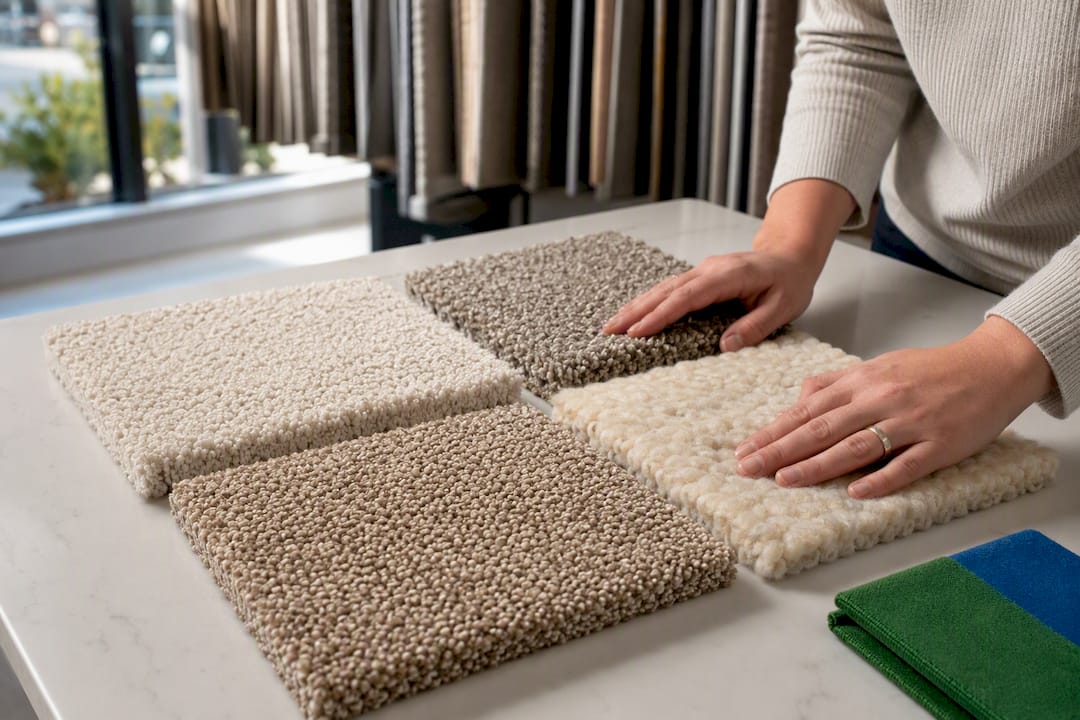
Nylon is the most stain and odor resistant of the common carpet fibers, resists crushing under paws and claws, and stands up well to repeated hot-water extraction without breaking down.
Olefin (polypropylene) resists moisture absorption extremely well, which limits how deep a urine accident can soak before you catch it, though it crushes more easily under heavy foot traffic than nylon.
Triexta blends stain resistance with softness and has become a strong middle-ground option for pet households that don’t want to sacrifice comfort for durability.
Wool, despite its reputation for luxury, is a poor fit for pet homes. It absorbs liquid and odor more readily than synthetic fibers and can be damaged by the enzyme and oxidizing chemistry that works best on pet stains.
Beyond fiber type, a low, tight loop pile or a short cut pile cleans far more easily than a long shag or plush cut, simply because there’s less depth for contamination to travel into. And whatever fiber you choose, ask your carpet retailer whether it comes pre-treated with a stain-resistant finish, since that layer buys you extra reaction time on every future spill.
Why an Organic, IICRC-Certified Approach Actually Makes the Difference
Most pet-odor problems that “won’t go away” weren’t cleaned wrong. They were cleaned at the wrong depth, with the wrong chemistry, or with residue-heavy products that mask smell instead of removing it. That gap between a quick DIY pass and real, permanent odor removal is where most pet owners get stuck.
DIY spot treatment handles fresh, surface-level accidents just fine. Once odor persists after cleaning, or you’re dealing with pad saturation, it’s time for IICRC-certified technicians using organic products and a fast, one-hour dry time.

— Jim
Get Professional Pet Odor Removal from Carpet & Tile Plus
If you’ve worked through the enzyme spot treatments and the odor keeps coming back, that’s usually a sign the contamination has gone deeper than any home method can reach. Local professional carpet cleaning services offer IICRC-certified technicians who use organic cleaning products and UV and moisture diagnostics to map exactly where pet urine has traveled, then treat it at the right depth instead of just refreshing the surface. Homeowners in various suburbs of Chicago may also benefit from fast dry times, so pets and family aren’t kept off the carpet all day waiting for it to cure.
Ready to solve a stubborn pet odor for good? Request a quote through the carpet odor removal service page or explore residential carpet cleaning options to schedule your next deep clean.
Sources
- EPA — Learn about the Safer Choice label
- AVMA — Household hazards for pets
- SoCal Steam — How to remove pet odors permanently (process overview)
- Gallery Carpet Care — Are carpet cleaning products safe for pets?