
In a Chicago winter, the best carpet care is a mix of three things: stopping salt and grit at the door, vacuuming often, and booking a professional low-moisture cleaning once the worst of the slush is behind you or when salt stains and wicking spots appear. Doing a little each week keeps fibers from being ground down. Doing the deep clean at the right moment keeps the results from fading.
This guide is for homeowners and business managers in the Northwest Suburbs, from Arlington Heights and Palatine to Elgin, Bartlett and Barrington. It covers what winter does to carpet, what you can safely do yourself, how to dry carpet in cold weather, and when it is time to call us.
TL;DR
- Road salt and grit are abrasive. Tracked in on boots, they dull carpet fibers over time, so frequent vacuuming and good entry mats matter more in winter than any other season.
- For fresh spots, use only a very mild detergent solution, blot rather than scrub, and rinse thoroughly so no soap residue is left to attract new soil.
- Carpet should be dry within 12 hours of cleaning. Keep air moving, and never shut a room with wet carpet inside.
- If your first two spot-treatment steps fail, or a stain keeps coming back, call a professional.
- Our low-moisture method is designed for a one-hour dry time, which suits a season when windows stay closed.
Table of Contents
- What a Chicago winter does to carpet
- Stop the soil at the door
- Vacuum more often than you think
- How to treat salt stains and slush spots yourself
- Drying carpet safely in cold weather
- When to clean: timing your winter carpet cleaning
- DIY or professional: how to decide
- Our perspective
- Book winter carpet cleaning in the Northwest Suburbs
- A simple winter carpet checklist
- FAQ
- Sources
What a Chicago winter does to carpet
The damage is rarely one dramatic spill. It is thousands of small trips from the driveway to the living room. Snow, slush and meltwater carry road salt and fine grit through the door, and the water evaporates but the salt does not. What stays behind sits at the base of the fibers.
The Carpet and Rug Institute (CRI) notes that tracked-in salt or granular soil may cause dullness over time through fiber abrasion. That is why a carpet can look flat and gray along a hallway by February even though nothing was ever spilled on it. The traffic lane itself is the stain.
Salt has a second effect. It can leave white, crusty or sticky patches near doors, and when you wet those patches the dissolved material can travel. We explain that more below under wicking.
Snow-melting products are not all the same either. CRI keeps a dedicated page on snow melting chemicals and carpet, because the residue they leave behaves differently from ordinary mud. If you see an oily, sticky or discolored patch near an entry, treat it as a salt problem, not just dirt.
Where the damage shows first
- Entryways and mudrooms. The first six feet of carpet take most of the soil.
- Stairs. Grit lodges in the edge of every tread.
- Hallways to the kitchen or garage door. These are the lanes people use every day in boots.
- Office lobbies and reception areas. Customers arrive straight from the parking lot, so the carpet inside the door takes the load.
If you notice any of these, our guide to the signs your carpet needs professional cleaning lists the indicators we look for.
Stop the soil at the door
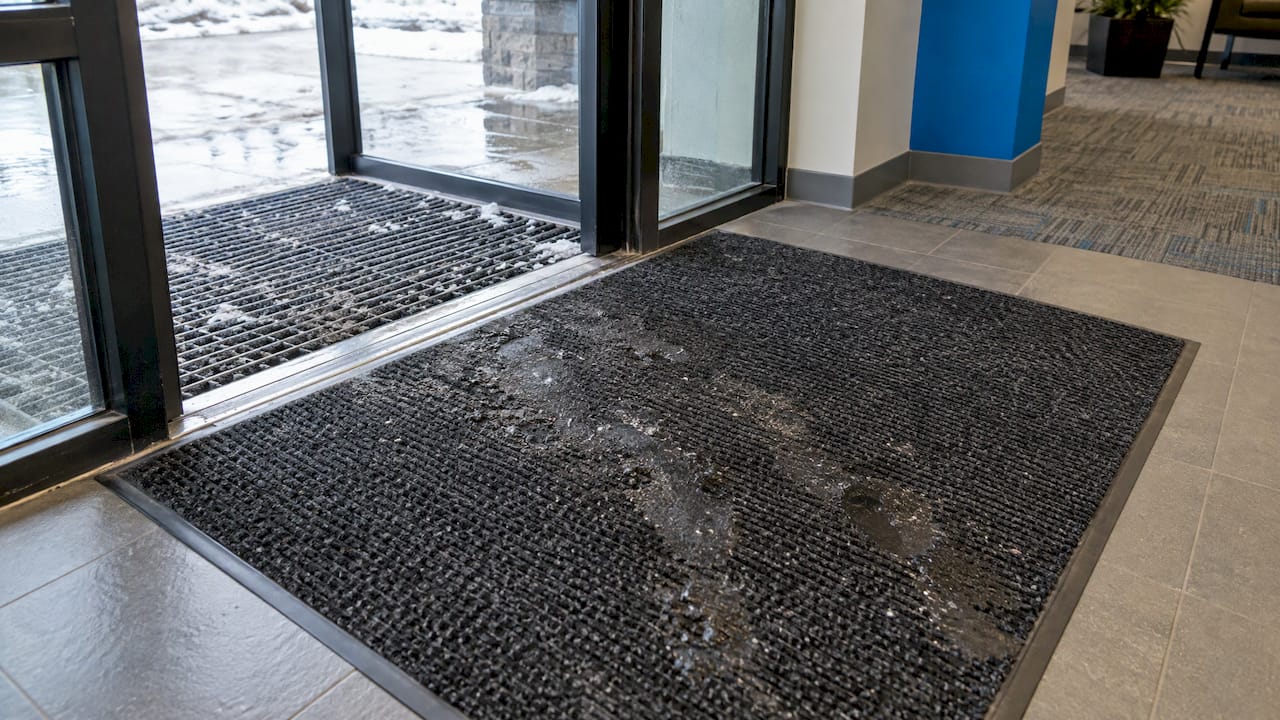
The cheapest winter carpet care is prevention. CRI’s commercial standard treats soil prevention as a primary element of a care program and relies on interior and exterior walk-off mats that scrape, brush or absorb moisture and debris.
Mats for businesses
For commercial buildings, a manufacturer’s care guide says effective walk-off systems, which capture about 80% of soil and moisture, should span 9 to 15 feet so they catch the first five or six steps. In practice, that means an outdoor scraper mat, a larger absorbent mat just inside, and carpet beyond. Most suburban office entrances have a small rug and nothing else, and that is where winter damage starts.

The same guide points out that the mats themselves need cleaning more often than the surrounding carpet, because once they are saturated with soil they stop trapping anything. A mat that has been full since December is just a carrier.
Mats and habits for homes
The same logic works at home, at smaller scale:
- Put a rough scraper mat outside and an absorbent mat inside every door you use in winter, including the garage entry.
- Keep a boot tray or a mat-covered boot zone so wet boots stay off carpet.
- Take shoes off at the door if the household agrees. It removes most of the problem.
- Wash or shake out the mats weekly in the snowy months.
The garage entry is where slush often starts its trip into the house, so winter garage door preparation belongs on the same fall checklist as your mats.
Vacuum more often than you think
Grit is what wears fiber, and a vacuum is what removes it. CRI’s standard calls frequent vacuuming with a CRI Seal of Approval certified vacuum essential to minimize the dullness caused by abrasive salt and grit.
A simple winter rhythm:
- Entry zones and main lanes: every two or three days.
- Bedrooms and low-traffic rooms: weekly.
- Stairs: weekly, using the crevice tool on the edges.
- Office lobbies: daily, if you have the staff for it.
This is our own rule of thumb, not a standard. Adjust it by how many people and pets come in and out, and how wet the weather has been.
How to treat salt stains and slush spots yourself
Some spots are worth tackling immediately. Others are better left for a pro. The difference is how much you use and how gently you use it.
The mild detergent method
For general spot removal, CRI says the solution should be no more than 1/4 teaspoon of liquid dish detergent per 1 cup of lukewarm water, and that thorough rinsing is mandatory. Leftover soap attracts future soil, which is how a spot you cleaned in January turns into a dark ring in March.
Steps:
- Vacuum the area first so dry grit is not pushed into the pile.
- Lightly apply the solution with a white cloth or sponge. Do not soak the carpet.
- Blot from the edge toward the center. CRI’s residential standard says to avoid scrubbing or brushing spots, because that can distort the fiber.
- Rinse with clear water and blot again, repeating until no suds or sticky feeling remain.
- Place a folded white towel on the spot and press to absorb moisture.
Do not use stronger solutions than the instructions call for. CRI’s guidance is to follow dilution directions and use Seal of Approval cleaning solutions and equipment, and to rinse in-tank solutions with clear water.
When the stain comes back: wicking
You clean a salt spot, it looks fine, and two days later it is back. That is usually wicking. The IICRC defines it as the upward or outward movement of water-soluble materials in the fibers as carpet dries, and it is a common reason for recurring stains.
The IICRC’s consumer tip sheet suggests that if wicking occurs, you let the carpet dry for at least 48 hours, then vacuum, lightly mist with distilled water and blot. Fresh 3% hydrogen peroxide is another option listed there. Test any product on a hidden corner first, since peroxide can affect dyes.
If the spot returns a second time, stop. Repeated wetting just moves more material up. Our article on how soil wicking ruins carpet cleaning results explains why, and our page on road salt carpet stains and when to call a professional covers the decision in more detail.
Drying carpet safely in cold weather
In July you open the windows. In January you do not, and heating systems dry the air, but not necessarily the carpet quickly. Drying is where winter carpet cleaning goes wrong.
CRI’s residential standard says carpet should be dry within 12 hours of cleaning. It recommends active ventilation: run the HVAC fan, use heaters at a moderate setting to reduce humidity, and add portable fans. It also says never to close off a room that has wet carpet in it.
If carpet is still wet after 12 hours, the same standard recommends professional help to prevent problems such as mildew or delamination.
Practical tips:
- Set the thermostat to a comfortable, ordinary level, not extreme heat.
- Point a fan across the carpet surface rather than at one spot.
- Keep interior doors open so air can move through the whole space.
- Keep boots and pets off the damp area until it is dry. Our page on walking on wet carpet explains what is safe and what to wait for.
Why low-moisture cleaning suits winter
The less water that goes into carpet, the less there is to dry out. That is the reason we use low-moisture methods, which are designed to give a one-hour dry time. You can read how this works in carpet cleaning quick dry methods explained, compare approaches in our quick dry carpet services comparison, and see what to expect after a visit in carpet dry time and minimizing disruption.
This matters at home when kids and pets are in the house all day, and at businesses that cannot close for an afternoon.
When to clean: timing your winter carpet cleaning
There is no single right date, but there are three useful moments.
Before the snow. A cleaning in late fall removes the summer’s soil so it is not sitting in the pile when salt arrives. Clean carpet that has fewer dirt particles to start with also tends to look better through the winter.
Before the holidays. If you are hosting family, a cleaning a week or two before gives the carpet time to be fully dry and gives you a clean baseline. Entry, living room and stairs are the usual priorities.
Late winter, once the heavy salt period has passed. This is when most of the damage has built up. Cleaning at this point removes the winter’s accumulated grit and salt before spring traffic begins.
For commercial space, a regular schedule through the cold months beats an emergency visit. Our commercial office carpet cleaning checklist for managers and commercial carpet cleaning best practices for businesses show how to build that schedule around business hours.
DIY or professional: how to decide
Use this as a quick guide.
| Situation | Handle it yourself? | Call a pro? |
|---|---|---|
| Fresh slush or a single wet boot print | Yes: blot, vacuum once dry | No |
| Small white salt ring near a door | Yes: mild detergent solution, rinse well | If it returns |
| Same spot reappears after drying | One wicking treatment, then stop | Yes |
| Wide gray traffic lanes | Vacuum more often | Yes: deep cleaning |
| Carpet wet after 12 hours | Increase airflow | Yes, promptly |
| Pet accident or odor | Blot only | Yes |
| Coffee, wine or other food stains on top of winter soil | Act fast with blotting | If it does not lift |
The CRI standard puts the rule simply: if the first two spot-treatment steps do not work, or if the carpet stays wet past 12 hours, contact a Seal of Approval service provider. Our own view is that the earlier you call, the less there is to remove.
For specific spills, see our quick guides on red wine on carpet and coffee stains on carpet, and the overview of carpet stains professional cleaners remove.
Our perspective
We clean carpet every week in the Northwest Suburbs, and winter is the season where we see the same mistakes over and over. People wait until the carpet looks bad, then try to fix it with too much water, too much soap, or a heavy scrubbing brush. The carpet gets wetter, the salt travels, and the stain comes back.
Our approach is different on purpose. We use organic cleaning products, and our technicians are IICRC-certified. We have more than 20 years of experience, and low-moisture methods designed to give a one-hour dry time. In winter, that dry time is the point: your furniture goes back, your family walks on the floor, and your heating is not fighting a soaked carpet.
If you take one thing from this guide, make it this: keep grit out, vacuum often, and do not keep re-wetting a spot that keeps coming back. Call us when it is time for a real cleaning. We stand behind our work with a 100% satisfaction guarantee.
Joe
Book winter carpet cleaning in the Northwest Suburbs
Carpet and Tile Plus is a local, family-owned company serving Arlington Heights, Palatine, Elgin, Bartlett, Streamwood, Barrington, Hanover Park and nearby suburbs. Residential carpet cleaning is published at $120 to $300 per job, and commercial carpet cleaning at $200 to $500, depending on the space. You can see the details on our carpet cleaning pricing page, or go straight to residential carpet cleaning or commercial carpet cleaning.

Winter also hits other floors. Tile and grout near the door collects the same salt and grit, so we offer residential tile and grout cleaning and commercial tile and grout cleaning. With windows closed for months, many customers also add air duct cleaning, and homes with pets can book pet stain and odor removal. If you have luxury vinyl plank, see our vinyl plank floor cleaning.
A simple winter carpet checklist
Before the first snow
- Put scraper mats outside and absorbent mats inside every winter entrance.
- Check that your vacuum bag or canister is empty and filters are clean.
- Consider a professional cleaning to start the season with a clean carpet.
December to March
- Vacuum entry lanes every two or three days.
- Wash or shake out mats weekly.
- Blot spills at once, and use only a mild solution at the CRI-recommended strength.
- Rinse any spot you treat, and let it dry fully before judging the result.
Late winter
- Look at the traffic lanes. If they are gray or dull, schedule a deep clean.
- Clean tile and grout at entries at the same visit.
- Keep air moving after any cleaning until the carpet is dry.
FAQ
Is it a bad idea to have carpet cleaned in the middle of winter?
No, as long as the carpet can dry. CRI says carpet should be dry within 12 hours, and good airflow gets it there. A low-moisture method, like the one we use, is designed to dry in about an hour, so cold weather is much less of a concern.
How do I get white salt marks out of carpet?
Vacuum first, then blot with a solution of no more than 1/4 teaspoon of liquid dish detergent in 1 cup of lukewarm water. Rinse thoroughly with clear water and blot dry. If the mark returns after drying, it is probably wicking, and a professional should look at it.
How often should I clean carpets in a Chicago-area winter?
Vacuum entry areas every few days, and have the whole carpet professionally cleaned at least once around the winter season. Homes with pets, children or heavy foot traffic, and businesses with customers coming in from the parking lot, may benefit from more frequent cleaning.
What if my carpet is still damp the next day?
Increase airflow with fans and HVAC and keep the room open. If it is still wet after 12 hours, CRI recommends calling a professional, because lingering moisture can lead to mildew or delamination.
Sources
- CRI 204 Commercial Carpet Standard for Maintenance and Restorative Cleaning
- CRI 205 Residential Carpet Standard for Maintenance and Restorative Cleaning
- IICRC Consumer Floor and Furnishings Care Information
- Commercial Carpet Care and Maintenance Guide, Aladdin Commercial