
Commercial carpet tiles stay clean with a layered routine: daily vacuuming, fast spot removal, regular interim cleaning, and periodic deep cleaning with a method that leaves the tiles dry quickly. Skip a layer and soil builds up faster than any single cleaning can remove it. This guide shows what each layer involves, how often it should happen, and where a professional crew earns its fee, so your office, clinic, school or store looks sharp without long closures.
What are the key takeaways for commercial carpet tile cleaning?
- The key takeaways for commercial carpet tile cleaning involve a five-part program, immediate spill treatment, traffic-dependent frequency, and efficient drying. A complete program, according to the Carpet and Rug Institute’s CRI 204 standard, includes soil prevention, routine vacuuming, spot and spill removal, interim cleaning, and deep cleaning. Spills should be treated at once by blotting, never scrubbing, and using a product suited to the stain. Cleaning frequency depends on traffic: light-traffic areas need restorative cleaning 1 to 2 times a year, medium traffic 2 to 4 times, per Interface’s guidance. Drying time is crucial in a working building; low-moisture cleaning keeps floors usable, and we dry carpets in about one hour. Commercial carpet cleaning with us is published at $200-$500 per one-off job.
Table of Contents
- Why carpet tiles need their own cleaning plan
- Daily and weekly care: the layer that does most of the work
- Spot and spill removal: what to do in the first five minutes
- Interim and deep cleaning: choosing a method
- How often to clean commercial carpet tiles
- Drying, residue and protecting the tiles
- Our perspective on carpet tile cleaning
- Professional commercial cleaning from Carpet and Tile Plus
- A simple annual plan for your floors
- FAQ
- Sources
Why carpet tiles need their own cleaning plan
Carpet tile is not just broadloom cut into squares. It is modular, usually has a stable backing, and is installed in offices, hallways, classrooms and retail floors where one stained square can be swapped but the whole floor still has to look uniform. That modularity is an advantage, but it also means harsh chemistry, too much water, or aggressive brushing can leave tiles looking different from their neighbors.
Two things drive almost every cleaning decision:
- Soil load. Most dirt arrives on shoes. Entrances, lobbies, copy rooms and the paths to restrooms collect far more than the corners of a conference room.
- Chemical sensitivity. Manufacturers warn about it. Interface says its carpet is chemically sensitive, tells users to follow the cleaning-solution maker’s guidelines, and advises avoiding products above pH 9.5 and toxic or flammable solvents.
That is why a good plan is written down by zone, not improvised by whoever has a mop handy.
Daily and weekly care: the layer that does most of the work
Stop soil at the door
CRI 204 starts with soil prevention, and for good reason: dirt that never gets onto the carpet never has to be extracted. Walk-off mats at every exterior entrance, kept clean themselves, are the first line of defense. In the northwest suburbs, where winter brings road salt and slush into every lobby from Elgin to Arlington Heights, entrance matting does more for your floors than any product.
Vacuum properly
The CRI 204 standard calls for an approved vacuum, daily attention to high-traffic areas, and prompt spot removal, as laid out in the CRI 204 commercial maintenance standard. Interface’s U.S. guide adds practical detail: cylindrical-brush vacuums, slow overlapping strokes and daily vacuuming, with lobbies, entrances and barrier mats sometimes needing more than one pass a day.
A few habits that make vacuuming work:
- Go slowly. Fast passes lift surface lint but leave gritty soil deep in the pile.
- Overlap strokes so no strip is missed.
- Empty bags and canisters before they are full, since a loaded vacuum loses suction.
- Vacuum before any wet cleaning. Every wet method works better on a floor with the loose grit already gone.
Spot and spill removal: what to do in the first five minutes
When coffee, ink or a client’s soda lands on a tile, the person nearest the spill decides how the next cleaning goes. Train staff on a short routine, drawn from CRI 204’s guidance:
- Act immediately. Time turns a spill into a stain.
- Remove the bulk. Blot or extract liquids with a clean white absorbent cloth. Gently scrape semi-solids and vacuum dry solids.
- Work from the outside toward the center so the stain does not spread.
- Do not rub or scrub. CRI says scrubbing can distort the pile.
- Pretest any spotting product in an inconspicuous place for colorfastness.
- Use chemistry matched to the contaminant, rinse where the product requires it, and repeat cautiously if the stain wicks back up.
All of this comes from the CRI 204 spill and stain guidance.
Match the product to the spot
Uline’s carpet-tile guide breaks it down simply: general soil spot removers for everyday spots, solvent spotters (preferably gels) for oil and grease, and specialty products for set stains. It also recommends pH-neutral products, because some disinfectants and quaternary ammonium compounds can harm carpet tiles over time. If your janitorial crew uses a quat-based disinfectant on hard floors, keep it away from the carpet.
When the stain keeps coming back
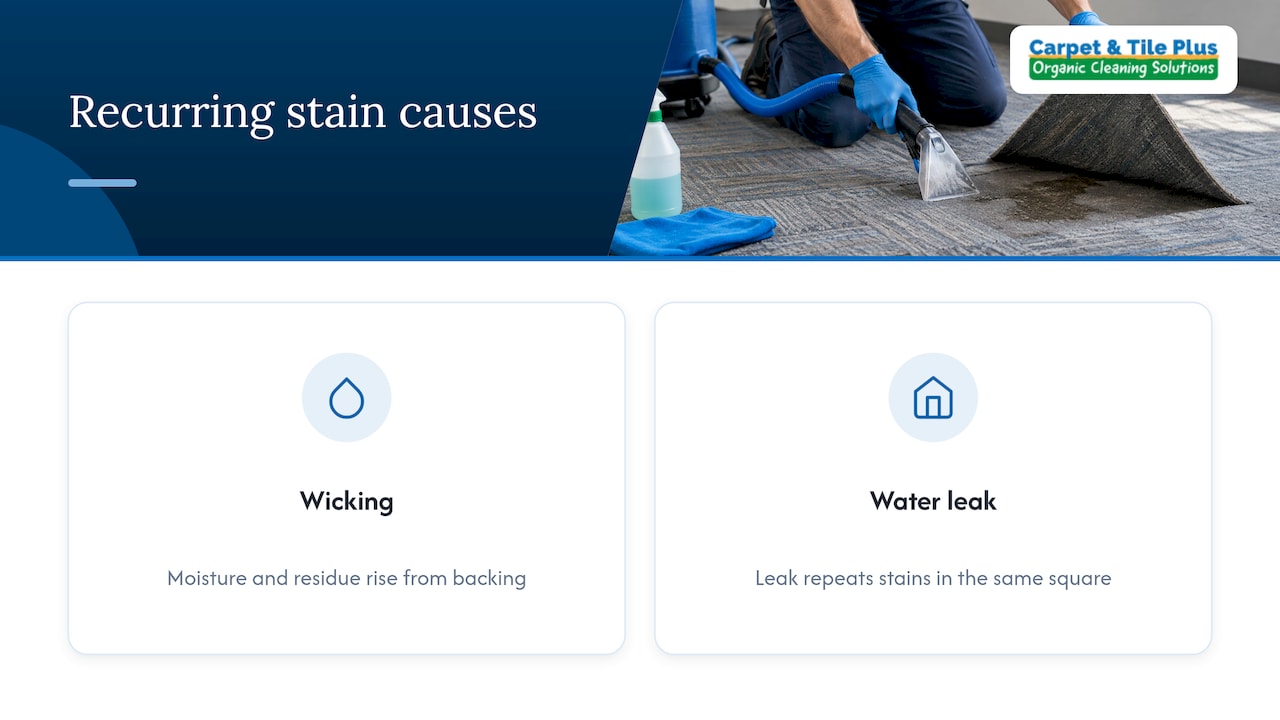
A spot that reappears after you have cleaned it is usually wicking: moisture and residue travel up from the backing as the tile dries. Sometimes the cause is not a spill at all. Water entering from above, such as a leaking pipe or roof, leaves repeat stains in the same square. Reading what a ceiling water stain is telling you helps you decide whether you have a cleaning problem or a building problem, because no amount of cleaning holds up against an active leak.
For stubborn or widespread stains, our guide to the types of carpet stains professional cleaners remove explains which ones respond to which treatments.
Interim and deep cleaning: choosing a method
Vacuuming removes dry soil. Over time, though, oily, sticky residue bonds to fibers and makes the carpet look dull and gray, especially along walkways. That is when interim and restorative cleaning come in.
The main methods
| Method | How it works | Best for | Notes |
|---|---|---|---|
| Low-moisture cleaning | Minimal water with agitation and extraction | Regular interim cleaning in occupied buildings | Fast drying keeps areas open |
| Encapsulation | A solution is applied and brushed in, dries to crystals that are vacuumed away | Interim maintenance between deep cleans | Interface says it typically dries in 30 to 60 minutes |
| Hot-water extraction | Hot water and cleaning solution are injected and extracted | Periodic restorative cleaning | Needs strong extraction and airflow to dry well |
| Bonnet cleaning | A rotary machine with an absorbent pad | Surface appearance only | Uline does not recommend it for carpet tile |
The encapsulation steps come from Interface’s maintenance guide: vacuum first, apply the solution, brush it gently through the fibers, let it dry into crystals, then vacuum again. The same guide says encapsulation typically dries in 30 to 60 minutes, depending on humidity, airflow and air temperature.
Uline adds a useful rule of thumb: always vacuum before encapsulation, and follow with hot-water extraction after every third encapsulation so residue does not accumulate. On bonnet cleaning, the same guide says it is not recommended for carpet tile.
Why low-moisture suits most commercial floors
Businesses rarely have a day to spare. A floor that stays wet for hours means closed rooms, rerouted foot traffic and a higher chance of wicking or mildew. Low-moisture cleaning is built for that reality. If you want to understand the technique, we explain it in what low-moisture carpet cleaning is.
How often to clean commercial carpet tiles
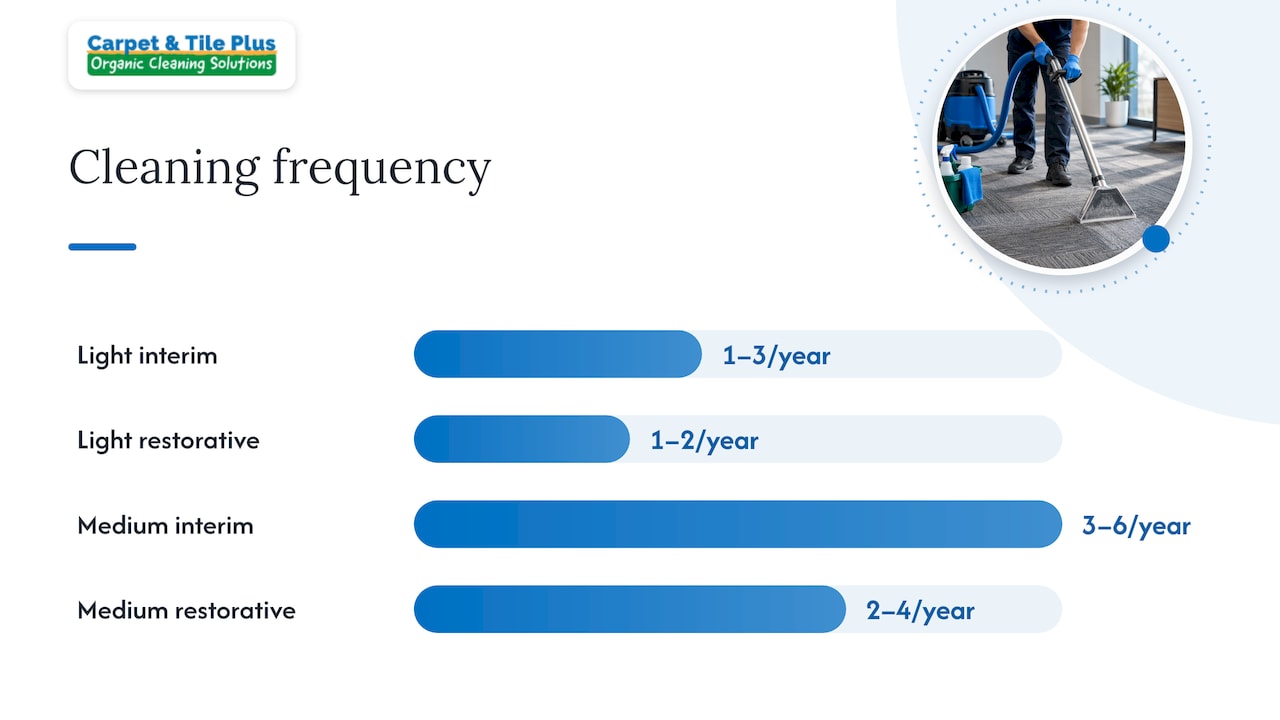
The honest answer is: by traffic, not by calendar. CRI 204 says to schedule deep cleaning according to how effective maintenance is, where the carpet is, traffic intensity and manufacturer requirements, and to do it before soil is easily visible. Waiting until the floor looks dirty means you are already behind.
Interface’s U.S. frequency chart gives a concrete starting point:
| Traffic level | Vacuuming | Spot cleaning | Interim maintenance | Restorative cleaning |
|---|---|---|---|---|
| Light (under 500 foot traffics per day) | 1 to 2 times weekly | Daily or immediate | 1 to 3 times a year | 1 to 2 times a year |
| Medium (500 to 1,000 per day) | Daily in traffic areas, overall 3 to 4 times weekly | Daily or immediate | 3 to 6 times a year | 2 to 4 times a year |
Both rows come from Interface’s U.S. carpet tile maintenance guide.
Putting it into practice
A small professional office with a few dozen visitors a day sits in the light bracket. A medical practice, a busy real estate or insurance office, or a school corridor will land in medium or above. Many buildings combine both: a quiet back office and a heavily used front lobby. Map your floor in zones and give each zone its own schedule. Our guide on how often office carpets should be professionally cleaned walks through that approach, and the commercial office carpet cleaning checklist for managers turns it into a task list you can hand to your team.
Drying, residue and protecting the tiles
A cleaning is only finished when the floor is dry and residue-free. CRI 204 is specific about what that takes:
- Extract thoroughly so little moisture remains.
- Use ventilation, HVAC, air movers or dehumidifiers to speed drying.
- Keep people off damp carpet until it is completely dry, and post wet-floor signs.
- Rinse or remove cleaning agents as required, because leftover residue attracts dirt and causes rapid resoiling.
- Add airflow to reduce wicking.
- Do not put chair mats back until the carpet is dry.
These points are in the CRI 204 guidance on drying and residue. The chair mat rule is easy to overlook: a mat on damp tile traps moisture and can leave a ring that looks like a stain.
One scheduling tip: book deep cleaning for the end of a workday or a weekend, and schedule it before a major event such as a client visit or a move-in, not on the day of it.
Our perspective on carpet tile cleaning
We have cleaned commercial floors in the northwest suburbs for over 20 years, and the pattern is the same almost everywhere. Facilities that keep a steady routine rarely need a rescue job. Facilities that wait for visible stains end up paying more and closing more space.
Our approach is built around the way businesses actually operate. We use low-moisture methods so floors are dry in about an hour, which means a crew can clean a lobby in the evening and the doors open on a normal morning. Our IICRC-certified technicians work with organic cleaning products, so the process is safe for the people in the building, from staff to visitors.
Our advice is to keep daily vacuuming and spot care in-house, and bring us in for the interim and restorative cleanings that need the right equipment and trained hands. That split gives you the best-looking floor for the least disruption, and we stand behind the work with a 100% satisfaction guarantee.
Joe
Professional commercial cleaning from Carpet and Tile Plus
If you manage a property in Arlington Heights, Elgin, Palatine, Schaumburg-area offices or anywhere else in the northwest suburbs, we can take the deep and interim cleaning off your plate. Our commercial carpet cleaning service is delivered by IICRC-certified cleaners using organic products and low-moisture methods, with floors dry in about an hour. Commercial carpet cleaning is published at $200-$500 for a one-off job, and you can see how pricing works on our carpet cleaning cost page.

Hard surfaces matter too. Entry vestibules, restrooms and break rooms often have tile, and clean carpet next to dirty grout undercuts the whole impression. Our commercial tile and grout cleaning covers those areas, and our commercial carpet cleaning best practices article explains how we plan a job for a working building.
A simple annual plan for your floors
Put the pieces together and the year looks like this:
- Every day: vacuum entrances, lobbies and main corridors; treat spills immediately with the right product.
- Every week: vacuum the rest of the floor according to your traffic level.
- Several times a year: schedule interim cleaning on a calendar for high-traffic zones, using a low-moisture or encapsulation approach.
- Once or twice a year at minimum: restorative deep cleaning, more often in medium or heavy traffic.
- After any leak or major spill event: inspect, dry fully, then clean the affected tiles.
Keep a short log of dates and zones. When a tile does fail, spare tiles from the original installation lot let you replace it without a visible mismatch, so store a few somewhere dry.
FAQ
Can you clean carpet tiles the same way as regular carpet?
Mostly, yes, but with more attention to the manufacturer’s rules. Carpet tile is chemically sensitive, so use pH-neutral products and avoid strong alkaline or solvent-heavy cleaners. Let the floor dry fully before returning furniture or chair mats.
How long does it take for commercial carpet tiles to dry?
It depends on the method, humidity, airflow and temperature. Encapsulation typically dries in 30 to 60 minutes according to Interface. With our low-moisture approach, we aim for a one-hour dry time so most areas reopen quickly.
Should I replace a stained carpet tile or clean it?
Try proper spot treatment first: blot, pretest, and use a product matched to the stain. If a tile is stained by a repeating source such as a leak, fix the source first. A professional can then advise whether cleaning will restore the square.
How much does commercial carpet cleaning cost in the northwest suburbs?
Our commercial carpet cleaning is published at $200-$500 per one-off job. The final figure depends on the space, so contact us with your square footage and traffic level.
Sources
- CRI 204 Commercial Carpet Standard for Maintenance and Cleaning
- Interface U.S. Carpet Tile Maintenance Guide
- Interface Carpet Tile Cleaning and Maintenance Guide
- Uline Commercial Carpet Tile guide
- Ceiling Water Stain Causes: What the Spot Is Telling You