
Spraying a sanitizer or disinfectant into your air ducts is not something the EPA has approved. The agency says HVAC systems are a unique place to use these products, and that without adequate data their use there could lead to significant indoor exposures with potentially unreasonable adverse effects. Physically cleaning dust and debris out of the system is a different job, and it is the one that makes sense when your ducts actually need attention. Below is how to tell the two apart, when a chemical is ever appropriate, and what to ask before a technician sprays anything in your home.
TL;DR
- Duct sanitizing means applying a chemical to kill bacteria on duct surfaces. Duct cleaning means physically removing dirt and debris. They are not the same service.
- The EPA has not found that chemical biocides in ducts are proven effective, and it has not assessed the health risks to occupants or applicators.
- No chemical biocides are registered for internally insulated ducts, fiberglass duct board or fiberglass-lined ducts.
- Chemicals are a last resort, used only after cleaning, only where visible microbial growth cannot be removed by physical means, and only strictly by the label.
- A technician who promises to “sanitize your whole system” with a fogger or a spray into the return deserves hard questions.
Table of Contents
- Sanitizing and cleaning are two different services
- What the EPA says about chemicals in air ducts
- It is also a legal question
- Health risks of chemical treatment
- Do you need your ducts sanitized at all?
- When a chemical might be appropriate
- What to ask before you agree to any duct treatment
- What clean ducts do and do not give you
- Our perspective
- Air duct cleaning from Carpet and Tile Plus
- FAQ
- Sources
Sanitizing and cleaning are two different services
The two terms get mixed up in advertising, so start with the definitions.
The National Air Duct Cleaners Association (NADCA) describes source removal as physically removing contaminants and debris from the internal surfaces of an HVAC system. That is brushing, agitation and vacuum collection. No chemical is needed to do it.
Sanitizing is a chemical step. The same NADCA white paper explains that a sanitizer kills a high percentage of bacteria on a surface (99.9%) but not all of it. The EPA’s own definition is similar: a sanitizer reduces a bacterial population in significant numbers without destroying all bacteria.
Two things follow from that:
- A sanitizer is not a sterilizer. “Hospital clean ducts” is a marketing line, not a result.
- Sanitizing a surface does nothing about the dust, debris or pet hair sitting on it. Cleaning has to come first.
If you want a plain walkthrough of what a physical cleaning visit looks like, our HVAC duct cleaning process guide covers it step by step.
What the EPA says about chemicals in air ducts
The EPA has been consistent on this for years, and its position is the best starting point for a safety question.
Efficacy and exposure have not been demonstrated
In its homeowner guidance, the EPA states that research has not demonstrated either the effectiveness of chemical biocides in duct cleaning or their potential adverse health effects. It also warns that simply spraying these materials into an operating duct system may carry much of the material through the system and release it into other areas of the home.
That last point matters for safety. A duct system is built to move air to every room. Anything sprayed into it goes where the air goes.
The agency has flagged the issue formally
In a 2006 Federal Register notice published December 29, 2006, the EPA said it was concerned that data showing efficacy of antimicrobial products in air ducts had not been submitted for review. It added that use in HVAC systems poses potential exposure and health risks to applicators and building occupants that the agency had not assessed.
The EPA’s later supplemental guidance repeats the point: before it can decide whether a product label may include HVAC use, it needs to conduct a risk assessment. The same guidance notes that affected labels should carry a “Do Not Use” statement for air ducts and other HVAC components, as set out in the EPA’s page on disinfectants and sanitizers in HVAC systems.
What is registered, and what is not
The EPA’s homeowner guide says no chemical biocides are currently registered for use in internally insulated air duct systems. No products are registered as biocides for fiberglass duct board or fiberglass-lined ducts. The registered products are solely for the smooth surfaces of unlined, bare sheet metal ducts.
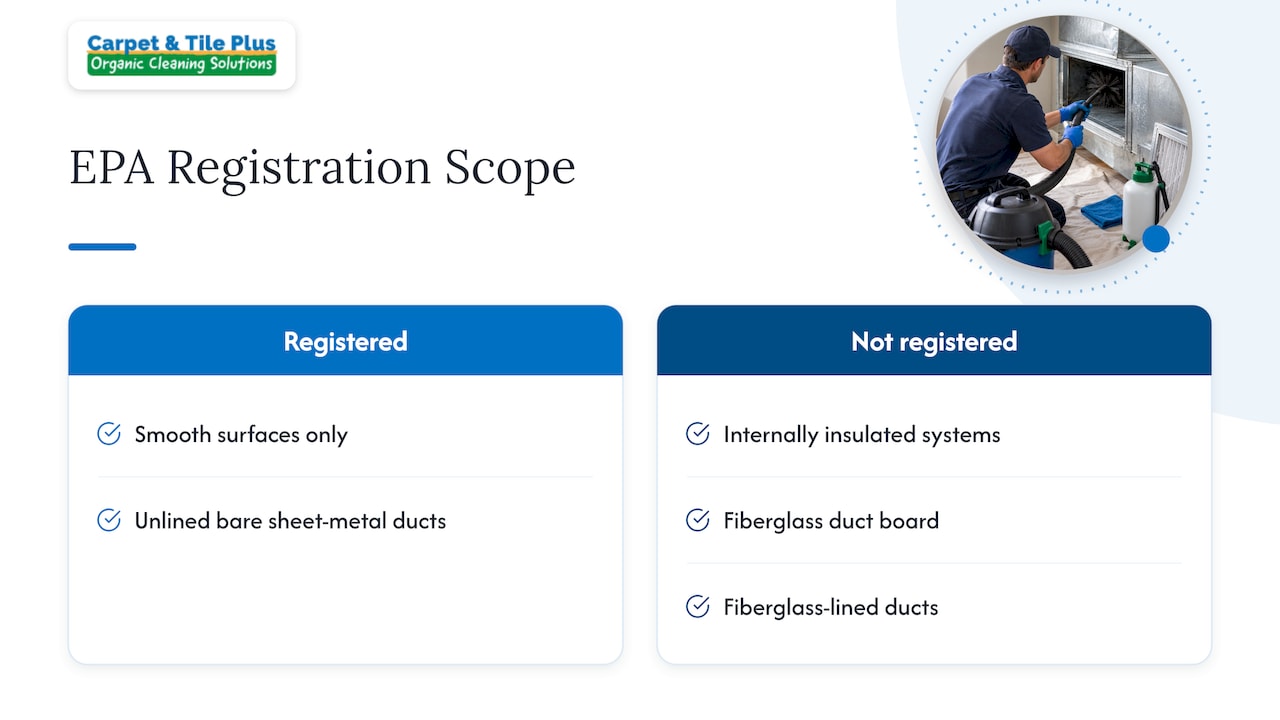
In many homes that is a narrow slice of the system. Lined plenums, flex duct and duct board are common, so a blanket “we sanitize your whole system” claim runs straight into this limit.
It is also a legal question
Pesticide labels are law. Under FIFRA section 12(a)(2)(G), it is unlawful to use a registered pesticide in a way that is inconsistent with its labeling. The federal regulation notes that a person who knowingly violates this provision faces criminal sanctions and that other failures can bring civil penalties.
NADCA’s president, Mark Zarzeczny, has put it bluntly: HVAC contractors cannot legally say they are sanitizing or disinfecting ductwork in the United States, and using antimicrobials against their labels violates federal law. He also advised technicians not to claim they are disinfecting or sanitizing ductwork, because the chemicals are not 100% effective.
For you as the customer, this is about safe use. A product applied in a way its label does not allow has not been tested for that use, and nobody has assessed what it does to the people breathing the air afterward.
Health risks of chemical treatment
NADCA’s white paper lists the possible risks of chemical products in HVAC systems: allergic reactions, chemical burns, respiratory irritation or damage, eye injuries, poisoning, toxic fumes, and exposure to carcinogens. Not every product causes every effect, and the risk depends on the product, the dose and the application. It is still a long list for something sprayed into the air path of a bedroom.
The EPA adds two specific cautions:
- Some people may react negatively to biocides or ozone, with adverse health reactions.
- If a product label says to rinse with water, the added moisture could stimulate mold growth inside the ducts.
Who should be especially careful
If anyone in your home has asthma, other respiratory conditions, chemical sensitivities, or is pregnant, an infant or elderly, talk with their physician before any chemical goes into the HVAC system. This is the kind of situation where the label and the doctor, not the sales pitch, should decide.
Fumes and re-entry
NADCA’s white paper says occupants may need to leave the building during a chemical application, and that fumes typically take 2 to 8 hours to clear. Zarzeczny gives the same range. If a company tells you there is no odor and no need to leave, ask to see the product label.
Physical cleaning has its own cautions
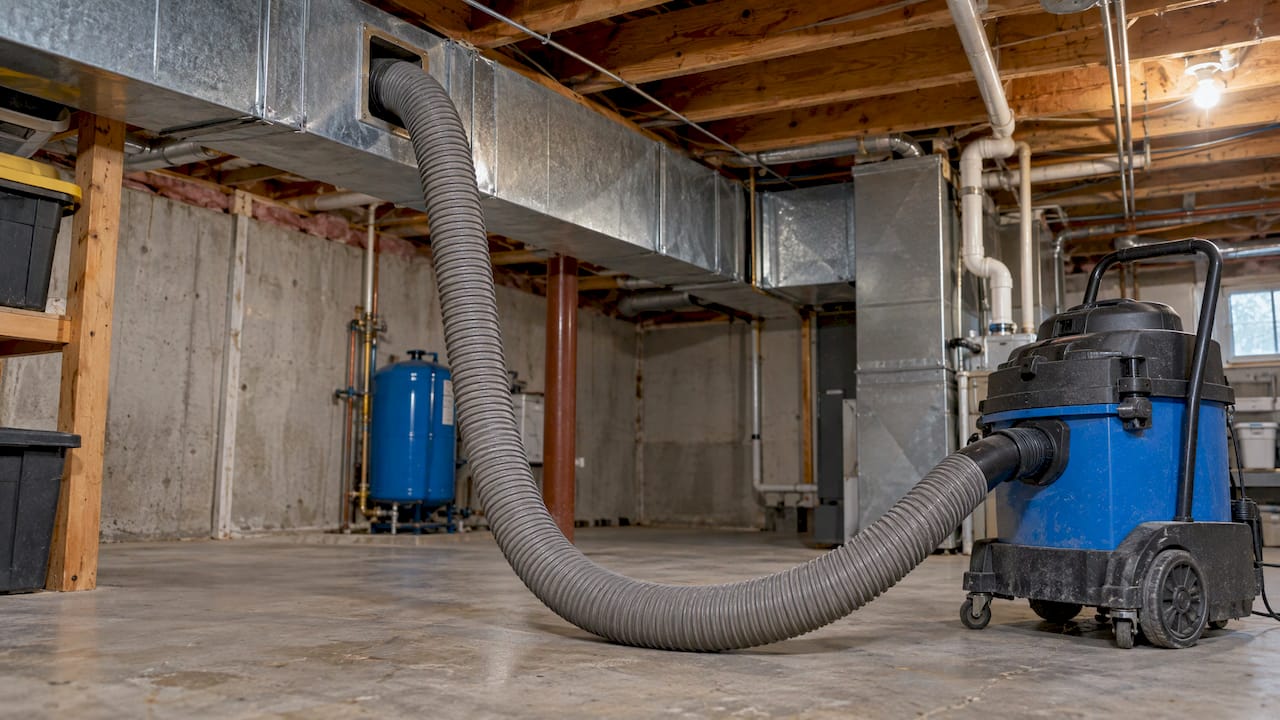
Safety is not only about chemicals. UGA Extension notes that cleaning can release particles that have adhered to the ducts, sticking to oil residues from manufacturing or corrosion-prevention oil on galvanized sheet metal. That can briefly raise contaminant levels in the air. This is why method matters: a proper cleaning keeps the system under negative pressure with a high-powered collection vacuum, so loosened debris is captured and not pushed into your rooms.
Do you need your ducts sanitized at all?
For most homes, the evidence does not point to sanitizing. Here is what the EPA and academic sources say about the underlying question of cleaning.
The EPA does not recommend routine duct cleaning, only cleaning as needed. It says cleaning has never been shown to actually prevent health problems, and that there is no evidence a light amount of household dust in ducts poses a health risk. UGA Extension cites a review of 48 research studies that reached the same conclusion about health outcomes, and found that cleaning heavily contaminated return ducts resulted in only an 8 percent increase in airflow.
That does not mean cleaning is never warranted. The EPA names three conditions where it makes sense:
- Visible mold growth inside ducts or on other HVAC components.
- Vermin infestation in the ducts.
- Excessive dust and debris released into the home from supply registers.
Our page on the three EPA-backed triggers goes through each one, and our 5 signs it is time to clean your ducts helps you spot them. If you suspect mold, this overview of mold in HVAC systems lays out what to do in the first hours and days.
A separate note on fuel-burning appliances: the EPA recommends inspecting and servicing furnaces, stoves and fireplaces before each heating season to protect against carbon monoxide poisoning. That matters more for your safety than any duct treatment.
When a chemical might be appropriate
There are narrow cases where a biocide comes up, and the rules around them are strict.
Visible microbial growth
The EPA says that before you let a provider use a chemical biocide in your ductwork, the provider should:
- Show you visible evidence of microbial growth.
- Explain why that growth cannot be removed by physical means such as brushing.
- Show you the biocide label describing its range of approved uses.
- Apply it only to un-insulated areas of the duct system, after proper cleaning.
- Use the product strictly according to its label.
NADCA’s white paper agrees that chemical application is acceptable only when the product is legally approved for the way it will be used.
Flood water or sewage
NADCA says HVAC components exposed to flood water or sewage should be assumed to contain disease-causing organisms and be disinfected before going back into service. Because no disinfectants are registered for use in air ducts, such a system needs evaluation by a qualified individual, and sections of duct may have to be replaced. In this case, bring in your insurer and an HVAC professional before anyone runs the system.
What to ask before you agree to any duct treatment
Use this list when a company proposes sanitizing, fogging, sealing or “antimicrobial treatment.”
| Ask this | What a safe answer looks like |
|---|---|
| What exactly will you apply? | A named product, with its label and safety data sheet available on site |
| Does the label list air ducts as an approved use? | Yes, with the label shown to you, and the duct type matches (bare sheet metal only) |
| Why is it needed? | Visible microbial growth you can see, with photos or a camera view |
| Why can’t brushing and vacuuming remove it? | A specific reason, not a general claim |
| Will you clean first? | Yes, chemicals only after proper physical cleaning |
| Do we need to leave the house? | A direct answer with a time frame, and a release for you to sign |
The NADCA white paper also says OSHA requires a safety data sheet to be available at any job site where chemicals are used, that workers must be trained to follow the label, and that respiratory protection must be worn where required. It recommends that the client review the product label and data sheet before authorizing the work and sign a release naming the specific products and acknowledging the risks.
Red flags
Zarzeczny has said he has seen people use foggers or just spray chemicals into a return while charging a lot of money and claiming it treats the whole system, when it does not, and he called that fraudulent. Warning signs include:
- A very low advertised price that grows once the technician is in your home.
- Claims that the service “kills all mold” or “purifies” your air.
- Refusal to show a product label.
- No mention of cleaning, only spraying.
- Pressure to decide on the spot.
Our guide to air duct cleaning scams covers more of these tactics, and our homeowner checklist for 2026 turns them into a pre-booking list.
What clean ducts do and do not give you
Set expectations honestly. Zarzeczny notes that after a system is turned back on, ducts can become contaminated again for reasons outside a technician’s control, including return air and fresh air intakes. A good provider tells you that up front.
What a physical cleaning can reasonably do is remove visible debris, dust buildup or pet hair that is showing up at your registers. Pairing that with regular filter changes helps keep the system cleaner between visits. For the wider picture, see our pages on why air ducts need regular cleaning and whether cleaning improves home air quality.
Our perspective
We get this question from homeowners across the Northwest Suburbs, and our answer is the same each time: start with the cleaning, and treat the spray as the exception.
The sources here are clear. The EPA has not found chemical biocides in ducts to be proven, and no product is registered for lined ducts. So when a family in Palatine or Arlington Heights asks us whether their ducts need “sanitizing,” we focus on what the evidence supports: are there signs of visible mold, pests, or heavy debris coming out of the registers? If so, a thorough physical cleaning is the right first step.
We are a family-owned company with more than 20 years in the industry, and we are IICRC-certified. That background shapes how we talk to customers: we would rather explain what a service does and does not do than sell a bigger promise. Honest scope is the reason many of our customers come back and recommend us.
If you are unsure whether your system needs anything at all, call us and describe what you are seeing. We will tell you plainly whether cleaning makes sense for your home.
Joe
Air duct cleaning from Carpet and Tile Plus
If your ducts show one of the EPA’s three triggers, or you simply want a straight answer on what your system needs, our team can help. We are a local, family-owned company serving homeowners and businesses in Arlington Heights, Palatine, Bartlett, Elgin, Barrington, Streamwood, Hoffman Estates and nearby Northwest Suburbs of Chicago, with IICRC-certified cleaners.
See our air duct cleaning service for details, or visit Carpet and Tile Plus to request an appointment. We do not publish a price for air duct cleaning, so contact us for a quote based on your home.
FAQ
Is duct sanitizing safe for my family?
The EPA says the health risks of chemical biocides in ducts have not been demonstrated or assessed, and that spraying them into an operating system can spread the material through your home. Possible effects listed by NADCA include respiratory irritation, allergic reactions and toxic fumes. If anyone in your household has asthma or chemical sensitivities, speak with their doctor before agreeing to any application.
Is duct sanitizing legal?
Using a pesticide in a way its label does not permit is unlawful under FIFRA. Many sanitizer labels either do not list air ducts or carry a “Do Not Use” statement for them. A provider should be able to show you a label that lists duct use for the specific duct material in your home.
How is duct sanitizing different from duct cleaning?
Cleaning physically removes dust and debris from the system’s internal surfaces. Sanitizing applies a chemical meant to reduce bacteria on a surface, and it does not remove the debris. The EPA says chemicals, if used at all, should come only after proper cleaning.
How do I know if my ducts need cleaning?
The EPA points to visible mold growth, vermin infestation, or excessive dust and debris coming out of your supply registers. A light layer of household dust inside the ducts is not considered a health risk. If you see any of the three signs, have a qualified provider inspect the system.
Sources
- EPA: Use of Disinfectants and Sanitizers in Heating, Ventilation and Air Conditioning Systems
- EPA: Should You Have the Air Ducts in Your Home Cleaned?
- EPA Federal Register notice, December 29, 2006
- NADCA White Paper: Using Chemical Products in HVAC Systems
- NADCA: The Truth About Disinfection
- 40 CFR 170.9, Violations of this part
- UGA Extension: HVAC filters, duct cleaning, and indoor air quality
- Mold in HVAC: EPA-backed 24 to 72 hour actions for homeowners