
A workable commercial tile cleaning schedule has four layers. Daily dust mopping or damp mopping with a neutral cleaner. Weekly scrubbing of grout lines. Monthly deep scrubbing in restrooms, kitchens and entrances. Professional deep cleaning every three to twelve months, depending on traffic and what gets tracked onto the floor. A restaurant kitchen sits at the short end of that range. A quiet office corridor sits at the long end.
Below, you’ll find what goes in each layer, how to adjust it for your building, and the signs that tell you the schedule has slipped.
TL;DR
- Daily: remove loose soil, then damp mop or auto-scrub with a pH-neutral cleaner. Spot-clean spills as they happen.
- Weekly: scrub grout lines, with extra attention to restrooms, entrances and food areas.
- Deep cleaning: roughly monthly for food service and busy restrooms, quarterly to annually for offices and retail with lighter traffic.
- Harsh acids and strong alkaline cleaners shorten the life of grout, so the daily product matters as much as the frequency.
- Dark grout, dull tile after mopping and lingering odor are the signs that it’s time to book a professional deep clean.
Table of Contents
- Why a written schedule beats “clean when it looks dirty”
- Start with four facts about your floor
- The daily tasks
- The weekly tasks
- Monthly and quarterly tasks
- Sample schedule by type of business
- How traffic, soil and room type change the schedule
- Signs your schedule needs a professional deep clean
- How to build your own schedule in six steps
- Professional commercial tile and grout cleaning in the Northwest Suburbs
- FAQ
- Sources
Why a written schedule beats “clean when it looks dirty”
Tile hides soil well, and grout hides it better. Grout is a porous, cement-based material, so it absorbs whatever the mop pushes into it: grease, tracked-in dirt, spilled drinks and the residue of the cleaning products themselves. By the time grout looks dark, the soil is already deep.
A written schedule fixes three problems at once:
- Consistency. Night crews, day porters and outside vendors all do the same tasks at the same intervals.
- Budget. Professional deep cleans become a planned line item instead of an emergency after a failed inspection or a bad review.
- Floor life. Regular, gentle cleaning keeps abrasive soil from wearing the surface and keeps grout from breaking down early.
One caution before the schedule itself: there is no single universal interval. Maintenance methods and frequency depend on the floor, including traffic volume, how close the floor is to contaminants and what the space is used for. The numbers below are working ranges to start from, then adjust.
Start with four facts about your floor
Before you set any frequency, write down:
- Tile type: ceramic, porcelain, quarry tile or natural stone. Stone is more sensitive to cleaner chemistry.
- Grout type: sanded, unsanded or epoxy. Epoxy and some premium grouts resist stains far better than standard cement grout.
- Sealer status: sealed or unsealed. Sealed grout responds differently to cleaning than raw grout.
- Surface finish: polished, matte or textured anti-slip. Textured tile holds more soil in its profile and often needs more aggressive agitation.
This takes ten minutes and prevents the most common scheduling mistake: using the same product and frequency for every tiled area in the building.
The daily tasks
Daily work keeps loose grit from becoming ground-in soil.
- Dust mop or sweep first. Grit under a wet mop acts like sandpaper and gets pushed into grout lines.
- Damp mop or auto-scrub with a neutral cleaner. MAPEI’s maintenance guidance recommends a mild, neutral-pH detergent and warns that strong alkaline, acidic, abrasive and ammonia-based cleaners can damage stone and grout.
- Change the water often. MAPEI’s technical documentation says to change cleaning water when it gets dirty or every 500 sq. ft., so soil isn’t redeposited on the floor.
- Spot-clean spills immediately, especially anything sugary, oily or acidic.
- Place and clean entrance mats. Most of the soil on a lobby floor walks in from outside.
Tile manufacturer Metro Ceramics gives a concrete daily mix in its commercial cleaning and maintenance guide: a 4-gallon bucket of hot water with 8 oz. of neutral cleaner. Always follow the product label and the tile maker’s instructions for your specific floor.
The weekly tasks
Weekly work is where grout gets attention that a daily mop can’t give it.
- Scrub grout lines with a swivel scrub brush or a machine with a nylon-bristle brush. For large floors, MAPEI says a walk-behind or ride-on scrubber with nylon brushes or white nylon pads is beneficial.
- Work in sections. Metro Ceramics’ weekly method scrubs 10 x 10 ft. areas at a time, with a weaker solution than the daily mix (a 2-gallon bucket of hot water with 4 oz. of neutral cleaner), concentrating on stained areas and grout joints.
- Rinse and pick up the solution. Leftover cleaner leaves a film that attracts soil and makes tile look dull.
- Inspect. A weekly walk-through catches cracked grout, loose tiles and stains early. Write down what you find.
Monthly and quarterly tasks
This is the layer most businesses skip, and it’s the one that determines whether grout stays light or turns permanently dark.
- Monthly: deeper scrubbing in restrooms, kitchens, entrances, break rooms and any area where the floor is wet or greasy.
- Quarterly or semi-annually: full hot-water extraction or steam cleaning of the whole tiled area, which pulls soil out of grout pores that brushes only loosen. This is professional work in most buildings, because it takes truck-mounted or commercial equipment and trained operators.
- Annually: a sealing assessment. Sealer wears down with foot traffic, chemical exposure and repeated cleaning, so each deep clean is the right time to check whether grout still repels water. Our guide to sealing grout after professional cleaning explains how that works.
Timing matters here. After heavy-duty restorative cleaning, MAPEI recommends at least 48 hours of drying time before applying its UltraCare sealer. Plan sealing around a weekend or a slow period, not the morning after cleaning. The same MAPEI document notes that some grouts, such as its epoxy and high-performance lines, don’t require sealing at all, so check what you have before budgeting for it.
If you’re deciding when a sealer is due, this guide to maintenance schedules and traffic shows how a cleaning calendar is built and audited in a food-service setting, which carries over well to tiled kitchens and dining rooms.
Sample schedule by type of business
Use this as a starting template. Adjust upward for heavy traffic, wet conditions or food and biological soil.
| Area | Daily | Weekly | Monthly | Professional deep clean |
|---|---|---|---|---|
| Restaurant kitchen | Degrease and mop at end of every shift | Full scrub with grout brush | Deep scrub of grout and floor drains’ surrounds | Monthly to quarterly |
| Restaurant dining room | Sweep, damp mop | Grout line scrub | Spot treat high-traffic paths | Quarterly |
| Commercial restrooms | Mop and disinfect | Heavy-duty grout scrub | Detail corners, bases, around fixtures | Quarterly |
| Retail store | Dust mop, damp mop entrances | Grout scrub at entrances and checkout | Machine scrub of main aisles | Quarterly to semi-annually |
| Office lobby and corridors | Dust mop, damp mop | Damp mop throughout | Machine scrub | Semi-annually to annually |
| Medical or institutional | Clean and disinfect per protocol | Grout scrub | Machine scrub | Quarterly |
The professional deep-clean column is our working guidance from cleaning commercial tile in the Northwest Suburbs, not a regulation. Your own floor and your health inspector’s expectations come first.
How traffic, soil and room type change the schedule
Traffic. More feet means more grit, so the dry-removal step and the weekly scrub matter more. Entrances, checkout lanes, hallways to restrooms and elevator lobbies wear fastest. Clean those on a tighter cycle than the rest of the floor.
Moisture and grease. Kitchens, dish areas, bars, locker rooms and restrooms need more frequent work, because wet, greasy or organic soil feeds odor and mildew in grout. Grease soaks into grout, and a mop pass won’t pull it back out, so the monthly deep scrub is not optional in food areas. See our step-by-step on tile and grout cleaning in a commercial kitchen.
High-touch and high-traffic areas. The CDC’s guidance on cleaning and disinfecting a facility says high-touch surfaces are more likely to spread germs and that facilities may choose to clean more often, or disinfect in addition to cleaning, in high-traffic areas. It also notes that during certain disease outbreaks, local health authorities may recommend specific disinfection procedures. If that applies to you, add those steps to the schedule.
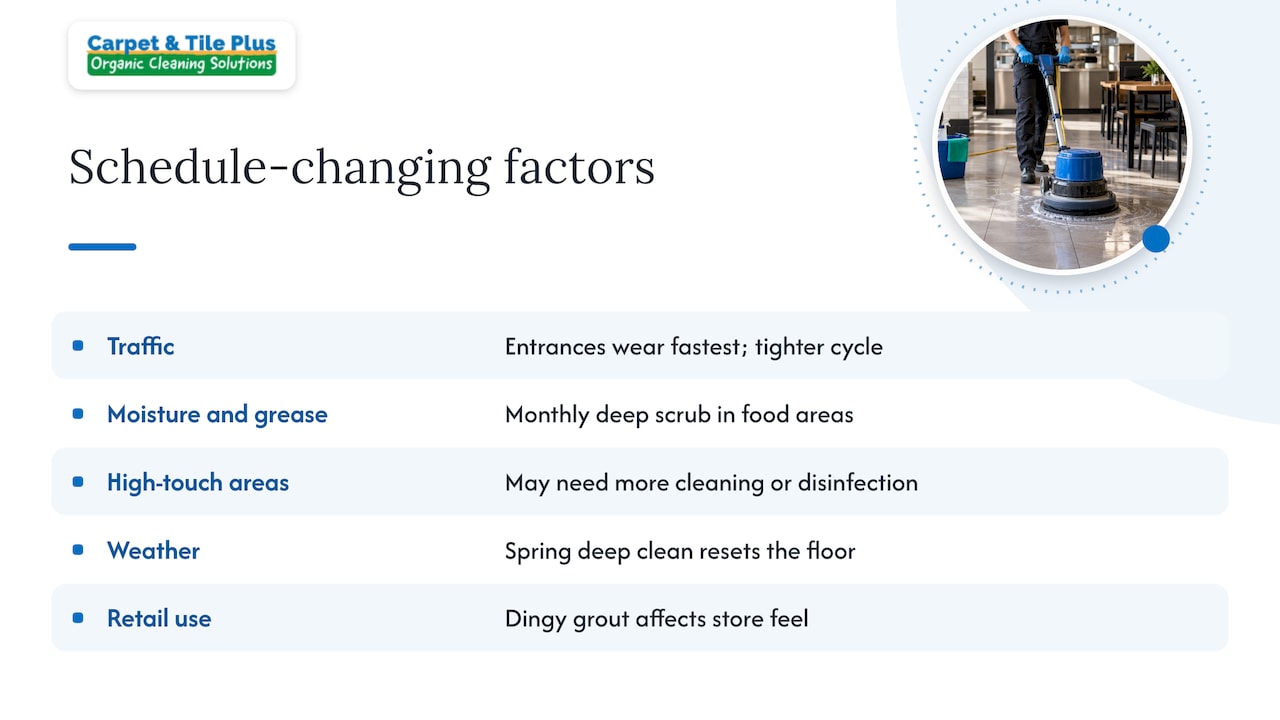
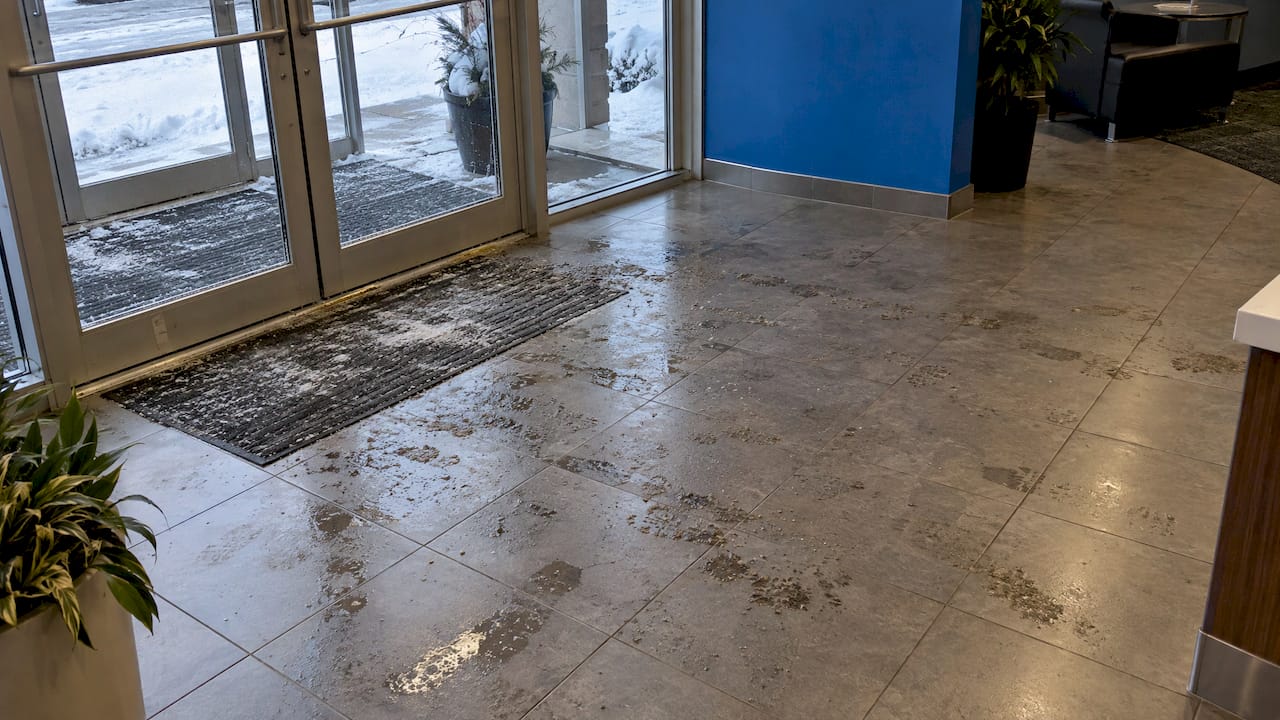
Weather. In the Chicago area, winter brings salt, slush and sand into every lobby. Many facility managers add an extra scrub of entrance tile after the snow season, and a deep clean in early spring is a natural point to reset the whole floor.
Retail and customer-facing spaces. Grout that looks dingy affects how a store feels before a customer reads a single sign. Our retail tile grout cleaning guide covers the aisles and entrances that matter most.
Signs your schedule needs a professional deep clean
A good schedule includes triggers that move a deep clean forward. Watch for:
- Dark grout that mopping doesn’t lighten. Soil has moved below the surface.
- Tile that looks dull right after cleaning. Usually this is residue or embedded soil, not worn tile.
- Odor that returns hours after mopping. Organic material in grout and under baseboards keeps releasing it.
- Uneven color, with lighter grout under mats and darker grout along walking paths.
- Water soaking into grout instead of beading, which suggests the sealer has worn.
- Mildew or staining in restrooms, showers and around floor drains.
- Floors that feel slippery or sticky even when clean. Residue and grease build-up can reduce traction.
If you see two or more, don’t wait for the next scheduled date. For an overview of what a heavy-traffic reset involves, read our guide to grout cleaning in high-traffic areas and see real project examples.
How to build your own schedule in six steps
- Map your floors. List every tiled area and mark it high, medium or low traffic, wet or dry, food or non-food.
- Record tile, grout and sealer details using the four facts above.
- Choose cleaners. Pick one pH-neutral product for daily and weekly work. A neutral range of about pH 6 to 9 is the commonly cited target, and strong alkaline or acid products stay out of routine use.
- Assign tasks and owners. Each line gets a person or crew, a time window and a sign-off.
- Book the professional visits for the year, aligned with your slow seasons, and leave enough drying time if sealing follows.
- Review quarterly. Check the inspection notes. If grout is darkening between deep cleans, shorten the interval.
A simple checklist posted in the janitorial closet works better than a long policy document that no one opens.
Our perspective
After more than 20 years cleaning floors across the Northwest Suburbs, we see the same pattern with commercial tile. Daily mopping gets done. The weekly grout scrub and the periodic deep clean get pushed back until the floor looks bad, and by then the job is bigger.
We believe the best schedule is a light one that actually happens, with a professional deep clean as its anchor. That is where our IICRC-certified technicians come in. We use organic cleaning products, and our methods are designed to leave floors dry in about an hour, so a restaurant, clinic or office doesn’t lose a day of business.
Our advice to managers: put the deep clean on the calendar before the floor forces your hand, and decide on sealing at the same visit. We back our work with a 100% satisfaction guarantee.
Joe
Professional commercial tile and grout cleaning in the Northwest Suburbs
We’re a local, family-owned company serving businesses in Arlington Heights, Palatine, Elgin, Bartlett, Streamwood, Barrington, Hoffman Estates, Elk Grove Village, Mount Prospect, Rolling Meadows, Lake Zurich and nearby towns. We clean commercial tile and grout with organic products, and we can set up a recurring deep-clean visit that fits your schedule.

See how it works on our commercial tile and grout cleaning page, or get in touch through Carpet and Tile Plus to talk about your floors and a cleaning frequency that suits them.
FAQ
How often should commercial tile floors be cleaned?
Sweep or dust mop and damp mop every day, scrub grout weekly, and schedule a deep clean monthly in food and restroom areas. Offices and retail spaces with lighter traffic can often stretch professional deep cleaning to quarterly or semi-annually. Heavier soil or wet conditions shorten that interval.
What cleaner is safe for routine commercial tile and grout care?
A mild, neutral-pH cleaner. MAPEI cautions that strong alkaline, acidic, abrasive and ammonia-based products can damage stone and grout. Follow the dilution on the label and the tile manufacturer’s instructions.
Does commercial grout need to be sealed?
Most cement-based grout benefits from sealing, and sealer wears down faster in high-traffic and wet areas, so check it at each deep clean. Some epoxy and premium grouts have very low absorption and don’t require sealing, according to MAPEI. Allow drying time after deep cleaning before any sealer goes on.
Can a deep clean be done without shutting down my business?
Often, yes. Our low-moisture methods are designed for about one hour of dry time, and we can schedule work before opening or after closing. Tell us your hours when you call.
Sources
- MAPEI: Maintenance of tile where non-cement grout was used (neutral cleaners, scrubbers)
- MAPEI: Maintenance of tile where non-cement grout was used (water changes, drying time, sealing)
- Metro Ceramics: Illustrated basic commercial cleaning and maintenance
- CDC: When and how to clean and disinfect a facility
- Foodservice cleaning calendar: schedule, audit, comply