
A gray traffic lane is the dull, darker path that forms where people walk most: down a hallway, in front of the sofa, from the door to the kitchen. It comes from two things working together: soil ground into the fibers and pile that has been bent, untwisted or crushed so it reflects light differently. Regular professional cleaning removes the soil part, and it is the best way to slow the rest. Here is how to tell what you are looking at and what to do about it.
TL;DR
- A traffic lane is partly dirt and partly pile distortion. Distorted fibers change how light reflects, so a lane can look dirty even after cleaning.
- Matting and shading are appearance changes. The Carpet and Rug Institute (CRI) says shading is a change in pile direction, not a change in color.
- Vacuum at least twice a week and have carpet deep cleaned every 12 to 18 months, more often in busy areas.
- Clean lanes before they become heavily soiled. Early cleaning does the most good.
- In Chicago’s Northwest Suburbs, we clean residential and commercial carpet with organic products and a one-hour dry time.
Table of Contents
- What a gray traffic lane really is
- Why soil builds up in the same spots
- Dirt, matting or wear: how to tell them apart
- What professional cleaning can and cannot change
- How to avoid damaging the lane when you clean
- Prevention: keep lanes from turning gray
- Signs it is time to call a professional
- What it costs in the Northwest Suburbs
- Perspective
- Get your lanes cleaned in the Northwest Suburbs
- FAQ
- Sources
What a gray traffic lane really is
Most people call it “dirty carpet,” and that is only half right. The lane shows up because repeated steps do something to the surface of the carpet. The Carpet and FabriCare Institute explains that repeated foot traffic can distort the pile or nap. Distorted or unraveled fibers alter how light refracts, which makes the carpet look darker or dirty, even after it has been cleaned.
The same source separates traffic-lane gray from ordinary soiling and from pooling or watermarking. That is why two carpets that were cleaned the same way can look different afterward. One had a soil problem. The other had a soil problem and a pile problem.
On the surface, a lane tends to show these signs:
- A path that looks flatter and darker than the carpet beside it
- Edges of the room, under furniture and along walls that still look fresh by comparison
- A dull look rather than a distinct stain, with no clear start or finish
- Fibers that lean in different directions or look frayed at the tips
Why soil builds up in the same spots
Foot traffic does more than flatten carpet. CRI’s guidance on heavier traffic notes that foot traffic wears on carpet and can grind in dirt. That is why higher-traffic areas need more attention than the rest of the floor.
In the Chicago suburbs, there is a seasonal factor. Winter brings road salt, slush and sand in through the entry. Spring brings mud. Both get tracked along the same route every day: door, mat, hallway, living room. Within a few weeks, that route is visibly darker than the rest of the room. Gritty soil acts like fine sandpaper under each step and dulls the fibers.
Because the path rarely changes, the lane repeats in the same place, year after year. It is easy to miss, because the change is gradual and you walk on it every day.
Dirt, matting or wear: how to tell them apart
The word “wear” has a specific meaning in the carpet industry, and it helps to know it. CRI’s technical bulletin says manufacturers define wear as loss of pile weight or pile fiber, usually ten percent, due to abrasive wear only. It adds that what looks like wear may actually be matting, crushing or fiber damage caused by soiling, with no loss of fiber at all.
In plain terms, a gray lane is often not worn out. Here is a practical way to sort what you are seeing:
| What you see | Likely cause | What helps |
|---|---|---|
| Dull, darker path that lightens when the carpet is cleaned | Embedded soil | Professional deep cleaning, then regular upkeep |
| Path that stays flat or looks different from a certain angle | Pile crushing or shading (change in pile direction) | Cleaning, then grooming the pile to lift fibers |
| Tips look fuzzy, untwisted or bunched together | Matting from yarn untwisting and tip intermingling | Cleaning and pile grooming; some change may remain |
| Thin spots, visible backing | True abrasive wear | Repair or replacement planning |
CRI also notes that matting is usually the result of untwisting of the yarn and intermingling of yarn tips from foot traffic. It is not considered a manufacturing defect unless the manufacturer’s warranty specifically cites it. If you think the lane is a warranty issue, read the carpet’s warranty before assuming it is covered.
A quick check you can do in a minute
Stand at one end of the hallway and look along the lane. Then walk to the other end and look again. If the lane changes tone depending on where you stand, you are probably seeing pile direction (shading or crushing). If it is dark from every angle and the carpet nearby is lighter, soil is a big part of the story.
Also press back a corner of the carpet under a sofa or inside a closet and compare that color to the lane. That untouched carpet shows you what the lane could look like when clean.
What professional cleaning can and cannot change
Cleaning can remove soil, and that is often the largest part of the difference you see. For a lane built mostly from embedded grit and film, a deep clean can make a visible difference. The CRI recommends professional deep cleaning every 12 to 18 months to remove embedded dirt and grime, and notes that some manufacturers require certified cleaning products.
The pile is the other half. The Carpet and FabriCare Institute says a properly cleaned lane may still look dirty when the pile or nap has changed. Fibers lying in different directions, unraveling or blooming are difficult to reverse. So the goal of cleaning is the best appearance the carpet’s current condition allows, and the best way to protect that is to clean early and often, before the soil builds up and the pile gets crushed into it.
Set expectations in two steps:
- Soil removal. This is where most homeowners see the improvement. The lane gets lighter and the color evens out with the rest of the room.
- Pile recovery. Grooming and drying the carpet properly helps fibers stand up and lie in a uniform direction. How much recovers depends on the carpet type, its age and how long the lane has been building.
Why drying time matters for lanes
A carpet that stays damp for hours is walked on while the fibers are soft, and that is when crushing and re-soiling happen. Low-moisture methods leave less water in the carpet to dry. Our approach is designed for a one-hour dry time, so the lane is not being walked into a wet pile all afternoon. That is a real benefit for a hallway you cannot block off, and for a business that has to reopen the same day.
How to avoid damaging the lane when you clean
Heavily soiled areas tempt people to scrub. CRI advises the opposite: use a Seal of Approval-certified cleaning product, follow its directions, use a small amount, and blot rather than scrub, to avoid fraying or changing the texture. Scrubbing a lane that is already untwisting can make the fuzzy, matted look worse.
This also explains why harsh or oversudsed products leave a lane looking dull afterward. Residue attracts new soil to the path you just cleaned. Our team uses organic cleaning products and a low-moisture process so there is less leftover film to pull dirt back in.
Prevention: keep lanes from turning gray
The cheapest fix for a gray lane is the one you do before it forms. CRI’s guidance for carpet maintenance points to a simple routine.
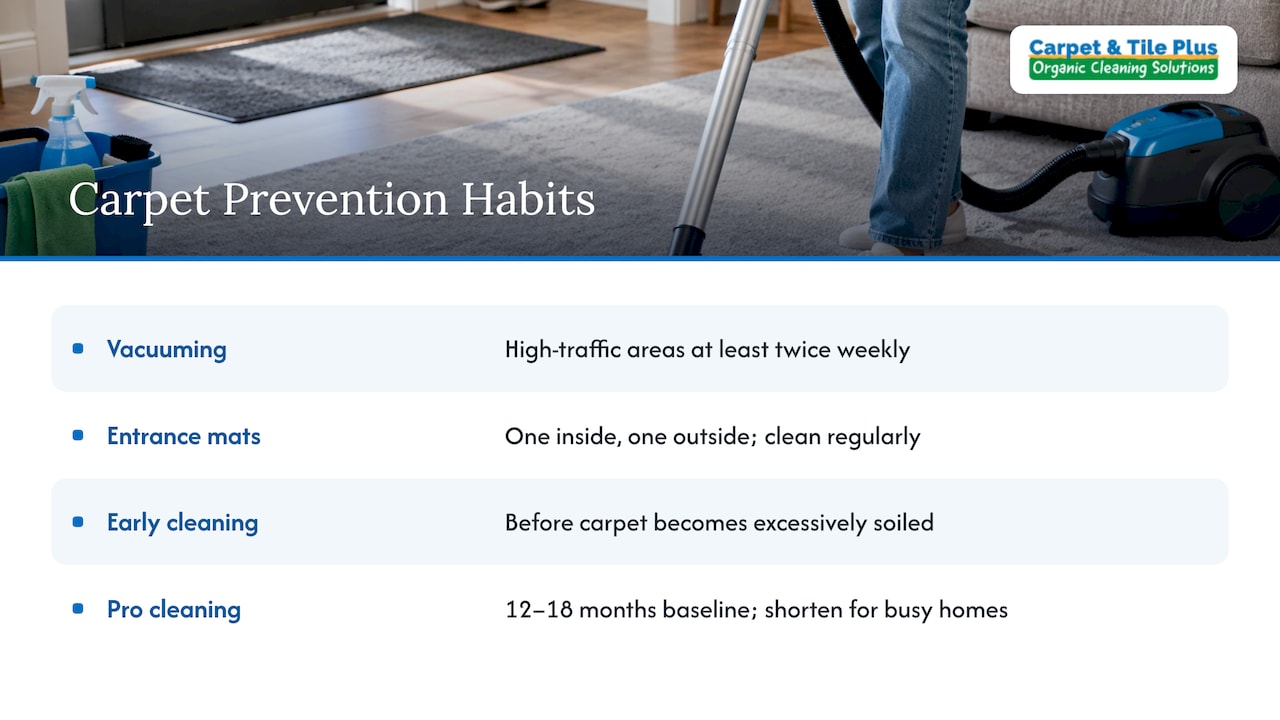
Vacuum often. The CRI FAQ advises vacuuming at least twice a week, including high-traffic areas, with a Seal of Approval/Green Label vacuum tested for soil removal, dust containment and carpet appearance retention. Grit is what grinds the fibers, so getting it out before it settles is the main job.
Stop soil at the door. A mat outside and a mat inside, cleaned regularly, catch much of the sand and salt that would otherwise end up in the lane. In a Chicago winter this does more than almost any other habit.
Clean before it looks dirty. CRI’s bulletin says the key to carpet beauty is to clean it regularly before it becomes excessively soiled. By the time the lane is obviously gray, the soil is deeper and the pile is more distorted.
Match the schedule to the traffic. The 12 to 18 month interval is a baseline for homes. Busier households shorten it. Our guides on how often carpets should be cleaned and how to choose a cleaning frequency walk through the factors. If pets share the house, see how often to clean carpets with pets.
Heavy-traffic and commercial carpet
Offices, clinics, retail and common hallways see far more traffic than a living room. For heavy and severe traffic areas, CRI recommends daily vacuuming with a commercial-grade vacuum, weekly low-moisture encapsulation interim cleaning, and deep cleaning monthly for severe areas or quarterly for heavy ones. Vacuuming is described there as the simplest and most important technique in commercial settings.
If you manage a building, our pages on office carpet cleaning frequency, a commercial office cleaning checklist and commercial carpet best practices help you set a schedule that keeps entrances and corridors looking consistent.
Choosing carpet that handles traffic
If you are replacing carpet, the Carpet and FabriCare Institute advises selecting carpet with components engineered for your application and maintaining it properly to help avoid replacement because of appearance changes. A carpet built for a bedroom is not built for a main hallway, and the right match delays the lane for years.
Signs it is time to call a professional
A lane is often the first obvious sign that carpet needs more than a vacuum. Other signs usually appear at the same time: odors when humidity rises, areas that feel gritty or sticky, allergy symptoms that seem worse indoors, or carpet that looks dull even in rooms with little traffic. Our list of signs your carpet needs professional cleaning covers nine of them.
Higher-end or delicate carpet needs extra care. Wool and specialty weaves can react badly to the wrong chemistry or too much moisture, which is why we wrote about gentle cleaning for high-end carpets. If you rent an apartment, see why apartment carpets need professional cleaning.
What it costs in the Northwest Suburbs
Our published pricing for one-off carpet cleaning is $120 to $300 for residential jobs and $200 to $500 for commercial jobs. The final figure depends on the size of the space and its condition, and a heavily built lane can affect the scope. You can see how we explain it on our carpet cleaning cost page.
Perspective
We see gray lanes in almost every home we clean, from Elgin to Arlington Heights. Homeowners often assume the carpet is worn out or that the last cleaning was done badly. In most cases, neither is true. The lane is the carpet doing its job in the one place everyone walks.
Our view is simple: the best results come from cleaning before the lane gets deep. That is why we built our service around low-moisture cleaning, organic products and a one-hour dry time. The lane is not walked on while wet, there is less residue to attract new soil, and the carpet is back in use quickly.
Our cleaners are IICRC-certified and we have more than 20 years of experience, and we stand behind our work with a 100% satisfaction guarantee. If you have a lane that bothers you, book a cleaning and we will give the carpet the best appearance its condition allows. Then keep it that way with a regular schedule.
Joe
Get your lanes cleaned in the Northwest Suburbs
We clean carpet for homeowners and businesses in Arlington Heights, Bartlett, Barrington, Elgin, Elk Grove Village, Hoffman Estates, Lake Zurich, Mount Prospect, Palatine, Rolling Meadows, Streamwood and nearby towns. Our IICRC-certified cleaners use organic products, and carpets are dry in about an hour.

See residential carpet cleaning or commercial carpet cleaning, or start at Carpet and Tile Plus to request a visit. If pets are part of the picture, we also offer pet stain and odor removal. Hard floors in the same hallway can be handled too, including tile and grout cleaning and vinyl plank floor cleaning.
FAQ
Why does my carpet still look gray after it was cleaned?
The lane may have a pile problem as well as a soil problem. When fibers are distorted, untwisted or lying in different directions, light reflects differently and the area can look dark even when it is clean. A cleaning removes the soil part, and grooming and proper drying help the pile.
Is a gray traffic lane the same as carpet wear?
Not necessarily. In the industry, wear means loss of pile fiber, usually around ten percent. A lane often comes from matting, crushing or soiling, with the fiber still there. Looking for thin spots or visible backing helps tell the difference.
How often should I clean a hallway that is turning gray?
CRI recommends a professional deep clean every 12 to 18 months as a baseline. Busy hallways, pets and kids usually call for more frequent cleaning. Vacuuming at least twice a week between cleanings keeps grit from settling.
Should I scrub the lane to get it clean?
No. CRI advises using a certified product sparingly and blotting instead of scrubbing, because scrubbing can fray fibers and change the texture. For a lane that bothers you, a professional cleaning is the safer route.
How much does carpet cleaning cost in the Northwest Suburbs?
Our one-off residential carpet cleaning is $120 to $300, and commercial carpet cleaning is $200 to $500. The range depends on the size and condition of the area. See our pricing page for details.
Sources
- Carpet Traffic and Wear Patterns, The Carpet and FabriCare Institute
- Carpet Maintenance and Troubleshooting Technical Bulletin, The Carpet and Rug Institute
- Cleaning and Maintenance, The Carpet and Rug Institute
- Frequently Asked Questions, The Carpet and Rug Institute
- Carpet Cleaning: Heavy and Severe Traffic Areas, The Carpet and Rug Institute