Eco-friendly air duct cleaning means cleaning the whole HVAC system with biodegradable, low-toxicity products and source-removal equipment that pulls debris out of the building, not just spraying something “green” into the ducts. For homes and businesses in Arlington Heights, Palatine, Elgin and the surrounding northwest suburbs, the label on the van matters less than three things: what goes into the system, how the dirt leaves the building, and whether the crew cleans every component, not only the duct runs. We are Carpet and Tile Plus, a local, family-owned company, and our IICRC-certified cleaners use organic cleaning products. Here is how to judge any eco-friendly duct cleaning offer.
What are the key takeaways for eco-friendly air duct cleaning?
- “Eco-friendly” has no legal definition for duct cleaning. Look for biodegradable, third-party-rated products, source-removal equipment and a full-system scope.
- The industry association NADCA says the whole HVAC system, not only the ductwork, needs cleaning, or the dirt comes back.
- The EPA names three situations where cleaning is clearly warranted: substantial visible mold, vermin, or heavy dust and debris blowing from registers.
- Get written estimates for the same scope and ask for product safety data sheets before anyone starts.
- We clean with organic products, IICRC-certified technicians and a 100% satisfaction guarantee, across the northwest suburbs.
Table of Contents
- What “eco-friendly” actually means for air ducts
- Products: what a greener cleaner looks like
- Method: how the dirt leaves your home
- Why “duct cleaning” has to mean the whole system
- When cleaning is warranted
- Can you stay home during the cleaning?
- How to vet an eco-friendly claim before you sign
- Our perspective
- Book eco-friendly air duct cleaning in the northwest suburbs
- FAQ
- Sources
What “eco-friendly” actually means for air ducts
No agency certifies a duct cleaner as “green.” The EPA says it does not set duct cleaning standards or certify, endorse or approve duct cleaning companies. So the word on a website is a promise from the company, and you have to translate it into things you can check.
There are two parts to a genuinely eco-friendly job:
- The products. What touches your ducts, coils and registers, and what goes down your drain or into the air.
- The method. Whether the dirt is captured and removed, or just moved around and released into your living space.
Most competing pages talk only about the first part. The second matters just as much, because a gentle product on a poorly contained job still puts dust in your rooms.
Products: what a greener cleaner looks like
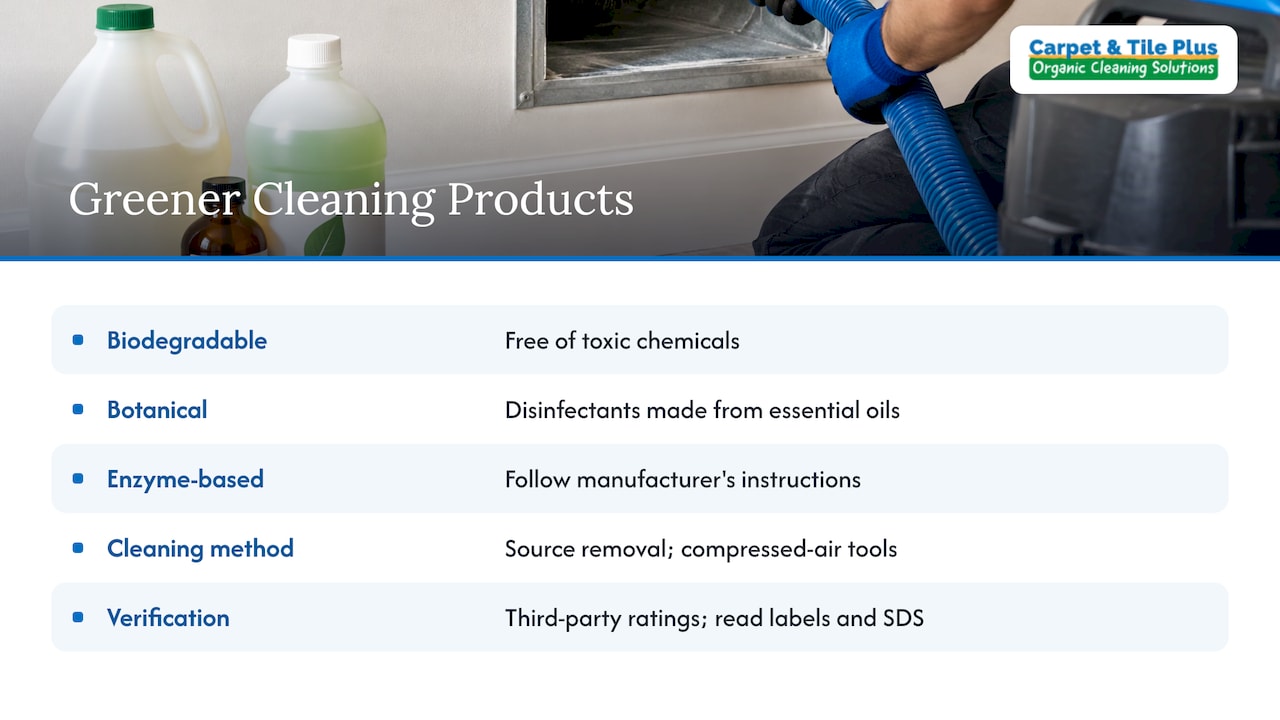
The National Air Duct Cleaners Association (NADCA) is the trade body that writes the cleaning standard for the industry. Its sustainable HVAC maintenance guidance points toward biodegradable cleaners free of toxic chemicals, botanical disinfectants made from essential oils, and enzyme-based cleaners used according to the manufacturer’s instructions. It also recommends source-removal cleaning, high-efficiency compressed-air tools, and responsible recycling and chemical-waste disposal.
The EPA explains why the product choice has an environmental side. In its guidance on greener cleaning products, it notes that volatile organic compounds (VOCs, chemicals that evaporate easily) in cleaning products can affect indoor air quality and contribute to smog outdoors. It also says some surfactants, the ingredients that lift dirt, break down slowly or turn into more harmful substances that threaten aquatic life once they reach the water supply.
How do you tell a better product from a marketing line? The Rutgers green cleaning guidance in the NJ Green Building Manual recommends products rated by independent third parties such as GreenGuard, Green Seal or the EPA’s Safer Choice program, and reading labels and safety data sheets. A safety data sheet (SDS, formerly called an MSDS) is the document that lists a product’s ingredients and hazards. Any professional should be able to hand you one.
Antimicrobials and sanitizers
If a company proposes an antimicrobial or sanitizing treatment, the rules are tighter. NADCA’s white paper on chemical products in HVAC systems says antimicrobial pesticides used in HVAC systems must be EPA-registered, that OSHA requires an SDS at job sites where chemicals are used, and that workers must wear appropriate protective equipment. Some EPA-registered products require the building to be evacuated during application. If you are weighing a sanitizing add-on, our guide on whether you should have your air ducts sanitized walks through the question.
Method: how the dirt leaves your home
A greener product does not help if the process spreads dust. According to NADCA’s description of proper cleaning methods, technicians use agitation tools such as brushes, air whips, compressed-air nozzles or “skipper balls” to break contaminants loose. Meanwhile the whole system is held under continuous negative pressure, so fine particles are drawn out and removed from the home instead of drifting into the rooms.
The EPA’s guidance adds practical details you can watch for on the day of service. The agency says a proper job includes:
- Opening access ports so the system can be fully inspected.
- Checking for asbestos-containing materials before anything is disturbed.
- Vacuum equipment that exhausts outside the building, or HEPA-filtered equipment if it exhausts indoors (HEPA filters trap very fine particles).
- Protection for carpets and furnishings.
- Controlled brushing with contact vacuuming, and only soft-bristled brushes on fiberglass-lined ducts.
Our article on negative air pressure duct cleaning explains the containment idea in more detail, and the HVAC duct cleaning process guide shows the sequence from inspection to final check.
Why “duct cleaning” has to mean the whole system
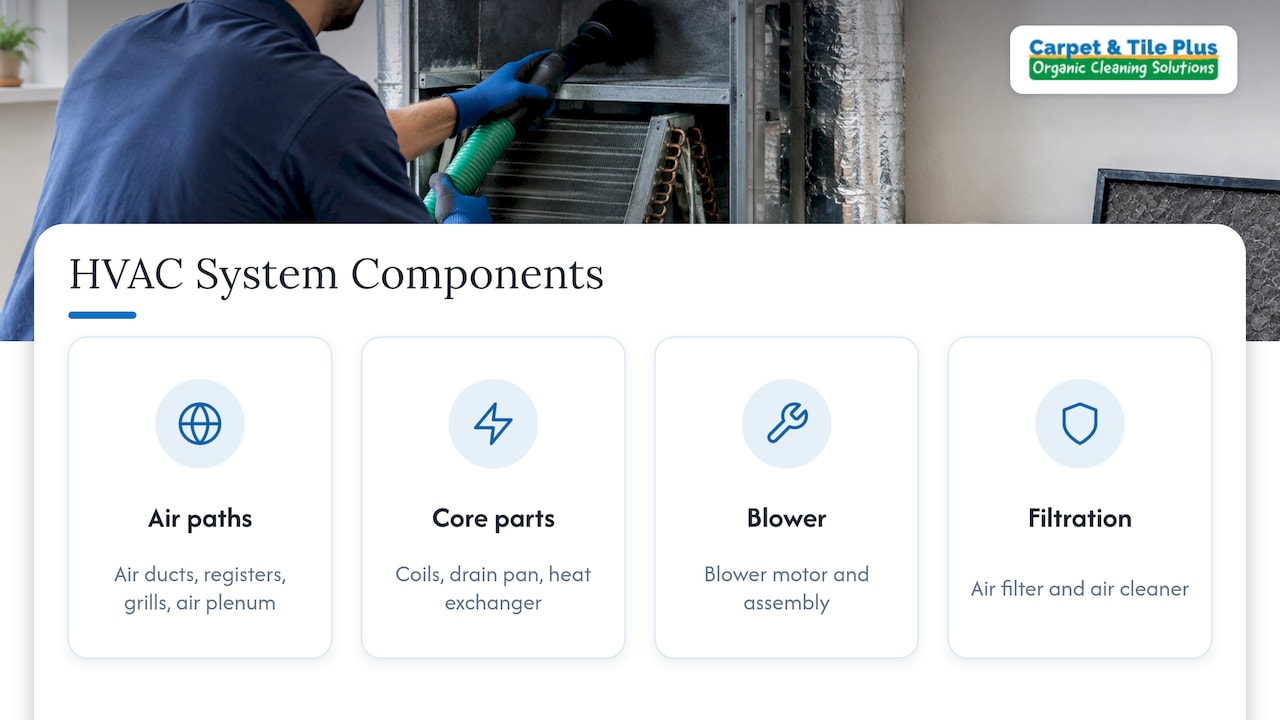
NADCA calls the phrase “air duct cleaning” a misnomer. In its words, the entire HVAC system should be cleaned: air ducts, coils, drain pan, registers, grills, air plenum, blower motor and assembly, heat exchanger, air filter and air cleaner. The reason is that cleaning only part of the system leads to recontamination.
That is the first question to ask a bidder: “Which components are in the quote?” A low price that covers only the visible duct runs is not the same job as a full-system cleaning. The same logic applies after a renovation, when fine dust settles in vents and equipment. A cleaning company that handles post-construction cleaning of surfaces still leaves the HVAC system to be dealt with on its own terms, so include it in the scope.
When cleaning is warranted
The EPA recommends cleaning when there is a real reason. Its guidance for homeowners lists three situations:
- Substantial visible mold growth on hard-surface ducts or other HVAC components.
- Vermin infestation, such as rodents or insects living in the ducts.
- Heavy dust and debris that clogs the ducts or blows out of the supply registers when the system runs.
We cover these in more detail in the three EPA-backed triggers, and the homeowner checklist helps you walk through your own registers before you call.
How often?
There is no calendar interval that the EPA sets. The practical answer is to look at the system on a regular basis, to clean when one of the three triggers shows up, and to include the HVAC system in the plan after major remodeling or after pests have been dealt with. Northwest suburban homes with a finished basement, shedding pets or a recent addition are the ones most likely to show heavy debris at the registers first. For offices, retail and other commercial spaces, the office air duct cleaning benefits page covers what to weigh.
Moisture and mold
If you see mold, the cause is usually moisture, so cleaning alone is not the finish line. Fix the leak or the humidity problem as well, or the growth returns. Our guide to why air ducts need regular cleaning and the piece on air duct cleaning and respiratory health explain what to look for. If anyone in your home has asthma, allergies or another breathing condition, talk to your doctor about your plans and about when they should be out of the house during the work.
Can you stay home during the cleaning?
With low-toxicity products and good containment, many households stay home. But the decision belongs to the household and the contractor together. NADCA’s chemical white paper lists the possible risks of HVAC chemical products, including allergic reactions, respiratory irritation, eye injuries and toxic fumes. It requires that occupants be told about the hazards, and says some jobs are done while occupants are out and the building is ventilated. If the product could create a hazard for sensitive occupants, that has to be communicated to occupants or building managers.
Practical rules for the day:
- Ask in advance what products will be used and get the SDS.
- Move infants, people with asthma or chemical sensitivities, and pets to another room or out of the house during any chemical application.
- Follow the label’s re-entry and ventilation instructions exactly.
How to vet an eco-friendly claim before you sign
Sweeping promises are the red flag. The EPA warns homeowners not to hire duct cleaners who make sweeping health-benefit claims or who recommend routine cleaning on a schedule. A company that says “green” and stops there has not told you anything yet.
The Better Business Bureau serving Chicago and Northern Illinois found that most local duct-cleaning complaints it reviewed involved bait-and-switch tactics, and it recommended written estimates from three companies for the same scope, plus checking NADCA membership and insurance. That report is from 2010, but the advice has not aged.
Use this checklist:
| Ask this | A good answer sounds like |
|---|---|
| What is in the scope? | Every component: ducts, registers, coils, drain pan, blower, plenum |
| What products do you use? | Named products, with an SDS, ideally third-party rated or biodegradable |
| How is dirt captured? | Negative pressure, with exhaust outside or HEPA filtration |
| Is any antimicrobial applied? | Only EPA-registered, with occupants informed and PPE worn |
| Is the price in writing? | One total for the full scope, with no add-ons appearing on site |
| Are you insured and trained? | Yes, with proof, and certified technicians |
For more on pushy sales tactics, read our page on air duct cleaning scams.
Our perspective
We have cleaned homes and businesses around the northwest suburbs for more than 20 years, and our technicians are IICRC-certified. The most common mistake we see people make is treating “eco-friendly” as a product question only. It is a product, a method and a scope question, and all three should be written down before the work starts.
That is why we use organic cleaning products and why we think a customer should know what goes into their home before anyone arrives. A safe process is one you can understand. If a family with kids or pets asks what we are using, they should get a straight answer in plain words.
We are local and family-owned, so the neighbors who book us are the same ones who see our work in the next street over. That is why we stand behind every job with a 100% satisfaction guarantee.
Joe
Book eco-friendly air duct cleaning in the northwest suburbs
If you are in Arlington Heights, Bartlett, Barrington, Elgin, Elk Grove Village, Hoffman Estates, Lake Zurich, Mount Prospect, Palatine, Rolling Meadows or Streamwood, our air duct cleaning service is built for homeowners and business managers who want a clean, safer-smelling process. Our IICRC-certified cleaners use organic cleaning products, and the work is backed by our 100% satisfaction guarantee.
Many customers pair the work with a refresh of their floors. We also clean carpet, tile and grout, and our carpet cleaning pricing page lists residential carpet cleaning at $120 to $300 per visit and commercial carpet cleaning at $200 to $500. Duct cleaning is quoted by job, so contact us through our main site to describe your home or building.
FAQ
Is green air duct cleaning as effective as conventional cleaning?
The cleaning itself comes from the method: agitation to loosen debris and negative pressure to capture it. NADCA’s sustainable guidance recommends biodegradable and enzyme-based cleaners alongside source-removal cleaning. A product that is gentler on people and drains is fully compatible with a thorough job.
How do I know a product is really eco-friendly?
Ask for the product name and its safety data sheet, then look for a third-party rating such as Green Seal, GreenGuard or EPA Safer Choice. Rutgers’ green cleaning guidance recommends exactly these labels. A company that cannot name its product has not told you much.
Do I need to leave the house during duct cleaning?
It depends on what is used. When no chemical is applied, many people stay home. When an antimicrobial or other chemical product goes into the system, follow the product’s label and ask the contractor in advance. Keep infants, pets and anyone with respiratory conditions away from the work area, and check with your doctor if you are unsure.
How much does duct cleaning cost?
Prices depend on the number of vents, the size of the system and which components are included, so compare written quotes that cover the same scope. We do not publish a flat duct cleaning price, so reach out with details about your home or building and we will quote the job.
Sources
- Proper Cleaning Methods, NADCA
- Sustainable Solutions for HVAC Maintenance, NADCA
- Using Chemical Products in HVAC Systems, NADCA white paper (2021)
- Identifying Greener Cleaning Products, US EPA
- Should You Have the Air Ducts in Your Home Cleaned?, US EPA
- Should You Have the Air Ducts in Your Home Cleaned?, US EPA (archived version)
- EC Green Cleaning, NJ Green Building Manual, Rutgers
- Make Sure Your Air Ducts Are Cleaned Out, ABC7 Chicago (2010)