
Choosing the right way to clean tile grout feels simple until you’re staring at a bathroom floor that won’t come clean no matter what you try. For homeowners and property managers across Elgin, Bartlett, Arlington Heights, and the rest of Chicago’s northwest suburbs, grout cleaning is a constant challenge. Between muddy winters, humid summers, and busy households, grout lines collect grime fast. The method you choose matters more than most people realize, not just for appearance, but for the long-term health and durability of your tile surfaces.
Table of Contents
- How to choose the right grout cleaning method
- Manual scrubbing and basic cleaners
- DIY pastes and chemical cleaners
- Steam and oxygen bleach cleaning options
- Professional and advanced cleaning methods
- What most guides miss about grout cleaning for Chicago homes
- Take the next step with expert grout cleaning services
- Frequently asked questions
Key Takeaways
| Point | Details |
|---|---|
| DIY paste is best | Baking soda and hydrogen peroxide paste outperforms other homemade options for tough grout stains. |
| Steam for hygiene | Steam cleaning eliminates most bacteria and is ideal for homes focused on hygiene and air quality. |
| Avoid harsh chemicals | Chlorine bleach can degrade grout and should only be used on white grout in exceptional cases. |
| Professional value | Professional cleaning methods can restore up to 95% of grout’s original color and solve persistent issues. |
| Seal after cleaning | Always seal grout after cleaning to prevent future stains and maintain cleanliness longer. |
How to choose the right grout cleaning method
Before diving into specific methods, it’s worth knowing how to pick what’s right for your home. Not every cleaner works on every surface, and using the wrong product can cause permanent damage to your grout or tile.
Start by assessing stain severity. Light discoloration from everyday foot traffic calls for a completely different approach than black mold stains embedded deep in grout lines after a wet winter. Think of it in three levels: light, moderate, and heavy. This simple assessment shapes every decision after it.
Consider your tile and grout type. Natural stone tiles like marble or travertine require pH-neutral cleaners because acids and bleach will etch and dull the surface. Colored or tinted grout can fade with harsh chemicals. Epoxy grout, which is popular in modern renovations, reacts poorly to abrasive or acidic solutions. The grout cleaning techniques you choose must match your specific materials.
Health and safety at home is another major factor. Homes with young children, pets, or family members with respiratory sensitivities need methods that avoid strong chemical fumes. This rules out chlorine bleach for most households and points toward steam or baking soda-based options.
Key evaluation criteria to keep in mind:
- Stain level: Match cleaning intensity to the stain, not the other way around
- Grout and tile material: Always check compatibility before applying any cleaner
- Safety requirements: Choose chemical-free options if needed for kids and pets
- Time and effort: Some methods require dwell time and scrubbing, others work faster
- Mold and humidity concerns: A real issue in Chicago homes where winter condensation promotes mold growth
Pro Tip: Always test cleaners on a small area before applying to the full surface, and plan to seal the grout after cleaning to block future stains. In Chicago winters especially, steam is a reliable tool for fighting the mold that humidity encourages.
Manual scrubbing and basic cleaners
Once you know your criteria, manual cleaning is often the first method most people try. It’s accessible, low cost, and effective for light to moderate staining when done correctly.
The method uses a nylon or stiff-bristle brush along with a cleaning solution. Using too-soft a brush wastes effort, but steel brushes can scratch tile surfaces, so nylon is the standard recommendation. Manual scrubbing with brushes works best in circular motions, which dislodge dirt more effectively than straight back-and-forth strokes.
For the cleaning solution, you have several options:
- Soapy water: Mild dish soap mixed with warm water for light surface grime
- Store-bought sprays: Products specifically formulated for tile and grout are widely available at hardware stores
- DIY solutions: Simple mixtures like baking soda and water work for moderate surface staining
- Grout-specific sprays: These often have a short dwell time, meaning you spray, wait a few minutes, and then scrub
“The biggest mistake with manual scrubbing is rinsing too quickly. Let your cleaner sit for at least five minutes before you start scrubbing. That dwell time allows the solution to break down the bond between the dirt and the grout, making your scrubbing far more effective.”
The main limitation of manual scrubbing is that it is physically demanding and struggles with deeply embedded stains or large areas. For a bathroom floor, it works fine. For a full kitchen, laundry room, and entryway, the time and effort quickly add up. That’s when considering professional grout cleaning becomes a practical decision rather than a luxury.
Pro Tip: Avoid using harsh chemicals like chlorine bleach on colored grout, even when scrubbing manually. The color fading can be irreversible after just one application.
DIY pastes and chemical cleaners
For deeper stains, chemical pastes and commercial cleaners often come into play. This is where results really start to separate from basic scrubbing.
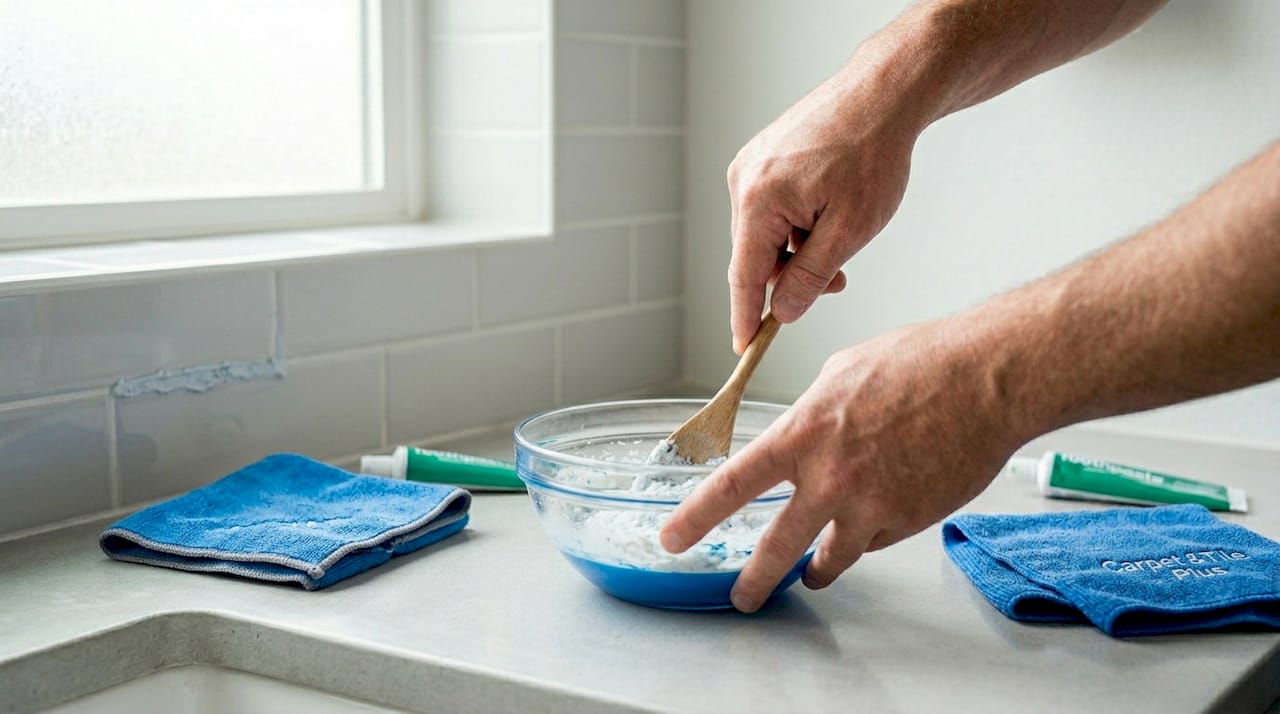
The standout DIY option is a paste made from baking soda, hydrogen peroxide, and a small amount of dish soap. This combination creates a mild abrasive and oxidizing reaction that lifts stains without damaging most grout types. In side-by-side testing, baking soda and hydrogen peroxide scored 9 out of 10 on tough stains, compared to just 3 out of 10 for straight vinegar. That’s a dramatic difference for two methods that are both considered “DIY.”
Many homeowners assume vinegar is a reliable go-to because it’s natural and cheap. The data says otherwise. Vinegar is acidic, which makes it destructive on natural stone and grout over time, and it simply doesn’t have the chemical power to break down heavy organic buildup or mold staining.
For commercial options, products like Zep and Black Diamond are well-regarded for quick application and strong results. Some formulas are labeled “no scrub,” meaning you apply them, allow dwell time, and rinse away. These products work well for DIY grout paste methods when you want more power than homemade solutions provide without calling in a professional.
Key points on chemical cleaners:
- Baking soda + hydrogen peroxide paste: Highly effective, safe for most surfaces, rated the top DIY option across multiple tests
- Vinegar: Poor for deep stains, damaging to natural stone, generally not recommended
- Commercial sprays and gels: Faster application, variable effectiveness depending on formula
- No-scrub commercial products: Convenient but may still require light agitation for heavy stains
Always check grout type compatibility before applying any commercial cleaner. Commercial cleaners like Zep are effective for quick application, but using an acid-based formula on natural stone or epoxy grout can cause lasting damage that no cleaning method will fix.
The most important safety rule with chemical cleaners: avoid anything acid-based or chlorine-bleach-based on natural stone, epoxy grout, or colored grout. This rules out a surprisingly large number of off-the-shelf products. When in doubt, read the label carefully and test in an inconspicuous spot.
Steam and oxygen bleach cleaning options
Looking for a deeper clean or chemical-free sanitizing solution? Consider steam and oxygen bleach options, both of which offer strong results with fewer safety tradeoffs.
Steam cleaning uses high-temperature steam, typically above 200 degrees Fahrenheit, to loosen embedded grime and sanitize surfaces without any chemicals. It is particularly well suited for homes with children, pets, or anyone with allergies or asthma. The steam kills 99.9% of bacteria on contact, making it one of the most hygienic options available. For Chicago homeowners dealing with post-winter mold in bathrooms or laundry rooms, this is a major advantage.
The performance data is compelling. Steam at 250°F with 40 PSI reduces bacterial load by 60% and improves discoloration removal by 35% compared to manual scrubbing. That’s a measurable, significant upgrade in both cleanliness and appearance.
Oxygen bleach, also called sodium percarbonate, is a powdered compound that releases oxygen when mixed with water, creating a foaming reaction that lifts organic stains and mold. It is far safer than chlorine bleach and far more effective on grout. Oxygen bleach handles organic stains and mold without the discoloration and grout degradation risks that chlorine bleach carries.
| Method | Chemical-free | Bacteria killed | Effective on mold | Safe for colored grout |
|---|---|---|---|---|
| Manual scrubbing | Yes | No | Partially | Yes |
| Steam cleaning | Yes | 99.9% | Yes | Yes |
| Oxygen bleach | No (mild) | Partially | Yes | Yes (test first) |
| Chlorine bleach | No | Yes | Yes | No |
| DIY baking soda paste | Yes | No | Partially | Yes |
When should you avoid steam? If your grout is already cracked, loose, or compromised, the high-pressure steam can loosen it further. Have the grout inspected first if you notice any crumbling or separation. Also avoid any bleach product, including oxygen bleach, on natural stone or epoxy grout without prior testing.
Pro Tip: For commercial steam grout cleaning in larger properties or spaces with heavy foot traffic, professional-grade steam equipment operates at pressures and temperatures that consumer units cannot match. The results in those situations are noticeably superior.
Professional and advanced cleaning methods
No single method works for every home and situation. For some, professional cleaning is the best next step, especially when DIY efforts repeatedly fall short.
Professional grout cleaning combines pre-treatment, rotary scrubbing machines, and steam or hot water extraction in a sequence that no household method can replicate. Professional methods restore 85 to 95% of the grout’s original color after deep cleaning, which is a dramatic result for grout that looked permanently discolored.
When should you consider professional help?
- Heavy staining that has not responded to multiple DIY attempts
- Recurring mold in bathrooms, basements, or laundry rooms, especially after Chicago winters
- Large surface areas like commercial kitchens, lobbies, or full-home tile floors
- Pre-sale cleaning when you need tile to look its best for home listings
- After renovation when construction dust and debris have embedded in grout lines
| Method | Effort | Cost | Stain level | Best for |
|---|---|---|---|---|
| Manual scrubbing | High | Low | Light to moderate | Small areas, quick touch-ups |
| DIY chemical paste | Medium | Low | Moderate to heavy | Bathrooms, kitchens |
| Steam cleaning | Low to medium | Medium | Moderate to heavy | Hygiene-focused homes |
| Professional cleaning | Low (for you) | Higher | Heavy, recurring | Large areas, stubborn stains |
Professional-grade equipment also applies sealant after cleaning, which is a step most homeowners skip. Sealed grout resists future staining for months and significantly reduces how often you need deep cleaning. That time savings over a year adds up fast.
To explore what professional cleaning services look like for northwest suburb homes, it helps to understand the full service process and what to expect in terms of timing and results.
What most guides miss about grout cleaning for Chicago homes
Most grout cleaning guides are written generically for every climate and every home. That one-size-fits-all approach misses some of the most important factors for homeowners in the northwest suburbs of Chicago.
The Chicago climate creates specific challenges that influence which cleaning method is truly best. Cold winters mean homes are sealed tight for months, and moisture from cooking, bathing, and even breathing accumulates indoors. Grout in bathrooms and kitchens absorbs that moisture, creating ideal conditions for mold growth. Generic guides skip this entirely. In our experience, homes in Elgin, Barrington, and Hanover Park often deal with mold-stained grout that looks like a deep discoloration problem but is actually an active biological growth issue that requires sanitizing, not just cleaning.
Another frequently overlooked point is material compatibility. We’ve seen expensive marble and travertine tile permanently etched by homeowners who followed generic “use vinegar” advice from popular websites. The risks of using acids or bleach on natural stone or epoxy grout are real and irreversible. Steam can also loosen grout that has minor cracking or is not fully adhered, turning a cleaning job into a repair job.
Here’s the honest take after more than two decades serving northwest suburb homes: durability comes from a consistent routine, not occasional deep cleaning. Homeowners who wipe down tile weekly with mild soap and seal their grout once or twice a year rarely need aggressive chemical treatments at all. The local grout cleaning strategies that work best here are the ones that account for seasonal humidity shifts and prioritize material-safe products over raw chemical power.
Sealing grout after any cleaning is one of the simplest, most impactful steps most people skip. It takes 30 minutes and prevents months of future staining. Treat it as a non-negotiable final step, not an optional add-on.
Take the next step with expert grout cleaning services
If the cleaning challenge in your home has moved past what DIY methods can fix, local professional help is the most reliable path to lasting results. Whether you manage a rental property in Streamwood or own a home in Palatine with years of embedded grime, there’s a practical solution that avoids guesswork.

Our IICRC-certified team at Carpet and Tile Plus has served northwest suburb homeowners and property managers for over 20 years, using organic cleaning products and professional equipment that delivers results you can see. Our residential grout cleaning service is designed for homeowners who want clean, healthy tile without spending a weekend scrubbing. For property managers and business owners, our commercial grout cleaning service handles large-scale jobs efficiently with a one-hour dry time that minimizes disruption. Contact us today to schedule your service and see what clean grout really looks like.
Frequently asked questions
Can I use vinegar to clean all types of grout?
No, vinegar works poorly for deep stains and should be avoided on natural stone or epoxy grout. Vinegar scores just 3 out of 10 on tough stains and can permanently etch natural stone tile surfaces.
How effective is steam cleaning for grout?
Steam cleaning is one of the most effective methods available, killing 99.9% of bacteria and removing discoloration up to 35% more effectively than standard manual scrubbing.
What grout cleaner is safest for homes with kids and pets?
Steam cleaning and a baking soda plus hydrogen peroxide paste are both highly effective and free of harsh chemicals. Baking soda and hydrogen peroxide paste is the top-rated DIY method, while steam is the preferred professional choice for chemical-free hygiene.
Should grout always be sealed after cleaning?
Yes, sealing grout after cleaning prevents future stains and keeps your floors looking cleaner for longer. Sealing grout post-cleaning is especially important in Chicago homes where winter humidity accelerates staining and mold growth.
What’s the risk of using chlorine bleach on grout?
Chlorine bleach can discolor and degrade grout over time and should only be used as a last resort on white grout. Oxygen bleach is the safer and more effective alternative for tackling mold and organic stains without causing long-term damage.