
Filtration soiling happens when carpet acts as an accidental air filter, trapping oily and sooty particles as air squeezes through tiny gaps at baseboards, doorways, and stair edges. It shows up as dark, sometimes greasy-looking lines exactly where air flow concentrates. The verdict on removal: synthetic carpets like nylon often respond well to professional treatment, but wool, olefin, and soil that’s been building for years may never look brand new again.
- Common trouble spots: wall-to-carpet edges, under closed doors, stair noses, and around HVAC vents
- Not caused by poor housekeeping. It’s a byproduct of how air moves through your home
- DIY cleaners rarely fix it. The chemistry and tools matter more than elbow grease
TL;DR:
- Filtration soiling results from airborne oily and sooty particles being mechanically trapped along carpet edges due to airflow pressure differences.
- It commonly appears as dark, greasy lines along baseboards, stair noses, and around vents, especially in homes with gaps or pressure imbalances.
- DIY cleaning methods are ineffective because they cannot remove nonionic, oily particles deeply embedded in synthetic fibers, and aggressive water scrubbing can worsen the problem.
- Professional treatment involves targeted chemistry, mechanical agitation with crevice tools, and high-heat extraction, with nylon carpets responding best to restoration efforts.
- Sealing gaps in the building envelope and upgrading HVAC filters helps prevent future buildup of filtration soiling along carpet edges.
Table of Contents
- What Filtration Soiling on Carpet Actually Is
- What Causes Filtration Lines to Form Along Carpet Edges
- How to Tell Filtration Soiling Apart From Other Carpet Stains
- How to Remove Filtration Soiling From Carpet
- Preventing Filtration Soiling Before It Starts
- When to Call a Professional Carpet Cleaner
- Key Takeaways
- Sources
What Filtration Soiling on Carpet Actually Is
Filtration soiling is a buildup of fine airborne particles that get physically strained out of moving air by carpet fibers, the same way a furnace filter catches dust. The particles causing it aren’t ordinary dirt. They’re soot, oily aerosols, fine dust, cooking grease vapor, candle residue, and vehicle exhaust that drifted in from the garage or an open window.
These particles bind to carpet fibers because many carry a static charge, and oily or “nonionic” compounds cling to synthetic fibers on a molecular level rather than just sitting on the surface. That’s why vacuuming alone barely touches it. The CRI’s technical bulletin on filtration soiling confirms this is a mechanical filtration effect tied to airflow, not mold growth or a sign you’ve neglected your floors.
- Soot and combustion byproducts from candles, fireplaces, and gas stoves
- Cooking oil vapor that settles on nearby flooring
- Fine dust and vehicle exhaust tracked in through attached garages
What Causes Filtration Lines to Form Along Carpet Edges
Filtration lines form when your HVAC system creates pressure differences between rooms, forcing air (and everything floating in it) through the smallest available gap. Here’s the typical chain of events:
- Your supply vents push more air into a room than the return vents pull out, creating positive pressure that has to escape somewhere.
- That air finds the path of least resistance: gaps under baseboards, along stair edges, through subfloor joints, or beneath a closed interior door.
- As the air squeezes through that narrow opening, carpet fibers along the edge act like a sieve, catching the oily and sooty particles suspended in it.
- Repeat this thousands of times over months, and you get a visible dark line tracing the exact path the air travels.
Closed doors make this worse because they force air to find alternate routes, usually the crack underneath. Homes with recessed lighting, older construction, or recently remodeled additions often show more filtration lines simply because there are more untreated gaps in the building envelope. The Carpet and Rug Institute points to this pressure dynamic as the primary driver, which is why sealing gaps matters as much as cleaning the carpet itself.
How to Tell Filtration Soiling Apart From Other Carpet Stains
Filtration soil looks and feels different from a spilled drink or a pet accident. It typically appears as a thin, consistent gray-to-black line that follows a straight edge, wall, or doorway rather than a random blotch. Run your fingers over it and you’ll often notice a slightly greasy or dry, chalky texture depending on the particle mix.
A few checks help you confirm what you’re dealing with:
- Press a clean white cloth against the line. If it transfers dark residue without moisture, that points to filtration soil rather than a wet stain.
- Check if the discoloration follows architectural lines (baseboards, stair edges, vents) instead of appearing in random spots.
- Look for a matching pattern on both sides of a doorway. Filtration soiling often mirrors itself where air pushes through from both directions.
If the area feels damp, smells musty, or the discoloration has an irregular, spreading shape, you’re probably looking at moisture damage or mold, not filtration soiling, and that needs a different response entirely. Pet stains and dye transfer from rugs also mimic filtration lines but usually show up away from air pathways.
Pro Tip: Take a flashlight and shine it at a low angle across the suspected area. Filtration soil tends to look uniformly dull, while moisture stains often show a subtle sheen or ring pattern around the edges.
How to Remove Filtration Soiling From Carpet
Ordinary carpet shampoo and store-bought spot cleaners usually fail here because they’re built for water-soluble stains, not the oily, nonionic particles that make up filtration soil. Scrubbing aggressively with water can actually push soot deeper into the backing, according to IICRC guidance, which is the opposite of what you want.
If you want to try something safe before calling in help, follow this sequence:
- Vacuum the affected edges thoroughly using a crevice or edging attachment, not just the main roller brush.
- Dry-blot the area with a clean cloth to lift loose surface particles before introducing any liquid.
- Spot-test a labeled dry-solvent spotter on a hidden section of carpet first, and check for color change or fiber damage.
- Protect nearby baseboards and paint with a barrier cloth before applying any solvent.
- Avoid heavy water scrubbing entirely. It’s one of the fastest ways to spread the problem, a pattern we’ve covered in detail when explaining how soil wicking ruins carpet cleaning.
Professional treatment looks fundamentally different. Technicians typically apply a solvent and detergent pretreatment designed specifically for oily, nonionic soils, then use a narrow crevice brush to physically agitate the fibers right along the tack strip and stair nose, a step LMCCA practitioners identify as critical since broad wands miss these tight seams entirely. From there, a focused, high-heat hot water extraction using a narrow crevice wand runs multiple passes and rinse cycles directly over the line.
Pro Tip: Ask whether the technician plans to use a dedicated crevice tool. General-purpose wands simply can’t concentrate enough heat and suction into a half-inch gap along an edge.
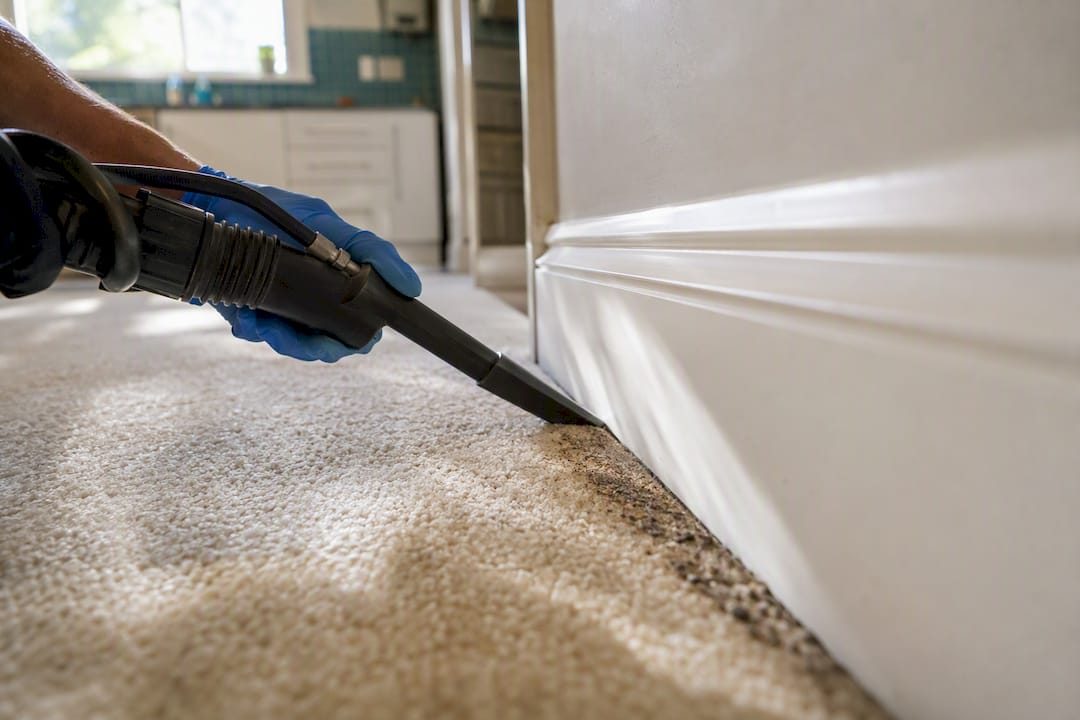
Fiber type sets the ceiling on results. Nylon typically responds well to this process, while wool and olefin hold onto embedded soil more stubbornly, and in some cases, full restoration isn’t realistic no matter how many passes you run. After treatment, proper drying, a protector application, and periodic monitoring help slow the line from reappearing.
Preventing Filtration Soiling Before It Starts
Prevention beats removal every time, and most of it comes down to reducing what’s in your air and closing the gaps that let it hit your carpet.
- Replace HVAC filters on schedule and consider a higher MERV-rated or HEPA-grade filter to reduce the airborne particle load reaching your floors.
- Have ducts inspected, and cleaned when needed, since dust and soot buildup inside ductwork feeds directly into the problem.
- Seal visible gaps under baseboards and along stair edges with caulk or expanding foam, ideally during a carpet re-stretch or renovation project.
- Keep interior doors open while your HVAC system runs to reduce the pressure differential that forces air through cracks.
- Run exhaust fans while cooking and limit candle use, since both are common sources of the oily particles that settle into fibers.
- Choose darker carpet tones or add runners in high-airflow zones, though this only masks the pattern rather than solving the airflow issue behind it, a distinction The Spruce makes clear in its consumer guidance.
Frequent edge vacuuming with a crevice tool also slows accumulation significantly, since it catches loose particles before they bind to the fibers.
When to Call a Professional Carpet Cleaner
Some filtration soiling responds to a solid DIY effort. Most doesn’t, especially once the lines have been building for a year or more. Call a professional when you notice any of the following:
- The affected area covers multiple rooms or runs the length of a hallway
- Your carpet is wool, olefin, or another fiber known to hold soil more stubbornly
- You’ve already tried a labeled spotter without meaningful improvement
- There’s any chance moisture, pet contamination, or mold is involved alongside the soiling
Before hiring anyone, ask what pretreatment chemistry they use for oily soils, whether they bring dedicated crevice tools, what extraction method they run, and what realistic improvement looks like given your carpet’s fiber and soil age. A cleaner who promises complete removal on wool without seeing the carpet first isn’t being straight with you.
Filtration soiling is oily and deeply embedded by nature, which is exactly why targeted chemistry and mechanical agitation from a trained technician outperform generic surface cleaning almost every time.
Carpetandtileplus technicians are IICRC-certified and start every job with an inspection to identify fiber type and soil age before recommending a treatment plan, so you know what to expect before any cleaning begins.
What Realistic Restoration Looks Like Long-Term
I’ve walked into plenty of homes where the homeowner was convinced their carpet was ruined for good, only to learn the discoloration was a fixable airflow issue rather than a stain that soaked in overnight. The honest answer is usually somewhere in the middle: expect meaningful improvement on synthetic fibers, and manage expectations on wool or older, deeply set lines. Anyone who guarantees perfection sight unseen hasn’t looked closely at your carpet.
— Jim
Get a Filtration-Soiling Inspection Before the Lines Get Worse
Carpetandtileplus gives you something a bottle of spot cleaner never can: a trained eye that knows the difference between a fixable filtration line and a fiber that’s already past the point of restoration, before you spend money guessing.

Our technicians inspect the soiled areas first, then apply a solvent and detergent pretreatment matched to oily, nonionic soils before running a narrow crevice tool along your baseboards and stair edges, the exact combination practitioners identify as most effective for this type of buildup. We follow with focused hot water extraction and offer an organic chemistry option for households that want to limit chemical exposure. Most jobs finish with a one-hour dry time, so you’re not blocking off rooms for a full day. Compared to a DIY attempt, professional treatment protects your carpet’s remaining lifespan and improves the air quality issue driving the problem in the first place, rather than just masking a symptom. If you’re seeing dark lines along your edges or doorways, schedule a residential carpet cleaning appointment and get an honest read on what’s achievable for your specific carpet.
Key Takeaways
Filtration soiling is an airflow-driven buildup of oily, sooty particles at carpet edges, and fixing it permanently requires sealing air pathways in addition to professional cleaning.
| Point | Details |
|---|---|
| It’s structural, not dirt | Filtration lines form from air pressure forcing particles through gaps, not from missed cleaning. |
| Fiber type sets expectations | Nylon typically responds well to treatment; wool and olefin may never fully return to original. |
| Skip aggressive DIY scrubbing | Water scrubbing can push soot deeper into the backing and worsen the appearance. |
| Seal gaps and upgrade filters | Caulking edges and using higher-grade HVAC filters slow future buildup. |
| Carpetandtileplus offers inspection-first service | IICRC-certified technicians pretreat, crevice-agitate, and extract with a one-hour dry time. |
Sources
- Filtration Soiling Technical Bulletin — Carpet and Rug Institute (CRI)
- IICRC Consumer Floor and Furnishings Care Information — Tip Sheet
- Heacock’s Corner: Soil filtration lines — LMCCA
- Filtration soil: The Spruce