Your carpet looks fine. You vacuumed last week, there are no visible stains, and the color still looks fresh. So why does the air inside your home feel stuffy, or why are your allergies flaring up? The truth is that a clean-looking carpet can be secretly working against your health. Carpets in homes and businesses across the Northwest Suburbs of Chicago collect far more than dirt — they trap allergens, mold spores, pet dander, and chemical residues deep in their fibers, where a standard vacuum can’t reach. This guide explains exactly what builds up in your carpet, how professional cleaning removes it, and what you can do right now to breathe easier at home and at work.
Table of Contents
- What’s hiding in your carpet? Understanding the indoor air connection
- How professional carpet cleaning actually improves indoor air quality
- Professional methods vs. DIY: What makes the difference for air quality?
- Beyond the carpet: Integrating carpet cleaning into a healthy indoor air program
- Why most air quality problems are solved in the details — a local expert’s view
- Ready for fresher air? Schedule a professional carpet cleaning today
- Frequently asked questions
Key Takeaways
| Point | Details |
|---|---|
| Carpets trap pollutants | Carpets collect dust, allergens, and residues that impact the air you breathe. |
| Professional cleaning reduces airborne particles | Hot-water extraction and powerful equipment remove deeply embedded contaminants for healthier air. |
| DIY vacuuming isn’t enough | Improper cleaning can spread fine particles; professional standards prevent re-release and improve results. |
| Routine care is essential | Lasting air quality improvements come from scheduled cleanings and maintenance, not just occasional effort. |
What’s hiding in your carpet? Understanding the indoor air connection
Most people think about carpet cleaning when they notice a stain or when company is coming over. But the real reason to clean your carpet has nothing to do with how it looks. The fibers in a carpet are like a deep net. Over time, that net catches and holds an enormous range of particles that are invisible to the naked eye.
Here is what typically lives inside a carpet in a typical home or office:
- Dust mite debris — waste particles from microscopic organisms that thrive in fabric
- Pet dander — tiny flakes of skin from cats, dogs, and other animals
- Pollen — tracked in from outside or carried through open windows
- Mold spores — especially in areas with any moisture history
- Volatile organic compounds (VOCs) — chemical residues from cleaning products, paints, and furniture
- Fine particulate matter — ultrafine particles from cooking, candles, and outdoor pollution
- Bacteria and viruses — carried in on shoes and settling from the air
The scary part is what happens next. Every time someone walks across the carpet, sits on the floor, or even when the HVAC system pushes air through the room, those trapped particles get stirred up. They move from the carpet fibers back into the air column at breathing level — right where you and your family or employees take in every breath.
According to the EPA’s indoor air quality resources, carpet can act as a contaminant reservoir for dust, allergens, microbes, and VOC residues, and disturbing or airflow over carpet can re-suspend particles into the breathing zone — so removing that reservoir through thorough cleaning can meaningfully improve indoor air quality.
Children playing on the floor, elderly adults spending time indoors, and anyone with asthma or respiratory conditions face the highest exposure risk. But even healthy adults feel the effects over time. If you’ve ever noticed that your home smells musty even after cleaning, or that allergy symptoms linger inside when they should improve, your carpet is likely the reason. You can find answers to many common questions about this in our carpet cleaning FAQ, which covers everything from timing to expectations.
With the link between carpet and air quality established, let’s break down exactly how professional cleaning makes a significant difference.

How professional carpet cleaning actually improves indoor air quality
Understanding the process helps you see why professional cleaning delivers results that regular vacuuming simply cannot. There are four core steps in a proper professional carpet cleaning, and each one targets the indoor air quality problem in a specific way.
- Inspection and soil level assessment — A certified technician evaluates traffic patterns, identifies problem areas, and selects the appropriate cleaning approach for the carpet type and contamination level.
- Pre-treatment and agitation — A professional pre-spray or dry compound is applied to break down embedded soils, allergens, and organic matter so they can be fully lifted from the fibers.
- Hot water extraction — High-temperature water is injected deep into the carpet pile at controlled pressure, penetrating below the surface layer where most contaminants live.
- Powerful vacuum extraction — Industrial-grade equipment then pulls the water and loosened contaminants out of the carpet and into a sealed waste tank, preventing re-release into the air.
This last step is what sets professional cleaning apart from nearly every DIY method available. As allergen reduction research confirms, hot water extraction improves air quality primarily through source removal — it penetrates the carpet pile and uses powerful extraction to remove soils and allergen-containing material, rather than simply moving it around. The same research indicates that hot water extraction can measurably reduce both surface and airborne allergen levels compared with pre-cleaning baseline measurements.
| Cleaning method | Allergen removal depth | Airborne particle risk | Dry time |
|---|---|---|---|
| Standard vacuuming | Surface only | Moderate re-suspension | Immediate |
| DIY rental machine | Shallow | High if over-wet | 12–24 hours |
| Professional hot water extraction | Deep into pile | Low with proper extraction | ~1 hour |
| Dry compound cleaning | Surface/mid-level | Low | Immediate |
Pro Tip: Always confirm that your cleaning provider uses truck-mounted or high-performance portable extraction units. The suction power in professional-grade machines is far greater than anything available for consumer rent, and that power difference is the key to actually removing allergens instead of redistributing them.
For homes in Elgin, Arlington Heights, and Barrington, our residential carpet cleaning process uses exactly this method. If you also have area rugs, our area rug cleaning benefits page explains how the same approach protects delicate fibers while delivering the same air quality results.
Professional methods vs. DIY: What makes the difference for air quality?
Here is a common scenario. A homeowner buys a rental carpet cleaning machine, spends an entire Saturday cleaning every room, and feels great about it. But two weeks later, the musty smell is back, and the allergies are worse than before. What went wrong?
The problem usually comes down to three factors: suction strength, water volume, and filtration. Most rental machines deposit more water than they extract. That leftover moisture creates the perfect environment for mold and mildew growth inside the carpet padding, which directly worsens indoor air quality. In addition, the exhaust air from underpowered machines can blow fine particles back into the room during cleaning.
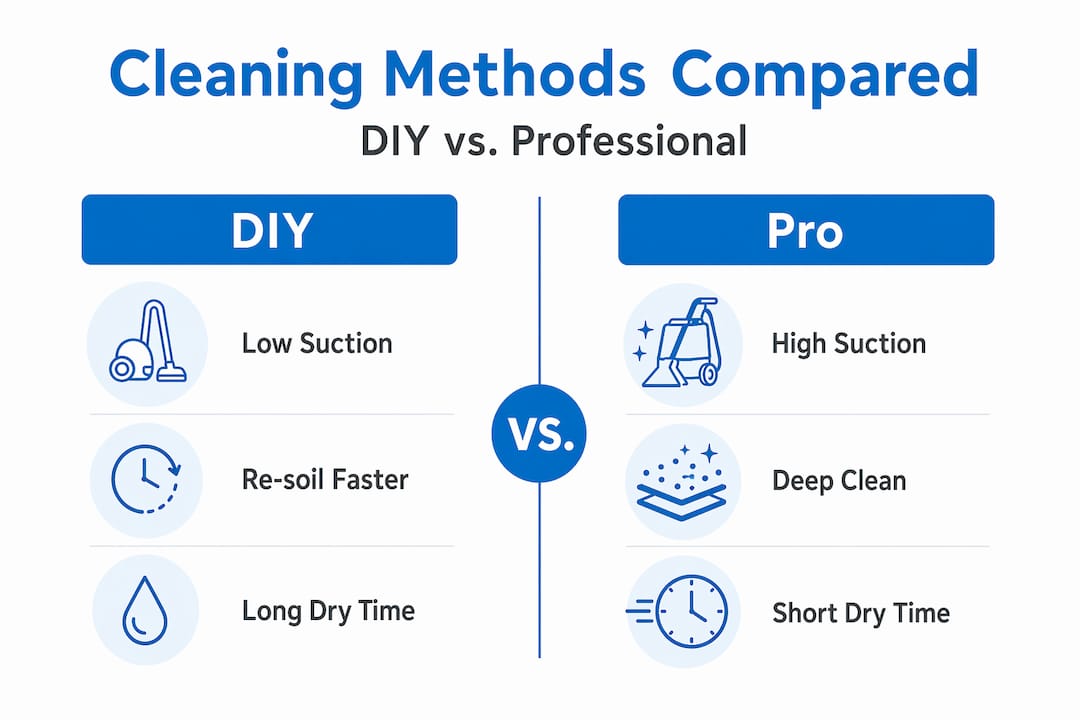
| Factor | DIY rental machine | Professional cleaning |
|---|---|---|
| Extraction suction | Low to moderate | Very high (truck-mounted) |
| Filtration system | Basic filter | HEPA or equivalent |
| Water left in carpet | Often significant | Minimal (1-hour dry time) |
| Allergen containment | Poor | Sealed waste system |
| Technician training | None | IICRC-certified |
Standard vacuuming has its own limitations. Even a good home vacuum can re-suspend fine particles if it lacks proper sealed filtration, and it reaches only the top layer of carpet fibers where perhaps 20 to 30 percent of total contamination sits. The majority of allergens and fine particles are buried deeper.
Pro Tip: Between professional cleanings, use a vacuum with a sealed HEPA filtration system rather than a standard bag or filter. HEPA filters capture particles as small as 0.3 microns, which covers dust mite allergens, pet dander, and most mold spores.
Here are the specific air quality risks of doing it wrong:
- Over-wetting the carpet leads to mold growth within 24 to 48 hours
- Using harsh chemical cleaners leaves VOC residues that off-gas into your air
- Incomplete extraction means allergens stay in the carpet and continue re-suspending
- Running a non-HEPA vacuum without sealing the exhaust deposits fine dust back into the room
The frequency of professional cleaning matters just as much as the method. One exceptional cleaning every five years does far less for your air quality than consistent, scheduled professional service every six to twelve months. Property managers and landlords also see real air quality benefits at turnover — learn more about those gains in our guide on cleaning for rental properties. For a broader look at how different cleaning approaches measure up, professional cleaning comparisons offer additional context across various methods and settings.
Beyond the carpet: Integrating carpet cleaning into a healthy indoor air program
Carpet cleaning is a powerful tool. But it works best as one part of a larger indoor air quality strategy, not as a stand-alone fix. Think of indoor air quality like a team effort — your carpet, your HVAC system, your humidity levels, and your ventilation habits all work together, and neglecting one area limits the gains you get from the others.
A well-rounded indoor air program for homes and businesses in the Northwest Suburbs looks like this:
- Schedule professional carpet cleaning every 6 to 12 months — more frequently for homes with pets, children, or allergy sufferers, and for commercial spaces with high foot traffic.
- Vacuum with a HEPA-filtered machine at least once a week — this reduces the surface buildup between deep cleans.
- Control indoor humidity between 30 and 50 percent — mold spores need moisture to thrive, and keeping humidity low slows their growth dramatically.
- Change HVAC filters on schedule — a clogged filter circulates dirty air throughout the entire building, depositing particles directly back onto your clean carpet.
- Have air ducts inspected and cleaned periodically — ductwork collects the same types of particles as carpet, and running the system distributes them through every room.
According to guidance from Facility Executive magazine, IAQ improvements from carpet cleaning work best as part of a broader program that includes HEPA vacuuming between deep cleans, scheduled professional cleaning, humidity control, and attention to HVAC filtration — because indoor air quality is a multi-source, ongoing challenge, not a one-time fix.
There is also a nuanced point worth addressing honestly. Research published on airborne allergen exposure suggests that in cases of severe allergies or specific health conditions, removing fitted carpet entirely may be part of the recommended approach, since floor type can affect both airborne exposure and cleaning behavior. For most people, regular professional cleaning is more than sufficient. But if you or a family member has severe respiratory conditions, it is worth speaking with a healthcare provider about your full indoor environment.
For businesses in Palatine, Streamwood, Hanover Park, and surrounding communities, coordinating air duct cleaning with carpet cleaning maximizes the air quality results you get from each service. A detailed, scheduled cleaning approach ensures every part of the system is addressed on a reliable timeline.
Why most air quality problems are solved in the details — a local expert’s view
After more than two decades of cleaning carpets across the Northwest Suburbs of Chicago, one thing stands out clearly: the homeowners and business operators who see the best long-term air quality results are not the ones who do the most cleaning. They are the ones who do the right cleaning, consistently.
We have seen well-meaning people rent machines and spend entire weekends working on their carpets, only to call us a month later with mold odors. We have also seen commercial properties that invested in cheap, fast cleaning services and then wondered why their employees kept getting sick. The common thread in both situations is the same: shortcuts and half-measures leave contaminants behind, and those contaminants keep affecting the air quality until they are fully removed.
The IICRC standards exist for exactly this reason. These are internationally recognized, ANSI-accredited guidelines that define inspection protocols, soil level assessment, cleaning approach selection, and extraction requirements. When a technician follows these standards, the outcome is not just a cleaner-looking carpet. It is a measurably cleaner indoor environment.
Organic cleaning products matter too. Products that off-gas VOCs into the air after application create a new air quality problem even as they address the old one. Our IICRC-certified team uses organic cleaning solutions specifically to avoid trading one set of airborne chemicals for another. You can read more about why that choice matters in our overview of organic carpet cleaning benefits.
The takeaway is straightforward. Hire certified local professionals who follow established standards, use safe products, and clean on a consistent schedule. That combination will do more for your indoor air quality than any single heroic effort ever could.
Ready for fresher air? Schedule a professional carpet cleaning today
If this article has made one thing clear, it is that cleaner air starts at the floor. The invisible reservoir of allergens, VOCs, and particulate matter building up in your carpet affects every breath you take inside your home or business. Taking action is simpler than most people expect.
At Carpet & Tile Plus, we serve homeowners and businesses throughout Elgin, Bartlett, Arlington Heights, Palatine, Barrington, Streamwood, and Hanover Park with IICRC-certified cleaning using organic products and a one-hour dry time. Our residential carpet cleaning services deliver deep extraction results that protect your family’s health, while our commercial carpet cleaning services keep your workplace air clean and your team at their best. For the most complete air quality improvement, pair carpet cleaning with our air duct cleaning service, and address every source of indoor contamination in one coordinated step.
Frequently asked questions
How often should carpets be professionally cleaned to support good air quality?
Every 6 to 12 months is the recommended baseline for most homes and businesses. High-traffic areas, homes with pets or children, and spaces with allergy-sensitive occupants benefit from more frequent cleaning, since poorly controlled cleaning or long gaps between services allow particle buildup to worsen air quality.
Does professional cleaning remove all allergens from carpets?
Professional hot water extraction significantly reduces allergens by removing soils and allergen-containing material from the carpet pile, but it may not eliminate every trace particle — supplement with regular HEPA vacuuming and HVAC maintenance for the best ongoing results.
Is carpet always safe for people with asthma and allergies?
For most people, regularly cleaned carpet is not a health hazard, but in some severe cases, allergen avoidance approaches may recommend carpet removal entirely. Always consult a healthcare provider and evaluate your full indoor air quality environment before making flooring decisions.
What’s the difference between cleaning for appearance and cleaning for air quality?
Cleaning for appearance focuses on visible stains and surface brightness, while cleaning for air quality prioritizes removing hidden contaminants deep in the carpet pile using full extraction — the carpet may look the same afterward, but the airborne particle count improves measurably.