ANSI/IICRC S100 is the recognized professional standard for cleaning carpet and other textile floor coverings. The IICRC, accredited by ANSI, publishes S100 and related standards that spell out how professionals inspect carpet, choose a cleaning method, and document the work. Following them protects carpet life, indoor air quality, and often a manufacturer’s warranty terms.
TL;DR:
- Properly following IICRC S100 ensures technicians accurately identify fiber types and soil conditions before selecting cleaning methods, preventing damage.
- Water damage or mold incidents require consulting S500 or S520 standards first, then returning to S100 for standard cleaning after drying.
- Certification tiers like CCT, JTC, and MTC indicate progressively advanced training, with certified firms demonstrating organizational standards like insurance and ethics.
- Using the latest edition of S100 from official sources is critical to ensure compliance with current procedures and avoid outdated practices.
- Adherence to standards helps protect warranties, improve indoor air quality, and improve carpet longevity through documented, professional cleaning.
Table of Contents
- What Is the IICRC, and Why Does ANSI Accreditation Matter?
- The Core IICRC Standards Related to Carpet
- What ANSI/IICRC S100 Actually Covers
- IICRC Certification: What CCT, CCMT, JTC, and MTC Actually Mean
- How Standards Show Up in an Actual Cleaning Job
- Where to Find the Official Standards and Keep Current
- How We Put IICRC Standards to Work
- Why Standards-Based Cleaning Protects More Than the Carpet
- Book a Standards-Informed Cleaning With Carpetandtileplus
- Sources
- FAQ
What Is the IICRC, and Why Does ANSI Accreditation Matter?
The Institute of Inspection, Cleaning and Restoration Certification (IICRC) is the nonprofit body that writes the technical standards governing carpet cleaning, water damage restoration, mold remediation, and related trades. Its ANSI accreditation means the standards go through a formal consensus process: technical committees draft language, stakeholders comment, and the document gets balloted before publication. That process is what separates an IICRC standard from a manufacturer’s marketing pamphlet or a franchise training manual.
Cleaning technicians aren’t the only ones who lean on these documents. Carpet manufacturers reference them when setting warranty conditions. Insurance adjusters cite them when evaluating water damage claims. Facility managers use them to write cleaning specifications into vendor contracts. The IICRC represents a large base of certified technicians and certified firms worldwide, which gives the standards practical weight far beyond any single company’s internal procedures.
Here’s who actually relies on these documents day to day:
- Carpet cleaning technicians selecting methods and chemistry
- Property and facility managers writing maintenance contracts
- Insurance adjusters assessing water damage and restoration claims
- Carpet manufacturers setting warranty compliance requirements
- Real estate and property management firms handling move-in and move-out inspections
The Core IICRC Standards Related to Carpet
Several IICRC documents touch carpet, but they don’t all cover the same ground. Knowing which one applies to a given situation saves time and prevents citing the wrong reference.
- ANSI/IICRC S100: the procedural standard for cleaning textile floor coverings, covering chemistry, fiber types, equipment, and inspection.
- IICRC R100: a reference guide that explains the reasoning behind S100’s procedures, useful for technicians who want the “why” behind the “what.”
- ANSI/IICRC S500: governs water damage restoration, relevant when carpet has been affected by flooding or leaks.
- ANSI/IICRC S520: covers mold remediation, which frequently intersects with carpet after moisture intrusion.
- ANSI/IICRC S800: the inspection standard, used when a formal, documented assessment of carpet condition is needed.
- ANSI/IICRC S300: addresses professional cleaning of upholstery, a close cousin to textile floor covering work.
A technician cleaning a dry, soiled carpet works primarily from S100. A restoration crew responding to a burst pipe consults S500 first, then loops back to S100 once the carpet has dried and needs standard maintenance cleaning.
What ANSI/IICRC S100 Actually Covers
S100 is dense, but its structure follows a logical sequence: understand the fiber and soil, then match the method to both. The standard organizes its guidance around a core set of topics that every certified technician is trained to work through.
- Chemistry of cleaning, including pH sensitivity and detergent behavior across fiber types
- Fiber and carpet construction, since wool, nylon, and olefin all respond differently to the same treatment
- Soil management, distinguishing between dry particulate soil and oil-based residue
- Equipment selection, from extraction units to encapsulation machines
- Cleaning methods and moisture control
- Safety procedures for technicians and occupants
- Inspection protocols, both before and after service
- Spotting and stain treatment
- Area rug cleaning, which the standard treats separately from wall-to-wall carpet
That sequence matters more than any single line item. A technician who skips fiber identification and jumps straight to a method is working outside what ANSI/IICRC S100-2021 actually specifies. Assessment comes first, method selection second, moisture control third.
On upkeep, the standard’s guidance is more specific than most homeowners expect. It recommends professional wall-to-wall cleaning at least annually for programmed maintenance, with area rugs cleaned every 12 to 24 months depending on traffic and soil load. Between professional visits, routine vacuuming and entry-mat maintenance do most of the heavy lifting.
Pro Tip: Wool carpet reacts to high alkalinity in ways synthetic fibers don’t, so a cleaner working from S100’s chemistry section will use a different pH range for wool than for nylon. If you’re unsure what’s underfoot, ask before assuming any product is safe. Fiber-specific handling gets its own detailed treatment in this carpet fiber guide.
IICRC Certification: What CCT, CCMT, JTC, and MTC Actually Mean
Not every certified carpet cleaner has the same training behind their card, and the tier matters more than most buyers realize.
- Certified Technician (CCT): entry-level credential covering fundamental cleaning theory, fiber ID, and basic method application.
- Certified Master Textile Cleaner (CCMT) and similar mid-tier credentials: additional coursework and testing beyond entry level.
- Journeyman Textile Cleaner (JTC): requires demonstrated field experience layered on top of initial certification.
- Master Textile Cleaner (MTC): the top tier, requiring specific prerequisite certifications plus at least three consecutive years of certified experience.
A Certified Firm is a separate designation from individual technician certification. It requires the business itself to meet standards around insurance, employee background checks, and documented ethics and complaint procedures. A company can employ certified technicians without holding Certified Firm status itself, so it’s worth asking about both. Continuing education keeps any of these credentials current as the standards get revised.
How Standards Show Up in an Actual Cleaning Job
Reading S100 is one thing. Watching a technician apply it is another, and the gap between the two is usually where quality problems show up.
- Pre-inspection: walk the space, note existing damage, staining, and traffic patterns using an apartment move-in inspection checklist
- Fiber identification: confirm what the carpet is made of before choosing chemistry
- Soil analysis: determine whether the problem is particulate, oily, or biological
- Method selection: match hot water extraction, encapsulation, or another method to the fiber and soil type
- Equipment setup and pretreatment application
- Moisture management during and after cleaning to control dry time
- Post-inspection: confirm results and document any pre-existing conditions
A written report tied to that process should note the carpet’s condition, the method and chemicals used, moisture readings at completion, and a recommended maintenance interval going forward.
Pro Tip: If a technician can’t tell you what fiber your carpet is or skips the walk-through inspection entirely, that’s a red flag. So is a job that leaves carpet noticeably damp more than a few hours after service. Excessive residual moisture invites mold growth, which is exactly what S520 exists to address after the fact.
Where to Find the Official Standards and Keep Current
Buying or reading the actual standard beats relying on secondhand summaries, including this one. The official versions live in two places: the IICRC’s own standards pages and ANSI’s document store at webstore.ansi.org, which sells the current edition directly.
Edition dates matter here. S100 has seen active revision work since its 2021 edition, so check the publication year before citing a copy as current or relying on it for a dispute. A few ways to stay current:
- Check iicrc.org directly for edition announcements
- Purchase current copies through webstore.ansi.org rather than relying on older PDFs circulating online
- Take continuing education through an IICRC-approved training provider
- Watch for consensus-body announcements when a standard enters revision
How We Put IICRC Standards to Work
A family-owned business with extensive experience in residential and commercial cleaning services, employing technicians trained on organic cleaning products. Customer reviews reflect positive experiences, and low-moisture methods can support fast drying times on many jobs. Ask any technician on-site for their certification card, and request a written report covering the conditions found, method used, and moisture readings at job’s end.
Why Standards-Based Cleaning Protects More Than the Carpet
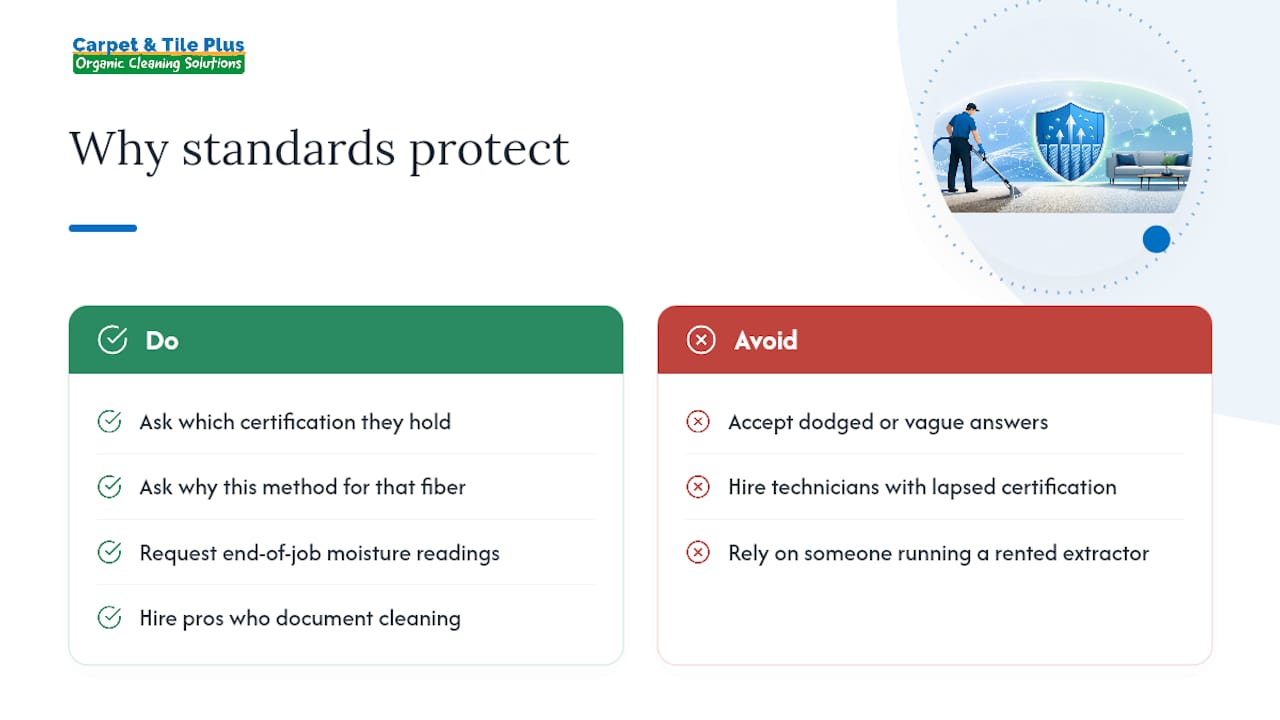
Standards adherence isn’t paperwork for its own sake. It protects the carpet fiber, keeps indoor air cleaner by controlling residual moisture and chemical residue, and helps homeowners stay compliant with manufacturer warranty terms that often require documented professional cleaning. A framework like S100 doesn’t dictate one product or one machine. It guides the judgment calls a technician makes on-site, and that judgment is what separates a trained professional from someone running a rented extractor.
Ask a few pointed questions before any job starts: which certification does the technician hold, why did they choose this method for this fiber, and what will the moisture readings look like at the end. Technicians should welcome those questions, not dodge them. Standards evolve, certifications lapse without renewal, and the field rewards professionals who keep training rather than coasting on a card they earned a decade ago.
— Jim
Book a Standards-Informed Cleaning With Carpetandtileplus
Carpetandtileplus applies the same inspection and method-selection thinking outlined in ANSI/IICRC S100 on every job, using organic cleaning products and low-moisture equipment that typically dries in about an hour.
That means less guesswork for you and less downtime in your home or business. Our technicians assess fiber type and soil condition before touching a machine, not after, and every job comes with a straightforward explanation of the method used. If your carpet is overdue for its annual professional cleaning, or you’re dealing with a pet stain that’s outlasted a few DIY attempts, start with residential carpet cleaning or check current carpet cleaning cost details for your home. Commercial property managers can review our commercial carpet cleaning options for scheduled maintenance programs. Reach out today to get a cleaning scheduled around your fiber type, traffic level, and dry time needs.
Sources
FAQ
What Is the S500 Standard for IICRC?
ANSI/IICRC S500 governs professional water damage restoration, covering assessment, drying procedures, and structural moisture management after flooding or leaks.
Do You Have to Be Licensed to Be a Carpet Cleaner?
Licensing requirements vary by state and municipality, but IICRC certification itself is a voluntary professional credential rather than a government license; check local rules for any separate business licensing requirement.
What Is the ANSI S520 Standard?
ANSI/IICRC S520 is the mold remediation standard, used when moisture intrusion has led to mold growth in carpet, padding, or surrounding structures.
What Is the IICRC S540 Standard?
The standard mentioned isn’t part of the current core set of published IICRC standards covered here; for trade-specific questions beyond S100, S500, S520, S800, and S300, check the IICRC standards page directly for the most current list.
Is a Certified Firm the Same as a Certified Technician?
No. A Certified Firm meets business-level requirements like insurance and documented ethics procedures, while individual technician certification (CCT, JTC, MTC) reflects personal training and experience.