
Most professional duct cleaning jobs take between 2 and 5 hours for a typical single-family home with one HVAC system. The biggest swing factors are home size, vent count, and how dirty the ducts actually are. Multi-system homes or heavily contaminated ductwork can push duct cleaning time past a full day, sometimes requiring a second visit.
TL;DR:
- Duct cleaning for typical homes takes 3 to 5 hours on average, but multi-system or heavily contaminated homes may require a full day or multiple visits.
- Accessibility, duct material, contamination level, and discovery of issues like mold can significantly extend cleaning times beyond basic estimates.
- Proper preparation, including clearing vents and access points, helps keep the appointment on schedule, especially for homes with complicated duct layouts.
- An on-site inspection before quoting is essential, as fixed-rate estimates often overlook system complexity and access challenges, leading to inaccurate timing.
- Homeowners should schedule cleaning based on actual needs indicated by inspection, especially after remodeling or if there are multiple pets, rather than following a fixed calendar.
Table of Contents
- How Long For Duct Cleaning Based On Your Home Size
- What Makes Duct Cleaning Take Longer Or Shorter
- The Duct Cleaning Appointment, Stage By Stage
- How To Prepare For Your Duct Cleaning Appointment
- When To Schedule Duct Cleaning And How Often
- What 20 Years Of Local Duct Work Has Taught Us About Timing
- Get A Real Time Estimate For Your Home
- Sources
- FAQ
How Long For Duct Cleaning Based On Your Home Size
Matching your square footage and vent count to a realistic time estimate beats guessing. Contractor breakdowns show a fairly predictable pattern once you know how many vents and systems you’re dealing with, and that per-vent math is a legitimate homeowner shortcut for estimating job length.
- Small homes and condos (under 1,500 sq ft, 5–10 vents): typically a few hours for one system.
- Average homes (1,500–2,800 sq ft, 10–15 vents): typically 3–5 hours, matching the 3 to 7 hours a properly equipped two-person crew usually needs for a comprehensive job.
- Large or multi-system homes (2,800+ sq ft, 15–20+ vents, two or more HVAC zones): may require extended periods, sometimes covering a full day or multiple visits.
Add-on services stretch the clock further. Dryer vent cleaning usually adds extra time. Coil cleaning at the air handler, if included, can substantially increase the total duration. If your HVAC duct cleaning process includes both, budget the high end of your size bracket rather than the low end.
What Makes Duct Cleaning Take Longer Or Shorter
Two homes with identical square footage can produce very different appointment lengths, and accessibility is usually the reason. Ductwork tucked into an open, walk-up attic gets cleaned fast. Ductwork buried behind finished ceilings, crammed into a tight crawlspace, or split across multiple mechanical closets slows everything down, since hard-to-reach ducts require more time and specialized tools.
Contamination level matters just as much as access. A lightly used system with a few dust bunnies cleans quickly. A home with three shedding dogs, recent drywall demolition, or visible mold growth needs extra containment, extra passes, and sometimes a different cleaning method altogether.
Other variables that move the needle:
- Duct material: flexible duct flexes and traps debris differently than rigid sheet metal, changing how long each run takes to clear.
- Trunk and plenum complexity: a simple single-trunk layout clears faster than a branching system with multiple takeoffs.
- Number of systems and crew size: a two-technician crew on one system moves faster per vent than a single technician covering two zones.
- Discovery events: disconnected duct runs, hidden mold, or structural obstacles found mid-job can add hours and sometimes require a follow-up visit.
Pro Tip: Ask your technician for a system evaluation before the quote, not after. NADCA warns against flat, low-cost quotes that skip inspection entirely, because those numbers rarely survive contact with your actual ductwork.
The Duct Cleaning Appointment, Stage By Stage
A comprehensive cleaning breaks down into predictable phases, and knowing them helps you understand where your appointment time actually goes.
- Inspection and mapping. The technician assesses the system, including vent count and accessibility, before proceeding with cleaning.
- Setup and containment. Preparation such as moving furniture, protecting floors, and connecting equipment is carried out.
- Vent-by-vent source removal. The main cleaning phase where each vent is individually cleaned, with time varying based on the number of vents.
- Trunk, plenum, and air-handler work. Cleaning of these components is performed and can add a significant amount of time depending on scope.
- Reassembly and final walkthrough. Restoration of access points and equipment packing, including a review of cleaning outcomes.
That sequencing matches how most contractor timelines break down the job, and it explains why a 10 vent home and a 20 vent home rarely take the same amount of time even with identical crews.
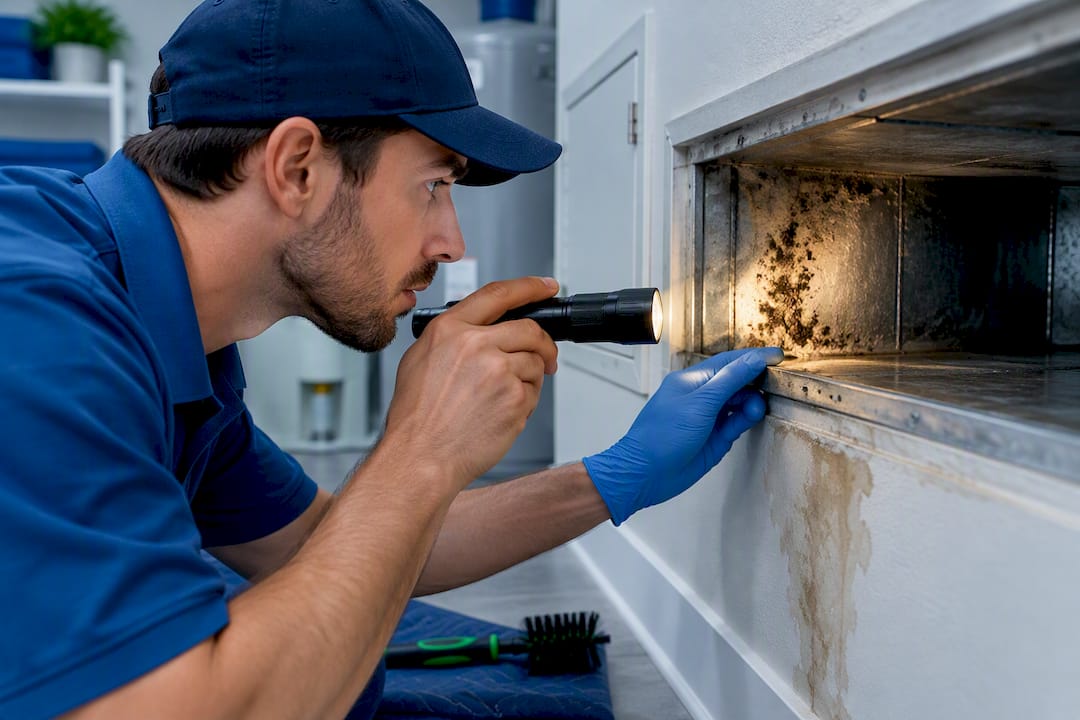
If a technician finds active mold growth or a serious contamination source like a water leak, expect the appointment to pause. Mechanical cleaning removes dust and debris effectively, but it won’t fix an underlying source of contamination, so that discovery usually means remediation first and a return visit for the actual cleaning.
How To Prepare For Your Duct Cleaning Appointment
A little prep the morning of service keeps your appointment on schedule and prevents the crew from burning time on logistics instead of ductwork.
- Clear a path to every vent, plus attic, crawlspace, or utility closet access points.
- Secure pets in a closed room and flag any allergies or medical concerns to the crew.
- Leave driveway or curb space open for the service vehicle and vacuum hose runs.
- Expect a short HVAC downtime while equipment is connected, and ask whether a new filter is included or recommended.
- Ask the crew for the expected time window, the exact scope, and whether they’ll document before-and-after conditions with photos.
A quick walk-through checklist like this one from Carpetandtileplus’s air duct cleaning checklist for homeowners covers most of this in more detail if you want a printable version.
When To Schedule Duct Cleaning And How Often
There’s no universal calendar rule here. The EPA doesn’t recommend a routine cleaning schedule at all. It recommends cleaning as needed, meaning when you see substantial mold growth, pest infestation, or debris buildup that’s actually restricting airflow.
NADCA’s guidance points homeowners toward a professional inspection first, letting the technician’s findings drive frequency rather than a fixed timeline. A useful rule of thumb: your first cleaning, especially in an older home, will run longer than every cleaning after it, since the buildup is starting from zero.
- Homes with multiple pets or heavy shedding often benefit from more frequent checks, roughly every 2 to 3 years.
- Right after a renovation involving drywall or flooring work is a smart time to schedule, since construction dust settles directly into the ductwork.
- Spring or fall tends to be the most convenient window, before peak heating or cooling season puts extra demand on your system.
For a deeper look at why cleaning matters between these milestones, see Carpetandtileplus’s guide on why air ducts need regular cleaning.
What 20 Years Of Local Duct Work Has Taught Us About Timing
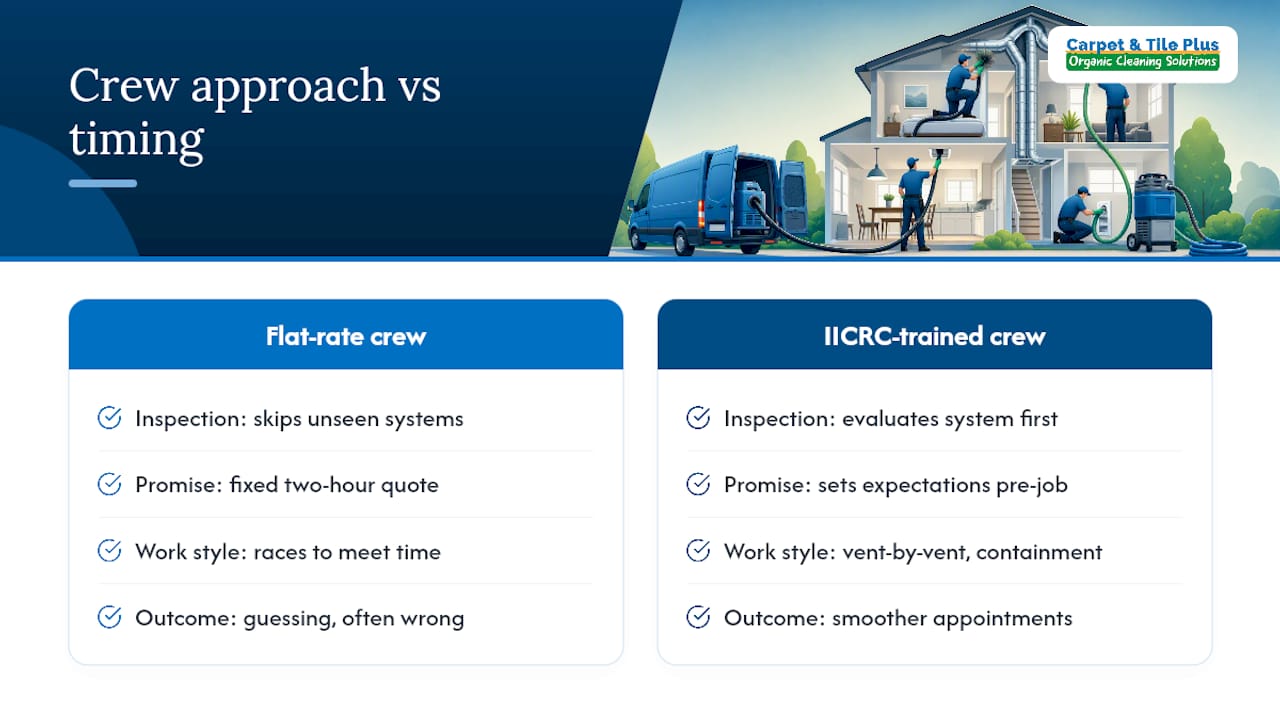
Homeowners almost always underestimate how much accessibility affects duct cleaning time, and overestimate how much a “quick” flat-rate quote can actually cover. A crew that skips the inspection and promises a fixed two-hour job on an unseen system is guessing, not estimating.
Certified technicians change the math in a different way. IICRC-trained crews using organic cleaning products don’t cut corners on containment or vent-by-vent work just to hit a faster number, and that discipline shows up in the outcome, not just the clock. Two decades of jobs across the Northwest Suburbs have shown that the homes with the smoothest appointments are the ones where the crew evaluated the system first and set expectations before starting.
— Jim
Get A Real Time Estimate For Your Home
Generic online ranges are a starting point, not your actual appointment length. An on-site evaluation before any quote ensures the time and cost you’re told upfront reflects your vent count, your access points, and your system’s actual condition, not a guess.

Our IICRC-certified technicians use organic cleaning products and document conditions with before-and-after photos, so you know exactly what was found and what was cleaned. If you’re ready to see what your own home’s duct cleaning time would actually look like, request an estimate through our air duct cleaning page, or check scope and pricing details on our Arlington Heights service page before booking.
Sources
The guidance in this article draws from the EPA’s official position on residential duct cleaning, NADCA’s cost and time estimate standards, and field data from EPA’s HVAC system cleaning study. Contractor time breakdowns referenced throughout come from AirFlow Solutions’ practical homeowner guide.
- Should you have the air ducts in your home cleaned? | US EPA
- Cost and time estimates for homeowners | NADCA
- How Long Does HVAC Duct Cleaning Service Take? A Carolina Homeowner’s Practical Guide – AirFlow Solutions
FAQ
Do Duct Cleaners Go Into Every Room?
Technicians typically service every supply and return vent throughout the house, since skipping vents leaves parts of the system uncleaned. If a room’s vent is inaccessible due to furniture or renovation work, the crew will usually ask you to clear it or note it as excluded from the job.
Does Your House Get Dusty After Air Duct Cleaning?
A properly done job uses negative-air containment, so dust and debris get vacuumed out rather than pushed into your living space. Some homeowners notice a brief dusty smell or light residue near vents right after service, which settles within a day as the system runs normally.
What Time Of Year Is Best For Duct Cleaning?
Spring and fall tend to work best, since scheduling before peak heating or cooling season avoids interrupting a system you’re relying on heavily. Right after a renovation involving drywall or flooring is also a strong time, since fresh construction dust settles directly into the ductwork.
How Often Do You Really Need To Clean Your Air Ducts?
The EPA doesn’t set a fixed schedule and recommends cleaning only when there’s visible contamination, like mold, pests, or airflow-restricting debris. Homes with multiple pets or recent renovation work often need attention closer to every 2 to 3 years, while lighter-use households can go longer between cleanings.