
Schedule professional cleaning for typical office carpets regularly, with high-traffic zones needing attention as often as monthly. That’s the baseline the Carpet and Rug Institute and most facility standards point to, and it’s the number to build your maintenance budget around.
- Low-traffic areas (private offices, executive suites): on a semiannual to annual basis.
- Moderate-traffic areas (open workstations, break rooms): about every few months.
- Heavy-traffic zones (lobbies, main corridors, entrances): monthly, sometimes more than once a month.
Shorten these intervals if your carpet manufacturer’s warranty requires it, or if your vendor doesn’t use CRI Seal of Approval certified products and IICRC-trained technicians. Skip that requirement and you risk voiding coverage on a warranty claim later.
Key Takeaways
Office carpets need professional cleaning every 6 to 12 months as a baseline, with high-traffic zones requiring monthly attention and routine vacuuming plus interim cleaning filling the gaps between deep extractions.
| Point | Details |
|---|---|
| Baseline frequency | Deep clean every 6 to 12 months, shifting to monthly for entrances and heavy corridors. |
| Zone-based scheduling | Match frequency to traffic level rather than applying one interval across the entire office. |
| Three maintenance levels | Routine vacuuming, interim low-moisture cleaning, and deep extraction work together to protect warranty coverage. |
| Inspection-driven adjustments | Use condition logs and visible triggers like odor or matting to move up scheduled deep cleans. |
| Require certified credentials | Insist on IICRC-certified technicians and CRI Seal of Approval products before signing a vendor contract. |
| Certified provider option | Carpetandtileplus offers IICRC-certified commercial cleaning with organic products and roughly one-hour dry time across its Northwest Chicago suburb service area. |
Where to Verify These Standards Yourself
The CRI’s cleaning and maintenance guidance lays out the baseline frequency recommendations and vacuuming rules of thumb referenced throughout this article, straight from the organization that certifies cleaning products and equipment.
CRI 204 is the actual standard document defining routine, interim, and deep maintenance levels with traffic-based frequency guidance, useful if you want to cite a specific standard in a vendor contract.
The IICRC standards page covers the ANSI-accredited protocols that certified technicians train against, worth checking if you want to verify a vendor’s certification claims.
For facilities managing larger footprints, Sparkle Pro’s guide to cleaning frequency in large commercial buildings offers additional scheduling examples worth comparing against your own zone map.
Table of Contents
- Office Carpet Cleaning Frequency by Area and Traffic Level
- What Are Routine, Interim, and Deep Cleaning?
- Which Cleaning Method Fits Which Office Zone?
- How Should Daily Carpet Maintenance Work?
- When Does an Office Need Emergency Deep Cleaning?
- What Should You Require From a Professional Carpet Cleaner?
- What Does a Sample Office Maintenance Program Look Like?
- Put a Certified Maintenance Program to Work
- Frequently Asked Questions
- Sources
Office Carpet Cleaning Frequency by Area and Traffic Level
The single biggest mistake office managers make is treating an entire floor plan like one uniform carpet. It isn’t. A lobby entrance absorbs ten times the foot traffic of a partner’s private office, and cleaning both on the same six-month cycle either wastes money on the private office or leaves the lobby looking tired within weeks.
Traffic bands break down into four practical tiers. Low traffic covers private offices, executive suites, and rarely used conference rooms. Moderate traffic includes general open-office workstations and break rooms where people pass through daily but don’t linger. Heavy traffic applies to main corridors, elevator lobbies, and reception areas. Very heavy traffic means building entrances, the first 10 to 15 feet inside any exterior door, and any carpet near a loading dock.
| Area type | Traffic level | Recommended professional cleaning interval |
|---|---|---|
| Entrances and lobbies | Very heavy | Monthly to twice monthly |
| Main corridors, elevator areas | Heavy | Monthly |
| Open-office workstations | Moderate | Quarterly |
| Conference rooms | Moderate | Quarterly to semiannually |
| Private offices | Low | Every 6 to 12 months |
| Break rooms | Moderate to heavy (spills) | Quarterly |
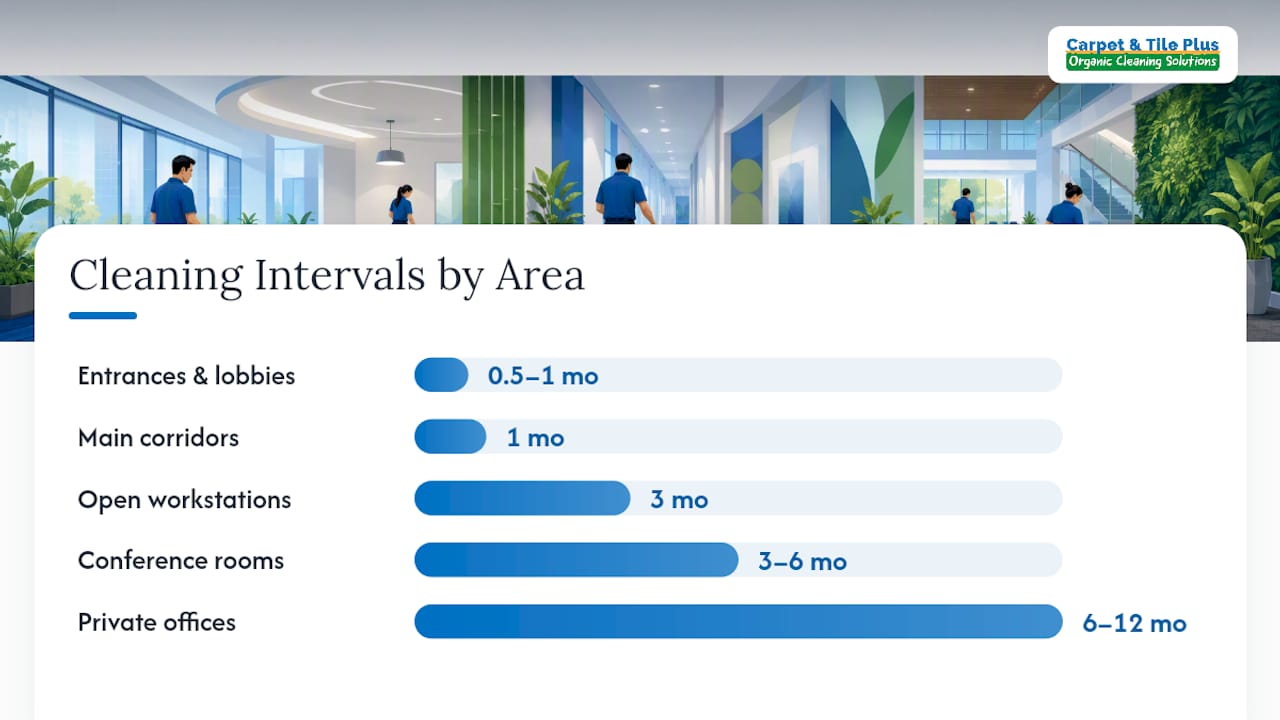
This zone-based approach lines up with what Foreman Pro’s facility guidance recommends: low-traffic spaces on a semiannual to annual cycle, moderate zones a few times per year, and entrances needing monthly or more frequent professional attention.
One seasonal wrinkle matters more than most managers plan for. A building in a climate with wet winters or a rainy season should expect its entrance carpet to load up with grit, salt, and moisture at two or three times the normal rate. If your building sees heavy rain, snow, or slush for several months a year, plan on pulling your entrance and first-corridor cleaning cycle forward by 30 to 60 days during and immediately after that season, regardless of what your default schedule says.
What Are Routine, Interim, and Deep Cleaning?
Every functional maintenance program runs on three distinct levels, and mixing them up is where most in-house janitorial contracts fall apart. CRI 204, the industry standard for commercial carpet maintenance, defines all three and ties frequency guidance directly to traffic level.
Routine cleaning is daily vacuuming and same-day spot removal. It’s the least glamorous part of the program and the most important, because it’s what keeps grit from grinding into carpet fibers between deeper services.
Interim cleaning uses low-moisture methods, usually encapsulation or bonnet cleaning, to refresh appearance between full extractions. CRI 204 puts interim cycles for heavy-traffic areas at intervals of about one to three months, which lets you stretch the interval between full hot-water extractions without letting the carpet look worn in the meantime.
Deep cleaning is hot-water extraction, the method that actually pulls embedded soil out of the pile rather than just lifting surface debris. This is the step most people mean when they say “professional carpet cleaning.”
- Routine: daily, every business day, non-negotiable for any traffic level.
- Interim: every 30 to 90 days in heavy zones, less often in light zones.
- Deep: every 6 to 18 months depending on traffic, per the frequency table above.
Pro Tip: Run interim cleaning consistently in your heaviest zones and you can often stretch deep-cleaning intervals toward the 12 month mark instead of the 6 month floor, without any visible loss of appearance. Skip interim cleaning entirely and you’ll likely need deep extraction every 6 months just to keep pace.
Which Cleaning Method Fits Which Office Zone?
Not every carpet cleaning method does the same job, and specifying the wrong one in a vendor scope of work is a common, costly mistake.
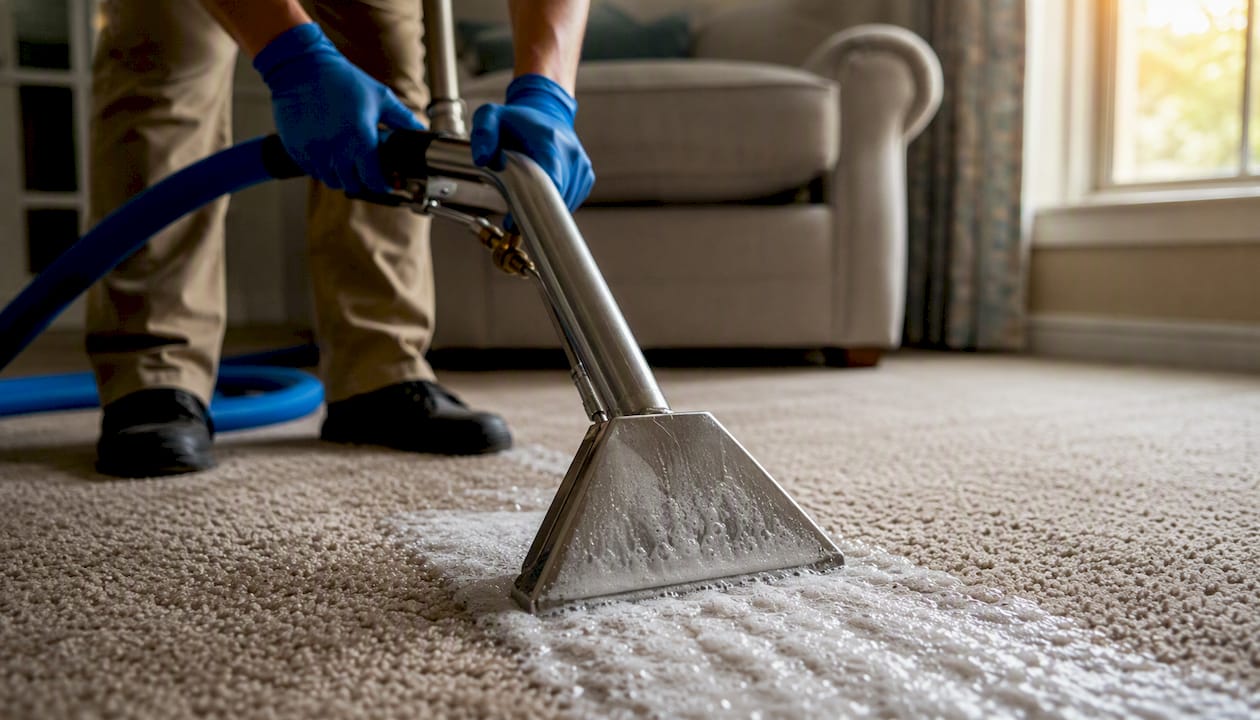
Hot-water extraction (HWE) injects hot water and cleaning solution into the pile, then extracts it along with dissolved soil. It reaches the deepest embedded soil of any method and is what most manufacturers require for warranty-compliant deep cleaning. Typical dry time runs 6 to 12 hours with standard equipment, though truck-mounted systems and pre-treatment can shorten that window.
Encapsulation uses a polymer that crystallizes around soil particles as the carpet dries, so the debris can be vacuumed away later. It’s fast, low-moisture, and ideal for interim cycles in offices that can’t tolerate long dry times.
Bonnet cleaning spins an absorbent pad across the carpet surface to lift surface soil. It’s quick and inexpensive but only addresses the top of the pile, which makes it a poor substitute for extraction on carpets that haven’t been deep cleaned in a while.
Dry cleaning and shampoo systems vary widely by manufacturer, but generally trade cleaning depth for speed. They work as a stopgap between extractions, not a replacement for them.
Daily vacuuming with brush-roll equipment does more heavy lifting than most managers realize. According to Opora Supply’s maintenance guidance, a proper hot-water extraction can reset embedded soil conditions for several months, but only if routine vacuuming continues consistently in between. Skip the daily vacuuming and that reset window shrinks fast.
Check your carpet manufacturer’s documentation before locking in a method. Many warranties specify hot-water extraction and require CRI Seal of Approval certified solutions and equipment, and using an uncertified product can leave sticky residue that accelerates resoiling.
How Should Daily Carpet Maintenance Work?
The gap between a carpet that lasts 10 years and one that needs replacement in five almost always comes down to what happens between professional visits, not the visits themselves.
- Vacuum high-traffic zones daily. Use brush-roll equipment, ideally CRI-certified for soil removal performance, and run four passes in opposite directions for the heaviest areas.
- Vacuum moderate-traffic zones twice weekly, with two passes per session.
- Vacuum low-traffic private offices weekly, since foot traffic rarely justifies more.
- Respond to spills same day. Blot, never rub, using a pH-neutral spotter matched to the stain type.
- Escalate anything beyond a basic spill to a professional rather than experimenting with household cleaners, which often set stains permanently or leave residue that attracts more soil.
Walk-off mats deserve more attention than they usually get. A quality mat system placed at every exterior entrance, extending at least 10 to 15 feet into the building, can capture a large share of the grit and moisture that would otherwise travel onto carpet fibers and grind in with foot traffic. Pair that with a documented maintenance checklist your janitorial staff actually follows, and you’ll cut down on how often you need emergency spot treatment between scheduled deep cleans.
When Does an Office Need Emergency Deep Cleaning?
Some signals mean you shouldn’t wait for the calendar. Watch for these triggers and move your schedule up when you see them.
- Visible traffic lanes or matted, darkened paths where people walk most often.
- Persistent odor that lingers after routine vacuuming and spot treatment.
- Recurring stains in the same location, which usually means the underlying soil wasn’t fully removed the last time.
- A warranty inspection requirement from the manufacturer, which some policies mandate at specific intervals.
- Fiber matting or crushing that vacuuming no longer reverses.
- Soil that reappears within days of a routine clean, a sign that embedded soil has built up past what surface maintenance can handle.
Most facilities can schedule a deep-cleaning appointment within a week or two of noticing these signs, and the job itself, depending on square footage, typically wraps in a single day with modern extraction equipment. Costs vary by square footage, soil condition, and method, so get a walk-through quote rather than relying on a flat per-room estimate. Keep a simple written condition log every time a technician inspects the carpet. That record becomes your evidence if you ever need to file a warranty claim or justify moving up next year’s budget for more frequent service in a specific zone.
What Should You Require From a Professional Carpet Cleaner?
Hiring the wrong vendor doesn’t just waste money. It can void a manufacturer warranty and leave you re-cleaning the same carpet within weeks. Build your vendor requirements around a short, non-negotiable list.
Look for these credentials before signing anything:
- IICRC certification for the technicians actually doing the work, not just the company name on the invoice.
- Equipment and cleaning solutions carrying the CRI Seal of Approval, which signals minimal residue and lower resoiling risk.
- A written scope of work naming the specific method (hot-water extraction, encapsulation, etc.) for each zone, not a vague “deep clean” line item.
Ask these questions before you book:
- What method will you use in each zone, and does it match my carpet manufacturer’s warranty requirements?
- What’s the expected dry time, and can you work around my business hours?
- What certifications do your technicians hold, and can you provide proof?
- What’s your soil-extraction recovery rate, and how do you verify it on-site?
- Can you provide references from other commercial clients in a similar facility type?
Red flags are just as telling as credentials. Walk away from any vendor who can’t produce references, who uses unbranded or non-certified detergents, who promises to remove every stain with no caveats, or who can’t explain how much moisture and soil their equipment actually recovers. A tailored commercial maintenance program built around documented methods protects both your carpet’s appearance and your warranty coverage.
What Does a Sample Office Maintenance Program Look Like?
Here’s a working template you can hand directly to a vendor or adapt for an internal janitorial contract.
| Zone | Routine (vacuum) | Interim (low-moisture) | Deep clean (extraction) |
|---|---|---|---|
| Entrance/lobby | Daily | Every 30 days | Monthly to bimonthly |
| Main corridors | Daily | Every 60 days | Monthly |
| Open workstations | Twice weekly | Every 60-90 days | Quarterly |
| Conference rooms | Weekly | Every 90 days | Quarterly to semiannually |
| Private offices | Weekly | As needed | Every 6-12 months |
| Break rooms | Daily | Every 30-60 days | Quarterly |
Before and after every deep-cleaning appointment, document a few things: overall soil condition, any visible staining or odor, moisture readings post-extraction, and photos of high-traffic zones. That inspection record does double duty. It protects you if you need to file a warranty claim, and it gives you hard evidence when you’re deciding whether to shorten an interval next budget cycle.
This is a starting template, not a fixed rule. Adjust the frequencies up or down based on your building’s actual foot traffic, climate, and whatever your carpet manufacturer’s documentation specifies.
A Cleaner’s Perspective on What Actually Goes Wrong
The most common mistake I see in office accounts isn’t neglect. It’s the opposite: managers who schedule an aggressive deep-cleaning cadence but skip the routine vacuuming and interim work in between, then wonder why the carpet still looks worn a month after a professional extraction. Deep cleaning resets the carpet. It doesn’t protect it going forward. The offices that get the most life out of their carpet are the ones that treat vacuuming schedules and walk-off mats as seriously as the extraction appointment itself. If you only remember one thing from working with a provider like Carpet & Tile Plus, remember that the days between visits matter as much as the visit.
Put a Certified Maintenance Program to Work
Building the right schedule is only half the job. Executing it with the right method, on the right cadence, in each zone, is what actually protects your investment and your warranty. Carpetandtileplus works with commercial clients across the Northwest Suburbs of Chicago, including Elgin, Bartlett, Streamwood, Arlington Heights, Palatine, Barrington, and Hanover Park, using IICRC-certified technicians and organic cleaning products that don’t leave the sticky residue that leads to fast resoiling.

Every job runs on a roughly one-hour dry time, which means you’re not shutting down a conference room or reception area for half a day to get a proper hot-water extraction done. That matters when you’re trying to keep a zone-based schedule on track without disrupting daily operations. Carpetandtileplus can walk your facility, assess traffic patterns zone by zone, and build a maintenance calendar suited to your actual foot traffic rather than a generic building-wide guess.
If you’re ready to move from a rough schedule to an actual program, request a walk-through and quote through the commercial carpet cleaning services page. Get your entrances, corridors, and workstations inspected before you lock in next year’s cleaning budget.
Frequently Asked Questions
How often should office carpets be professionally cleaned?
Most offices should schedule professional deep cleaning every 6 to 12 months, with high-traffic areas like lobbies and main corridors needing attention as often as monthly.
What’s the difference between interim and deep carpet cleaning?
Interim cleaning uses low-moisture methods like encapsulation to maintain appearance between full services, typically every 30 to 90 days in busy areas. Deep cleaning means hot-water extraction, which removes embedded soil and is usually required to satisfy manufacturer warranty terms.
Does skipping professional cleaning void a carpet warranty?
It can. Many commercial carpet manufacturers require documented professional cleaning at set intervals, often using specific methods and CRI Seal of Approval certified products, as a condition of warranty coverage.
How often should office carpets be vacuumed between professional cleanings?
High-traffic areas need daily vacuuming, moderate-traffic zones about twice a week, and low-traffic private offices roughly once a week, using brush-roll equipment for the best soil removal.
What signs mean an office carpet needs cleaning sooner than scheduled?
Watch for visible traffic lanes, lingering odor, recurring stains in the same spot, and soil that reappears within days of vacuuming. Any of these justifies moving up your next professional appointment.
Sources
- IICRC standards
- Commercial Carpet Cleaning Frequency by Facility Type (Foreman Pro)
- Carpet, tile, broadloom maintenance playbook (Opora Supply)