
Soap scum on tile is a chalky film made of soap, minerals from hard water and body oils. It bonds to tile and grout and thickens with every shower. Light film comes off with the right cleaner, a brush and a good rinse. Years of buildup in a shower is slower, harder work and puts grout at risk. That is when our IICRC-certified tile and grout cleaners at Carpet and Tile Plus take over for homes and businesses across the Northwest Suburbs.
What is the quick summary for removing soap scum from tile?
- Soap scum forms when soap reacts with calcium and magnesium in water, then traps skin oils and dirt. Rinsing alone will not remove it.
- Match the cleaner to the surface: acidic products suit glazed ceramic, but never natural stone, and grout needs a gentler approach.
- Never mix bleach with vinegar, ammonia, or any other cleaner. Use one product at a time, rinse between products, and ventilate.
- Squeegeeing after each shower and running the fan cuts how often you need a deep clean.
- Thick, years-old buildup or grout that stays dark after cleaning is a job for a professional.
What topics are covered in this guide to removing soap scum from tile?
- What soap scum on tile actually is
- First, identify what you are cleaning
- The safety rules that come before any cleaner
- How to remove soap scum from shower tile, step by step
- Cleaning dirty grout lines
- Stopping it from coming back
- When routine cleaning is no longer enough
- Our perspective
- Professional tile and grout cleaning in the Northwest Suburbs
- FAQ
- Sources
What soap scum on tile actually is
Soap scum is not just dried soap. Mr. Clean describes it as a stubborn film created when the fatty acids in soap bind to minerals in hard water and mix with body oils, dirt and product residue. The result is an insoluble deposit that sticks to surfaces and builds layer by layer.
The mineral side is the key. The U.S. Geological Survey explains that calcium and magnesium in hard water react with most soaps to form scum, and that a water softener, which swaps those ions for sodium, prevents it from forming.
Why it shows up in Northwest Suburban showers
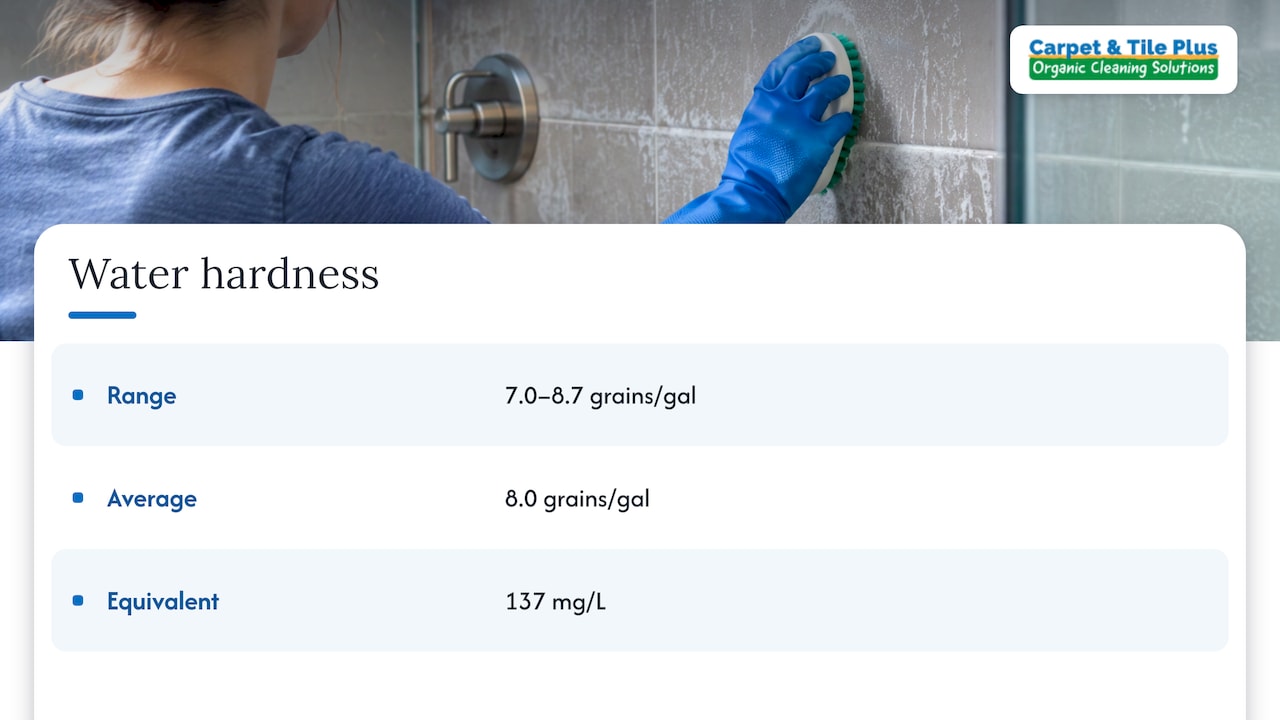
Many of our towns, Palatine among them, buy Lake Michigan water treated by Evanston. In its 2024 water quality report, Palatine lists Evanston’s average hardness at 8.0 grains per gallon, or 137 mg/L, with a range of 7.0 to 8.7. Hardness is the calcium and magnesium content, and the figure shifts a little from year to year and by supplier, so check your own village’s latest annual report. Hardness at this level is enough to leave a film on glass, fixtures and tile over months of daily showers.
If you want to attack the problem at the source, this guide to how a water softener works explains what the equipment does to hardness minerals before the water reaches your shower.
First, identify what you are cleaning
Before you pick a product, work out three things: the tile material, the grout type and how thick the buildup is.
| Surface | What is generally safe | What to avoid |
|---|---|---|
| Glazed ceramic or porcelain tile | A dedicated soap scum remover or a mild acidic cleaner for hard-water deposits | Abrasive pads that scratch glaze |
| Natural stone (marble, granite) | Cleaners made for porous stone | Acids and bleach |
| Cement grout | pH-neutral cleaner, or alkaline cleaner for soap scum and grease | Acids, vinegar, oil or wax soaps |
| Epoxy grout | pH-neutral cleaner with a soft brush | High heat |
The sources behind this table are specific. Wirecutter advises that natural stone showers need cleaners formulated for porous surfaces, with no vinegar, citric acid or bleach, while acidic cleaners are generally fine on ceramic, acrylic, glass or fiberglass. The Tile Council of North America explains that the cement in grout is alkaline and dissolved by acids, so grout should be cleaned with an alkaline cleaner, and it warns that oil-based or wax-based products such as Murphy’s Oil Soap or Pine-Sol leave a film in porous grout that attracts dirt.
That is why a homemade vinegar spray, a popular first move, can do damage on the grout lines while it cleans the tile face. If you are unsure whether your shower is ceramic, porcelain or stone, or whether the grout is sealed, that question is worth settling before you spray anything. We assess it on every tile and grout job, and our page on cleaning unsealed grout fast and safely shows how sealing status changes the approach.
The safety rules that come before any cleaner
This is the part that matters most. Household cleaning chemicals can release dangerous gases when they meet.
The New Jersey Department of Health’s hazard alert lists the pairs to keep apart:
- Bleach and ammonia produce chloramine gases.
- Bleach and an acid, such as vinegar, lemon juice, rust or lime removers and drain cleaners, release chlorine gas.
- Bleach and rubbing alcohol form chloroform.
- Hydrogen peroxide and vinegar form peracetic acid, an irritant to eyes, skin and lungs.
The CDC says never to mix household bleach or any disinfectant with other cleaners, to ventilate by opening windows or doors, and to check whether you need gloves or eye protection.
Residue counts as mixing. WC Safety notes that you should apply one product, let it work, rinse thoroughly, and only then use another, and that ammonia hides in some glass cleaners while acids hide in bowl cleaners, rust removers and descalers. If you ever smell chlorine or feel an ammonia-like sting, leave the room, get fresh air and call Poison Help at 1-800-222-1222.
So: gloves, eye protection, the bathroom fan on, a window open if you have one, and a single product at a time.
How to remove soap scum from shower tile, step by step
Here is the routine for a shower with ordinary to moderate buildup on glazed tile.
1. Remove the loose buildup first
On smooth ceramic, porcelain or glass, thick dried deposits can be lifted with a plastic or metal scraper before any chemical goes on. The professional tile manual from The Cleaning Standard describes using a razor or a 4-inch hand scraper this way, and warns to test first, since a blade that is fine on one surface can scratch another tile, glaze or coating. It also notes that scraping creates fine airborne debris, so wear respiratory protection and sweep or vacuum the loosened material up before adding water.
Where it goes wrong: scraping a textured, matte or stone surface, or tile with a decorative glaze. If you are not certain, skip this step.
2. Apply the right cleaner and let it dwell
Spray a cleaner made for soap scum on the tile and give it time. Wirecutter’s shower routine is to spray the solvent and let it sit so it can penetrate the scum, rather than scrubbing immediately. The Cleaning Standard manual makes a related point: removing what you can mechanically first means less chemical, less dwell time and less rinsing overall.
Where it goes wrong: reaching for bleach. Bettesworth Construction notes that bleach is the wrong tool for ordinary soap scum or hard-water scale and can corrode some metals or grout.
3. Scrub, with the right brush
Use a scrub brush on the tile in circular motions and a small angled brush for corners and grout lines, per Wirecutter. For grout, CNN Underscored’s experts recommend a stiff nylon brush and say to avoid steel brushes, which scratch surfaces.
4. Rinse thoroughly and dry
Rinse with plain water, then dry with a microfiber cloth. This step is not cosmetic. Grout absorbs soap as well as stains, and cleaner left in the joints dries to a sticky film that attracts dirt. The Tile Council of North America’s preferred method is to apply cleaner, vacuum up the dirty water, then rinse and vacuum again to pull out any remaining film.
5. Give the cleaner time to cool off before the next product
If you used anything bleach-based, Wirecutter recommends waiting 24 hours before using an acidic cleaner. Treat that as a hard rule.
Cleaning dirty grout lines
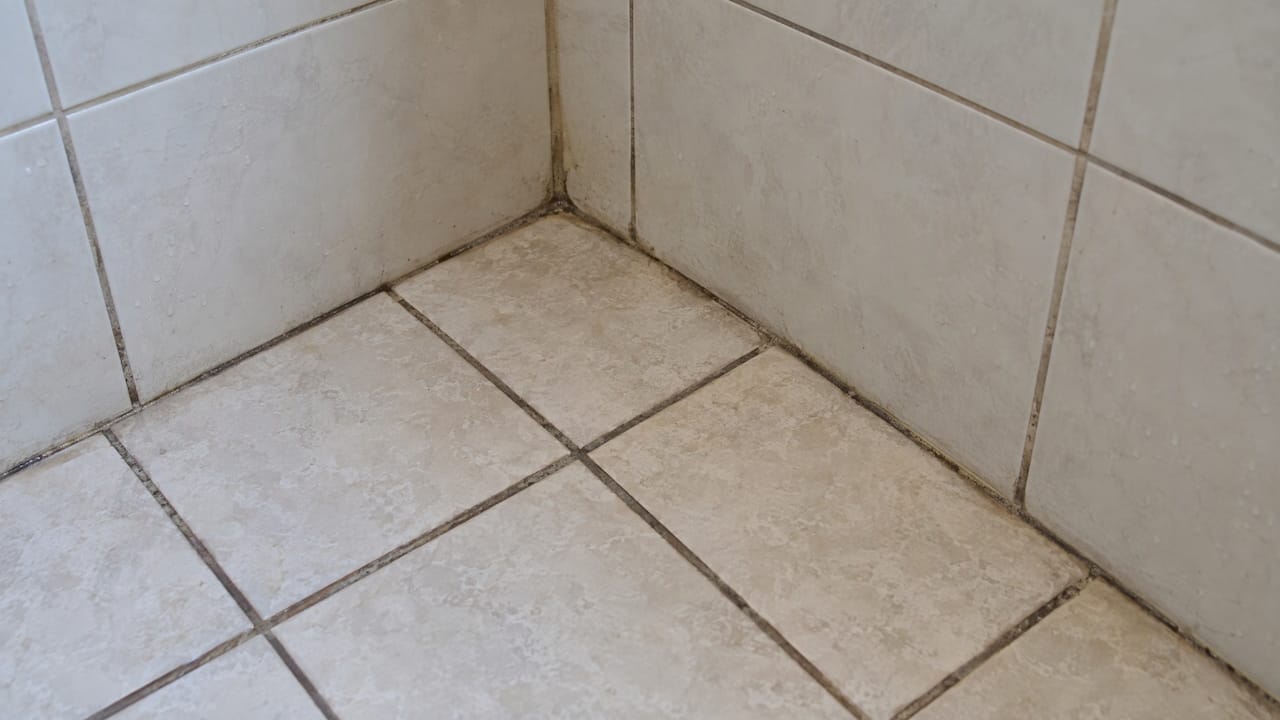
Grout is where soap scum does the most lasting harm. It is porous, so soap, oils and minerals sink in rather than sitting on top, and the lines go gray or dark even after the tile face looks fine.
Manufacturer guidance is consistent on the order of operations. H.B. Fuller’s grout cleaning bulletin directs routine cleaning with a pH-neutral cleaner, an alkaline cleaner for grease and soap scum, and an acid-based cleaner only for hard-water deposits and inorganic stains. It says to scrub joints with a white nylon pad, rinse and dry, test a small hidden spot first, and never use acid on natural stone or acid-sensitive tile.
LATICRETE’s care sheet adds that strongly acidic, alkaline, ammonia-based or abrasive cleaners and bleach can damage tile and grout and degrade sealers. Interceramic’s care guide says neutral pH cleaners are the only ones recommended for colored grout, and that alkaline cleaners such as bleach can strip sealant over time.
Putting that together for a typical shower:
- Start with a pH-neutral cleaner and a nylon brush, working in short strokes.
- Move to an alkaline grout cleaner if soap film and body oils remain.
- Keep acid for isolated hard-water deposits, on tile and grout that can take it, and rinse it completely.
- Rinse, dry and, ideally, remove the dirty water with a wet vacuum rather than spreading it around with a mop. LATICRECE notes that damp mopping redistributes dirt and collects it in the joints.
Steam is another option for some jobs. BISSELL’s guide says most sanded or unsanded shower grout can take steam, but epoxy grout can be sensitive to heat and should get a pH-neutral cleanser and soft brush instead.
For a closer look at why chemistry matters on grout, see our guide to effective tile grout cleaning methods. For dark spots that may be mold rather than scum, read about safely removing shower grout mold.
Stopping it from coming back
Prevention is cheaper than any deep clean. Wirecutter says squeegeeing the shower after every use can reduce deep cleaning to about once a quarter, and running the fan or opening a window for at least 20 minutes after each shower helps limit mold and mildew.
A few more habits help:
- Wipe the tile face as well as the glass. Scum that dries on the wall is the start of the next layer.
- Clean with a pH-neutral product regularly. The IICRC recommends a no-rinse neutral pH cleaner and a microfiber flat mop system for regular care of tile and grout floors.
- Seal the grout. Standard cement grout is porous and stains easily when unsealed, according to the IICRC. Sealer reduces absorption and staining, though Bettesworth Construction points out it does not make grout maintenance-free.
After a deep clean, sealing is the natural next step, and our guide to grout sealing after professional cleaning explains how it fits in.
When routine cleaning is no longer enough
Some showers are past the point where a spray bottle helps. The signs:
- A hard, crusty or cloudy layer that returns within days of cleaning.
- Grout that stays dark or discolored after you have scrubbed and rinsed properly.
- Tile you cannot identify, or stone, where the wrong product can etch the surface permanently.
- A bathroom where the same chemicals keep being layered on, raising the risk of an accidental mix.
- A rental turnover, a listing or a commercial restroom where results have to be even and quick.
The IICRC says soil that has not saturated deeply can usually be removed with thorough cleaning, while deeply set stains call for regrouting or a topical color seal. Knowing which side of that line your grout is on is the judgment call a trained technician makes. The Cleaning Standard manual also notes that in badly neglected showers, dissolving years of crust with chemicals alone can turn into hours of repeated applications, which is why professionals remove what they can mechanically first.
If you manage a business, the same logic applies to restrooms, locker rooms and kitchens. Our guides on high-traffic tile grout cleaning and commercial kitchen grout cover those settings.
Our perspective
Most of the soap scum we are called about is not one bad week of showers. It is years of thin layers, and each layer makes the next one stick better.
The mistake we hear about most is a stronger product on top of a weaker one. People add more chemical when the answer is usually better order of work: lift what can be lifted, use one cleaner suited to the surface, rinse completely, and let the surface dry.
Our cleaners are IICRC-certified and use organic cleaning products, which fits how families want to clean a bathroom where kids bathe. We have more than 20 years in this work and back it with a 100% satisfaction guarantee. If you would like to see what a chlorine-free approach looks like, read how chlorine-free tile cleaning works.
Joe
Professional tile and grout cleaning in the Northwest Suburbs
We clean tile and grout for homeowners and businesses in Arlington Heights, Bartlett, Barrington, Elgin, Elk Grove Village, Hoffman Estates, Lake Zurich, Mount Prospect, Palatine, Rolling Meadows, Streamwood and nearby. Our IICRC-certified cleaners use organic products, and we are a local, family-owned company with hundreds of five-star reviews. See residential tile and grout cleaning for homes, or commercial tile and grout cleaning for offices, retail and restaurants.

Tile and grout cleaning is quoted per job, so reach out through our site to book. We also clean carpet, vinyl plank floors and air ducts, if you want to handle the whole house in one visit.
Frequently Asked Questions about removing soap scum from tile
What is the best way to clean soap scum?
Lift loose buildup first if the surface allows it, then apply a cleaner made for soap scum and let it dwell before scrubbing. Rinse thoroughly and dry. Choose the cleaner for your tile and grout type, and never mix products.
Can I use vinegar on soap scum on shower tile?
Acidic cleaners are generally fine on glazed ceramic, glass and fiberglass, but not on natural stone, and acid dissolves the cement in grout. Never combine vinegar with bleach, since that releases chlorine gas.
Do professionals clean shower tile differently?
Yes. A professional identifies the tile and grout first, removes what can be lifted mechanically, uses the cleaner matched to the surface, and removes the dirty water so soap film is not left in the grout. We do this for homes and businesses across the Northwest Suburbs.
Why does my grout look dirty right after I clean it?
Usually the grout absorbed soap and the joints were not fully rinsed, leaving a sticky film that attracts dirt. A thorough rinse and drying pass, or removing the water with a wet vacuum, helps. Grout that stays dark may be stained deeply.
How often should I deep clean the shower?
Wirecutter says squeegeeing after every shower can reduce deep cleaning to about once a quarter. Without that habit, expect to clean more often, particularly with hard water.
What are the sources for this soap scum removal guide?
- Mr. Clean: How to remove soap scum
- USGS: Hard water and soft water
- Village of Palatine 2024 Consumer Confidence Report
- Wirecutter: How to clean a shower
- Tile Council of North America: Cleaning grout
- New Jersey Department of Health: Mixing cleaners hazard alert
- CDC: Cleaning and disinfecting with bleach
- WC Safety: Using bleach and cleaning chemicals safely
- The Cleaning Standard: Tile, stone and grout manual
- Bettesworth Construction: How to clean a shower safely
- CNN Underscored: How to clean a shower
- H.B. Fuller: Grout cleaning technical bulletin
- LATICRETE: Care and maintenance of tile and stone
- Interceramic: Care and maintenance
- BISSELL: How to clean shower tile and grout
- IICRC: Tile, stone and grout tip sheet