
Negative air pressure duct cleaning is a professional HVAC source-removal method where a powerful vacuum connects directly to your duct system and maintains continuous suction throughout the cleaning process. As technicians use agitation tools to loosen debris inside the ducts, the negative pressure draws everything toward a sealed collection point rather than letting it drift back into your living space. According to NADCA’s proper cleaning methods guidance, the system stays under continuous negative pressure so dislodged particles are removed rather than released into occupied areas. This method is the right call when containment genuinely matters: post-renovation dust, visible debris, documented contamination, or any situation where stirring up particles without capturing them would make things worse.
Before you book anyone, confirm three things: the contractor follows NADCA-aligned practices, the vacuum collection unit uses HEPA filtration, and pressure is monitored and documented during the job. IICRC-certified technicians, like those at Carpetandtileplus, are trained to meet those standards.
At a glance:
- Negative air pressure cleaning keeps the duct system under continuous suction during the entire job
- HEPA filtration on the collection unit captures fine particles at 99.97% efficiency at 0.3 microns
- NADCA membership and IICRC certification are the two credentials worth requiring from any contractor
- Best suited for post-renovation cleanup, visible contamination, or heavy debris situations
- Flex ducts need assessment before cleaning, not automatic exclusion
Key Takeaways
Negative air pressure duct cleaning is the professional standard for source removal because continuous suction during agitation keeps dislodged debris contained and moving toward a HEPA-filtered collection point rather than back into your home.
| Point | Details |
|---|---|
| Core method | A vacuum maintains continuous negative pressure so agitated debris travels to a sealed HEPA-filtered collection drum, not back into living spaces. |
| HEPA filtration matters | HEPA filters capture nearly all particles at very small sizes; such filtration is required on any indoor vacuum exhaust per industry ACR standards. |
| Flex ducts need assessment | Flex duct is not off-limits, but requires physical support and calibrated suction to avoid liner distortion. |
| Vet by credentials and documentation | Require NADCA-aligned practices, IICRC-certified technicians, a manometer log, and before-and-after photos from any contractor. |
| Carpetandtileplus local service | IICRC-certified, HEPA-equipped, and pressure-verified duct cleaning across the Northwest Suburbs of Chicago, with documented results at every job. |
Table of Contents
- How does negative air pressure duct cleaning actually work?
- What equipment should you see on the job site?
- Why does negative pressure cleaning improve air quality?
- When is negative pressure cleaning not the right fit?
- What safety and containment practices should you expect?
- What should you expect on the day of service?
- How much does negative pressure duct cleaning cost, and how often do you need it?
- How do you vet and hire a qualified contractor?
- What Carpetandtileplus does differently in the Northwest Chicago suburbs
- Carpetandtileplus air duct cleaning: book your assessment
- Sources
How does negative air pressure duct cleaning actually work?
The process starts before any agitation tool touches a duct. Here is the sequence a properly trained crew follows:
- Establish service openings. Technicians cut or remove access points in the main trunk lines so the vacuum hose can connect directly to the duct system.
- Attach the negative air machine. A high-capacity vacuum unit connects to the duct at a central collection point, typically near the air handler.
- Create and verify negative pressure. The vacuum runs and a manometer (pressure gauge) confirms the system is holding a negative differential. Trade providers often reference a working target around −0.5 in. w.c. as a practical benchmark, though NADCA defines the standard by cleanliness outcome rather than a single prescriptive pressure value.
- Agitate while the vacuum collects. Technicians work through each branch using brushes, air whips, or pneumatic tools to dislodge debris. Because the system is already under suction, loosened material travels toward the collection drum rather than floating back into the room.
- Contain and remove debris. Everything captured goes into a HEPA-filtered collection bag or drum that is sealed before removal.
The physics here are straightforward. Suction creates a pressure gradient: air moves from higher pressure (the duct branches) toward lower pressure (the collection point). Any particle that gets knocked loose rides that airflow to the drum. Without the negative pressure, agitation alone just redistributes dust.
Roto-Brush’s overview of common duct cleaning methods confirms that combining agitation tools with continuous suction is what separates true source removal from methods that simply move debris around.
Pro Tip: Ask the technician to show you the manometer reading before agitation starts. If they cannot point to a gauge or cannot explain what the reading means, that is a red flag worth acting on.
What equipment should you see on the job site?
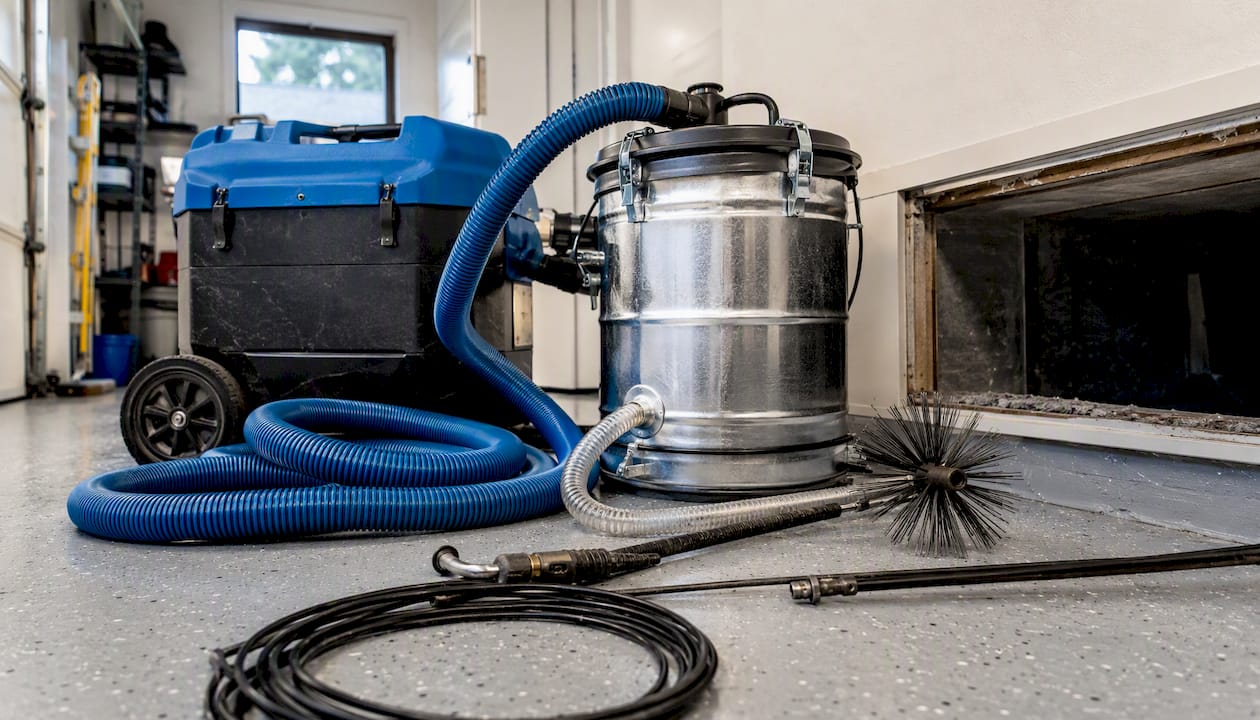
Understanding the gear helps you vet a contractor on the spot. A legitimate negative pressure cleaning setup includes several specific components, each with a job.
| Equipment | Role | What to confirm |
|---|---|---|
| Negative air machine / vacuum unit | Creates continuous suction and collects debris | CFM rating appropriate for system size; HEPA-filtered exhaust |
| HEPA-filtered collection drum or bag | Captures dislodged particles at the containment point | HEPA present; bag sealed before removal |
| Agitation tools (brushes, air whips) | Loosen debris from duct walls so suction can capture it | Tools sized for duct diameter; no damage to liner |
| Manometer / pressure monitor | Verifies and logs negative pressure differential during cleaning | Readings documented and available to homeowner |
| HEPA air scrubber (ambient) | Cleans background air in the work area during and after cleaning | At least four air changes per hour in containment scenarios |
The HEPA standard matters most when the vacuum exhausts indoors. Industry ACR specifications require HEPA filtration capable of retaining dislodged debris when equipment exhausts inside the home, and specify that unfiltered exhaust must be routed outdoors and away from any air intake. HEPA filters capture nearly all particles at very small sizes, which covers the fine dust and biological debris that standard filters miss.
Questions worth asking before you hire:
- What is the CFM rating of your vacuum unit, and how do you size it for my system?
- Where does the vacuum exhaust? If indoors, confirm HEPA filtration is on that exhaust port.
- Do you use a manometer, and will you provide a log of pressure readings?
- Do you run an ambient HEPA air scrubber during the job?
Why does negative pressure cleaning improve air quality?
The core advantage is containment. Methods that agitate without capturing debris can redistribute fine particles throughout the home. Negative pressure cleaning eliminates that risk by keeping the system under suction the entire time agitation is happening.
- Particle containment: Dislodged dust, mold spores, and allergens travel toward the collection drum rather than back into living spaces.
- Fine particle removal: The combination of agitation and continuous suction reaches debris that surface-level cleaning misses entirely.
- Source removal alignment: NADCA’s approach targets the actual source of contamination, not just surface appearance. NADCA’s source-removal standard defines success by verified cleanliness, not by how long the crew spent on site.
- Reduced re-distribution: Compared with “blow-and-go” methods that use compressed air without a collection system, negative pressure cleaning keeps debris out of the breathing zone.
The benefits are most meaningful in specific scenarios: after a renovation that generated drywall dust or insulation fibers, when visible debris is present at registers, when occupants have respiratory sensitivities, or when an HVAC inspection reveals documented contamination. For a routine cleaning on a well-maintained system, the method still works well, but the containment advantage is most dramatic when there is a real contamination load to manage. You can read more about how duct cleaning affects indoor air quality and what the evidence actually shows.
When is negative pressure cleaning not the right fit?
The method works on most residential duct systems, but a few situations require assessment or adjustment before proceeding.
Flexible ducts are the most common concern. Flex duct is made of a wire coil wrapped in plastic liner and insulation, and aggressive suction without proper support can distort or collapse the liner. R&R Magazine’s analysis of negative pressure on flex ducting confirms that flex ducts need special assessment and physical support during cleaning, but that properly calibrated suction avoids structural damage. NADCA has publicly stated that flex ducts are not categorically off-limits for negative pressure cleaning; the requirement is professional assessment, not automatic exclusion.
Fiberglass-lined ducts present a different issue. The internal liner can be damaged by aggressive agitation tools, and damaged liner releases fibers into the airstream. Technicians should use softer agitation and lower suction levels, or recommend liner repair before cleaning.
Damaged or leaking ducts undermine the entire method. If the duct system has significant gaps or disconnected sections, negative pressure cannot be maintained, and debris may escape into wall cavities or unconditioned spaces. Repair comes before cleaning in those cases.
| Duct type | Suitability for negative pressure cleaning | Key precautions |
|---|---|---|
| Sheet metal (rigid) | High | Standard procedure; confirm access points |
| Flexible duct | Moderate, with assessment | Physical support required; calibrate suction carefully |
| Fiberglass-lined | Moderate, with care | Softer agitation; inspect liner integrity first |
| Damaged / leaking ducts | Low until repaired | Seal or replace before cleaning |
The decision flow: inspect first, assess duct condition and type, then choose between cleaning, repair, or replacement. A contractor who skips the inspection and goes straight to cleaning is cutting a corner that matters.
What safety and containment practices should you expect?
NADCA ACR requirements set the floor for how a professional job should be run. The standard requires maintaining a verifiable negative pressure differential throughout cleaning, HEPA filtration on any indoor exhaust, and documented verification of pressurization during the project. These are not optional add-ons; they are the baseline for a compliant job.
Homeowner checkpoints during the service:
- Pressure log: Ask the technician to record manometer readings at the start, during agitation, and at completion. A contractor who cannot produce this documentation did not verify containment.
- Exhaust routing: Confirm where the vacuum exhaust exits. Indoors requires HEPA filtration on the exhaust port. Outdoors requires placement away from windows, doors, and HVAC intakes.
- Ambient air scrubbing: A HEPA air scrubber running in the work area keeps background particulates low. NADCA guidance recommends at least four air changes per hour in containment scenarios.
- Containment practices: Registers and grilles should be sealed during trunk-line work. Protective coverings on floors and furniture near access points are standard practice.
- Redundant equipment: For larger jobs, a backup vacuum unit should be available in case the primary unit loses suction mid-job.
A contractor who cannot explain where the exhaust goes or who dismisses pressure monitoring as unnecessary is not running a NADCA-aligned job, regardless of what their marketing says.
Local and state environmental codes may also govern outdoor particle discharge. A qualified contractor knows these rules and routes exhaust accordingly.
What should you expect on the day of service?
Preparation makes the job faster and less disruptive. Here is what to do before the crew arrives:
- Clear a path to every supply and return register in the home.
- Move fragile items away from registers and the area near the air handler.
- Notify all occupants that the HVAC system will be offline for several hours.
- Secure pets in a room away from the work area.
- Confirm with the contractor where they plan to route the vacuum exhaust before work begins.
For a typical single-family home, the job runs three to five hours depending on system size, duct complexity, and contamination level. Larger commercial systems can take a full day or more. The noisiest phases are when agitation tools are running inside the ducts and when the vacuum unit is at full draw. Most of the disruption is concentrated in the first hour when access points are being established.
At completion, a properly documented job includes:
- Before-and-after photos of duct interiors at representative access points
- Pressure verification data (manometer log)
- Debris containment confirmation (sealed collection bag or drum)
- Written scope of work with notation of any duct conditions observed
That documentation is your evidence that the job was done correctly. Keep it with your home maintenance records. For a full preparation checklist, the air duct cleaning checklist for homeowners covers every step in detail.
How much does negative pressure duct cleaning cost, and how often do you need it?
Cost varies by system size, duct complexity, contamination level, and the labor involved in setting up proper containment and HEPA exhaust. For a typical single-family home in the U.S., professional duct cleaning generally runs in the range of $300–$700, with larger or more contaminated systems running higher. Any quote significantly below that range for a full-system job warrants scrutiny about what is actually included, particularly whether HEPA filtration and pressure monitoring are part of the service.
Key cost drivers:
- Number of supply and return registers
- Duct material (flex duct requires more care and time)
- Degree of contamination (heavy debris means more passes)
- HEPA exhaust setup and ambient air scrubbing
- Any duct repairs needed before cleaning can begin
- Access difficulty (finished ceilings, tight crawl spaces)
Frequency guidance: The EPA and NADCA do not prescribe a universal cleaning interval, because need varies by household. A home with pets, smokers, or occupants with allergies may benefit from cleaning every three to five years. Most homes without those factors can go longer between cleanings. Event-driven cleaning makes the most sense after renovation work, after a documented mold or pest issue, after a fire or flood, or when HVAC performance has noticeably declined.
Industry guidance: The EPA notes that duct cleaning has not been shown to prevent health problems in all cases, but recommends it when ducts are visibly contaminated, infested, or clogged with substantial debris.
Avoid scheduling cleaning purely on a calendar basis if the system shows no signs of contamination. A visual inspection at the registers and at the air handler is a reasonable first step before committing to a full cleaning.
How do you vet and hire a qualified contractor?
This is where most homeowners make mistakes. The right contractor is not necessarily the cheapest or the one with the most aggressive marketing. Here is how to evaluate them properly.
Vetting checklist:
- Ask for NADCA membership or explicit reference to NADCA ACR practices in their scope of work.
- Confirm IICRC certification for the technicians who will be on site.
- Ask for the make and model of the vacuum collection unit and confirm HEPA filtration is present.
- Request their pressure-monitoring procedure and ask what documentation they provide.
- Verify they carry liability insurance and ask about their debris disposal method.
Sample questions to ask on the phone:
- “Do you maintain negative pressure throughout the entire cleaning, or only during certain phases?”
- “Where does your vacuum exhaust? Is it HEPA-filtered if it exhausts indoors?”
- “Will you provide a manometer log and before-and-after photos?”
- “How do you handle flex duct sections?”
Red flags that should end the conversation:
- Vague answers about containment (“we just vacuum everything out”)
- No mention of pressure monitoring or inability to explain what a manometer is
- Vacuum exhaust routed indoors without HEPA filtration
- “Blow-and-go” claims (compressed air only, no collection system)
- Refusal to provide documentation or photos
- Unusually low flat-rate pricing with no site assessment
Contract items to require before work begins:
- Written scope of work specifying which ducts will be cleaned
- Equipment list including vacuum unit specs and HEPA confirmation
- Containment measures and exhaust routing plan
- Post-clean verification method (photos, pressure log)
- Debris disposal method and confirmation of sealed removal
- Any warranty or follow-up terms for deficiencies found
Knowing the signs your HVAC needs cleaning before you call a contractor helps you describe the problem accurately and evaluate whether the contractor’s proposed scope matches the actual need.
What Carpetandtileplus does differently in the Northwest Chicago suburbs
After more than 20 years serving homeowners in Elgin, Bartlett, Streamwood, Arlington Heights, Palatine, Barrington, and Hanover Park, the team at Carpetandtileplus has seen what separates a properly contained negative pressure cleaning from a job that just looks like one. Every air duct cleaning we perform uses HEPA-filtered collection, documented pressure verification, and containment practices that align with NADCA guidance. Our IICRC-certified technicians know how to assess duct condition before agitation starts, which matters especially for homes with flex duct runs or older fiberglass-lined systems.
We provide before-and-after photos and pressure documentation at every job, not as an upsell, but because that record is what proves the work was done right. Our commitment to minimal disruption means we work efficiently and leave the space clean. If you want to understand what a thorough duct cleaning assessment covers before scheduling, the HVAC duct cleaning process guide walks through every step.
Carpetandtileplus air duct cleaning: book your assessment
Carpetandtileplus brings IICRC-certified technicians, HEPA-filtered collection equipment, and documented pressure verification to every air duct cleaning job in the Northwest Suburbs of Chicago. You get a real site assessment before any work begins, so the scope matches your actual system, not a generic package.

Hundreds of five-star reviews from homeowners across Elgin, Bartlett, Streamwood, and surrounding communities reflect what two decades of local experience looks like in practice. If your ducts are due for cleaning or you have just finished a renovation, now is the right time to schedule. Book your air duct cleaning assessment with Carpetandtileplus and get a clear picture of what your system needs before committing to a full service.
Sources
The following sources informed this article and are worth reviewing if you want to go deeper on any specific point:
- Proper Cleaning Methods | National Air Duct Cleaners Association (NADCA)
- Effects of Negative Air Duct Cleaning on Flex Ducting | R&DR Magazine
- Common Air Duct Cleaning Methods | Roto-Brush