
Professional carpet damage assessment is a structured evaluation process that determines whether a carpet can be cleaned, repaired, or must be replaced. The industry term for this process is carpet condition evaluation, and it goes far beyond a quick visual scan. Certified technicians apply systematic diagnostic methods with measurable thresholds to distinguish between surface soil, fiber wear, and structural failure. Knowing how professional cleaners assess carpet damage gives homeowners and facility managers the information they need to make decisions based on root causes, not surface symptoms.
How professional cleaners assess carpet damage: the full process
A professional carpet inspection follows a defined sequence, not a gut feeling. Technicians trained under IICRC standards evaluate four core factors: visual condition, structural integrity, moisture levels, and padding condition. Each factor feeds into a final recommendation. Skipping any one of them produces an incomplete picture and often leads to money wasted on cleaning that cannot fix the underlying problem.
The inspection starts at the surface and works downward. A technician walks the entire area, noting traffic patterns, stain locations, color changes, and fiber behavior. This walkthrough takes only a few minutes, but it sets the direction for every test that follows. Carpetandtileplus technicians, for example, use this structured approach on every job in the Northwest Suburbs of Chicago to avoid misdiagnosis before a single drop of cleaning solution is applied.
What visual and physical signs do professionals look for?
Visual signs tell the first part of the story. Professionals scan for these indicators during a standard carpet cleaning assessment:
- Staining patterns: Isolated stains suggest spot damage. Widespread discoloration often points to fiber degradation or wicking from below.
- Color fading: Bleach contact, UV exposure, and chemical spills each produce distinct fading patterns that a trained eye can separate.
- Fiber loss and backing exposure: Worn areas where the backing is visible signal structural failure, not just surface soiling.
- Traffic lane graying: This can come from simple dirt or from permanent fiber abrasion. The difference matters because cleaning fixes one and cannot fix the other.
- Edge darkening: Dark borders along walls and under doors indicate that the carpet is acting as an air filter, trapping fine particles in its edges. Professionals call this “filter capacity,” and heavy edge darkening signals that the carpet’s dust-holding limit has been reached.
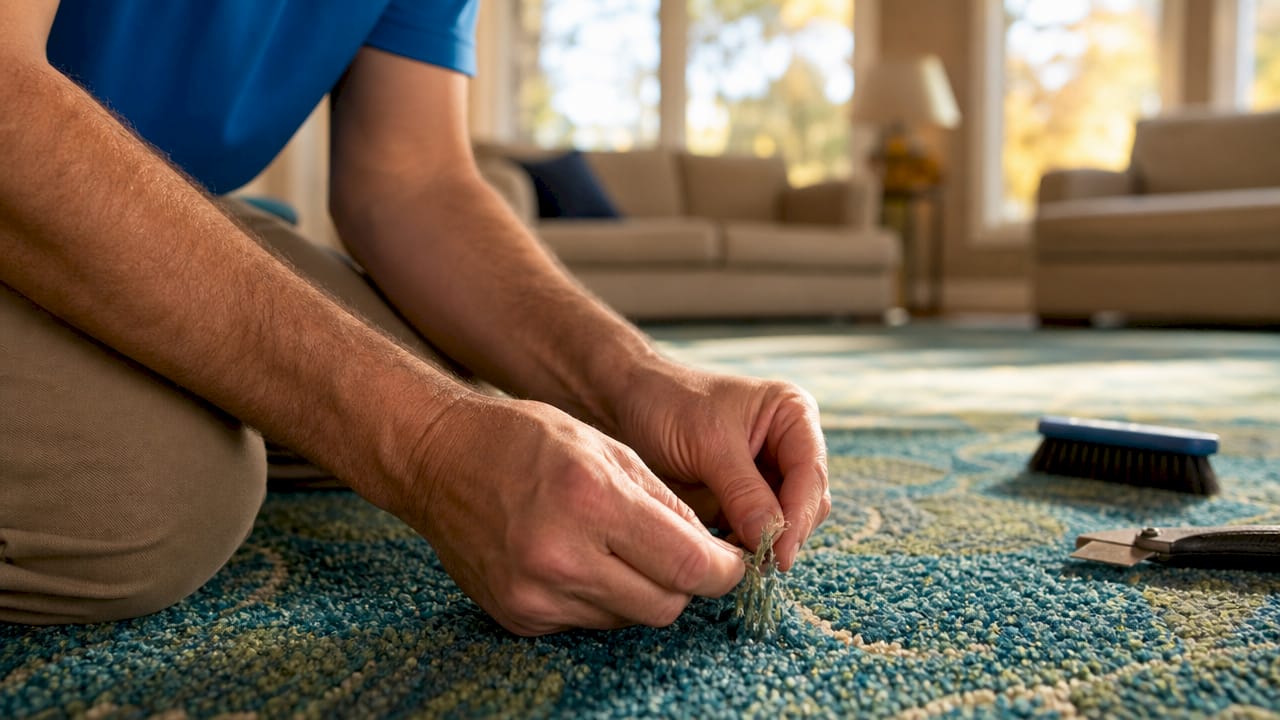
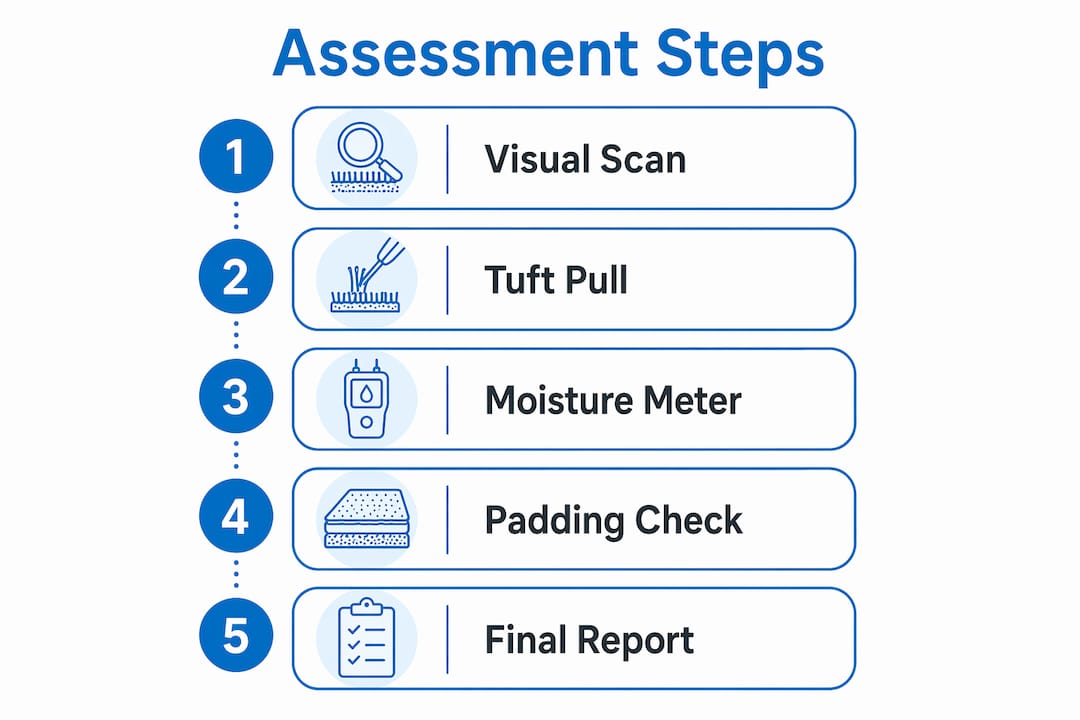
Physical tests follow the visual scan. The tuft pull test is the most telling. A technician grips a small cluster of fibers and applies light upward force. If tufts release easily, the primary backing has lost structural integrity and the carpet is at end of life. Photos taken from across the room cannot reveal this. The test takes seconds and delivers a clear answer.
Pro Tip: Ask any professional you hire whether they perform a tuft pull test before quoting a cleaning price. If they skip it, they are pricing without a full diagnosis.
Padding thickness evaluation rounds out the physical inspection. A technician lifts a corner of the carpet and presses the pad. Compression below 1/4 inch, crumbling texture, or a sour odor are all signs that the pad has failed. Cleaning the carpet without addressing the pad produces short-lived results.
How do standardized tools and tests aid in assessing carpet damage?
Visual and physical checks identify obvious problems. Standardized tools find the hidden ones. The three most common technical procedures in a professional carpet damage evaluation are:
- Calibrated moisture meter testing: A technician presses the meter’s probes into the carpet and reads the moisture percentage. IICRC S500 standards classify water damage by category and require pad replacement when moisture exceeds 20%. That threshold is not a judgment call. It is a documented standard used in insurance and warranty claims.
- Fiber analysis: The technician examines pile height, fiber type, and twist level under magnification or strong light. Nylon, polyester, and wool each respond differently to cleaning chemistry. Misidentifying the fiber leads to the wrong treatment and potential damage.
- Infrared thermal imaging: A thermal camera detects temperature differences in the subfloor caused by hidden moisture. Thermal imaging catches moisture migration that meters miss when moisture has not yet wicked to the surface.
The table below shows how each tool contributes to the final assessment.
| Tool | What it measures | Why it matters |
|---|---|---|
| Calibrated moisture meter | Moisture percentage in carpet and pad | Determines pad replacement threshold per IICRC S500 |
| Fiber analysis | Pile height, fiber type, twist condition | Guides correct cleaning chemistry selection |
| Infrared thermal camera | Subfloor temperature variation | Detects hidden moisture causing odor and damage |
Standardized inspection methods that use calibrated tools produce defensible documentation. That documentation matters when filing an insurance claim or disputing a warranty denial. An informal visual inspection produces an opinion. A calibrated moisture reading produces evidence.
How do professionals differentiate between repairable damage and replacement?
This is the decision that costs or saves the most money. Professionals use specific thresholds, not impressions, to draw the line between restoration and replacement.
Repairable damage typically includes surface stains that have not bonded to the fiber, minor pile crushing from furniture, and localized areas of soiling. Deep cleaning, fiber lifting, or targeted spot treatment resolves these issues. The signs your carpet needs professional cleaning rather than replacement include stains that respond to pre-treatment, pile that springs back after steam, and padding that still holds its thickness.
Replacement becomes the right call when any of the following are present:
- Backing failure: Torn or delaminated backing cannot be restored. The carpet will continue to unravel.
- Persistent wicking stains: Stains that return after cleaning are pulling contamination up from the pad or subfloor. Cleaning the surface repeatedly does not fix the source.
- Chemically bonded stains: Stains bonded to fibers at a molecular level cannot be lifted by cleaning. Dyeing or replacement are the only options.
- Excessive pile height loss: When pile height has dropped significantly across large areas, the carpet has lost its functional and aesthetic value.
- Pad failure with odor: A pad that crumbles and smells will transfer contamination back into a freshly cleaned carpet within weeks.
Pro Tip: If a stain reappears within two weeks of professional cleaning, the source is below the carpet surface. Request a moisture and pad inspection before paying for a second cleaning.
| Condition | Recommendation | Reason |
|---|---|---|
| Surface stains, no backing damage | Clean | Stains are removable; structure is intact |
| Pile crushing, no fiber loss | Clean and lift | Fibers can recover with heat and agitation |
| Wicking stains, pad odor | Replace pad, then clean | Source is below carpet; surface cleaning fails |
| Backing failure or delamination | Replace carpet | Structural integrity is gone |
| Chemically bonded stains | Dye or replace | Cleaning chemistry cannot break molecular bond |
What role does the carpet pad and subfloor play in damage assessment?
The pad and subfloor are the foundation of carpet performance. A carpet sitting on a failed pad will re-soil faster, feel flat underfoot, and hold odors that no surface cleaning can remove. Professionals treat the pad inspection as non-negotiable, not optional.
Signs of pad failure that trigger a replacement recommendation include:
- Compression below 1/4 inch when pressed firmly with a finger
- A crumbling or flaking texture when the pad is lifted
- A persistent sour or ammonia odor that does not dissipate after ventilation
- Visible staining on the pad surface from pet urine or water intrusion
Subfloor moisture is the less obvious problem. Infrared thermal imaging detects hidden moisture migration in subfloor areas that the naked eye cannot see. A carpet can look dry on the surface while the subfloor holds enough moisture to grow mold within days. Thermal imaging prevents the misdiagnosis that leads to cleaning a carpet that will fail again in weeks.
Inspecting carpet padding by lifting corners gives the technician direct evidence of compression and deterioration. This step takes less than two minutes and determines whether any cleaning recommendation will actually hold up over time. Skipping it is the single most common mistake made by technicians who rush through an assessment.
Pro Tip: If a technician does not lift a corner of your carpet to check the pad, ask them to do it before they start. The condition of the pad changes the entire cleaning plan.
For homeowners dealing with water events, quick-dry methods and moisture monitoring are especially relevant. IICRC S500 requires remediation within 24–48 hours for Category 1 water damage. Waiting longer moves the damage into a higher category and often makes pad replacement unavoidable.
Key takeaways
Professional carpet damage assessment combines visual inspection, physical testing, and calibrated tools to produce a defensible recommendation that saves homeowners and facility managers from costly mistakes.
| Point | Details |
|---|---|
| Systematic evaluation beats guesswork | Professionals use measurable thresholds, not impressions, to separate cleanable damage from structural failure. |
| Tuft pull test reveals backing integrity | If tufts release with minimal force, the carpet is at end of life and cleaning will not restore it. |
| Moisture above 20% mandates pad replacement | IICRC S500 sets this threshold for water-damaged carpets; exceeding it makes cleaning the surface alone ineffective. |
| Thermal imaging finds hidden moisture | Infrared cameras detect subfloor moisture invisible to the eye, preventing misdiagnosis and repeat damage. |
| Early inspection prevents unnecessary replacement | An unbiased professional evaluation often identifies cleaning or minor repair as sufficient before replacement is considered. |
What I’ve learned after years of carpet assessments
The biggest misconception I see from homeowners and facility managers is that professional cleaning fixes everything. It does not. Cleaning is a surface treatment. When the damage is in the backing, the pad, or the subfloor, cleaning the top layer is like painting over a cracked wall. It looks better for a few weeks, and then the problem comes back.
The second misconception is that replacement is always the expensive option. An early unbiased inspection regularly shows that deep cleaning or a pad swap will restore carpet functionality for a fraction of replacement cost. I have seen facility managers authorize full carpet replacement in conference rooms that needed nothing more than a pad replacement and a hot water extraction cycle. That is an expensive mistake that a proper assessment prevents.
The advice I give every homeowner and facility manager is this: get the inspection before you get the quote. A technician who quotes a price without lifting the pad, running a moisture meter, or performing a tuft pull test is guessing. You deserve a diagnosis, not a guess.
— Jim
Carpetandtileplus: professional carpet evaluation in the Northwest Suburbs
Carpetandtileplus brings over 20 years of IICRC-certified experience to every carpet inspection and cleaning job across Elgin, Bartlett, Streamwood, Arlington Heights, Palatine, Barrington, and Hanover Park.

Every assessment includes a structured walkthrough, moisture testing, and a clear recommendation before any cleaning begins. Whether you need residential carpet cleaning for a family home or commercial carpet cleaning for a high-traffic facility, Carpetandtileplus delivers a written evaluation and a customized treatment plan. Organic cleaning products and a one-hour dry time mean your space is back in use the same day. Call Carpetandtileplus to schedule a professional carpet damage evaluation before making any repair or replacement decision.
FAQ
What does a professional carpet inspection include?
A professional carpet inspection covers visual condition, fiber integrity, moisture levels, and padding condition. Technicians use calibrated moisture meters, tuft pull tests, and sometimes infrared thermal imaging to produce a complete assessment.
How do professionals know when a carpet needs replacement instead of cleaning?
Backing failure, pad compression below 1/4 inch, persistent wicking stains, and chemically bonded stains all indicate that cleaning will not restore the carpet. These conditions require repair or full replacement.
What is the IICRC S500 standard and why does it matter?
IICRC S500 is the industry standard for water damage assessment and remediation. It classifies water damage by category and sets the 20% moisture threshold that triggers mandatory pad replacement.
Can photos show whether a carpet is damaged beyond cleaning?
Photos cannot reveal backing failure or moisture wicking below the surface. The tuft pull test and calibrated moisture meter provide evidence that photos cannot capture.
How often should carpets be professionally inspected?
The recommended inspection interval depends on traffic volume, household composition, and carpet age. High-traffic commercial areas benefit from annual inspections, while residential carpets typically need evaluation every 12–18 months.