HVAC duct cleaning is the professional removal of dust, debris, mold, and microbial contaminants from a building’s ductwork to improve indoor air quality and system performance. The process follows a structured, multi-phase method known as source removal, which the EPA and NADCA now recognize as the gold standard for healthy buildings. Understanding what this service actually involves helps you hire the right contractor, ask the right questions, and know exactly what you are paying for.
What is the HVAC duct cleaning process, step by step?
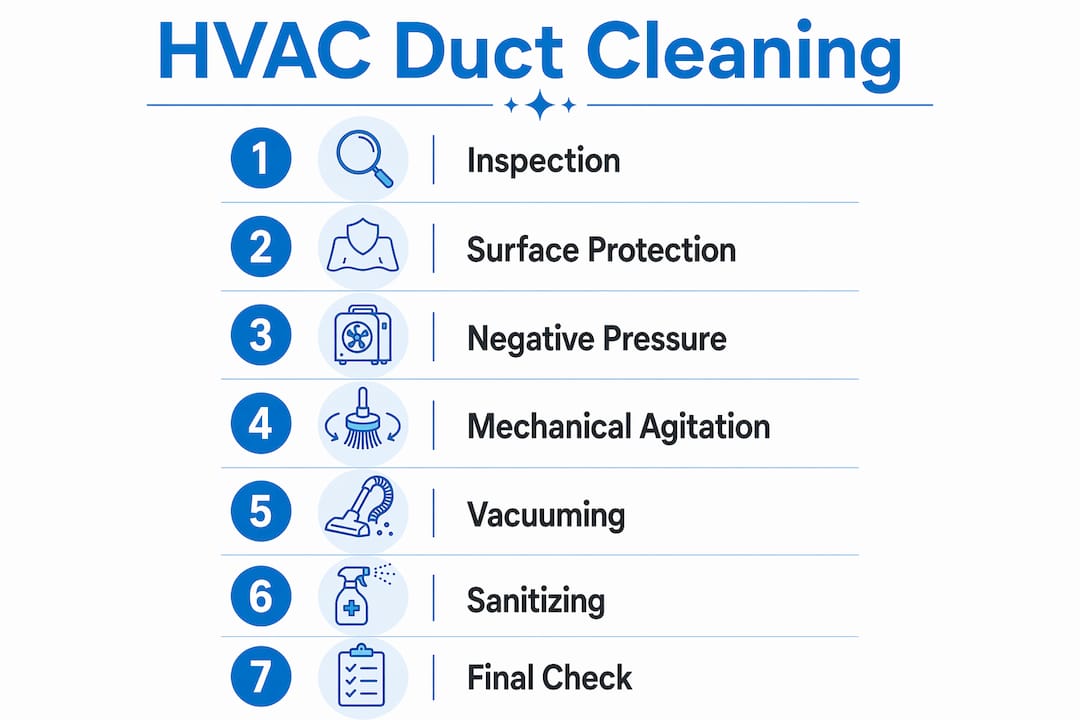
Professional duct cleaning is a systematic seven-phase process that takes 3–5 hours on average for a residential system. Anything faster almost certainly skips critical steps. Here is what a qualified technician does from start to finish.
-
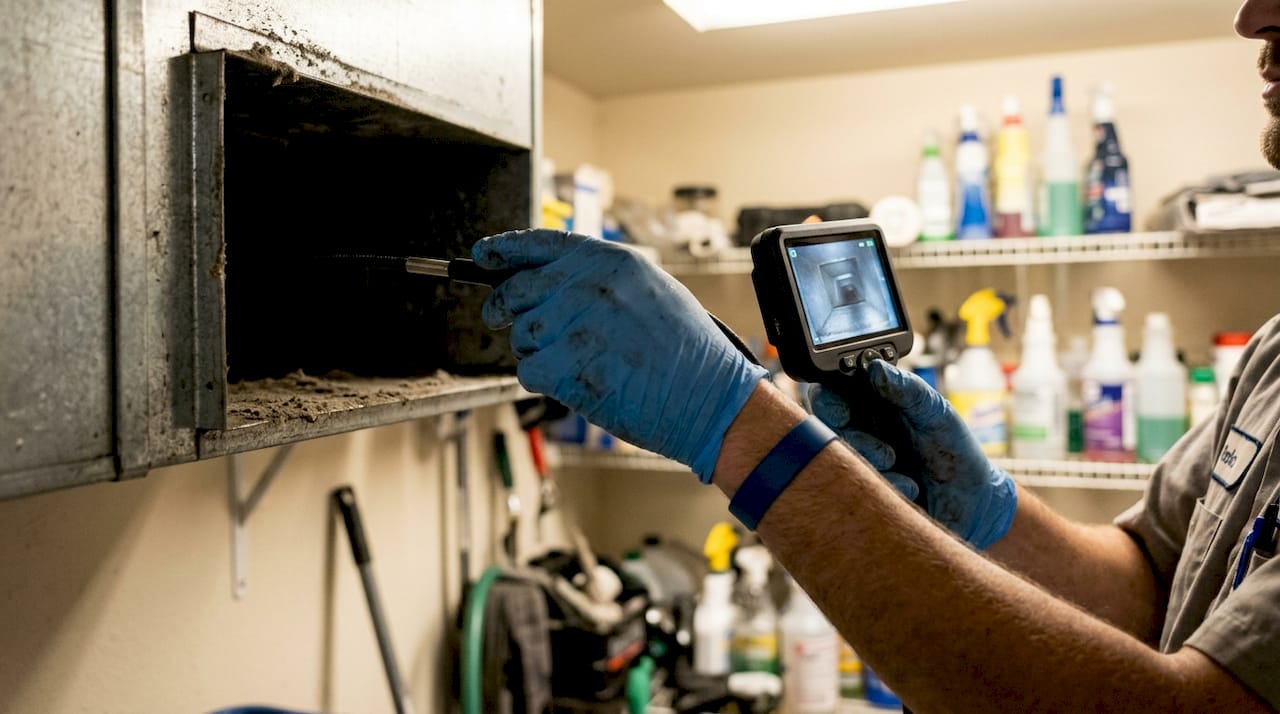
Initial inspection. The technician uses a camera or inspection scope to document contamination levels inside the ductwork. This footage gives you a baseline and confirms whether cleaning is actually warranted.
-
Surface and furniture protection. Drop cloths and plastic sheeting go over floors, furniture, and vents near the work area. This step prevents loosened debris from settling on your belongings.
-
Negative pressure establishment. An industrial HEPA-filtered vacuum attaches to the main trunk line and creates strong suction throughout the duct system. This is the most critical step. Without negative pressure, agitated dust blows back into your living space instead of being captured.
-
Mechanical agitation. Technicians use rotating brushes, compressed air whips, and pneumatic tools to dislodge debris from duct walls. The negative pressure vacuum captures everything as it breaks free. A typical cleaning removes 10–20 pounds of accumulated dust and debris from a residential system.
-
Furnace and component cleaning. Blower motors, evaporator coils, and drain pans often collect the same contaminants as the ducts. A thorough job includes these components, not just the duct runs.
-
Sanitizing and deodorizing (optional). Sanitizing treatments apply only after verified mechanical cleaning and when a specific microbial or odor problem exists. Chemical biocides are not a substitute for physical contaminant removal. If a contractor leads with sanitizing before cleaning, that is a red flag.
-
Final inspection and verification. The technician performs a second camera pass to confirm cleanliness. You should receive before-and-after footage as proof of work.
Pro Tip: Ask to watch the final camera inspection in real time. Reputable contractors welcome this. If a technician refuses or does not offer post-cleaning footage, request it explicitly before signing off.
Why does the EPA now recommend source removal in HVAC duct cleaning?
The EPA’s position on duct cleaning has shifted significantly. The agency’s 2025 IAQ guidance now names source removal alongside ventilation and filtration as a core best practice for healthy buildings. This is a meaningful update from earlier EPA publications that were more cautious about endorsing duct cleaning broadly.
Source removal means physically extracting contaminants from the duct system rather than simply loosening them. The distinction matters because loosening debris without capturing it can redistribute particles throughout your home. NADCA’s Air Conveyance System Cleaning (ACR) standards have required source removal for years. The EPA’s updated guidance now aligns with that position.
“Source removal is the only method that physically extracts contaminants from the duct system rather than redistributing them. The EPA’s 2025 IAQ guidance endorses this approach alongside ventilation and filtration as a foundation for healthy indoor air.”
The practical benefit is measurable. Removing built-up debris improves airflow through the system, which reduces the energy your HVAC unit needs to maintain temperature. Occupant health outcomes also improve, particularly for people with asthma or allergies. The NADCA source removal method uses strong negative pressure with HEPA filtration to capture contaminants safely without releasing them into living spaces. That combination of physical removal and containment is what separates professional cleaning from ineffective shortcuts.
How do professionals ensure thorough and safe duct cleaning?
Certification is the clearest indicator of quality. NADCA-certified technicians hold Air System Cleaning Specialist (ASCS) credentials, which require documented training in safety protocols, equipment use, and cleaning verification. Hiring a certified technician is the single most reliable way to avoid substandard work.
Beyond credentials, several practices separate quality jobs from poor ones:
- Negative pressure throughout the job. The HEPA vacuum must run continuously during agitation. Turning it off at any point risks blowing debris into the room.
- Access port creation when needed. Technicians sometimes cut small ports into duct sections to reach deeply embedded debris. These ports are professionally sealed after cleaning to maintain system airtightness and energy efficiency.
- Camera documentation. Visual verification via camera is a standard quality assurance practice. Before-and-after footage is your evidence that the job was done correctly.
- Appropriate sanitizing use. Sanitizing is only appropriate after mechanical cleaning confirms a microbial issue. Applying it as a first step or as an upsell without evidence of contamination adds cost without benefit.
- Written scope of work. A reputable contractor provides a written list of what will be cleaned, including all supply and return registers, main trunk lines, and any components like the blower or coil.
Pro Tip: Before hiring any contractor, ask whether they follow NADCA ACR standards and whether their technicians hold ASCS certification. A legitimate company answers both questions without hesitation.
For homeowners researching signs of duct contamination, visible debris at registers and musty odors are the most reliable early indicators that cleaning is overdue.
What signs indicate that HVAC duct cleaning is needed?
The EPA does not set a fixed cleaning interval. Instead, the agency recommends cleaning based on specific conditions rather than a calendar schedule. Knowing what to look for saves you from unnecessary service calls and helps you act when cleaning genuinely matters.
The EPA identifies three primary triggers for duct cleaning:
- Visible mold growth inside ducts or on components like the air handler or coil
- Vermin infestation, including evidence of rodents or insects inside the duct system
- Excessive dust or debris release from supply registers during normal system operation
Beyond those EPA-defined triggers, homeowners and property managers often notice secondary symptoms that warrant an inspection:
- Unexplained allergy flare-ups or respiratory irritation that improves when occupants leave the building
- Persistent musty or stale odors that return after cleaning carpets and surfaces
- Visible dust accumulation on registers shortly after wiping them clean
- A recent renovation that generated significant drywall dust or debris
| Condition | Action recommended |
|---|---|
| Visible mold in ducts | Clean immediately; address moisture source first |
| Vermin evidence | Exterminate, then clean and seal entry points |
| Dust blowing from registers | Inspect and clean if debris is confirmed |
| Allergy symptoms at home | Inspect ducts; consider air quality testing |
| Post-renovation dust | Schedule cleaning before running system normally |
You can learn more about when ducts need cleaning and what specific symptoms to watch for in your home or commercial space.
Key Takeaways
Professional HVAC duct cleaning follows a structured source removal process endorsed by the EPA and NADCA, and cleaning is warranted by specific conditions rather than a fixed schedule.
| Point | Details |
|---|---|
| Source removal is the standard | The EPA and NADCA both endorse physical contaminant extraction, not just loosening debris. |
| Seven phases define a quality job | Inspection, protection, negative pressure, agitation, component cleaning, optional sanitizing, and final verification. |
| Cleaning takes 3–5 hours | Jobs completed in under an hour typically skip the negative pressure step, risking dust blowback. |
| Certification matters | NADCA ASCS-certified technicians follow documented safety and quality protocols. |
| No fixed cleaning interval | Clean based on visible mold, vermin, excessive debris, or confirmed symptoms, not a calendar. |
What I’ve learned after years of watching duct cleaning jobs go wrong
The most common mistake homeowners make is choosing a contractor based on price alone. I have seen jobs quoted at a fraction of the going rate that amounted to a technician blowing compressed air through registers without ever establishing negative pressure. The result is dust redistribution, not removal. The occupants felt worse after the “cleaning” than before.
The 3–5 hour timeframe is not padding. A thorough job on a typical residential system genuinely takes that long when every register, return, trunk line, and component gets proper attention. If a contractor quotes you a one-hour job for a full home, ask them specifically how they plan to establish and maintain negative pressure throughout the system. The answer will tell you everything.
Camera inspections are where homeowners can add real value. I always recommend being present for the post-cleaning walkthrough. You do not need technical knowledge to recognize whether a duct looks clean on camera. Trust your eyes. A post-cleaning video inspection is your best protection against paying for work that was not done.
One more thing: sanitizing is not a bonus feature. It is a targeted treatment for a specific problem. If a contractor pushes sanitizing as a standard add-on without first confirming a microbial issue, decline it. Spend that money on a contractor who does the mechanical cleaning correctly instead.
— Jim
Carpetandtileplus brings certified duct cleaning to Chicago’s northwest suburbs
Carpetandtileplus provides professional air duct cleaning services for homeowners and businesses across Elgin, Bartlett, Streamwood, Arlington Heights, Palatine, Barrington, and Hanover Park. Every job follows NADCA and EPA source removal guidelines, using industrial HEPA-filtered equipment to physically extract contaminants rather than redistribute them.
With over 20 years of experience and hundreds of five-star reviews, Carpetandtileplus brings IICRC-certified technicians to every job. The team also handles residential carpet cleaning and tile and grout services, making it easy to address your entire indoor environment in one visit. Contact Carpetandtileplus to schedule an inspection and get a clear picture of what your ducts actually contain.
FAQ
What does the HVAC duct cleaning process involve?
The process involves seven phases: inspection, surface protection, negative pressure establishment, mechanical agitation, component cleaning, optional sanitizing, and final camera verification. A complete job takes 3–5 hours on average.
How often should HVAC ducts be cleaned?
The EPA recommends cleaning based on specific conditions rather than a set schedule. Clean when you see visible mold, evidence of vermin, excessive dust from registers, or confirmed occupant health symptoms linked to air quality.
What is source removal in duct cleaning?
Source removal is the physical extraction of contaminants from duct walls using negative pressure and mechanical agitation. The EPA’s 2025 IAQ guidance endorses it as a best practice alongside ventilation and filtration.
How do I know if a duct cleaning job was done correctly?
Request before-and-after camera footage from the technician. A properly cleaned duct system shows visibly clear walls on inspection. Also confirm the job took at least 3 hours and that negative pressure was maintained throughout.
Does NADCA certification matter when hiring a duct cleaner?
Yes. NADCA ASCS-certified technicians complete documented training in safety protocols and cleaning standards. Certification is the most reliable indicator that a contractor follows industry best practices rather than cutting corners.