Professional air duct cleaning can help prevent respiratory problems, but only when inspection confirms that your ducts are actually contaminated. EPA guidance is direct: cleaning has never been shown to prevent health problems as a routine measure. It works when specific, verifiable problems exist.
The short version:
- Clean when inspection shows it: Visible mold, water damage, pest infestation, registers discharging visible dust, or post-construction debris are the triggers that justify cleaning, per NADCA’s 2021 standard.
- Don’t expect a cure: Cleaning is not a proven treatment for asthma or allergies. It removes a contamination source; it doesn’t override outdoor air, cooking, pets, or other dominant indoor particle sources.
- Act on inspection first: Have a qualified technician inspect before scheduling a cleaning. If no contamination is found, upgrading your HVAC filter and controlling moisture will do more for your air quality than cleaning ducts that aren’t actually dirty.
Table of Contents
- What builds up in your ducts and why some of it matters more
- How contaminated ducts can contribute to breathing problems
- What the science actually says about cleaning and respiratory health
- When should you actually schedule a cleaning?
- What a qualified professional actually does during a cleaning
- How to choose a contractor who won’t make things worse
- Why Carpetandtileplus’s credentials matter for this kind of work
- Key Takeaways
- What I actually see on inspection jobs
- Carpetandtileplus serves the northwest Chicago suburbs
- Useful sources and further reading
What builds up in your ducts and why some of it matters more
Not everything that accumulates in a duct system poses the same risk. Some deposits are largely inert; others are biologically active and genuinely capable of triggering symptoms.
Common contaminants found in residential duct systems:
- Settled dust and fibers: Skin cells, textile fibers, and general household particulate. Mostly inert, but heavy accumulation can restrict airflow.
- Pollen: Seasonal allergens that enter through fresh-air intakes and settle in supply ducts. Relevant for allergy sufferers when pollen loads are high.
- Pet dander: Protein-based allergen particles that are small enough to stay airborne for hours and accumulate on duct surfaces. A real trigger for sensitized occupants.
- Mold and mold spores: The highest-priority contaminant. Mold requires moisture to grow, so its presence signals an underlying water problem. Spores distributed through supply air can trigger respiratory symptoms, especially in people with asthma or mold sensitivity.
- Rodent droppings and nesting debris: Biologically active and a serious allergen source. Mouse urinary proteins are among the most potent indoor allergens, particularly for children with asthma, according to CDC asthma trigger data.
- Combustion by-products: Carbon particles and volatile compounds from gas appliances or attached garages that infiltrate the return air stream.
- Construction debris: Drywall dust, insulation fibers, and wood particles left after renovations. These can restrict airflow and carry irritants.
The practical distinction is this: dust and fibers sitting quietly in a duct that isn’t actively distributing them are a lower priority than mold, rodent contamination, or heavy debris that your system is blowing into living spaces. A musty odor at registers, visible slime or discoloration inside ducts, droppings near returns, or a visible dust cloud when the system kicks on are the signs that warrant immediate attention.
Contaminants to prioritize: Mold, rodent allergens, and heavy debris that actively recirculate are the contaminants most likely to affect respiratory health. Settled dust in an otherwise clean, dry system is a much lower concern.
How contaminated ducts can contribute to breathing problems
The mechanism isn’t complicated. Your HVAC system moves air through the house continuously. When that air passes over contaminated duct surfaces, it picks up particles and distributes them to every room. The more biologically active the contaminant, the more likely it is to trigger a response in susceptible occupants.
Three main exposure pathways:
- Resuspension: Airflow disturbs settled material on duct walls and floors, lifting particles back into the air stream.
- Direct release from HVAC components: Mold growing on cooling coils, drain pans, or duct liner releases spores directly into supply air every time the fan runs.
- Infiltration from contaminated sections: A single moldy duct segment or a pest-infested return can seed the entire system.
People with asthma, allergic rhinitis, or compromised immune systems are at the highest risk. The American Academy of Allergy, Asthma & Immunology identifies indoor allergens including pet dander, dust mites, mold, and rodent proteins as primary triggers for allergic respiratory disease. When those allergens are being actively distributed through supply air, reducing that source matters.
Pro Tip: Pull a supply register off the wall and shine a flashlight inside. If you see visible dust buildup on the duct floor, mold discoloration, or debris, that’s a legitimate reason to schedule an inspection. If the duct interior looks clean and dry, your filter and humidity control are probably doing their job.
What the science actually says about cleaning and respiratory health
Here’s where the honest answer gets more nuanced. The EPA’s pilot field study found that mechanical cleaning effectively removed particulate from HVAC systems, but indoor respirable particle concentrations were highly variable after cleaning and were often dominated by outdoor air levels and occupant activities rather than duct deposits.
A 2010 scientific review reached a similar conclusion: while ducts can be contaminated and controlled experiments show that resuspension can elevate indoor exposure, field studies have not consistently shown that duct cleaning improves indoor air quality or reduces occupant symptoms. In some cases, post-cleaning particle concentrations were higher than pre-cleaning levels, likely because the cleaning process itself disturbed material.
“The need for duct cleanliness has to be properly balanced by the probable generation of indoor pollution resulting from duct cleaning and subsequent potential health risks.” — Is ventilation duct cleaning useful? A review of the scientific evidence
That doesn’t mean cleaning is useless. It means cleaning is a targeted fix for a confirmed problem, not a blanket health intervention. The NIH/DOHS fact sheet puts it plainly: cleaning should follow source control and proper evaluation, not precede it.
When NADCA and EPA say cleaning is justified:
| Condition | Justification |
|---|---|
| Visible microbial growth inside ducts or on HVAC components | Mold is biologically active and distributes spores through supply air |
| Permanent water damage to duct system | Moisture creates ongoing mold risk; cleaning alone is insufficient without fixing the source |
| Pest infestation evidence (droppings, nesting) | Rodent allergens are potent respiratory triggers |
| Debris restricting airflow | Reduces system efficiency and can harbor microbial growth |
| Registers discharging visible dust or debris | Confirms active distribution of contaminants into living spaces |
| Post-fire or post-construction contamination | Combustion residue and construction debris are respiratory irritants |
| Offensive odors from the duct system | May indicate microbial growth, pest activity, or combustion residue |
The common thread: every condition on that list is something an inspection can confirm. Routine cleaning on a fixed schedule, without inspection, is not supported by EPA, NIH, or NADCA guidance.
When should you actually schedule a cleaning?
The EPA guidance and NADCA both land on the same position: clean when inspection shows a reason to, not on an arbitrary calendar. Here’s a practical checklist.
Schedule an inspection if you notice any of these:
- Visible mold or slime inside ducts, on registers, or on HVAC components
- A musty or moldy odor that gets stronger when the system runs
- Evidence of rodents or insects in the duct system (droppings, nesting material, chewed insulation)
- Registers blowing visible dust or debris into the room
- Recent water intrusion, flooding, or a condensate drain backup that affected the duct system
- A major renovation that generated drywall dust, insulation fibers, or construction debris
- Fire or smoke damage that sent combustion residue into the system
- Purchasing a home where the duct history is unknown and a visual inspection reveals heavy buildup
What about frequency? There’s no universally recommended cleaning interval. The NIH/DOHS fact sheet emphasizes avoiding routine cleaning without cause. A visual check annually, or any time one of the triggers above appears, is a reasonable approach. If your system stays dry, your filters are changed regularly, and you have no pest activity, you may go years without needing a cleaning.
On cost: pricing varies by system size, accessibility, and scope. Ask any contractor for a written estimate that specifies which components will be cleaned, what methods will be used, and how cleanliness will be verified after the job. A flat low-ball quote with no scope detail is a red flag. You can also review a detailed air duct cleaning checklist before calling anyone, so you know exactly what questions to ask.
What a qualified professional actually does during a cleaning
Understanding the process helps you evaluate whether a contractor is doing the job correctly. The NADCA 2021 standard defines both the engineering controls and the procedural steps that qualified technicians follow.
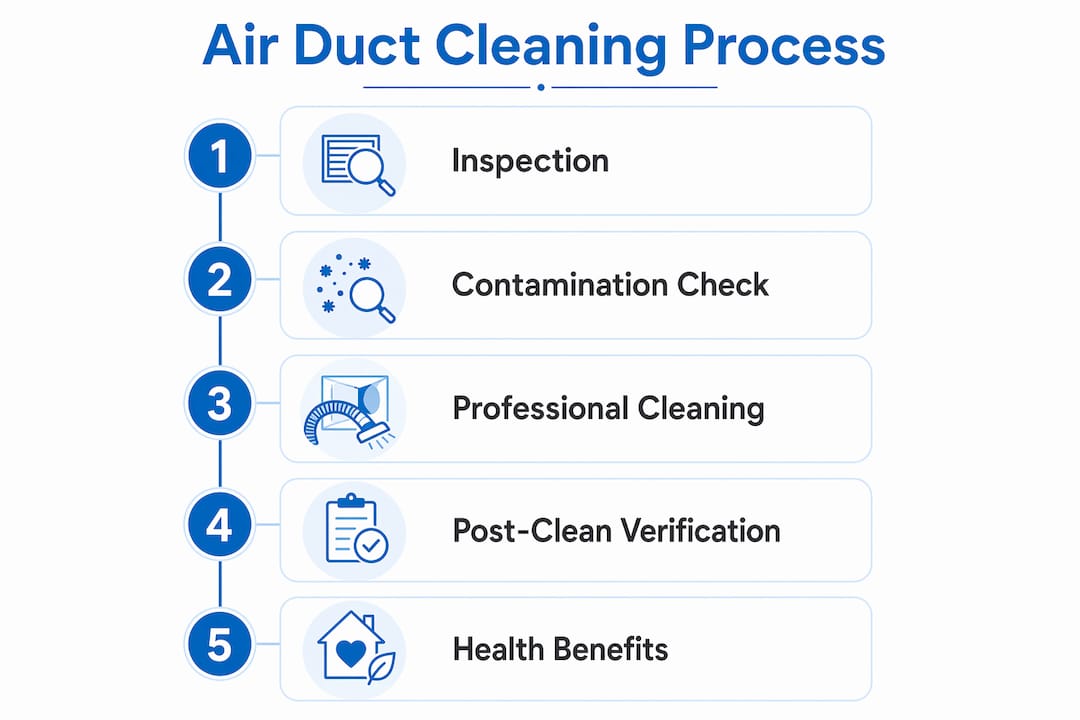
The standard cleaning workflow:
- Pre-service inspection and documentation: The technician inspects accessible duct sections, HVAC components, and registers before touching anything. Photos or video document conditions before work begins.
- Access openings: Technicians cut or remove access panels to reach duct interiors without damaging the system.
- Negative-pressure containment: A HEPA-filtered vacuum unit is connected to the system and placed under negative pressure before agitation begins. This prevents dislodged material from escaping into the living space.
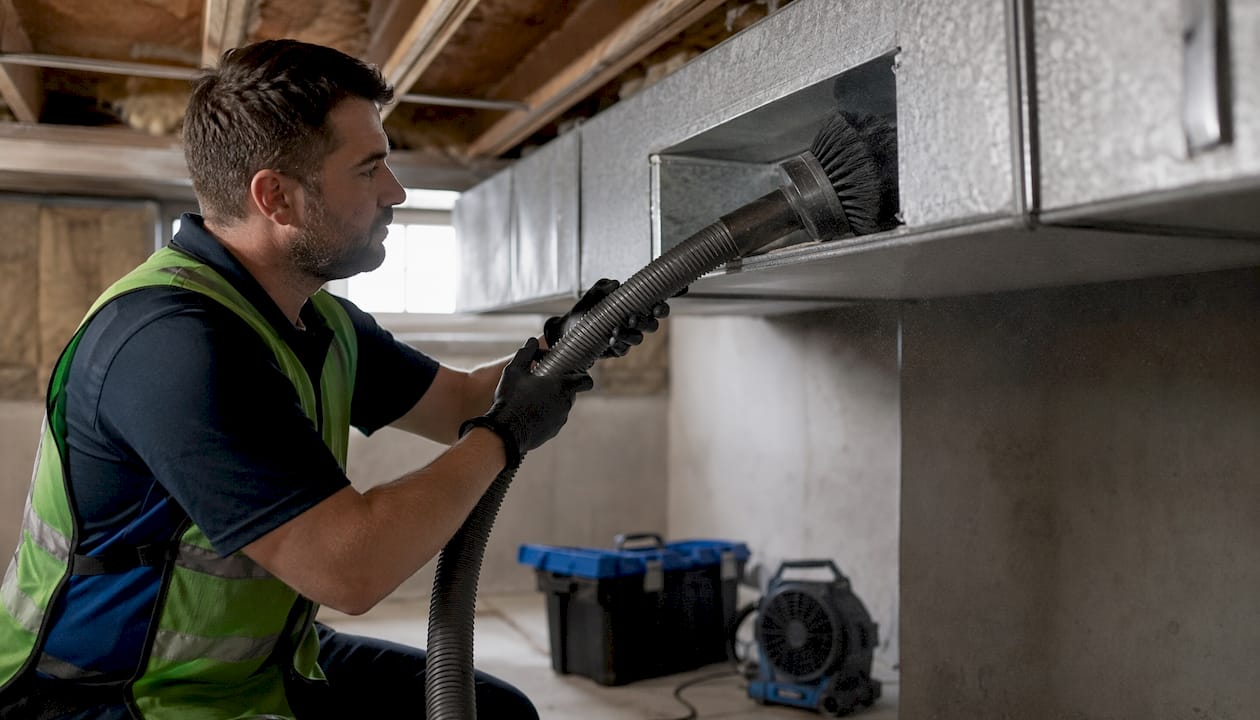
- Mechanical agitation: Rotary brushes, air whips, or compressed-air tools dislodge material from duct walls. Agitation without negative pressure is how cleaning spreads contamination instead of removing it.
- HEPA vacuuming: All dislodged material is captured by the negative-pressure HEPA unit. Capture velocity is matched to the contaminant type to prevent re-entrainment.
- AHU component cleaning: Cooling coils, drain pans, blower fans, and air handler cabinets are cleaned separately. Mold on coils or standing water in drain pans are common sources that duct cleaning alone won’t fix.
- Register and grille cleaning: Supply and return registers are removed, cleaned, and reinstalled.
- Post-cleanliness verification: NADCA describes visual inspection and the NADCA Vacuum Test or Surface Comparison Test to confirm the system is clean when visual inspection alone is inconclusive.
Pro Tip: If a contractor offers to apply a biocide or sealant as a standard part of the job, ask why. Both EPA and NIH advise caution: biocides have limited registration for duct use and carry potential health risks, and sealants should never be applied to wet or moldy duct liner. In those cases, duct sanitization may be appropriate only under specific, documented conditions — not as a default upsell.
| HVAC component | Primary cleaning method | Verification approach |
|---|---|---|
| Sheet metal supply ducts | Mechanical agitation + HEPA vacuum | Visual inspection, NADCA Vacuum Test |
| Return air ducts | Mechanical agitation + HEPA vacuum | Visual inspection |
| Cooling coils | Manual cleaning, coil cleaner | Visual inspection for fouling |
| Drain pan | Manual cleaning, flush | Visual for standing water or slime |
| Blower fan and housing | Manual cleaning | Visual inspection |
| Supply and return registers | Remove, wash, reinstall | Visual |
| Fiberglass duct liner (if damaged or moldy) | Replacement preferred over cleaning | Visual for integrity |
How to choose a contractor who won’t make things worse
A poorly executed cleaning can spread contamination rather than remove it. The NADCA standard requires negative-pressure containment and HEPA vacuuming precisely because inadequate methods create that risk. Here’s what to look for and what to avoid.
Questions to ask before hiring:
- Do you perform a documented inspection before quoting a cleaning?
- What standards do you follow? (Look for NADCA adherence and IICRC-certified technicians.)
- Do you use negative-pressure HEPA vacuum equipment and mechanical agitation?
- How do you verify cleanliness after the job?
- Are biocides or sealants part of your standard process? If so, why?
- Can you provide a written scope of work and before/after documentation?
Trust signals worth having:
- NADCA adherence for the cleaning process
- IICRC certification for technicians
- Written estimate with itemized scope
- Before/after photos or video documentation
- Verifiable local reviews and references
- Liability insurance
Red flags that should end the conversation:
- Recommending cleaning on a routine schedule without any inspection
- Pushing biocides or sealants as a default service
- Refusing to show equipment or explain their containment method
- A suspiciously low flat fee with no scope detail
- No mention of AHU component cleaning (coils, drain pans, blower)
Experts consistently warn homeowners to be skeptical of contractors who recommend scheduled cleaning without a prior inspection. Inspection-first is the professional standard, and any contractor who skips it is either cutting corners or selling a service you may not need. For a deeper look at signs your ducts need cleaning, a quick visual check before you call can save you time and money.
Why Carpetandtileplus’s credentials matter for this kind of work
Air duct cleaning done wrong can make indoor air quality worse, not better. That’s why credentials and process transparency matter as much as price.
Carpetandtileplus brings over 20 years of residential and commercial cleaning experience to every job in the northwest Chicago suburbs, including Elgin, Bartlett, Streamwood, Arlington Heights, Palatine, Barrington, and Hanover Park. The team holds IICRC certification, which means technicians are trained to industry standards for inspection, cleaning methods, and contamination control.
Every job starts with a documented inspection. If the system doesn’t warrant cleaning, we say so. If it does, homeowners get before/after documentation and a clear explanation of what was found and what was done. That transparency is what “inspection-first” actually looks like in practice.
What that translates to for homeowners:
- Inspection before any cleaning is scheduled or quoted
- Mechanical agitation and negative-pressure HEPA vacuuming as standard practice
- Organic cleaning products used throughout the process
- Before/after documentation provided on every job
- Guidance on filter upgrades and moisture control after cleaning
- Hundreds of verified 5-star reviews from local homeowners
The combination of indoor air quality improvements from cleaning and source control measures like better filtration and humidity management gives homeowners the best chance of a real, lasting outcome.
Key Takeaways
Air duct cleaning prevents respiratory problems only when inspection confirms active contamination; cleaning a clean system produces no consistent health benefit.
| Point | Details |
|---|---|
| Inspect before you clean | NADCA, EPA, and NIH all require a documented inspection to justify cleaning. |
| Mold, pests, and debris are the real triggers | These biologically active contaminants are the ones most likely to affect respiratory health. |
| Cleaning has evidence limits | Studies show variable indoor air outcomes; cleaning is not a proven cure for asthma or allergies. |
| Pair cleaning with source control | Filter upgrades and humidity control address dominant particle sources that cleaning alone cannot fix. |
| Carpetandtileplus applies inspection-first standards | IICRC-certified technicians, before/after documentation, and mechanical cleaning methods in the northwest Chicago suburbs. |
What I actually see on inspection jobs
The conventional wisdom in this industry tends to run in one of two directions: either “clean your ducts every year for better health” or “duct cleaning is a scam.” Both miss the point.
What I see on actual inspection jobs is more specific. The jobs where cleaning makes a real difference almost always involve one of three things: visible mold on coils or duct liner, evidence of rodent activity in the return system, or post-renovation debris that the homeowner didn’t realize had gotten into the ductwork. In those cases, cleaning removes a genuine contamination source that was actively circulating through the home. Occupants with asthma or allergies often notice a difference within days.
The jobs where cleaning doesn’t help are the ones where the system is fundamentally clean but the homeowner has been told by a marketing pitch that they’re overdue. In those cases, the bigger wins come from upgrading to a MERV 11 or MERV 13 filter, fixing a bathroom exhaust fan that’s been venting into the attic, or addressing a crawl space moisture problem. Those interventions address the actual particle sources. Cleaning a dry, uncontaminated duct system doesn’t.
The honest answer to “will cleaning help my respiratory symptoms?” is: it depends entirely on what’s in your ducts. That’s why inspection comes first, every time. A contractor who quotes you a cleaning price before looking inside the system is not following professional standards, and you should find someone who does.
Carpetandtileplus serves the northwest Chicago suburbs
If you’re dealing with persistent allergy symptoms, a musty smell when the HVAC runs, or you’ve just moved into a home with an unknown duct history, the right first step is a professional inspection, not a cleaning quote. Carpetandtileplus provides residential air duct cleaning services across the northwest Chicago suburbs, including Elgin, Bartlett, Streamwood, Arlington Heights, Palatine, Barrington, and Hanover Park.
Every job starts with a documented inspection. If cleaning is warranted, IICRC-certified technicians use mechanical agitation and negative-pressure HEPA vacuuming, with before/after documentation provided. If it isn’t warranted, you’ll get honest guidance on filtration and moisture control instead. Organic cleaning products are used throughout, and the process is designed to minimize disruption to your day.
Call or schedule online to book your inspection. You’ll get a written estimate with a clear scope of work before any cleaning begins.
Useful sources and further reading
The guidance in this article draws from primary regulatory and industry sources. Here’s where to go if you want the original documents.
- EPA: Should You Have the Air Ducts in Your Home Cleaned? The primary EPA consumer guidance document. Covers when cleaning is and isn’t recommended, the limits of health claims, and the role of source control.
- NIH/DOHS Fact Sheet: HVAC Duct Cleaning Practical procedural guidance from the NIH Office of Research Services. Covers engineering controls, when to clean versus replace, and cautions on biocides and sealants.
- NADCA ACR Standard 2021 Edition The industry standard for HVAC inspection, cleaning, and restoration. Defines the conditions that justify cleaning, required engineering controls, and cleanliness verification methods.
- EPA Pilot Field Study on Residential HVAC Cleaning The EPA’s own field study on cleaning effectiveness. Key finding: mechanical cleaning removes duct contaminants, but indoor particle concentrations are highly variable and often driven by outdoor and occupant sources.
- Is Ventilation Duct Cleaning Useful? A Review of the Scientific Evidence A peer-reviewed scientific review that evaluates field studies and controlled experiments. Concludes that evidence for consistent IAQ or health benefits from duct cleaning is insufficient, and raises concerns about biocide and sealant use.
- CDC: Asthma Triggers Background on the indoor allergens most associated with asthma exacerbations, including pet dander, mold, and rodent proteins.
For a practical next step, a documented inspection from a qualified provider is more useful than any of these documents on their own. What’s in your specific system determines whether cleaning will help.