
An antimicrobial carpet treatment is a chemical agent applied to carpet fibers, backing, or both to slow or prevent the growth of bacteria, mold, and mildew in the carpet material itself. The key word is material. Under the EPA Treated Articles Exemption, these treatments are classified as product preservatives, not human-health interventions. They protect the carpet, not the people living on it. If you’re dealing with persistent odors, moisture damage, or backing mold in a Northwest Chicago suburb home or commercial space, a quick assessment from a certified pro is the fastest way to know whether treatment makes sense for your situation.
Table of Contents
- What counts as an antimicrobial carpet treatment?
- How do antimicrobial treatments actually work on carpet?
- What can antimicrobial treatments realistically do — and what can’t they?
- When is antimicrobial treatment worth considering?
- What does U.S. regulation actually allow manufacturers to claim?
- What to expect from professional application, cost, and maintenance
- How Carpetandtileplus approaches carpet protection in the Northwest suburbs
- Key Takeaways
- The case for staying skeptical about antimicrobial claims
- Ready for an on-site assessment in the Northwest suburbs?
- Useful sources
What counts as an antimicrobial carpet treatment?
Three distinct forms exist, and a contractor offering “antimicrobial service” could mean any of them.
- Built-in (extruded into fiber): The antimicrobial agent is incorporated during manufacturing, often by extruding silver-based compounds or zinc pyrithione into fibers or backing. This is the most durable form.
- Topical sprays or foams: Applied to an existing carpet after installation or cleaning. Effective short-term, but processing preservatives often wash out and do not support long-term antimicrobial claims.
- Backing and latex treatments: Antimicrobial chemistries such as thiabendazole or isothiazolinone are incorporated into the foam underlay or latex backing layer, where moisture damage typically starts.
Common chemistries by use:
| Agent | Typical Application |
|---|---|
| Silver-based compounds | Extruded into fiber; long-lasting |
| Zinc pyrithione | Fiber and backing treatments |
| Thiabendazole / isothiazolinone | Latex backing and foam underlay |
| Topical spray formulations | Post-install surface application |
Pro Tip: If you’re protecting a basement carpet or a commercial kitchen floor mat against moisture, ask specifically whether the backing treatment is available for your carpet type. A surface spray alone won’t reach the latex layer where mold typically starts.
How do antimicrobial treatments actually work on carpet?
Most treatments act through contact inhibition: the antimicrobial agent sits on or within the fiber surface and disrupts microbial reproduction when a microbe lands on it. Picture a microbe settling into soiled carpet. It first contacts the face fiber, then works toward the backing as moisture carries it deeper. A surface-only treatment intercepts it at the fiber; a backing treatment catches what gets through.
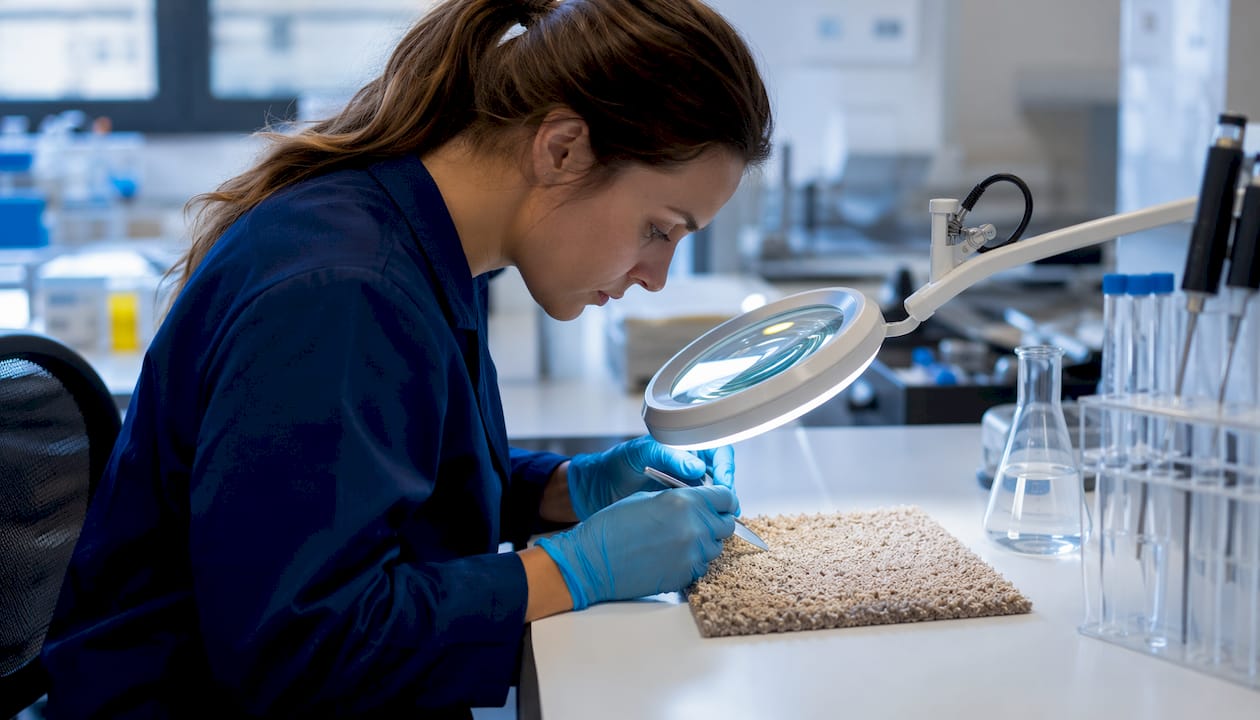
The distinction between biostatic and biocidal action matters here. Biostatic treatments slow or stop microbial growth without necessarily killing the organism. Biocidal treatments kill on contact. Most carpet treatments are biostatic, which is why they reduce odor and slow backing degradation rather than eliminating contamination outright.
Durability splits along another line: leaching vs. non-leaching chemistry. Leaching technologies release active ingredients over time and lose efficacy as those ingredients deplete. Non-leaching (bound) technologies stay fixed to the fiber and remain active through repeated cleaning. For any installation where longevity matters, bound chemistry is the better choice.
What can antimicrobial treatments realistically do — and what can’t they?
The core benefit is product preservation: protecting the carpet’s fiber, adhesive, and backing from fungal breakdown under moisture conditions that would otherwise cause deterioration. Odor control is a real secondary benefit, since many carpet odors come from microbial activity in the backing. Stain resistance is sometimes bundled in, though that depends on the specific product.
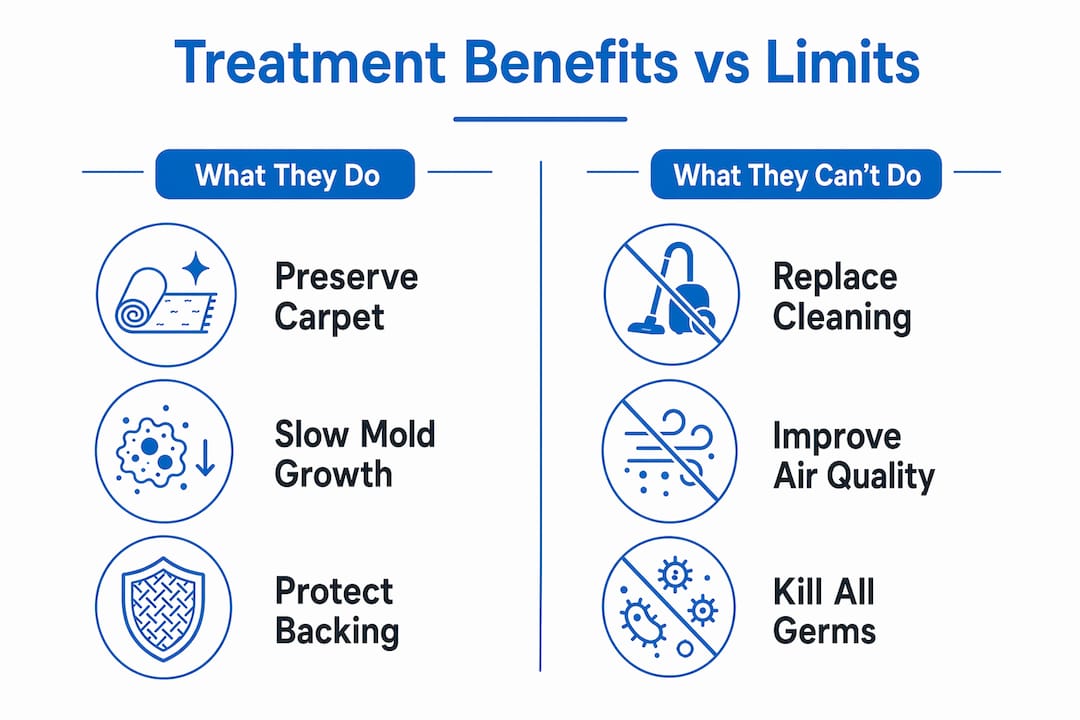
| What treatments can do | What they cannot do |
|---|---|
| Slow mold and mildew growth in backing | Replace professional deep cleaning |
| Reduce odor from microbial activity | Improve indoor air quality on their own |
| Extend carpet life in high-humidity areas | Disinfect surfaces or kill pathogens |
| Protect latex and foam underlay | Correct existing moisture intrusion |
| Reduce staining from microbial sources | Substitute for pad or backing replacement |
Indoor air quality depends far more on ventilation and physical soil removal than on textile treatments. Any marketing that implies a treated carpet acts as a home disinfectant is misleading.
Pro Tip: Watch for vague “kills germs” language in product marketing. Under EPA rules, a finished carpet cannot legally make human-health claims unless it is itself EPA-registered as a treated article — and very few finished carpets are. If a sales pitch sounds like a public-health claim, ask for the EPA registration number.
When is antimicrobial treatment worth considering?
Treatment adds real value in specific situations. In most standard residential rooms with normal humidity, routine professional cleaning and moisture control are sufficient.
Consider treatment when you can check at least two of these:
- History of mold or mildew in the carpet backing or padding
- Persistent musty odor that returns within weeks of professional cleaning
- Chronic elevated humidity (basements, crawl-space-adjacent rooms, below-grade commercial spaces)
- Repeated water intrusion events (flooding, pipe leaks, HVAC condensation)
- Commercial kitchens, locker rooms, or other high-moisture commercial environments
- Rental units with documented pet accident history and odor complaints
For basements in the Northwest Chicago suburbs, summer humidity alone can push backing moisture above the threshold where mold becomes a real risk. In that scenario, antimicrobial finishes in the backing extend carpet life by protecting the latex layer from fungal breakdown. If the backing is already compromised, though, replacement is the right call, not treatment.
What does U.S. regulation actually allow manufacturers to claim?
The EPA’s position is clear: antimicrobial additives in carpets are treated-article uses intended to protect the product. Manufacturers may claim product-level benefits such as odor and stain resistance. They cannot claim the carpet prevents disease or protects human health unless the finished product carries its own EPA registration.
| Claim type | Allowed under EPA Treated Articles Exemption? |
|---|---|
| “Protects carpet from odor-causing bacteria” | Yes |
| “Resists mold and mildew in backing” | Yes |
| “Reduces staining from microbial sources” | Yes |
| “Kills germs to protect your family” | No — requires EPA registration |
| “Prevents illness or infection” | No — requires EPA registration |
| “Improves indoor air quality” | No — not a treated-article claim |
Before hiring any contractor for antimicrobial application, ask for:
- The exact product name and manufacturer
- The product’s Safety Data Sheet (SDS)
- The test standard used to substantiate claims (AATCC or ASTM are the recognized methods)
- Whether the product is listed on the EPA’s registered pesticide database if health claims are made
- Confirmation that the product is labeled for carpet or textile use
What to expect from professional application, cost, and maintenance
Factory-applied treatments are the most durable because the agent is bound during manufacturing. Post-install topical applications are the most common service offering and require periodic reapplication depending on traffic and cleaning frequency. Backing treatments, when available, sit between the two in durability.
Questions to ask any contractor before booking:
- Are you IICRC certified, and can you show documentation?
- What is the exact product name, and can I see the SDS?
- Is the chemistry leaching or non-leaching (bound)?
- What is the expected drying time after application?
- Will this treatment void my carpet manufacturer’s warranty?
- How does the treatment interact with hot-water extraction cleaning?
Cost varies by square footage, product type, and whether treatment is bundled with a cleaning service. Standalone topical applications in the Chicago suburbs typically run in the range of a few cents to a fraction of a dollar per square foot, though bundled pricing with professional cleaning is often more economical. Understand what professional carpet cleaners do before comparing quotes.
Maintenance after treatment: vacuum regularly, address spills immediately, and schedule professional hot-water extraction at least once a year. Heavy soiling and trapped moisture create conditions that no antimicrobial treatment can fully correct on its own.
How Carpetandtileplus approaches carpet protection in the Northwest suburbs
Carpetandtileplus starts every assessment with IICRC-certified cleaning and moisture evaluation before recommending any antimicrobial application. The company’s position is that treatment is a secondary measure: soil extraction, moisture control, and proper drying come first. Antimicrobial treatment gets recommended selectively, primarily for backing protection in high-moisture situations or for persistent odor control when cleaning alone hasn’t resolved the problem.
The team serves homeowners and property managers across Elgin, Bartlett, Streamwood, Arlington Heights, Palatine, Barrington, and Hanover Park. With over 20 years of experience, hundreds of 5-star reviews, and IICRC-certified technicians, Carpetandtileplus uses organic cleaning options wherever possible. The one-hour dry time minimizes disruption, which matters whether you’re managing a rental turnover or getting a basement back in use before the next rain event.
Key Takeaways
Antimicrobial carpet treatment protects carpet materials from microbial degradation under moisture conditions — it is not a disinfectant, and professional IICRC cleaning remains the primary defense for both carpet longevity and indoor hygiene.
| Point | Details |
|---|---|
| Product protection, not people protection | Treatments protect carpet fibers and backing; EPA rules prohibit human-health claims without registration. |
| Non-leaching chemistry lasts longer | Bound (non-leaching) agents stay active through cleaning cycles; leaching types deplete over time. |
| Best use cases are moisture-prone spaces | Basements, commercial kitchens, and flood-history rooms benefit most from backing treatments. |
| Always request the SDS and test standard | Ask for AATCC/ASTM test documentation and the product SDS before any contractor applies a treatment. |
| Carpetandtileplus recommends cleaning first | The company prioritizes IICRC-certified extraction and moisture control, adding antimicrobial treatment only when the situation calls for it. |
The case for staying skeptical about antimicrobial claims
Most of the antimicrobial carpet marketing I see in the Chicago suburbs oversells what these treatments do. The pitch is usually some version of “your carpet will be cleaner and healthier,” which sounds great but sidesteps what the EPA actually permits manufacturers to say. The treatment protects the carpet. Full stop.
What gets underestimated is how much the local environment matters. Northwest Chicago basements are genuinely humid in summer, and winter salt tracked in from driveways creates a moisture cycle that accelerates backing deterioration. In those conditions, a backing-applied treatment is a reasonable investment. But I’ve seen plenty of cases where a homeowner paid for a topical spray on a carpet that already had mold in the padding. The spray did nothing useful. The right call was pad replacement and moisture remediation.
The honest framework: clean first, control moisture second, treat only if the situation warrants it. A contractor who leads with antimicrobial upsells before assessing your moisture situation is working backward.
Ready for an on-site assessment in the Northwest suburbs?
Carpetandtileplus offers on-site assessments for homeowners and property managers across the Northwest Chicago suburbs. A visit covers a full inspection, a moisture check, and a straight recommendation: cleaning, backing repair, or antimicrobial treatment, with an estimate before any work begins. No guesswork, no pressure.
Whether you manage a commercial property in Arlington Heights or own a home in Barrington with a basement carpet that’s been through one too many humid summers, the team brings IICRC certification, organic cleaning options, and 20-plus years of local experience to every job. For persistent odors that haven’t responded to cleaning, the carpet odor removal service is a natural starting point. Book your assessment at carpetandtileplus.com and get a clear answer on what your carpet actually needs.
Useful sources
The claims in this article draw on EPA regulatory guidance, industry testing standards, and manufacturer technical documentation. These sources are worth bookmarking if you want to go deeper before hiring a contractor.
- CRI Technical Bulletin: Antimicrobial Carpet Treatments — The Carpet and Rug Institute’s primary reference on EPA treated-article rules, AATCC/ASTM test methods, and what manufacturers can and cannot claim. Start here.
- Designtex: Antimicrobials (industry guidance) — A commercial textile manufacturer’s technical note on why antimicrobial treatments are not substitutes for cleaning and what indoor air quality actually depends on.
- Ultra-Fresh: Antimicrobial Flooring and Carpet — Covers silver-based and zinc pyrithione chemistries, backing and underlay applications, and moisture-related use cases.
- Danfloor: Understanding Antimicrobial Agents — Clear explanation of leaching vs. non-leaching (bound) technologies and how each performs through cleaning cycles.
- Flooring Clarity: Using Microban on Carpet — Practical breakdown of built-in vs. topical Microban applications, real-world performance limits, and why IICRC cleaning takes priority.
For Carpetandtileplus service pages relevant to this topic: residential carpet cleaning, commercial carpet cleaning, and carpet odor removal.