Office air duct cleaning removes built-up dust, debris and contamination from the supply and return ducts, registers and air-handling components that move air through your workspace. The clearest benefits show up when something is visibly wrong: dust blowing from vents, musty odors, debris in the system, or a coil and fan section that has gone dirty. Done by a properly equipped crew, cleaning also gives a facility manager a documented, clean starting point for maintenance. Below we explain what you can realistically expect, when it makes sense, and how to run the job so it helps rather than disrupts your team.
TL;DR
- Duct cleaning removes accumulated dust, debris and contamination from ducts, registers, coils and fan components, which is the whole point of the service.
- It pays off most when there is a visible reason: heavy dust, debris or particles from supply registers, a pest problem, or mold growth after the cause is fixed.
- The efficiency gains come mainly from cleaning the coils, fans and heat exchangers, not just the duct walls, so ask for the whole air-handling system to be inspected.
- Method matters: containment, negative-air machines and filtered grilles keep the dust from spreading through your office.
- Schedule after hours or on a weekend, and hire a contractor with certified air system specialists on staff.
Table of Contents
- What office air duct cleaning actually covers
- The real benefits for an office
- What the research says about air quality and health
- When your office should schedule duct cleaning
- How to get the benefits without the mess
- What to ask a duct cleaning contractor
- Our perspective
- Pair duct cleaning with the rest of the office
- Book office cleaning in the Northwest Suburbs
- FAQ
- Sources
What office air duct cleaning actually covers
The EPA describes duct cleaning as cleaning the parts of a forced-air system: supply and return ducts, registers, grilles, diffusers, heating and cooling coils, and fan components. The goal is to remove accumulated dirt, dust and debris.
In an office, that system is usually bigger and busier than a home’s. Air is pulled back through return grilles in ceilings and walls, mixed with outside air, filtered, conditioned and pushed out again to open floors, conference rooms and private offices. Paper dust, carpet fibers, construction debris and the everyday shedding of dozens of people all end up somewhere in that loop.
A thorough job covers more than the visible vents. It means:
- Inspecting the supply and return ductwork, ideally with a camera where access allows
- Cleaning registers, grilles and diffusers
- Cleaning the coils, drain pans and fan sections where dirt affects performance
- Replacing or checking filters before the system goes back into service
If you want a step-by-step look at how a crew works, our HVAC duct cleaning process guide walks through it.
The real benefits for an office
Here is where duct cleaning earns its place, and where we think expectations should be set carefully so you get what you pay for.
A cleaner system and cleaner-looking workspace
The most direct benefit is the simplest one. Dust and debris that have settled in ducts and at registers are physically removed. If your staff notices dust streaking around supply diffusers, gray buildup on grilles, or particles puffing out when the system starts, cleaning addresses the source. The EPA lists particles released from supply registers, and excessive dust or debris in the ducts, among the situations where cleaning is worth considering.
Removing contamination after a problem is fixed
Substantial visible mold growth and vermin infestation are also on the EPA’s list of reasons to clean. The sequence is important: the NIH facility fact sheet says cleaning should follow identifying and controlling the source of contamination, otherwise it may be only a temporary fix. So a leak is repaired, the humidity problem is solved or the pests are dealt with first, then the ducts are cleaned. Handled in that order, cleaning gives you a genuinely fresh system rather than a repeat problem.
Better HVAC upkeep and equipment life
This is the benefit people most often get slightly wrong. The EPA says there is little evidence that cleaning only the ducts improves system efficiency, while cleaning cooling coils, fans and heat exchangers may improve efficiency and operating life. For an office, where the HVAC system runs long hours, that points to a clear strategy: book a service that covers the air-handling components, not just a vent-and-duct vacuum. A dirty coil is a real maintenance item, and cleaning it is part of keeping equipment in good shape.
A documented baseline for facility managers
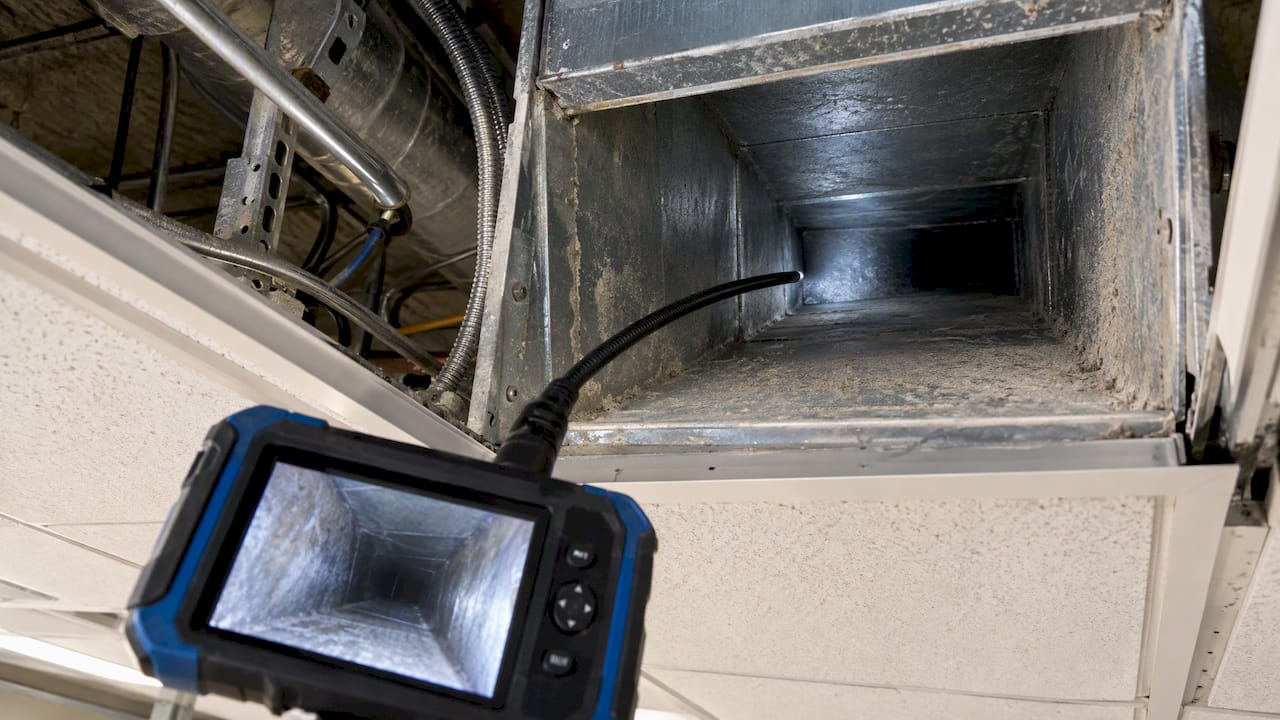
A proper job comes with an inspection. ASHRAE’s preventive maintenance checklist calls for inspecting supply and return ductwork, using a camera or borescope where accessible, for dust loading, biological growth, debris and rodent activity. Photos before and after give a building manager or landlord a record to compare against next time, which makes future decisions easier.
Fresher air where odors come from the system
If a musty or stale smell comes and goes with the HVAC cycle, the ducts and the equipment around them are a reasonable place to look. Cleaning the system, along with fixing any moisture source, can take away that odor source. Our 5 signs it’s time to clean your air ducts article covers what to look and smell for.
What the research says about air quality and health
Many pages ranking for this topic promise dramatic health gains. We would rather you hear the evidence plainly so you can set the right goal.
The EPA states that studies have not conclusively shown that particle levels in a building go down after duct cleaning, and that duct cleaning has never been shown to prevent health problems. An EPA pilot field study found that cleaning removed particulate and fibrous contamination from the ducts, but airborne particle concentrations in the rooms were not substantially different before and after, because outdoor air and other indoor sources contribute too.
What that means for an office: duct cleaning is one part of a healthy indoor environment, not the entire thing. Air quality in a workplace depends on several pieces working together:
- Filtration: ASHRAE notes that effectiveness depends on the contaminants, airflow and how the technology is applied, so performance in your specific building should not be assumed.
- Ventilation and outside air intake
- Housekeeping, including carpet and hard floor cleaning
- Unobstructed airflow: the EPA’s guide for office building occupants notes that furniture or partitions blocking supply or return registers can affect indoor air quality
That last point is a quick win. Walk the floor and make sure bookshelves, file cabinets and cubicle panels are not blocking a return grille before you spend anything.
For readers who want the respiratory angle in more depth, we cover it in air duct cleaning and respiratory health, and the broader question in can air duct cleaning improve home air quality. If anyone in your office has asthma or severe allergies, they should talk to their own doctor about their triggers rather than rely on any cleaning service to treat them.
When your office should schedule duct cleaning
The EPA does not recommend routine duct cleaning on a fixed calendar. It recommends considering it when there is substantial visible mold growth, vermin infestation, or excessive dust and debris, or when particles come out of supply registers, after the underlying cause is corrected. That is a sensible, condition-based approach for an office too.
The NIH fact sheet adds that the NADCA ACR standard recommends visual cleanliness inspections at regular intervals depending on building use. In practice, a good rhythm looks like this:
- Inspect on a schedule. Have the ducts, returns and air-handling unit looked at periodically, with photos.
- Clean when the inspection says so. Visible dust loading, debris, biological growth or rodent activity are the triggers.
- Clean after disruption. Renovation, tenant build-outs and construction put heavy dust into a building. Cleaning once the work is finished makes sense.
- Keep up the basics. The EPA recommends preventive maintenance: change filters regularly and ask your HVAC service provider to clean cooling coils and drain pans during maintenance.
Other moments when owners call us: moving into a space whose ductwork history is unknown, finding debris in a register, or noticing a persistent odor linked to the HVAC cycle. Our air duct cleaning checklist is written for homes, but most of its inspection points apply to small offices as well.
Is it worth it for your space?
A small office in a newer building with clean filters and no complaints may only need an inspection. A medical suite, restaurant-adjacent unit, older building, or any space with a visible problem will get far more from a full cleaning. For a broader look at the cost-versus-value question, see is air duct cleaning worth it.
How to get the benefits without the mess
A badly run job can undo the point of the job. The EPA warns that if a provider does not follow proper procedures, cleaning can cause indoor air problems, and an inadequate vacuum collection system can release more dust, dirt and contaminants than if the ducts had been left alone. A review by M.S. Zuraimi also stresses that the need for duct cleanliness must be balanced against the chance that the cleaning itself generates indoor pollution.
The NIH fact sheet describes the good-practice side, and it is what you should expect to see:
- Work done while the building is unoccupied, which for an office means evenings or weekends
- Containment barriers around the work area
- Negative-air machines with high-efficiency filters
- Filters placed over supply and return grilles before the system is returned to service
We explain the equipment side in negative air pressure duct cleaning. To answer one of the most common questions: will the office be dusty afterward? With containment and negative air in place, the goal is no. If you see dust spreading during the job, stop the crew and ask why.
What to ask a duct cleaning contractor
Use this list when you collect quotes for your office.
| Question | What a good answer sounds like |
|---|---|
| Do you clean the whole system or only the ducts? | Ducts, registers, plus coils, fans and drain pans where accessible |
| What certifications does your team hold? | The NIH advises a NADCA member in good standing with certified Air System Cleaning Specialists on staff |
| How do you control dust? | Containment, negative-air machine with HEPA-grade filtration, covered grilles |
| Do you use biocides or sealants? | Rarely, if ever. The NIH advises avoiding them |
| Will you show me before and after photos? | Yes, as a standard part of the job |
| Can you work after hours? | Yes, with a plan for your floor layout |
The biocide question deserves a second look. The NIH says even EPA-registered biocides may pose health risks, including eye, nose and skin irritation, and that none are EPA-registered for use on fiberglass duct board or fiberglass-lined ducts. A crew that pushes a chemical treatment as a routine add-on deserves a follow-up question. We talk through that in should you have your air ducts sanitized.
There is also no nationwide industry-specific regulatory program, according to an EPA research agenda on the industry, so you carry the vetting. Be wary of very low advertised prices, per-vent gimmicks and pressure tactics. Our air duct cleaning scams guide lists the common ones.
Our perspective
We clean ducts, carpets and tile for homes and businesses across the Northwest Suburbs, and the offices we serve share one worry: disruption. Nobody wants a crew tearing up the floor plan on a Tuesday afternoon, or a dusty smell lingering into Wednesday.
So we think about duct cleaning as a maintenance decision, not a magic fix. When there is a real reason, such as visible debris, dust at the registers or a system that has gone untouched through a renovation, a careful cleaning gives you a visibly cleaner system and a record of its condition. Our IICRC-certified team works with organic cleaning products and low-moisture methods, and the same habits that give our carpet work a one-hour dry time carry over to how we plan any job: minimal disruption, tidy work, no loose ends.
Our advice to office managers is to look at the whole picture. Clean ducts, clean filters, unblocked returns and clean floors all feed the same air your team breathes. Carpet holds dust that gets kicked back into the room, and grout in break rooms and restrooms holds its own grime. When we handle several of those in one visit, you get one schedule, one point of contact and one invoice.
We also stand behind our work with a 100% satisfaction guarantee. Ask us any question about your system before you book. We would rather you understand the job than just sign off on it.
Joe
Pair duct cleaning with the rest of the office
Air moves through a building, and so does dust. If you are already scheduling after-hours work for the ducts, it is efficient to look at the surfaces too. Our commercial office carpet cleaning checklist for managers and commercial carpet cleaning best practices help you plan around your own traffic patterns. Break rooms, entrances and restrooms with tile benefit from commercial tile and grout cleaning.
Book office cleaning in the Northwest Suburbs
We are a local, family-owned company with more than 20 years of industry experience, serving offices and homes in Arlington Heights, Palatine, Elgin, Bartlett, Streamwood, Barrington, Hoffman Estates, Mount Prospect, Elk Grove Village, Rolling Meadows, Lake Zurich and nearby towns. Our air duct cleaning service is built around careful, low-disruption work, and we are happy to talk through whether your office needs a cleaning or only an inspection.

Published carpet pricing is on our site: commercial carpet cleaning is listed at $200-$500 per job, and you can see the details on our commercial carpet cleaning pricing page. For duct cleaning, we quote after learning about your building, so contact us through the air duct cleaning page to get started.
FAQ
What is the purpose of cleaning air ducts in an office?
The purpose is to remove accumulated dirt, dust and debris from the supply and return ducts, registers, coils and fan components of the HVAC system. It is most useful when there is a visible problem, such as heavy dust, debris, pests or mold growth that has been traced and fixed.
Will my office be dusty after duct cleaning?
It should not be if the crew uses containment barriers, negative-air machines with high-efficiency filters and covered grilles, as the NIH describes. Poor procedures can release more dust than before, so ask your contractor how they control it before you book.
Does duct cleaning lower energy costs?
The EPA says there is little evidence that cleaning only the ducts improves efficiency. Cleaning cooling coils, fans and heat exchangers may improve efficiency and operating life, so ask for the air-handling components to be included.
How often should an office have its ducts cleaned?
The EPA does not recommend routine cleaning on a fixed schedule. A better approach is regular inspection, with cleaning when you see dust loading, debris, biological growth, rodent activity or particles from registers, and after major construction.
Sources
- Should You Have the Air Ducts in Your Home Cleaned? (US EPA)
- Results of a Pilot Field Study to Evaluate the Effectiveness of Duct Cleaning (EPA)
- ASHRAE Position Document on Filtration and Air Cleaning
- ASHRAE Indoor Air Quality Preventive Maintenance Checklist
- NIH DOHS Fact Sheet on HVAC Duct Cleaning
- An Office Building Occupant’s Guide to Indoor Air Quality (EPA)
- Is ventilation duct cleaning useful? A review (Zuraimi, 2010)
- Research Agenda on Air Duct Cleaning (EPA)