
Professional commercial tile cleaning transformations are defined as multi-stage restorative processes that return tile and grout to near-original condition through mechanical agitation, chemical treatment, and high-heat extraction. These are not the same as routine mopping. The industry term is “restorative deep cleaning,” and the results separate professional work from janitorial maintenance by a wide margin. For property owners and business managers in the Northwest Suburbs of Chicago and beyond, the examples of commercial tile cleaning transformations below reveal exactly what is possible, what methods produce those results, and how to protect that investment long-term.
1. Real examples of commercial tile cleaning transformations
The most instructive tile cleaning project examples come from documented commercial jobs where the starting condition, applied method, and final result are all on record.
NYC Steam Cleaning, Midtown Manhattan Office: This project involved a high-traffic office lobby with grout lines blackened by years of mop-water buildup and biofilm. The crew applied an alkaline pre-treatment to break down organic soils, followed by mechanical agitation with a dual-cylinder rotary scrubber, then finished with truck-mounted steam extraction at over 200°F. The commercial tile cleaning before and after contrast was stark. Grout color was restored from near-black to its original gray, and steam extraction at 200°F removes up to 99% to 99.9% of bacteria and contaminants embedded in grout. That figure matters because it means the floor is not just visually cleaner. It is measurably safer.
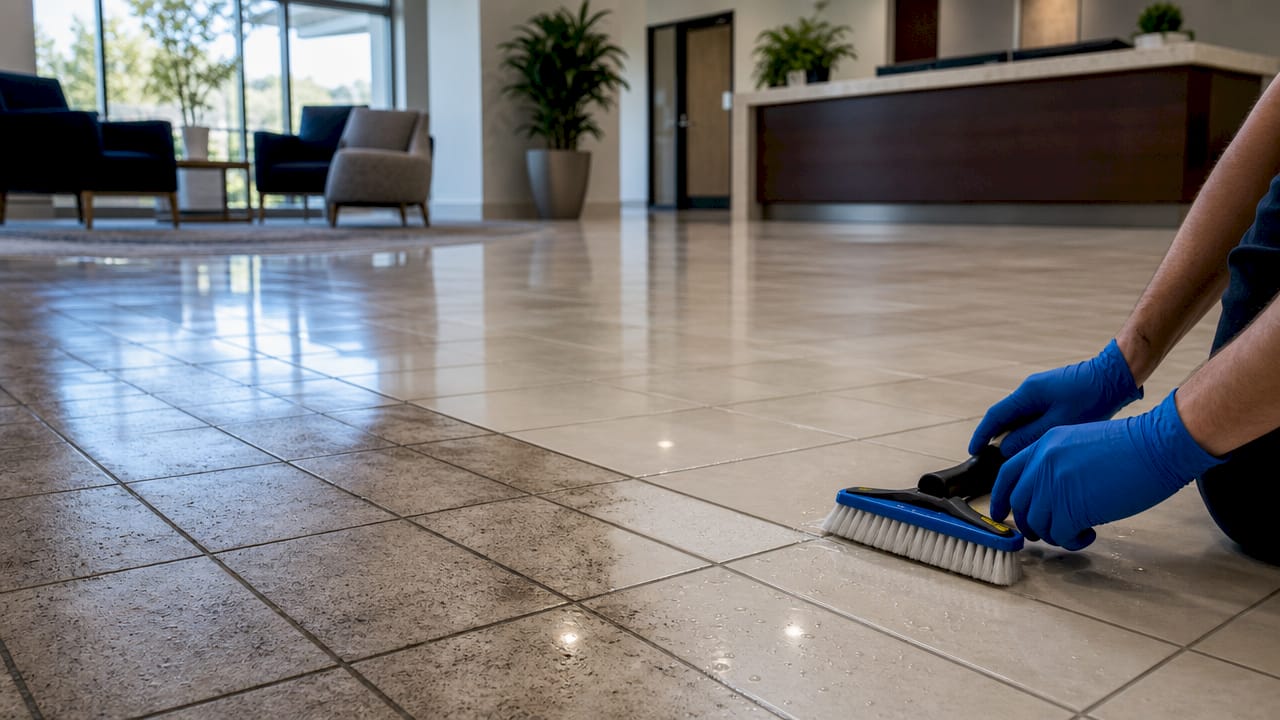
Spot On Cleaning, Princeton NJ Office: This project tackled soap scum accumulation and heavy grout staining in a multi-floor office building. The team used a multi-stage chemical process, starting with alkaline cleaners for grease and organic residue, then acidic washes to dissolve mineral deposits and cement smears. After rinsing, a penetrating grout sealer was applied. The penetrating sealer post-cleaning creates a barrier that prevents future staining and extends maintenance intervals. The transformation of commercial floors in this building was visible within a single service visit.
On Time Steam Cleaning, Retail Environment: This project addressed a retail floor where slip resistance had degraded due to grease film and embedded grime. Restoration included alkaline degreasing, rotary scrubbing, and hot water extraction. Slip resistance was restored, and the floor passed safety inspection post-service.
| Feature | Before cleaning | After cleaning |
|---|---|---|
| Grout color | Dark gray to black | Original tone restored |
| Bacterial load | High biofilm present | 99%+ removal confirmed |
| Slip resistance | Below safe threshold | Restored to compliant level |
| Odor | Noticeable in enclosed areas | Eliminated |
| Sealer condition | Degraded or absent | Fresh penetrating sealer applied |
Pro Tip: Schedule your commercial tile cleaning before and after documentation with photos taken under the same lighting conditions. This gives you a clear record for facility audits and insurance purposes.
2. Why routine mopping fails and professional tools succeed
Routine janitorial mopping pushes dirt deeper into porous grout lines rather than extracting it. This is not a minor inefficiency. Over months, it creates a compacted layer of grime and biofilm that no mop will ever remove. Property managers who rely solely on janitorial crews are not maintaining their floors. They are slowly degrading them.
Professional restorative cleaning uses a different category of equipment entirely. The tools that produce the dramatic before and after results seen in successful tile restoration projects include:
- Truck-mounted hot water extraction units: These deliver water at 200°F to 240°F with industrial suction, pulling contaminants out of grout rather than spreading them.
- Dual-cylinder rotary scrubbers: Counter-rotating brushes agitate cleaning solution deep into grout lines, loosening compacted soil that hand tools cannot reach.
- Chemical emulsifiers (alkaline phase): Applied first to break down grease, body oils, and organic soils before mechanical action begins.
- Acidic wash solutions: Applied after alkaline treatment to dissolve efflorescence, mineral deposits, and cement smears. Alkaline then acidic washes achieve a clean standard that janitorial mopping cannot match.
- Moisture meters: Used before sealing to confirm the floor is fully dry. Moisture meters before sealing prevent sealer failure and efflorescence, two of the most common problems from rushed professional jobs.
The combination of these tools is what separates a true transformation of commercial floors from a surface-level clean. Each tool addresses a specific failure point in the cleaning process.
Pro Tip: Never allow a contractor to apply sealer the same day as cleaning without confirming floor moisture with a meter reading. Sealer applied over damp grout traps moisture and fails within weeks.
3. How to maintain tile cleaning results in high-traffic areas
A professional deep clean is an investment. The question every property manager should ask is: how do you protect it? The answer starts with grout sealing and continues with the right daily maintenance products.
Deep cleaning every 6 to 12 months is the standard recommendation for high-traffic commercial spaces. This interval prevents permanent grout staining and keeps slip resistance at a safe level. Spaces with food service, heavy foot traffic, or chemical exposure may need the shorter end of that range.
Daily maintenance between professional visits requires pH-neutral cleaners to protect sealers. High-pH cleaners found in most supermarkets strip the sealer prematurely, causing faster re-soiling and shortening the time before the next restorative clean is needed. This is one of the most common and costly mistakes in commercial tile maintenance.
Aftercare best practices for sustained results:
- Apply a penetrating grout sealer within 24 hours of professional cleaning, once moisture readings confirm the floor is dry.
- Use only pH-neutral floor cleaners for daily and weekly maintenance.
- Place walk-off mats at all entry points to reduce the volume of soil reaching tile surfaces.
- Inspect grout lines quarterly for early signs of staining or sealer breakdown.
- Schedule professional restorative cleaning for high-traffic areas every 6 to 12 months without exception.
| Space type | Recommended cleaning interval | Key risk without it |
|---|---|---|
| Office lobby | Every 6 months | Biofilm buildup, slip hazard |
| Retail floor | Every 6 months | Grease film, staining |
| Restaurant kitchen | Every 3 to 4 months | Health code violations |
| Low-traffic office | Every 12 months | Gradual grout discoloration |
Pro Tip: Ask your cleaning contractor to leave the specific sealer product name and application date in writing. This gives your maintenance team a reference point for reapplication schedules.
4. Tile texture modification as part of a full transformation
Some of the most impressive tile cleaning project examples go beyond chemistry and extraction. They include surface texture modification as part of the restoration process.
The Nespresso Doncaster SC project is a documented case where light honing and matte polishing smoothed the tile surface to improve cleanability and reduce long-term maintenance costs. The store’s tile had developed an uneven texture from years of wear, which trapped soil and made routine cleaning less effective. After controlled honing, the surface was more uniform, easier to clean, and visually consistent across the floor. Steam cleaning followed the texture work to remove all honing residue and prepare the surface for sealing.
Mechanical restoration through controlled honing reduces maintenance effort and demonstrates the cost-saving benefits of professional restoration beyond a standard clean. For retail and hospitality environments where appearance directly affects customer perception, this level of detail matters.
Benefits of combining texture refinishing with deep cleaning:
- Smoother tile surface reduces soil adhesion between professional cleaning visits.
- Visual consistency across the floor improves the overall appearance of the space.
- Reduced texture variation lowers the risk of uneven wear patterns developing.
- Steam cleaning after honing removes all abrasive residue before sealing.
This approach is not necessary for every commercial property, but for spaces where tile appearance is part of the brand experience, it is worth discussing with your cleaning contractor before the next scheduled service.
Key takeaways
Professional restorative deep cleaning outperforms routine mopping by extracting embedded grime, restoring grout color, eliminating bacteria, and protecting floors with penetrating sealers that extend maintenance intervals to 6 to 12 months.
| Point | Details |
|---|---|
| Restorative cleaning vs. mopping | Mopping redistributes dirt; professional extraction removes it at the source. |
| Bacterial removal rate | Steam extraction at 200°F to 240°F removes 99% to 99.9% of contaminants from grout. |
| Sealing after cleaning | Apply a penetrating sealer post-cleaning to prevent re-staining and extend intervals. |
| Daily maintenance products | Use pH-neutral cleaners only; high-pH products strip sealers and accelerate re-soiling. |
| Cleaning frequency | High-traffic commercial spaces need professional deep cleaning every 6 to 12 months. |
What I’ve learned from years of commercial tile work
After more than two decades working on commercial tile and grout across the Northwest Suburbs of Chicago, the pattern I see most often is this: property managers wait too long. They assume the floor looks acceptable because it gets mopped daily. What they do not see is the grout. Grout is porous, and every mop pass without proper extraction deposits a thin layer of suspended soil directly into those pores. By the time the floor looks visibly bad, the grout has been degrading for months or years.
The commercial tile cleaning before and after results that impress clients most are rarely the ones where the tile itself was in bad shape. They are the ones where the grout was unrecognizable. Restoring grout color from near-black to its original tone is the single most dramatic visual change in any tile restoration project, and it is entirely achievable with the right process.
The other misconception I encounter regularly is that professional cleaning is a one-time fix. It is not. The grout sealing guide we follow at Carpetandtileplus treats sealing as a required step, not an optional add-on. Without it, the floor re-soils faster than before because the cleaning process opens the grout pores. Sealing closes them. That one step is the difference between a result that lasts 12 months and one that looks tired again in 90 days.
My honest advice to any business manager reading this: do not evaluate a cleaning contractor on price alone. Ask what temperature their extraction equipment operates at, whether they use a two-stage chemical process, and whether they include moisture testing before sealing. Those three questions will tell you everything about whether you are getting a real transformation or just a surface clean.
— Jim
See what Carpetandtileplus can do for your commercial floors

Carpetandtileplus delivers the same multi-stage restorative process described throughout this article to commercial properties across Elgin, Bartlett, Streamwood, Arlington Heights, Palatine, Barrington, and Hanover Park. IICRC-certified technicians use truck-mounted hot water extraction, dual-stage chemical treatment, and penetrating sealer application on every commercial job. Scheduling is built around your business hours, with after-hours and weekend availability to avoid disruption. One-hour dry times keep your space operational. If you are ready to see what a real transformation looks like on your floors, explore Carpetandtileplus’s commercial tile and grout services and request a quote today.
FAQ
How long does a commercial tile cleaning job take?
Professional commercial tile cleaning in office environments typically takes 4 to 6 hours and is scheduled after hours or on weekends to avoid business downtime.
What does professional tile cleaning remove that mopping cannot?
Professional extraction removes embedded biofilm, compacted grease, and mineral deposits from grout pores. Routine mopping redistributes these contaminants rather than extracting them.
How often should commercial tile floors be professionally cleaned?
High-traffic commercial spaces need restorative deep cleaning every 6 to 12 months to prevent permanent grout staining and maintain slip resistance.
Does grout need to be sealed after professional cleaning?
Yes. A penetrating grout sealer applied after cleaning prevents the freshly opened grout pores from absorbing dirt, extending the time between professional services. Learn more in the grout sealing guide.
Can tile texture be changed as part of a cleaning project?
Light honing and matte polishing can smooth tile surfaces to improve cleanability and visual consistency, as demonstrated in the Nespresso Doncaster SC project. Steam cleaning follows to remove all residue before sealing.