
Carpets smell after cleaning because moisture reactivates trapped contaminants buried deep in carpet fibers, backing, and padding. This post-cleaning carpet odor is not a sign of a bad cleaning job. It signals that the carpet holds deeper contamination than the surface treatment reached. The three most common triggers are excess moisture promoting microbial growth, leftover cleaning product residue bonding with soil, and pet urine salts releasing ammonia compounds when rehydrated. Understanding which cause applies to your carpet determines the right fix.
What causes carpets to smell after cleaning?
Carpet odors after cleaning often signal reactivated trapped contamination, not poor cleaning quality. The smell is the carpet telling you something was already there before the cleaner arrived.
The four main causes break down like this:
- Trapped moisture and microbial growth. Damp carpets allow mold, mildew, and bacteria to thrive, producing volatile organic compounds that register as musty or sour smells. The carpet pile may feel dry to the touch while the backing and pad underneath remain saturated for hours.
- Cleaning solution residue. Leftover surfactants form an invisible sticky film across carpet fibers. This film attracts fresh soil and moisture, locking in odors that return within days of cleaning.
- Pet urine contamination. Urine salts penetrate past the fiber layer into the carpet backing and underlay. When cleaning water rehydrates those salts, they release ammonia-like compounds that smell worse than the original stain.
- The wicking effect. Overwetting or insufficient extraction lets moisture travel upward through the carpet layers during drying, pulling dissolved contaminants to the surface. You may notice the smell appears or worsens hours after the cleaner leaves.
Pro Tip: If the odor follows a specific traffic pattern or concentrates in one area, that localized pattern almost always points to deep pet stain contamination rather than general moisture issues. Treat those zones separately.
How does drying time affect carpet odor after cleaning?
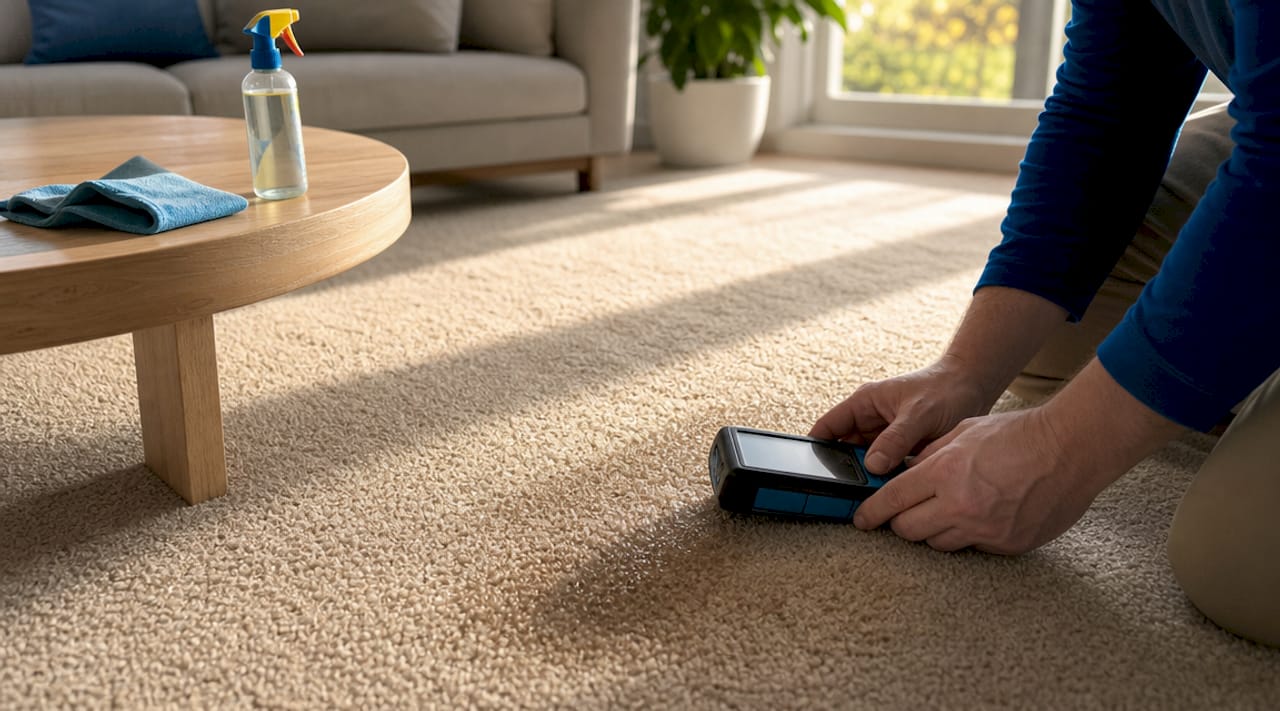
Drying speed is the single biggest variable in whether a cleaned carpet smells fresh or musty within 24 hours. Most homeowners focus on the cleaning itself and treat drying as something that just happens on its own. That assumption causes most post-cleaning odor complaints.
Here is how drying conditions directly shape the outcome:
- Airflow. Stagnant air allows moisture to sit in the carpet pad for 24 hours or longer. Running ceiling fans, box fans, or professional air movers keeps the evaporation rate high and cuts drying time significantly.
- Humidity. High indoor humidity slows evaporation. A dehumidifier running in the room during and after cleaning pulls moisture from the air, which in turn pulls it faster from the carpet.
- Temperature. Warmer rooms dry faster. Opening windows in warm weather or raising the thermostat slightly in winter accelerates drying without any equipment.
- Fiber type. Wool carpets hold more moisture than synthetic fibers like nylon or polyester. Wool can emit a natural “wet fur” smell when damp that disappears within 24 hours once fully dry. Synthetic carpets dry faster but still require adequate airflow.
Air movers can reduce drying time by 50 to 65% compared to passive drying. That reduction matters because every extra hour of dampness is an extra hour for mold and bacteria to multiply. Carpetandtileplus achieves a one-hour dry time on most residential jobs by combining high-extraction equipment with controlled airflow, which is why post-cleaning odors are rare for their customers.
The carpet pad and backing retain moisture long after the pile feels dry. Drying must be treated as part of the cleaning process, not an afterthought. Skipping this step is the most common reason a professionally cleaned carpet still smells bad the next morning.
Why pet stains cause persistent odors despite cleaning
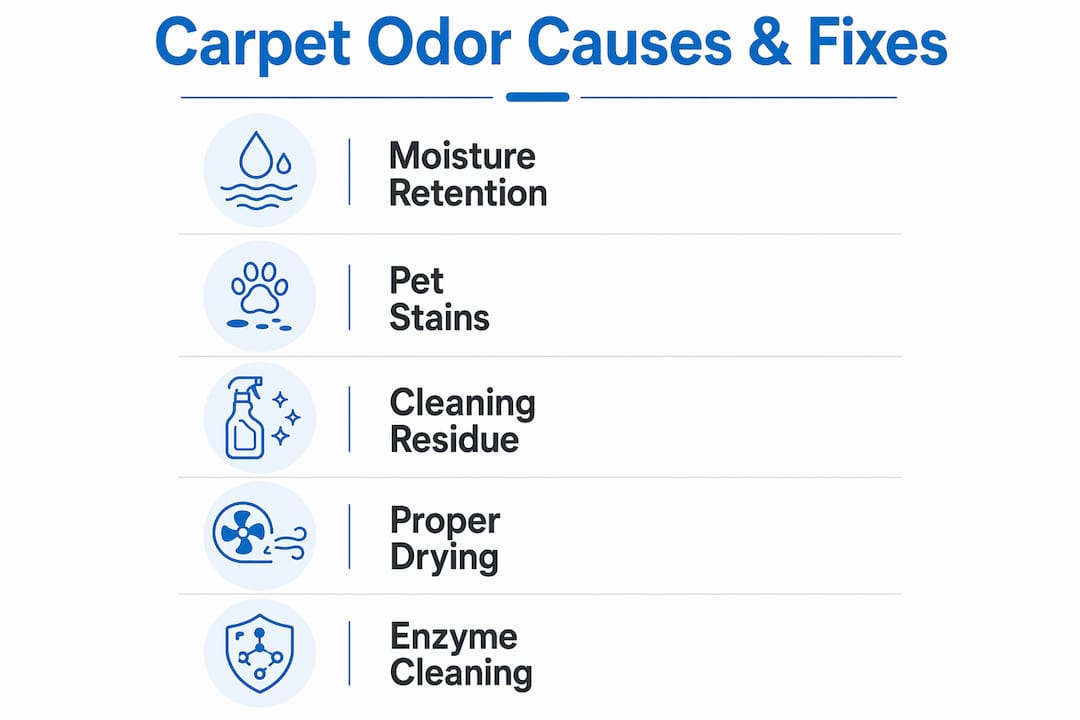
Pet urine is the most stubborn source of carpet cleaning odor because the contamination is almost never limited to the visible stain. A single accident soaks through the fiber layer, saturates the backing, and pools in the padding beneath. The stain you see on the surface represents roughly 20% of the total affected area.
The odor cycle works like this:
- Urine salts crystallize as the stain dries. The crystals are odorless until moisture hits them again.
- Cleaning water rehydrates the crystals. This releases ammonia compounds and mercaptans, which smell sharper and more pungent than the original accident.
- Standard steam cleaning reaches only the fiber layer. It does not penetrate the backing or padding where the bulk of the contamination sits.
- The smell returns stronger after cleaning because the cleaning process reactivated the crystals without neutralizing them.
Enzyme cleaners break down the odor-causing compounds that regular cleaning cannot reach. Enzymes work by digesting the uric acid crystals at a molecular level, permanently eliminating the odor source rather than masking it. Products like Nature’s Miracle, Rocco and Roxie, and Biokleen Bac-Out are widely available for homeowner use on fresh or moderate stains.
Persistent odors after cleaning indicate deeper contamination in the backing or underlay that surface treatments cannot fix. When the smell returns within 48 hours of cleaning, the padding likely needs professional treatment or replacement. Masking pet odors with deodorizing sprays does not solve the underlying contamination. It delays the problem until the next time moisture activates those crystals.
Pro Tip: Treat pet accidents within the first hour whenever possible. Fresh urine has not yet crystallized, so enzyme cleaners work faster and penetrate more effectively. Waiting 24 hours or more allows the salts to bond with carpet fibers, making professional intervention far more likely.
How cleaning residues lead to lingering odors
Cleaning solution residue is a less obvious but equally common cause of carpet smell after cleaning. When too much detergent is applied or the rinse extraction is incomplete, a surfactant film coats the carpet fibers. That film is invisible and odorless when dry, but it creates a chain reaction that produces odors over time.
The table below shows how proper rinsing compares to residue-heavy cleaning across the outcomes that matter most to homeowners:
| Factor | Proper rinsing and extraction | Residue left in carpet |
|---|---|---|
| Odor after drying | Minimal to none | Returns within 2 to 5 days |
| Re-soiling rate | Normal | Accelerated, carpet looks dirty faster |
| Wicking risk | Low | High, contaminants drawn to surface |
| Fiber condition | Preserved | Stiff, sticky texture over time |
Residue repeatedly activates with moisture and foot traffic, causing delayed odors days after cleaning. This is why some homeowners notice their carpet smells fine immediately after cleaning but develops a stale or sour odor within a week. The sticky surfactant film traps fresh soil and moisture with each pass, compounding the problem with every cleaning cycle that uses too much product.
The fix is straightforward: use less detergent, rinse thoroughly, and extract aggressively. Professional truck-mounted systems generate far more suction than rental machines, which is why cleaning solution residue is a much more common problem with DIY or hire-machine cleaning than with professional services. Organic and low-residue cleaning products also reduce this risk significantly.
Effective ways to fix and prevent carpet odors after cleaning
Most post-cleaning odors are preventable. The solutions below address both immediate fixes and long-term habits that keep carpets smelling clean between professional visits.
- Maximize airflow immediately after cleaning. Open windows, run ceiling fans, and place box fans at room entrances. Do not close the room and assume the carpet will dry on its own. For quick-dry methods that professionals use, the goal is always to move air across the carpet surface continuously until the pad is dry.
- Use a dehumidifier in humid conditions. Basements, lower-level rooms, and homes in humid climates need active moisture removal. A standard 30-pint dehumidifier running for 4 to 6 hours after cleaning makes a measurable difference.
- Apply enzyme treatments for pet stains before and after cleaning. Pre-treating with an enzyme cleaner, then cleaning, then applying a second enzyme treatment gives the best results. This two-pass approach addresses both the surface and the deeper contamination.
- Replace underlay when moisture damage is severe. If the padding has been wet repeatedly or has absorbed years of pet urine, no amount of surface treatment will eliminate the odor. Replacement is the only permanent solution in those cases.
- Choose eco-friendly cleaning products that are low-residue and rinse cleanly. Organic formulations leave fewer compounds behind in the fiber, reducing both odor risk and re-soiling.
- Schedule professional cleaning on a regular cycle. Carpets in homes with pets or children benefit from professional cleaning every 6 to 12 months. Routine maintenance prevents the deep contamination buildup that causes the worst post-cleaning odors.
Pro Tip: After any carpet cleaning, place a box fan facing outward in a window of the cleaned room. This creates negative pressure that pulls fresh air across the carpet and out of the room, cutting drying time faster than a fan blowing inward.
Key takeaways
Post-cleaning carpet odor is caused by moisture reactivating trapped contaminants, and the fix requires addressing the source, not the smell.
| Point | Details |
|---|---|
| Moisture is the primary trigger | Damp carpet backing and padding allow mold and bacteria to produce musty odors within hours. |
| Wicking brings odors to the surface | Overwetting or poor extraction draws deep contaminants upward during drying, worsening the smell. |
| Pet urine needs enzyme treatment | Standard cleaning rehydrates urine crystals without neutralizing them; enzyme cleaners are required. |
| Residue accelerates re-soiling and odor | Surfactant films left by excess detergent trap moisture and soil, causing odors to return within days. |
| Fast drying prevents most problems | Air movers and dehumidifiers reduce drying time by up to 65%, cutting microbial growth before it starts. |
What 20 years of carpet cleaning taught me about post-cleaning smells
After two decades working in carpet cleaning across the Northwest Suburbs of Chicago, the most common complaint I hear is some version of: “We just had it cleaned and now it smells worse.” My honest answer is always the same. The cleaning did not cause the smell. It revealed what was already there.
The biggest mistake I see homeowners make is renting a machine from a hardware store and flooding the carpet with water and detergent. Those machines lack the extraction power to pull the moisture back out. The carpet stays wet for 24 to 48 hours, and by the time it dries, the mold and bacteria have already done their work. The smell people blame on “carpet cleaning” is actually the result of under-powered equipment leaving too much water behind.
The second mistake is treating pet odors as a surface problem. I have pulled back carpets in homes where the padding looked like it had been soaked in urine for years, while the carpet pile above it looked perfectly clean. No spray, no steam, no deodorizer fixes that. The pad has to come out.
My advice: treat drying as seriously as you treat cleaning. If you are doing it yourself, rent an air mover along with the cleaning machine. If you are hiring a professional, ask specifically about their dry time. A company that cannot give you a clear answer on dry time is not thinking about the full job. At Carpetandtileplus, our IICRC-certified team treats drying as a non-negotiable part of every residential cleaning, which is why we consistently deliver a one-hour dry time. That single commitment eliminates most of the odor complaints before they ever start.
— Jim
Get rid of carpet odors for good with Carpetandtileplus
If your carpet still smells after cleaning, the problem is almost certainly deeper than the surface. Carpetandtileplus serves homeowners across Elgin, Bartlett, Streamwood, Arlington Heights, Palatine, Barrington, and Hanover Park with IICRC-certified cleaning that addresses the root cause, not just the symptom.

Our team uses organic, low-residue cleaning products and professional-grade extraction equipment to remove deep contamination without leaving behind the surfactant films that cause odors to return. For pet stain problems, our carpet odor removal service combines enzyme treatments with high-extraction cleaning to neutralize urine salts at the source. For general residential cleaning with a guaranteed one-hour dry time, our residential carpet cleaning service is the right starting point. Contact Carpetandtileplus today and stop living with a carpet that smells worse after every cleaning.
FAQ
Why does my carpet smell musty after cleaning?
A musty smell after cleaning means the carpet backing or padding stayed damp long enough for mold and bacteria to grow. Improving airflow with fans or a dehumidifier immediately after cleaning prevents this in most cases.
How long should a carpet smell after cleaning?
A mild, clean-soap smell can linger for 2 to 4 hours as the carpet dries. Any odor lasting beyond 24 hours indicates a deeper problem such as slow drying, cleaning residue, or reactivated pet urine contamination.
Why does my carpet smell worse after cleaning pet stains?
Cleaning water rehydrates dried urine crystals in the backing and padding, releasing ammonia compounds that smell sharper than the original stain. Enzyme cleaners are required to break down those crystals permanently.
Can cleaning residue cause carpet odors?
Yes. Leftover surfactant films from excess detergent trap moisture and organic soil, producing odors that return within 2 to 5 days of cleaning. Thorough rinsing and high-extraction equipment prevent residue buildup.
Does carpet type affect how much it smells after cleaning?
Wool carpets hold more moisture than synthetic fibers and can emit a temporary “wet fur” smell when damp. This odor disappears within 24 hours once the carpet is fully dry and is not a sign of contamination.