
Hire a professional the moment you see white, chalky residue that won’t vacuum up, feel stiffness in the carpet fibers, or notice the same stain reappearing near a doorway. Two facts back that call: the IICRC S100 standard requires inspection, pre-treatment, and controlled extraction for proper stain removal, and Carpetandtileplus runs exactly that process on-site across the Northwest Suburbs of Chicago. Your move right now:
- Dry-vacuum the area first, thoroughly, before any water touches it
- Blot (never rub) any damp spots with a clean towel
- Book a professional assessment if the stain returns after cleaning
Pro Tip: If the carpet smells musty near the stain, don’t wait. That usually means moisture reached the pad, and pads trap salt long after the surface looks clean.
Key Takeaways
Professional on-site cleaning removes road salt stains that DIY vacuuming and spot treatments leave behind because hot-water extraction dissolves and pulls out embedded mineral residue that consumer methods can’t reach.
| Point | Details |
|---|---|
| Check for stiffness first | Gritty, stiff, or crunchy fibers mean salt reached deep into the pile, not just the surface. |
| Skip water before vacuuming | Adding water to dry salt dissolves it further into the backing before extraction even starts. |
| Professional extraction beats rentals | Truck-mounted systems use higher heat and stronger suction than consumer machines, per the S100 standard. |
| Watch for permanent damage signs | Persistent browning, brittle fibers, and lingering odor after cleaning often mean pad replacement is needed. |
| Carpetandtileplus delivers documented results | IICRC-certified technicians, organic cleaners, and roughly one-hour dry times back every road-salt cleaning job. |
Table of Contents
- How To Assess Road Salt Carpet Stains In Under Three Minutes
- What Happens During A Professional Road Salt Stain Removal Visit
- What To Do (And Avoid) Before The Crew Arrives
- How Much Does Road Salt Stain Removal Cost, And How Long Does It Take?
- When Salt Damage Becomes Permanent
- What To Ask Before You Hire A Carpet Cleaner
- What We’ve Learned Cleaning Carpets Through Chicago Winters
- Ready To Book A Road Salt Stain Removal Appointment?
- Sources
How To Assess Road Salt Carpet Stains In Under Three Minutes
Get down on one knee and touch the affected area. If fibers feel gritty or stiff instead of soft, salt crystals are still embedded, not just sitting on the surface. Technicians run through a fast mental checklist during that first walk-through, and you can do the same version at home.
- White or grayish chalky film that returns after vacuuming
- Fibers that feel brittle, stiff, or “crunchy” underfoot
- Yellow or brown discoloration spreading outward from the original spot
- A musty smell suggesting the pad or backing absorbed moisture
- The stain reappearing days later in the same spot (a phenomenon called wicking)
Fiber type changes the math. Wool and other natural fibers absorb salt and moisture faster than synthetic nylon or polyester, and low-pile commercial carpet tends to show salt damage sooner than high-pile residential carpet because there’s less fiber mass to buffer the contamination. Before calling anyone, photograph the stain in natural light, plus a close-up showing fiber texture. That comparison shot is what a technician uses to judge whether this is a surface job or something that reached the backing.
Pro Tip: Take your photo before you vacuum. Loose salt crystals visible in the fiber tell a technician more about severity than a stain that’s already been disturbed.
What Happens During A Professional Road Salt Stain Removal Visit
A trained technician doesn’t start with water. They start with a walk-through, checking traffic patterns, fiber type, and how far the salt has migrated from the entry point. That inspection determines everything that follows.
- Inspection and fiber assessment — the technician identifies fiber type, checks for backing saturation, and maps the full extent of the contamination, not just the visible stain.
- Dry soil removal — a combination of vacuuming and dry agitation lifts loose crystals before any liquid is introduced, which matters because water on top of dry salt just dissolves it deeper into the pile.
- Targeted pre-treatment — a pH-balanced solution formulated to dissolve mineral residue gets applied directly to the affected zones.
- Hot-water extraction or low-moisture treatment — truck-mounted systems run water at temperatures and pressures no consumer rental machine can match, which is the actual difference between a pro visit and a rented carpet cleaner. Higher heat breaks down mineral bonds; stronger suction pulls the dissolved salt out instead of just relocating it. Research on winter salt damage confirms that crystallized residue re-forms if it isn’t fully extracted, which is exactly why weeks-old salt often defeats DIY vacuuming and store-bought spot cleaners.
- Neutralizing rinse and repeat extraction — a second pass removes any remaining alkaline residue so nothing is left behind to attract new dirt.
- Controlled drying — airflow and dehumidification prevent the classic problem of stains “wicking” back up from the backing as the carpet dries.
Technicians watch for backing saturation throughout, and if a section feels oversaturated, they’ll pull a small pad sample to check how far the moisture traveled. Over-wetting without proper extraction can do more harm than the salt itself.
Most reputable crews document the job as they go:
- Before-and-after photos of every treated zone
- Moisture readings taken during and after extraction
- A final walk-through inspection confirming the stain is gone and the carpet is drying evenly
What To Do (And Avoid) Before The Crew Arrives
What you do in the hours before a technician shows up can shorten the job or make it harder. Start with the basics.
Do this:
- Vacuum the dry area thoroughly, picking up as many loose crystals as possible
- Blot any fresh damp spots with a clean towel, working from the outside in
- Photograph problem areas so you have a record before treatment begins
- Clear small furniture and personal items from the work zone
Skip this:
- Don’t pour water on the stain before vacuuming. It dissolves salt straight into the backing.
- Don’t scrub or rub. Agitation grinds crystals deeper into the fiber and can fray it.
- Don’t mix cleaning chemicals like bleach and vinegar, and skip hot tap water on your own. Home remedies can set residue rather than lift it.
Pro Tip: Clear a path to the affected rooms before the crew arrives. Every minute they spend moving furniture is a minute not spent extracting salt, and clear access can keep your quote closer to the estimate. A prep checklist built for cleaning day covers the rest.
How Much Does Road Salt Stain Removal Cost, And How Long Does It Take?
Price depends on how far the salt traveled, not just how big the stain looks. A technician pricing your job weighs several factors at once.
- Total square footage of affected carpet and how much of it sees daily foot traffic
- Carpet fiber type, since wool and natural fibers often need gentler, slower treatment than synthetic blends
- How deep the salt penetrated: surface residue costs less to treat than backing saturation
- Whether truck-mounted extraction equipment is needed versus a portable unit
- Timing, since after-hours or emergency commercial visits typically cost more than standard scheduling
Reported residential job pricing for typical salt-stain cleaning often lands in a moderate range, generally higher than routine maintenance cleaning because of the added pre-treatment step, though your local quote will reflect your region and the job’s actual scope. On timeline: a standard residential room takes a technician roughly an hour or two for inspection through extraction, and drying time depends heavily on method. Traditional hot-water extraction can leave carpet damp for several hours, while low-moisture systems and fast-dry setups can get you back to a walkable, mostly dry carpet in around an hour. Extra fees show up when there’s heavy mineral buildup requiring repeated pre-treatment, when the pad needs replacing, or when a stain-blocking protectant gets added after cleaning.
When Salt Damage Becomes Permanent
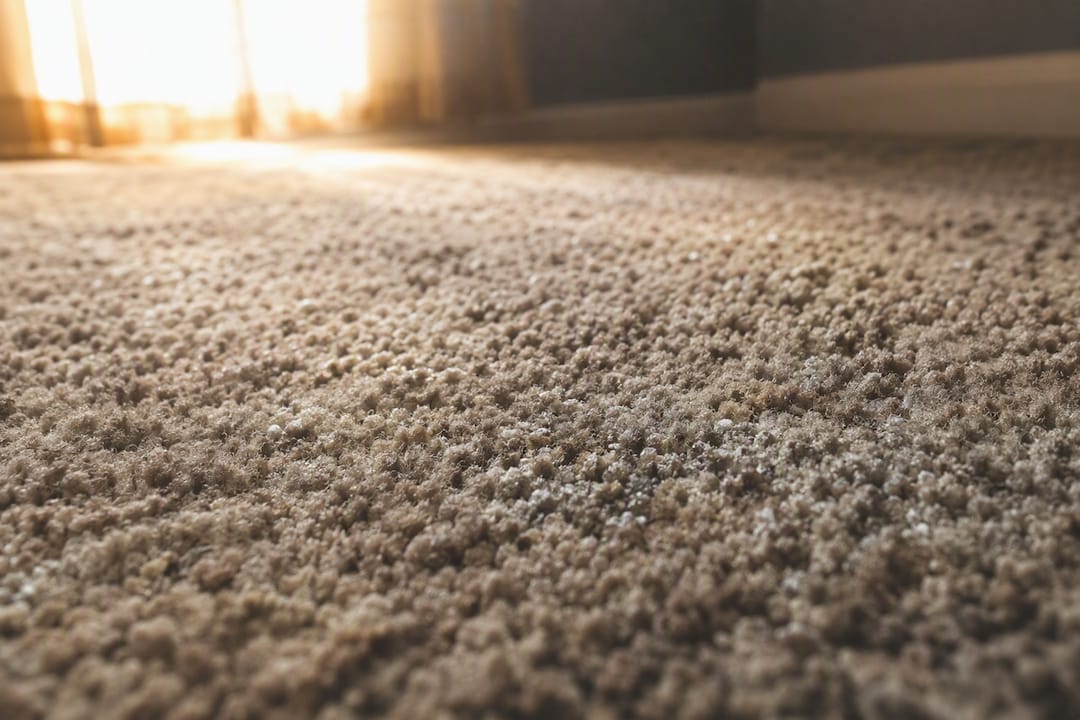
Salt doesn’t just sit on carpet, it works against it. Crystals abrade fiber surfaces every time someone walks over them, and de-icers containing calcium chloride leave a sticky film that grabs dirt and grinds it into the pile over time, according to reporting on winter salt damage. That combination of mechanical wear and chemical residue is what separates a stain you can clean from damage you can’t reverse.
Here’s how to tell the difference:
- Reversible: fibers still feel soft after drying, color returns to normal, no lingering odor
- Permanent: persistent browning that doesn’t lift, brittle or fraying fibers, a smell that returns even after cleaning (often meaning the pad is contaminated)
When damage has gone that far, your realistic options are repeated restorative cleaning for borderline cases, patch repair in a defined zone, full pad replacement if the backing absorbed contamination, or, in the worst cases, replacing the carpet stains professionals typically remove versus the ones that require a new installation. A good technician will tell you honestly which category your carpet falls into instead of selling you a cleaning that won’t hold.
What To Ask Before You Hire A Carpet Cleaner
Not every carpet cleaning company handles salt damage the same way, and the wrong hire can waste money on a job that doesn’t stick. Start with the credentials, then get specific about the work itself.
Trust signals to look for:
- IICRC certification for the technicians doing the actual work, not just the company name
- A stated process that references the S100 standard for inspection, pre-treatment, and extraction
- Proof of insurance, plus before-and-after photo examples from past salt-stain jobs
- A meaningful volume of five-star customer reviews, not just a handful
Questions worth asking directly:
- “Have you handled road salt stains before, and what did that job involve?”
- “Do you use truck-mounted extraction or portable units for this type of stain?”
- “What’s your expected dry time for this room?”
- “What happens if the stain comes back in a few weeks?”
Red flags:
- Vague or evasive answers about equipment
- A verbal quote with no written scope of work
- A technician who suggests bleach, ammonia, or other harsh DIY chemicals
- No references or documented before-and-after examples
What We’ve Learned Cleaning Carpets Through Chicago Winters
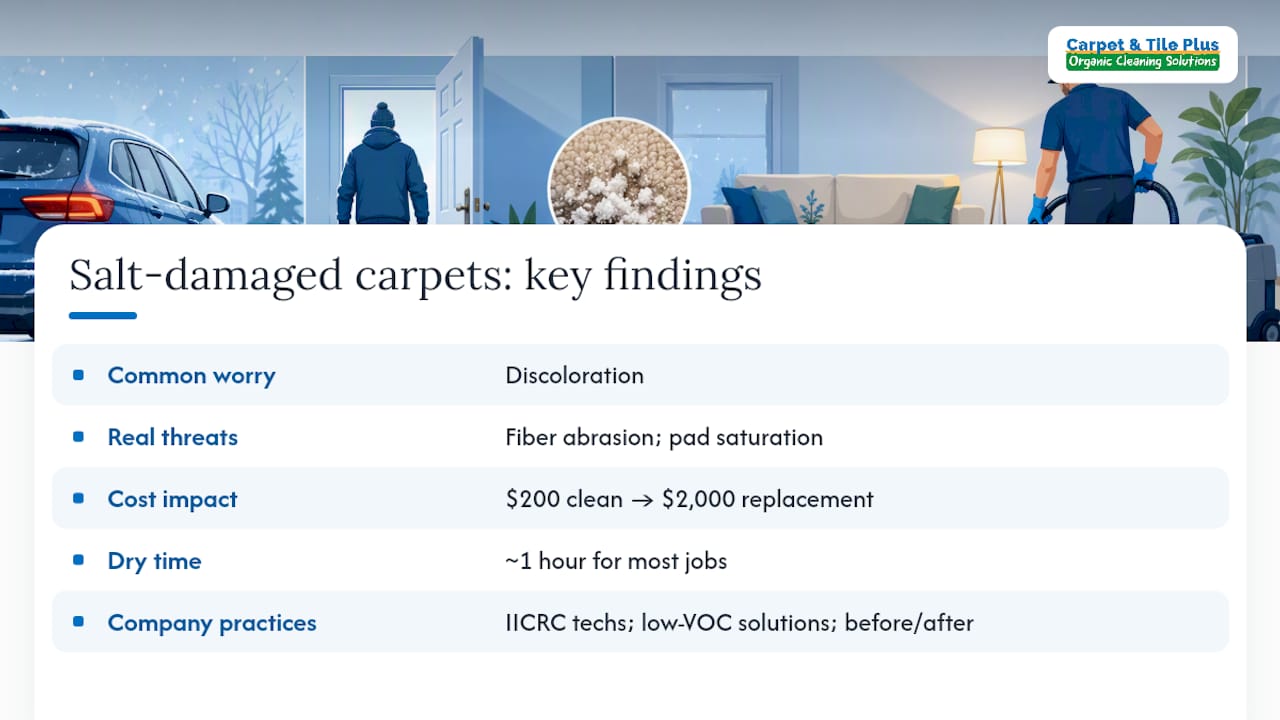
Two decades of pulling road salt out of Northwest Suburb carpets teaches you one thing fast: the damage people worry about most, discoloration, usually isn’t the real threat. Fiber abrasion and pad saturation are the quiet problems, and they’re the ones that turn a $200 cleaning job into a $2,000 replacement if nobody catches them early. Carpetandtileplus runs IICRC-certified technicians on every job, uses organic, low-VOC solutions instead of harsh chemical pre-treatments, and documents before-and-after results because customers deserve to see exactly what changed. We also built our process around a one-hour dry time for most jobs, because a soaked carpet sitting for a day is often how minor salt exposure turns into a mold problem. If you’re in Elgin, Bartlett, Streamwood, Arlington Heights, Palatine, Barrington, or Hanover Park, requesting an on-site assessment costs you nothing but a phone call.
Ready To Book A Road Salt Stain Removal Appointment?
If you’ve read this far, you already know DIY vinegar rinses and rented extractors only go so far against salt that’s reached the backing. Carpetandtileplus handles what those methods can’t: a full on-site inspection, targeted pre-treatment for mineral residue, and hot-water extraction strong enough to actually pull salt out of the fiber instead of pushing it deeper.

Every visit includes IICRC-certified technicians, organic and low-VOC cleaning solutions, and a fast dry-time option that gets most rooms walkable again in about an hour, a real advantage if you’re managing a commercial entryway that can’t stay closed all day. We document every job with before-and-after photos so you can see the actual result, not just take our word for it. Homeowners can request a residential carpet cleaning visit, and property managers handling high-traffic entrances can set up commercial carpet cleaning with flexible after-hours scheduling. If salt exposure left a lingering odor behind, our odor removal service handles that too. Call or request a free quote today and get a technician to look at the actual stain before it sets any deeper.
Sources
- S100 – IICRC
Keep your own before-and-after photos and any written estimate from every professional visit.