
Foam carpet cleaning is a low-moisture technique that uses an aerated detergent solution to encapsulate surface dirt, which is then vacuumed away once the foam dries. The industry term for this process is dry foam extraction, and it sits firmly in the maintenance cleaning category rather than the deep-cleaning category. Carpetandtileplus uses this method alongside hot water extraction to match the right technique to each carpet’s condition. Understanding how dry foam extraction works helps homeowners and businesses make smarter decisions about routine carpet care.
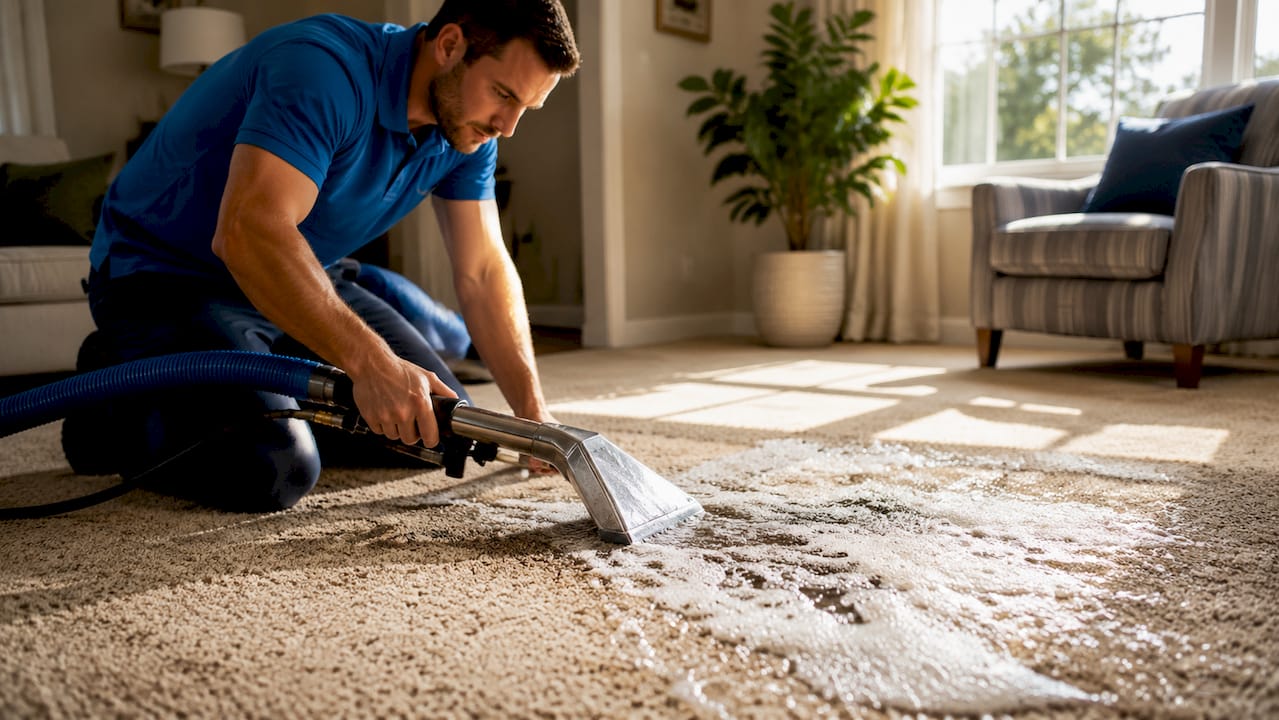
How does foam carpet cleaning work?
The foam carpet cleaning method follows five distinct steps that are considered industry standard: pre-vacuuming, foam application, agitation, dehydration, and final vacuuming. Each step builds on the last, and skipping any one of them reduces the result noticeably.
-
Pre-vacuum. Remove all loose debris, pet hair, and surface dust before any foam touches the carpet. Foam applied over loose grit simply traps it, making removal harder.
-
Apply the foam. A rotary machine or manual applicator distributes the foamed detergent evenly across the carpet surface. The foam is roughly 90% air and 10% liquid, which is what keeps moisture levels low throughout the process.
-
Agitate the fibers. A brush or rotary pad works the foam into the carpet pile. This mechanical action breaks the bond between dirt particles and carpet fibers so the cleaning agents can do their job.
-
Allow full dehydration. The foam dries and crystallizes around the encapsulated soil. This is the phase most DIY users rush, and it is the most consequential. Early vacuuming during dehydration can smear dirt back into the fibers rather than removing it.
-
Final vacuum. Once the carpet is fully dry, a thorough vacuuming pulls out the brittle, dirt-filled foam crystals. The carpet is left clean, dry, and ready for foot traffic.
Pro Tip: Set a timer for at least 30 minutes after foam application before you pick up the vacuum. Rushing this step is the single most common reason foam cleaning produces disappointing results.
What are the benefits and ideal uses of foam cleaning?
Dry foam extraction offers a specific set of advantages that make it the right tool for the right job.
- Fast drying time. Because the formula is 90% air and 10% liquid, carpets are typically dry and ready for use within 30–60 minutes. That matters enormously for businesses that cannot close a room for hours.
- Gentle on delicate fibers. Foam cleaning is safe for wool, silk, and loose-weave carpets that would be damaged by the hydraulic pressure of steam cleaning.
- Extended contact time. Foam stays on a surface 3–10 times longer than a liquid spray, giving cleaning agents more time to break down grease and protein bonds.
- Reduced chemical and water use. Foaming systems cut chemical usage and airborne aerosols, which improves indoor air quality and is safer for families, pets, and building occupants. You can read more about how cleaning affects air quality at home.
- Suitable for interim maintenance. Foam cleaning refreshes carpets between professional deep-cleaning cycles, keeping them presentable without the cost or disruption of a full steam service.
- Effective on surface soils and oils. Light grease, common food stains, and everyday foot-traffic dirt respond well to foam’s adhesive cleaning action.
Pro Tip: For rental properties or commercial spaces with high foot traffic, schedule foam cleaning every 2–3 months between annual professional steam sessions. This keeps carpets looking fresh without the cost of frequent deep cleans.
Foam carpet cleaning vs steam cleaning: what’s the difference?
Choosing between foam and steam comes down to one question: how deep does the soil go?
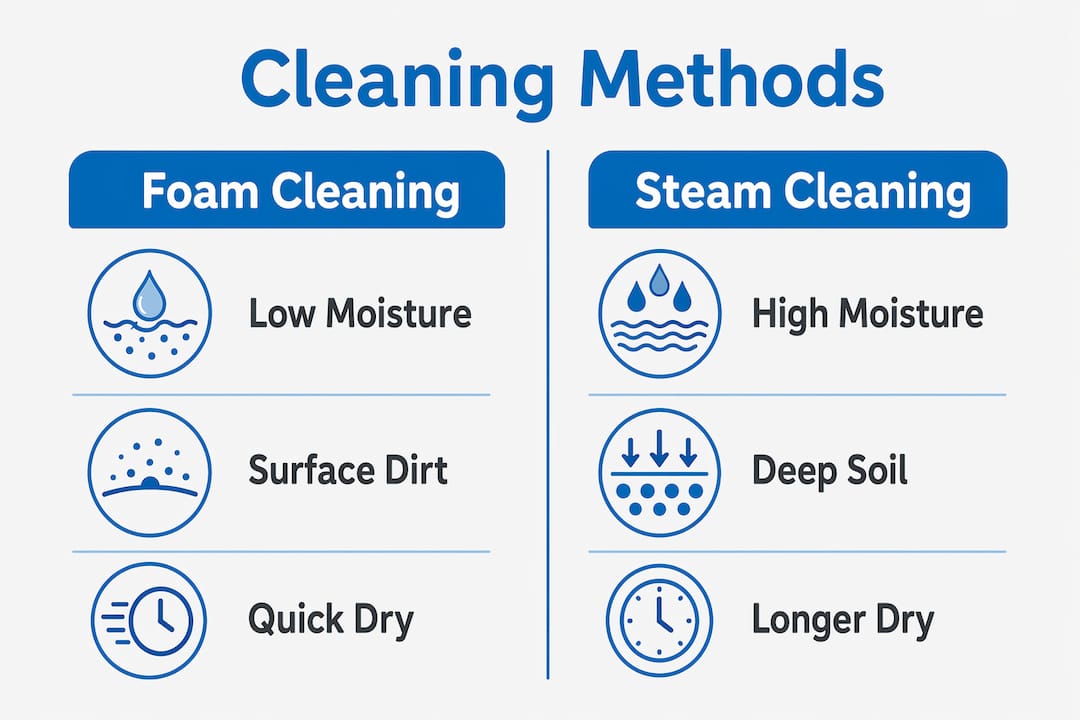
| Factor | Foam cleaning | Steam cleaning |
|---|---|---|
| Moisture level | Very low (10% liquid) | High (hot water extraction) |
| Cleaning depth | Surface and upper fiber | Deep fiber and backing |
| Drying time | 30–60 minutes | Several hours |
| Best for | Routine maintenance, delicate fibers | Heavy soiling, allergens, pet stains |
| Equipment cost | Lower | Higher |
| Chemical use | Minimal | Moderate to high |
Foam cleaning is a surface method. It lifts dirt from the upper portion of carpet fibers but lacks the hydraulic pressure to flush contaminants from deep within the pile. Steam cleaning, also called hot water extraction, pushes a heated solution deep into the carpet and then extracts it along with dissolved soil, allergens, and bacteria.
The practical implication is clear. Foam handles what you can see. Steam handles what you cannot. A carpet that looks dull after a foam clean almost certainly has embedded grime that only extraction will remove. Conversely, using steam on a delicate wool rug when a foam clean would suffice risks shrinkage, color bleeding, and fiber damage.
The smartest approach combines both. Use foam as a routine maintenance method between professional appointments, and schedule hot water extraction at least once a year for a genuine deep clean. For commercial environments, the case for professional deep cleaning is even stronger because foot traffic embeds soil faster than any surface method can address.
Common challenges and expert tips for effective foam cleaning
Foam cleaning fails most often because of process errors, not product quality. Knowing the pitfalls in advance puts you ahead of most DIY attempts.
- Uneven foam application. Patchy coverage leaves some areas undertreated and others oversaturated. Use a rotary machine when possible for consistent distribution.
- Incorrect chemical dilution. Too concentrated and you risk residue buildup. Too diluted and the foam loses its encapsulating power. Uneven application and wrong dilution are the two most cited causes of cleaning failure among DIY users.
- Premature vacuuming. Vacuuming before the foam fully crystallizes smears the encapsulated dirt back into the fibers. Always wait for the carpet to feel completely dry to the touch.
- Residue buildup over time. Repeated foam cleaning without periodic deep extraction causes cleaning agent residue to accumulate in the pile. This residue actually attracts more dirt, leading to faster re-soiling after each clean.
- Skipping a patch test. Always test any foam product on a hidden section of carpet first. Some dyes and fiber treatments react poorly to specific detergent formulas.
Pro Tip: If your carpet feels stiff or looks dull after foam cleaning, residue buildup is the likely cause. A single professional hot water extraction session will reset the carpet and restore its original texture.
Proper preparation also matters. Review a home carpet cleaning prep guide before your first foam cleaning session to avoid the most common setup mistakes.
Which carpets and stains are best suited for foam cleaning?
Foam cleaning is not a universal solution. It performs best in a defined set of conditions.
Delicate natural fiber carpets are the clearest win for foam. Wool and silk carpets require gentle handling, and foam’s low moisture and minimal agitation protect those fibers from the damage that steam or aggressive scrubbing can cause. The Wool Carpet Cleaning Process guide from Carpetandtileplus explains this in detail for homeowners with high-end floor coverings.
Surface-level soils respond well to foam. Light grease, cooking oil residue, everyday foot-traffic dirt, and minor food stains all fall within foam’s effective range. The foam’s adhesive quality gives cleaning agents extended contact time to break down these deposits before they are vacuumed away.
Foam cleaning is not recommended for heavy soiling, deep-set pet stains, or embedded grime. Pet urine, for example, penetrates through the carpet pile and into the backing and subfloor. Foam simply cannot reach that depth. Attempting to treat pet stains with foam alone risks masking the odor temporarily while leaving the contamination source untouched.
Allergy sufferers benefit from foam cleaning’s low chemical residue and minimal moisture. Foam cleaning is safe for allergy-sensitive environments because it does not saturate the carpet, which reduces the risk of mold growth and limits airborne chemical exposure. That said, foam does not remove allergens embedded deep in the pile the way hot water extraction does. For households with severe allergies, foam is a useful maintenance tool, not a complete solution.
Key takeaways
Foam carpet cleaning is a low-moisture, surface-level maintenance method that works best on delicate fibers and light soiling, and it should be combined with periodic professional deep cleaning for complete carpet care.
| Point | Details |
|---|---|
| Dry foam composition | Foam is 90% air and 10% liquid, which produces a 30–60 minute drying time. |
| Five-step process | Pre-vacuum, apply foam, agitate, dehydrate fully, then vacuum to complete the clean. |
| Best applications | Ideal for wool, silk, and delicate fibers, and for surface soils like grease and light stains. |
| Key limitation | Foam cannot reach embedded soil, allergens, or pet stains deep in the carpet pile. |
| Combine with steam | Use foam for routine maintenance and schedule professional hot water extraction at least once a year. |
What I’ve learned about foam cleaning after 20 years on the job
Foam cleaning is one of those methods that gets oversold to homeowners and undersold to businesses. Homeowners often expect it to do what only steam extraction can do, and they end up disappointed. Businesses sometimes dismiss it as too light-duty, when it is actually perfect for keeping high-traffic areas presentable between scheduled deep cleans.
The honest truth is that foam cleaning is a maintenance tool. It is not a substitute for professional deep cleaning, and treating it as one is the fastest way to shorten your carpet’s lifespan. Residue builds up, re-soiling accelerates, and what looked like a clean carpet six months ago starts looking worse than before you started.
What I recommend to every customer at Carpetandtileplus is a simple rhythm: foam cleaning for routine upkeep every couple of months, and a professional hot water extraction service once or twice a year depending on foot traffic. That combination keeps carpets genuinely clean, not just surface-clean. It also protects your investment. A well-maintained carpet lasts years longer than one that only gets attention when it looks visibly dirty.
For DIY users, the biggest mistake is not the product choice. It is the process. Skipping the pre-vacuum, rushing the dehydration phase, or using the wrong dilution turns a straightforward job into a frustrating one. Follow the five steps exactly, and foam cleaning delivers exactly what it promises.
— Jim
Professional carpet cleaning from Carpetandtileplus
Carpetandtileplus serves homeowners and businesses across the Northwest Suburbs of Chicago, including Elgin, Bartlett, Streamwood, Arlington Heights, and Palatine. With over 20 years of experience and IICRC-certified technicians, the team matches the right cleaning method to each carpet’s condition, whether that means foam maintenance or a full hot water extraction.

For homes, the residential carpet cleaning service covers everything from routine maintenance to deep extraction, with a one-hour dry time that keeps your day on schedule. For offices, retail spaces, and commercial buildings, the commercial carpet cleaning service handles high-traffic environments with minimal disruption. If pet stains or odors are the issue, the pet stain and odor removal service goes beyond what any foam method can address.
FAQ
What is dry foam extraction?
Dry foam extraction is the industry term for the foam carpet cleaning method. It uses a detergent solution aerated into foam, which is worked into carpet fibers and then vacuumed away after drying.
How long does foam carpet cleaning take to dry?
Foam-cleaned carpets are typically dry and ready for foot traffic within 30–60 minutes. The low moisture content of the foam formula is what makes this fast drying time possible.
Is foam carpet cleaning effective for pet stains?
Foam cleaning is not effective for deep-set pet stains or odors. Pet urine penetrates into the carpet backing and subfloor, which requires hot water extraction or a specialized treatment to address properly.
Can foam cleaning damage wool or silk carpets?
Foam cleaning is safe for delicate fibers like wool and silk. Its low moisture and gentle agitation make it one of the preferred methods for natural fiber carpets that cannot tolerate steam or heavy water exposure.
How often should you use foam carpet cleaning?
Foam cleaning works well as a maintenance method every 2–3 months between professional deep-cleaning sessions. For a full schedule based on carpet type and traffic level, the carpet cleaning frequency guide from Carpetandtileplus provides specific recommendations.