
Tile that feels slick right after you mop is almost always coated with something it did not have before: a thin film of cleaner, dissolved dirt, or leftover water. Mopping with too much product, dirty water, or a degreaser spreads that film instead of lifting it. The fix is usually simple: re-clean with a properly diluted, tile-safe cleaner, rinse with fresh clear water, and dry the floor. This guide explains each cause, how to tell which one you have, and when the problem is bigger than a mop can solve.
TL;DR
- Slippery tile after mopping is most often cleaner or soap residue, or dirty mop water that leaves a thin film behind.
- Re-clean at the correct dilution, rinse with fresh clear water, then wipe, squeegee, or vacuum the water up.
- Use a pH-neutral cleaner made for tile and grout, and skip wax, routine degreasers, and all-purpose sprays.
- Stay off wet tile until it is fully dry, and keep mats at every entrance.
- If the floor stays slick after a thorough rinse, the cause may be old buildup in the grout or a worn surface. That is when a professional deep clean makes sense.
Table of Contents
- Why mopped tile turns slippery
- How to tell what is making your tile slick
- How to fix slippery tile floors after mopping
- Mop and dry tile so it stays grippy
- Staying safe while the floor is wet or drying
- Our perspective: slippery tile is usually a cleaning-process problem
- When slippery tile needs a professional
- Prevent it for good: a simple routine
- FAQ
- Sources
Why mopped tile turns slippery
A clean, dry tile floor is rarely the problem. A 2021 peer-reviewed study of ceramic tile reports that clean, dry surfaces pose little slip risk, while wetness and contaminants can sharply reduce friction, especially on polished surfaces. So the question is never really “is my tile slippery?” but “what is sitting on it right now?”
There are four usual suspects.
Cleaner and soap residue
This is the number one cause. Daltile’s care guidance notes that tile can feel slippery after mopping when dirt or cleaner residue stays on the surface, and that some products leave a slick film. More soap does not mean a cleaner floor. Extra product just means more to rinse, and a single pass with a damp mop rarely removes it all.
Tell-tale signs: the floor feels smooth or faintly tacky underfoot, your socks slide, and footprints or streaks show up as it dries.
Dirty mop water
A mop bucket turns gray after a room or two. From that point you are no longer cleaning, you are redistributing dissolved grease and soil across the tile. That fine layer fills the tiny texture that gives tile its grip. Daltile’s guidance is blunt on this: do not mop with dirty water.
Grease, oil, and the wrong product
Kitchens are the classic case. Cooking oil mists settle on the floor, and a mop spreads it thin rather than removing it. Degreasers can cut that oil, but they are often strongly alkaline and need a thorough rinse. MAPEI recommends pH-neutral products made specifically for tile and grout and advises against routine use of all-purpose cleaners and degreasers. The same document says not to wax tile, because wax can make the floor slippery.
Leftover moisture and a smooth surface
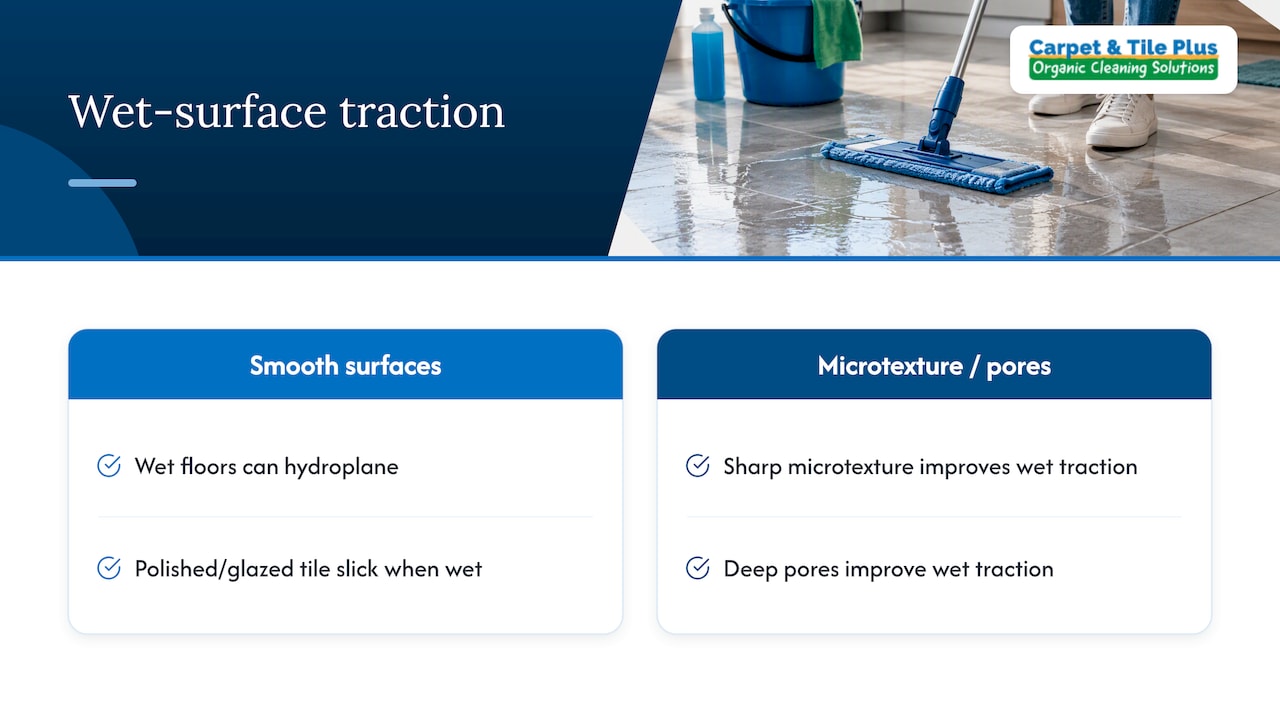
Sometimes there is no residue at all, just water. The 2021 study explains that a smooth wet floor can create a hydroplaning effect, while an appropriately distributed sharp microtexture, or sufficiently deep pores, can improve wet traction. Polished porcelain and glazed tile are slick when wet by design. If your floor only feels slippery in the first few minutes after mopping and then grips normally, moisture is the culprit, not residue.
WorkSafe Queensland, an Australian workplace regulator, makes a useful general point here: a floor that is slip-resistant when dry may not be when wet, incorrect cleaning can increase slipperiness, and smooth hard surfaces raise slip risk.
How to tell what is making your tile slick
Before you re-mop, spend two minutes diagnosing. The right fix depends on the cause, and a few quick observations will point you there. These are practical checks, not lab tests.
| What you notice | Likely cause | First move |
|---|---|---|
| Slick or tacky for hours, streaks or haze when dry | Cleaner or soap residue | Rinse with fresh clear water, then dry |
| Slick mainly near the stove, fryer, or sink | Grease or oil film | Re-clean with a tile-safe cleaner at the correct dilution, then rinse |
| Slippery only while damp, fine once dry | Moisture on a smooth surface | Wipe or squeegee dry, use mats |
| Slick in one high-traffic path, dull when dry | Worn or polished surface | Have the area assessed |
| Grout lines look dark and the whole floor feels slick | Buildup in grout | Deep clean the grout |
| Slippery even before you mop | Soil, footwear tracking, or drainage | Check entrances and sweep more often |
A simple damp-cloth test
Wipe a small, out-of-the-way patch with a clean cloth dampened with plain water, then dry it with a second clean cloth. If that patch now feels grippier than the surrounding floor, you have residue that clear water can lift. If it still feels slick, the issue is more likely grease, a sealer or wax, or the tile surface itself.
Check the dry floor too
Come back after the floor is completely dry and walk it in socks or smooth-soled shoes. Floors with a worn, shiny path in the middle of a hallway or entry are showing wear, not residue. WorkSafe Queensland recommends assessing existing floors for worn or contaminated high-traffic spots, damaged tiles, unevenness, and conditions that change when the surface gets wet. Those are not mopping problems and no amount of rinsing will solve them.
How to fix slippery tile floors after mopping
The approach below follows Daltile’s step-by-step care guidance for ceramic and porcelain tile: reclean at the right dilution, rinse with fresh water, and remove the water.
- Clear the room and warn others. Keep kids, pets, and guests off the floor while you work. A floor you are actively fixing is the one most likely to cause a fall.
- Sweep or vacuum first. Loose grit turns into slurry once it gets wet and adds to the film.
- Mix a tile-safe cleaner at the manufacturer’s dilution. Measure it. Guessing “a good squirt” is how residue starts. Choose a pH-neutral product made for tile and grout.
- Mop in sections with a clean microfiber mop. Daltile recommends a microfiber mop for tile. Work a few square feet at a time and wring the mop well so you are not flooding the grout.
- Rinse with fresh, clear water. This is the step most people skip. Use a clean bucket and a clean mop head, not the water you just washed with. Daltile says to rinse thoroughly with clear water to remove soap or chemical film.
- Remove the water. Wipe, squeegee, or vacuum up standing water with a wet vac so it does not dry into new residue. The Lowe’s-hosted tile care guide recommends a clear-water rinse followed by wiping dry to prevent film formation.
- Repeat if needed. Daltile advises repeating the rinse when residue remains, particularly from alkaline or bleach products. Two or three clear-water passes on a heavily coated floor is normal, not a sign you did something wrong.
- Let it dry completely before walking on it.
If you used bleach or a strong degreaser
These products leave the most stubborn film. Expect extra rinses. Never mix bleach with other cleaners, and ventilate the room. If you want to avoid harsh chemistry on your floors altogether, our page on how chlorine-free tile cleaning works explains the alternative.
What not to do
- Do not add more soap to “cut” the slickness. It makes the film thicker.
- Do not wax or apply floor polish to tile. MAPEI says wax can make tile slippery.
- Do not use a sponge mop with dirty water and call it done. Sponge mops push dirty water into grout lines.
- Do not use vinegar or other acids on natural stone or on grout without checking the tile manufacturer’s guidance first.
Mop and dry tile so it stays grippy
Once you have stripped the film, a few habits keep it from coming back.
Use less product than you think
Follow the label dilution exactly. For light day-to-day cleaning, the Lowe’s-hosted guide recommends clear water or a soapless pH-neutral cleaner, followed by a clear-water rinse and wiping dry. On a lightly used bathroom floor, that may be all you need.
Change the water often
Swap mop water as soon as it clouds. In a larger kitchen or a family room that connects to it, that may mean two or three fills. Wring the mop head out between passes and wash the head regularly. A greasy, stale mop head puts residue down before the water even gets there.
Keep grit off the floor
MAPEI says frequent sweeping or vacuuming removes sand, grit, and other abrasives, and recommends mats inside and outside entrances. In the Chicago suburbs, that matters year-round: winter brings salt, slush, and sand into mudrooms and kitchens, and spring brings mud. Grit reduces how much mopping you need, and less mopping means less opportunity for residue.
Dry the floor, do not air-dry it
Even clear water can leave mineral spots on tile, particularly if your tap water is hard. If your tile shows chalky spots or a dull haze that does not wipe away, you may be dealing with mineral deposits rather than soap. Our guide to removing hard water stains from tile covers how to tell the two apart.
Pick the right tool
A microfiber mop with a removable, washable head is the simplest upgrade. Steam mops can work on sealed tile, but check your tile and grout manufacturer’s guidance first, because heat and moisture can be hard on unsealed grout. Swiffer-style pads with pre-loaded solution are convenient, but the solution can build up over weeks on a floor that never gets a clear-water rinse.
Staying safe while the floor is wet or drying
A slippery floor is a safety issue before it is a cleaning issue. The UK Health and Safety Executive states that people rarely slip on a clean, dry floor and that contamination is involved in almost all slip accidents, and it lists cleaning activity among the sources of contamination. In other words, mopping itself can create the hazard.
Practical ways to cut the risk:
- Stay off wet tile. The DuPont StoneTech care guide says to avoid walking on wet stone or tile until it is completely dry, since wet floors tend to be slippery.
- Mop in sections and finish at an exit. Work toward the doorway you will leave through, so you never have to walk back across wet floor.
- Mop when traffic is lowest. Early morning or late evening in a home; after hours in a business.
- Put out a wet-floor sign in shared spaces. For offices, restaurants, and rental common areas, this is basic practice.
- Wear shoes with real tread while you clean. Socks on wet tile are a bad combination.
- Mind the stairs and thresholds. Tile steps and entry transitions are where wet-floor falls get serious.
If you manage a business, a slip-and-fall is both a human and a liability problem. Treat a recurring slippery spot as something to fix, not something to warn people about.
Our perspective: slippery tile is usually a cleaning-process problem
We clean tile and grout in homes and businesses across the Northwest Suburbs, and the pattern repeats. When someone calls about slick tile after mopping, the tile itself is rarely the issue. It is usually a film: months of cleaner, mop water, and kitchen oil packed into the surface texture and, especially, into the grout, which is porous and holds onto whatever the mop leaves behind.
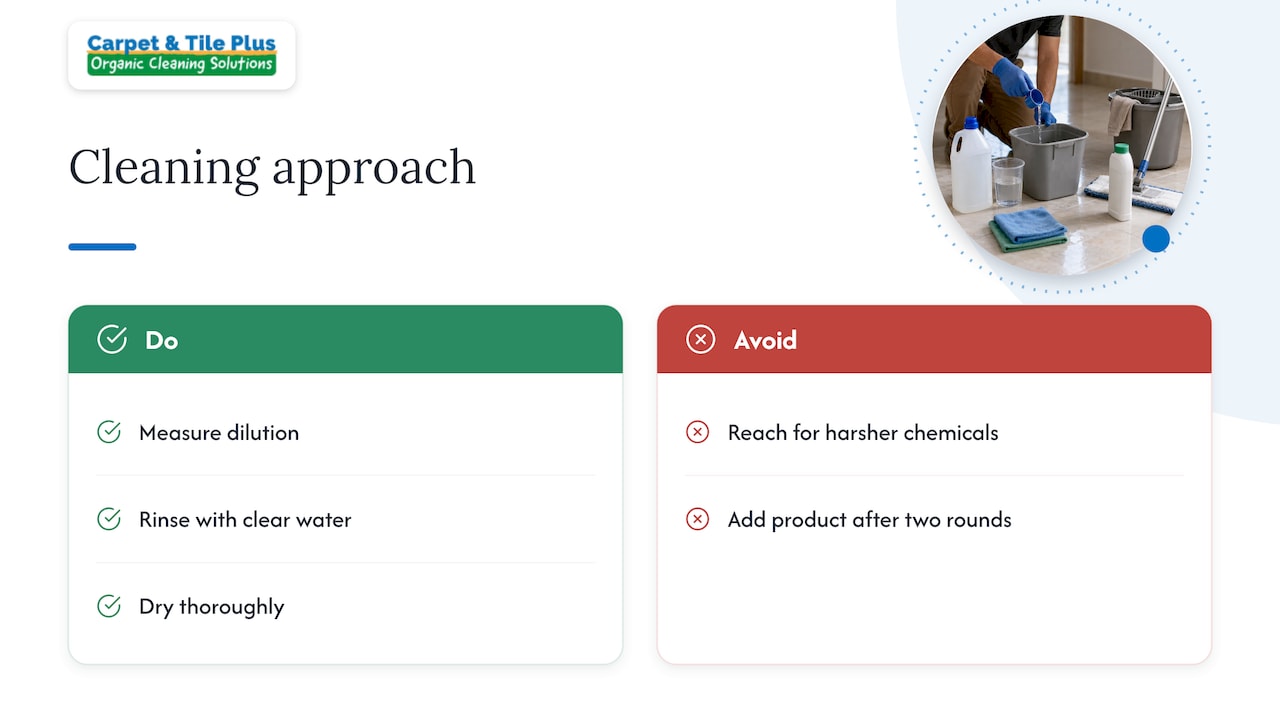
That is why we do not think the answer is a stronger chemical. Harsher products can leave harsher residue. Our approach is to use organic, eco-friendly cleaning products and low-moisture methods, which is how we get floors back to a one-hour dry time. Less water left behind means less to dry, less time with a slick floor, and less moisture sinking into grout. Our cleaners are IICRC-certified, and after more than 20 years in this work, we have learned that a floor feels right when the film is gone, not when it smells strongly of product.
If you want to try it yourself first, do it the way we described above: measured dilution, a true clear-water rinse, and thorough drying. If the floor is still slick after two honest rounds of that, stop adding product. Something else is going on, and it is time for someone to look at the floor itself.
— Joe
When slippery tile needs a professional
A good re-clean fixes most cases. Call someone in when:
- The slickness returns within a day or two of a thorough rinse. That points to residue deep in the grout or tile pores.
- Grout is dark, uneven, or visibly grimy. Dirty grout holds film and reduces friction. Our overview of effective tile grout cleaning methods explains what actually works on it.
- An old sealer, wax, or floor finish is on the tile. Stripping it takes the right products and technique.
- A large area, such as an open kitchen, entry, or basement, is affected. Rinsing and drying that much floor by hand is slow and easy to get wrong.
- The tile is worn or polished smooth in a path. That is a surface problem. Have the area assessed for worn spots, damaged tiles, and unevenness.
- It is a business floor. Daltile notes that commercial applications may require specialized equipment, chemicals, and procedures, and that deep cleaning may call for tailored solutions, equipment, or commercial cleaning companies.
One caution on testing: WorkSafe Queensland points out that objective slip tests can report a coefficient of friction, but there is no single universally safe value, because risk depends on the floor, the contaminant, the cleaning method, footwear, activity, and environment. If you run a business with a real slip history, the right step is a proper assessment of the whole situation, not just a number.
How we help
If you are a homeowner in Arlington Heights, Palatine, Elgin, Bartlett, Streamwood, Barrington, or the surrounding suburbs, our residential tile and grout cleaning removes the buildup that mopping leaves behind, using organic products and low-moisture methods that dry in about an hour. For restaurants, offices, and other properties, see our commercial tile and grout cleaning. We stand behind the work with a 100% satisfaction guarantee. You can read how our non-toxic approach works on our page about IICRC-certified non-toxic grout cleaning.
After a deep clean, sealing is worth a conversation. Our grout sealing guide explains what sealing does and when it makes sense.
Prevent it for good: a simple routine
| How often | What to do |
|---|---|
| Daily or every few days | Sweep or vacuum, wipe spills right away |
| Weekly | Mop with a measured, pH-neutral tile cleaner and fresh water, rinse, dry |
| Every mop session | Change water when it turns cloudy, wash the mop head |
| Seasonally | Check entry mats, wash or replace them, look at grout lines |
| As needed | Deep clean grout when it darkens or the floor feels slick again despite proper rinsing |
For busy spaces, such as a family entry or a shop floor, our guide to tile grout cleaning for high-traffic areas shows how to set a schedule that fits the traffic.
FAQ
How do I fix slippery floors after mopping?
Re-clean the floor using a tile-safe cleaner at the correct dilution, then rinse with fresh clear water to lift soap or chemical film. Wipe, squeegee, or vacuum up the water so it cannot dry into a new film. If a residue is still there, repeat the rinse, especially after using alkaline or bleach products.
How do I make my tile floor less slippery?
First remove whatever is causing the slickness: residue, grease, or wax. Then use mats at entrances, dry the floor after cleaning, and mop with less product. If the tile itself is smooth or polished and still slick when wet, the lasting fix is a surface treatment or a different floor covering, which is a job to have assessed by a professional.
Why is my tile floor sticky and slippery after I use a Swiffer or similar mop?
Pre-loaded cleaning solution and pads deposit a little product each time, and without a clear-water rinse, it builds up. Strip the film once with a clean-water rinse and a microfiber mop, then rinse with clear water regularly or switch to a lighter routine of plain water for everyday cleanups.
Can I use vinegar to fix slippery tile?
We would not make it your first choice. Acids can damage some grout and natural stone, and a clear-water rinse does the job in most cases. Check the tile manufacturer’s care guidance before using any acidic product on your floor.
Is a slippery floor after mopping dangerous?
Yes, it can be. Contamination, including that from cleaning, is involved in almost all slip accidents according to the UK HSE. Keep people off the floor until it is dry, and fix recurring slick spots rather than working around them.
Sources
- Daltile: Ceramic and porcelain tile care and maintenance
- MAPEI: How to clean, maintain and care for ceramic and porcelain tile
- Tile Care and Maintenance guide hosted by Lowe’s
- What Makes a Floor Slippery? A Brief Experimental Study (2021)
- WorkSafe Queensland: Floor and ground surfaces
- UK Health and Safety Executive: Contamination
- DuPont StoneTech Professional Stone and Tile Care Guide