
If you have pets, vacuum your carpets at least once or twice a week, treat accidents the same day, and book a professional deep clean more often than the standard 12 to 18 months. For most homes with a dog or cat, that means every 6 to 12 months. For homes with several pets, puppies, shedding breeds, or allergy and asthma concerns, it means every 3 to 6 months. Below is how to pick your interval, what to do between visits, and what to avoid.
What are the key takeaways for pet carpet cleaning frequency?
- Vacuum once or twice a week at minimum. Shedding breeds and multi-pet homes need it every other day or so.
- The Carpet and Rug Institute (CRI) recommends a professional deep clean every 12 to 18 months for any carpet. Pets are a reason to shorten that, typically to every 6 to 12 months, or 3 to 6 months in hard cases.
- Blot accidents right away and never use steam or heat on urine. Heat can set the stain and odor.
- Keep pets off the carpet until it is completely dry. Our low-moisture method gets you to a one-hour dry time.
Table of Contents
- What the experts actually say about frequency
- Your schedule by household type
- Vacuuming: the habit that does most of the work
- Spot cleaning accidents the right way
- Signs you are overdue, whatever the calendar says
- Keeping pets safe around cleaning products
- Our perspective: shorten the interval, then stick to it
- Commercial and shared spaces with pets
- Costs and what to expect from a visit
- Book a pet-friendly carpet cleaning
- FAQ
- Sources
What the experts actually say about frequency
There is no single official number, and it helps to know that. The EPA states it has not issued specific recommendations on how often carpet should be cleaned. It points homeowners to the carpet manufacturer’s maintenance guidance and industry standards instead.
The industry baseline comes from CRI, which recommends professionally deep cleaning your carpet every 12 to 18 months. CRI also says more frequent cleaning can be right depending on the number of pets, traffic and specific odor or stain concerns, as described in its cleaning and maintenance guidance for homes. It also suggests checking your carpet warranty, because some manufacturers set their own requirements.
So the 12 to 18 month figure is a ceiling for a quiet, pet-free household, not a target for yours. The sections below turn that into something you can act on.
Your schedule by household type
These are our working recommendations, based on the CRI baseline and what we see in homes across the Northwest Suburbs. Adjust them to your carpet, your pets and your household.
| Household | Vacuuming | Spot cleaning | Professional deep clean |
|---|---|---|---|
| One adult dog or cat, low shedding, few accidents | 1 to 2 times a week | Same day | Every 9 to 12 months |
| One shedding dog or cat, mostly lived-in carpet | 2 to 3 times a week | Same day | Every 6 to 9 months |
| Two or more pets | Every other day in main rooms | Same day | Every 4 to 6 months |
| Puppy in training, senior pet with accidents, or litter box trouble | Every other day | Immediately, then a follow-up | Every 3 to 4 months, plus targeted odor treatment |
| Allergy or asthma in the household | 2 to 3 times a week with a HEPA vacuum | Same day | Every 3 to 6 months, ideally |
If your carpet is light-colored, in a bedroom where pets sleep, or on stairs where pets run, expect to land on the shorter end. If you are not sure which row you fit, our guide on how to choose carpet cleaning frequency walks through the same decision for any household.
Vacuuming: the habit that does most of the work
Professional cleaning resets your carpet. Vacuuming decides how fast it needs resetting.
The EPA’s asthma guidance includes a simple line on dust: vacuum carpets and furniture every week. That is the floor for any home. With pets, we would treat it as the minimum and go to two or three passes in the rooms where your animals spend their time.
A few practical points:
- Use a vacuum with strong suction and a sealed filter. CRI points to vacuums with its Seal of Approval, and a HEPA filter keeps fine dander from blowing back out into the room.
- Go slowly. Pet hair weaves into the pile. Two slow passes in different directions beat four fast ones.
- Do the edges and under furniture. Hair and dander collect along baseboards and beneath couches, where pets like to lie.
- Empty the canister or replace the bag often. A full container loses suction.
If allergies are a concern, the air your vacuum exhausts matters too. A HEPA filter for home HVAC can complement a HEPA vacuum by catching fine particles that circulate through the house.
Why vacuuming alone is not enough
Vacuuming is good at removing surface hair and loose soil. It does less about allergens that have settled deep. A CDC document on indoor environments notes that after a pet is removed from a home, allergen levels in settled dust take 4 to 6 months to fall to the levels seen in homes without cats. That tells you how long pet allergen lingers in a carpet and the dust within it. If someone in your home has asthma, this is the strongest argument for a shorter professional interval, and a conversation with their doctor about what else to change.
Spot cleaning accidents the right way
How you handle the first ten minutes decides whether you need a professional visit for that spot at all.
- Blot, do not rub. Press clean white cloths or paper towels into the spot to lift liquid. Rubbing pushes it deeper and frays the fibers.
- Use an enzymatic cleaner made for pet urine. Enzymes break down the proteins that cause the smell. Follow the label and test a hidden corner first.
- Rinse with cool water and extract. Pull the moisture back out with a wet vacuum or towels pressed under weight.
- Skip the heat. CRI’s cleaning guidance and industry practice point away from steam on urine. Many homeowners assume a rented steam machine is the best answer, but heat can bond the proteins to the fibers and lock in the stain and odor.
- Let it dry fully, then check. A smell that returns after drying usually means urine reached the pad.
Our own write-ups on pet odor elimination cover this in more depth. If the same spot keeps coming back, it is time for a professional.
What a black light can and cannot tell you
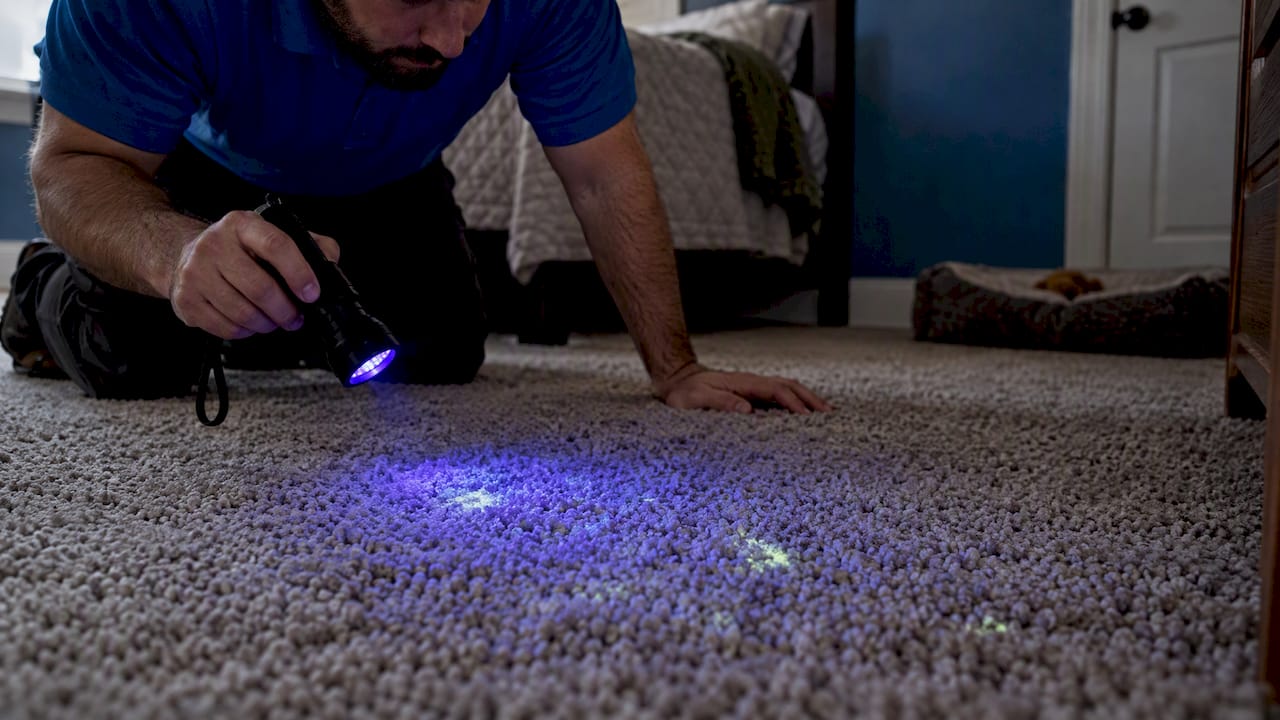
Professionals often use a UV light to find urine deposits you cannot see. One thing surprises homeowners: some areas may still glow after a thorough cleaning. According to the IICRC’s consumer tip sheet on carpet topics, the light can pick up residue left from the breakdown of urine compounds that bonded to the fibers. A glow after cleaning is not proof the job was incomplete. Judge the result by smell and by whether the odor stays away, not by the glow alone.
Signs you are overdue, whatever the calendar says
Intervals are a starting point. Your carpet will tell you when it needs help sooner:
- A musty or sour smell in a room that returns a day or two after you air it out
- Pet traffic lanes that look darker than the rest of the carpet
- Pets scooting, rolling or sleeping on one spot more than before
- More sneezing or itchy eyes indoors, especially after vacuuming
- Stains that reappear after you cleaned them, a sign of wicking from the pad
- A gritty feel underfoot even right after vacuuming
Our list of signs your carpet needs professional cleaning goes through nine indicators in more detail.
Keeping pets safe around cleaning products
Frequency means nothing if the cleaning itself puts your animals at risk. Two rules cover most of it.
Keep pets off wet carpet. The ASPCA warns about household cleaning products and pets and advises keeping animals away from treated areas until they are fully dry. Skin irritation and stomach upset can follow when a pet walks through residue and licks its paws. A veterinary news report in the Journal of the American Veterinary Medical Association describes how accidental exposure to wet cleaning products drives many poison control calls. Most diluted products are safe when used as directed, but wet carpet is when contact happens.
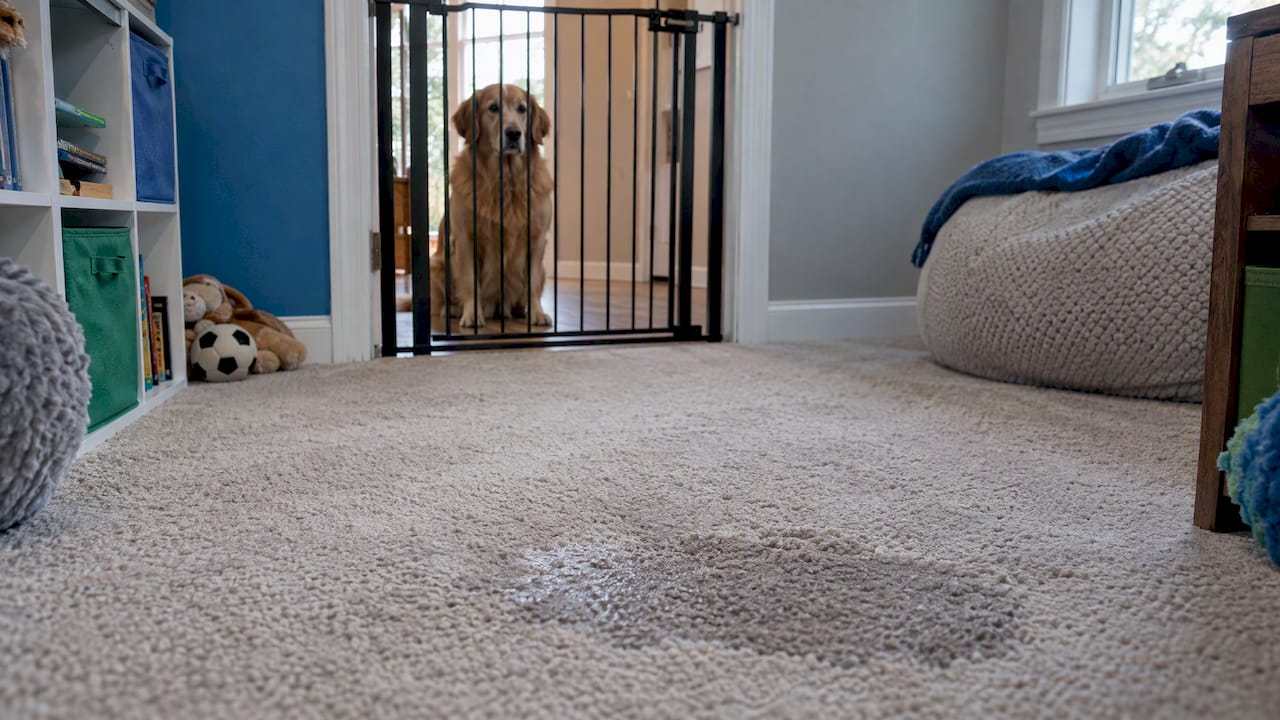
Ask what is going into the carpet. Question any cleaner about the products and the dry time. If your pet is a chewer, a licker, or very small, call your vet if you suspect contact and have the product name ready.
This is why dry time is a real consideration for pet owners. A carpet that takes 8 to 24 hours to dry means a day of keeping a dog off the living room. Our low-moisture method brings that down to about an hour, which makes the job much easier to schedule around a household with animals. Put pets in a closed room or a crate while we work and bring them back once the carpet is dry. While you are at it, wash pet bedding on your own schedule too; if you are updating where your pets sleep, pet-friendly bedding ideas can help you choose fabrics that shed less hair and wash easily.
Our perspective: shorten the interval, then stick to it
We have been cleaning carpets in Elgin, Bartlett, Streamwood, Arlington Heights, Palatine, Barrington and Hanover Park for over 20 years, and the pattern with pet homes is consistent. Owners who book on a regular schedule spend less per visit and fight fewer odors than owners who wait until the smell becomes unbearable.
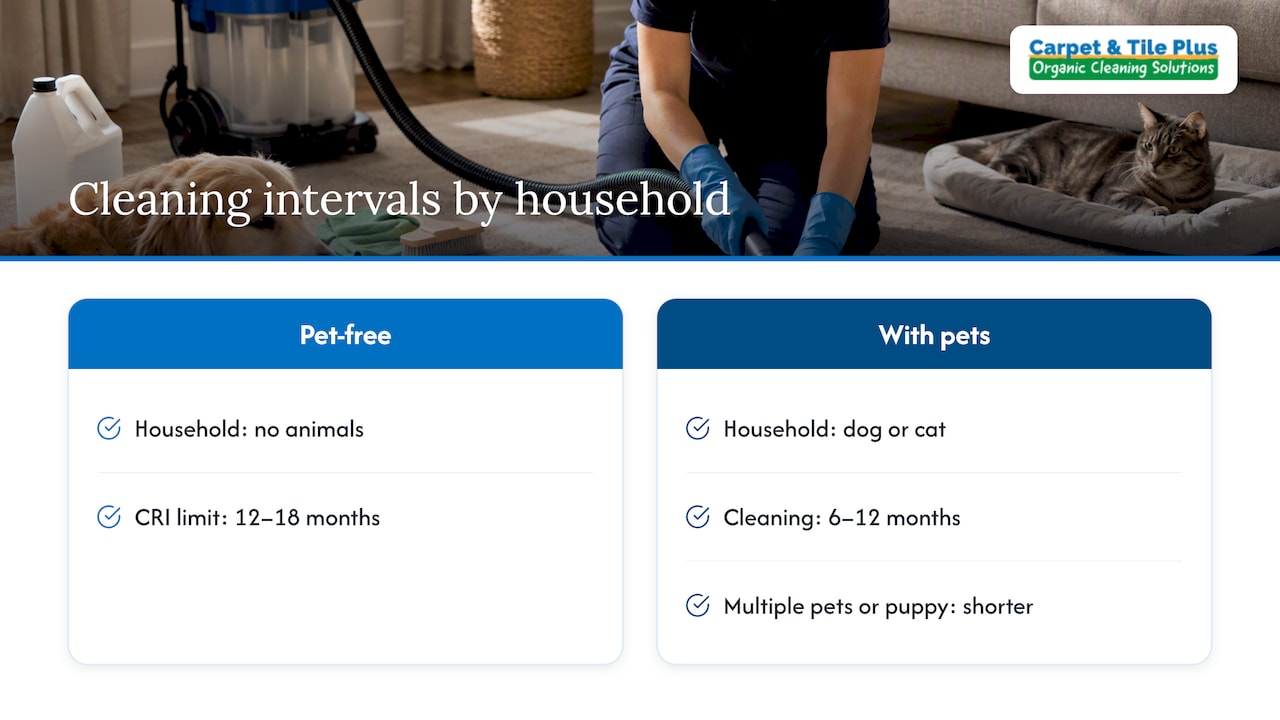
We treat the CRI 12 to 18 month figure as the limit for a household without animals. With a dog or cat, we plan around 6 to 12 months, and often shorter when there are multiple pets or a puppy. A regular visit means soil never builds into the pad, which is where most odor problems begin.
Our technicians are IICRC-certified and use organic cleaning products with low-moisture methods, so the carpet is dry in about an hour. For families with pets and kids, that matters more than any other feature. You do not need to rearrange your day around a damp floor.
One more point from experience: do not rent a steam machine to fight urine. We see it often, and the heat can make the problem permanent. Call us before you reach for it.
— Joe
Commercial and shared spaces with pets
Pet-friendly offices, groomers, vet clinics and property managers face the same question on a faster clock, because foot traffic adds to pet traffic. Our guides on how often office carpets should be professionally cleaned and the commercial office carpet cleaning checklist help managers set a schedule by traffic level.
Costs and what to expect from a visit
Our published pricing for residential carpet cleaning is $120 to $300 per one-off visit, and commercial carpet cleaning is $200 to $500 per one-off visit. See our carpet cleaning cost page for details. Where you land depends on the size of the space and the condition of the carpet. Pet stain and odor removal, tile and grout, vinyl plank and air duct cleaning do not have published prices, so we quote those after we know the job.
On visit day, here is what typically happens:
- We walk through the home and talk about your pets, problem spots and any fabric or warranty concerns.
- We vacuum and pretreat traffic lanes and stained or odor areas.
- We clean with organic products using a low-moisture method.
- We check the result and talk through aftercare.
- The carpet is ready for foot and paw traffic in about an hour.
We back our work with a 100% satisfaction guarantee.
Book a pet-friendly carpet cleaning
If your carpet has gone past its interval, or you are dealing with a smell that keeps returning, we can help. Our carpet pet stain and odor removal service uses UV mapping to find the problem areas before treatment, and our residential carpet cleaning covers the whole home. We serve the Northwest Suburbs of Chicago, including Arlington Heights, Palatine, Elgin, Bartlett, Streamwood, Barrington and Hanover Park. Reach us through carpetandtileplus.com to schedule.
FAQ
How often should I clean my carpet with pets?
Vacuum at least once or twice a week and professionally deep clean every 6 to 12 months for a typical one-pet home. CRI’s general recommendation for any carpet is every 12 to 18 months, and pets are a good reason to go shorter. Multi-pet homes and puppies may need cleaning every 3 to 6 months.
Is steam cleaning safe for pet urine?
Generally no. Heat can set urine proteins into the fibers and make the odor permanent. Blot, treat with an enzymatic cleaner made for pets, rinse with cool water and extract the moisture. If the smell returns, call a professional.
How long should I keep my pets off the carpet after cleaning?
Until it is completely dry. The ASPCA advises keeping pets away from treated areas until they dry, because paw contact and licking can lead to irritation or stomach upset. With our low-moisture cleaning, that is typically about an hour.
Does professional cleaning help pet allergies?
It can help reduce the allergen reservoir in carpet, which vacuuming does not fully reach. CDC material notes allergens in settled dust take months to fall even after a pet leaves the home. Talk to your doctor about managing asthma or allergies, and use cleaning as one part of the plan.
Sources
- CRI: Hire a Carpet Cleaning Professional
- CRI: Cleaning and Maintenance for homes
- EPA: Has EPA issued specific recommendations on how frequently carpet should be cleaned?
- EPA: Asthma Triggers: Gain Control
- CDC: Asthma in the Inner City and the Indoor Environment
- IICRC: Consumer Floor and Furnishings Care Information
- ASPCA: Pet poisons and household cleaning agents
- AVMA: Pet poison control calls rise